## The hidden risk of the 'No Response' community ### Why a 'Help' channel isn't always helpful A public community forum is a real-time record of a vendor’s technical debt rather than a reliable support extension. While a sales representative might point to a Slack workspace with 5,000 members as evidence of a vibrant ecosystem, this figure is a vanity metric. It masks how many users are actually resolving deployment blockers. A high member count without active, expert moderation means your lead engineer is likely shouting into a void during a critical production outage. ### The high percentage of unresolved community threads Barely better than a coin flip is the probability of receiving a functional solution from a peer-to-peer forum. According to data from [ECM Architect](https://ecmarchitect.com/archives/2012/02/29/1558), only 55% of community forum topics result in a helpful response, leaving nearly half of all inquiries without a resolution, which means that users seeking assistance face a coin-flip chance of remaining ignored. | Response Type | Percentage | Impact on Project | | :--- | :--- | :--- | | Helpful Response | 55% | Moves the project forward with a functional solution. | | No Response | 34% | Creates a dead zone; developers wait days for answers that never arrive. | | Unhelpful Interaction | 10% | Leads to deprecated APIs or insecure workarounds; increases debt. | 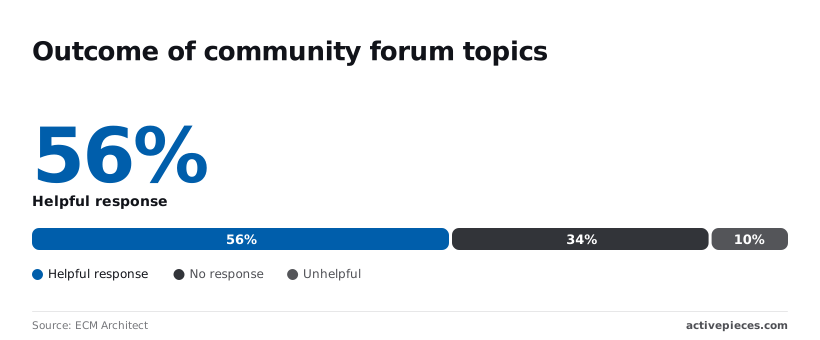 By performing the 15-Minute Community Audit, you can quantify the health of a vendor's ecosystem to see if their support channel is a graveyard of ignored pings. Join the public Discord or Slack and search for 'bug', 'error', or 'fail'. Check the support channel for unanswered threads and compare the date of the last bug. A security team can close a review faster when they aren't forced to take a vendor's word on faith. Activepieces maintains an MIT-licensed core, allowing engineers to clone the repository and audit the queue and worker architecture directly. This level of technical evidence removes the friction of a typical review, as teams can verify the system by running it self-hosted or fully air-gapped before a single contract is signed.  **The delta between the marketing promise and the operational reality is revealed by this audit.** If the audit shows a pattern of silence, you are looking at a product where your team will be the primary investigators for every core library failure. ### The cost of engineering hours spent on unhelpful forums Approximately $150 in direct payroll is lost every hour a senior engineer spends refreshing a browser tab for a community response. This cost, combined with the opportunity cost of delayed features, turns a simple support query into a major drain on corporate profitability. When **44% of community queries fail** to provide a fix, a week-long integration sprint can easily balloon into a month-long research project. ## Vendor community auditing as a mandatory procurement step Community-led due diligence treats a vendor’s public forum or chat history as a living ledger of technical debt, revealing the hidden labor costs your team will inherit post-deployment. ### The 'Search Bar Test' for recurring error codes Searching a vendor’s public Slack or Discord for specific error strings reveals whether a bug is a transient glitch or a systemic flaw that will stall your production pipelines.When a vendor labels a bug a "known issue" in a public forum without a corresponding pull request or patch timeline, the buyer has unknowingly inherited the vendor's technical debt.
If a search for a specific timeout error returns dozens of results spanning several months, your team is likely to encounter that same bottleneck. When the same error code appears across multiple versions without a documented fix, the vendor’s engineering team has prioritized new sales over stabilizing the existing codebase. ### Response times: Support staff vs. community volunteers Monitoring the delay between a user’s technical query and a vendor’s official response determines whether you are buying a managed service. This check also shows if you are merely paying for the right to ask other customers for help. A healthy ecosystem shows vendor employees engaging with complex edge cases. ### The ratio of feature requests to actual changelog updates Comparing the volume of requested fixes in the community forum against the vendor’s official release notes identifies whether the roadmap is driven by customer stability. A backlog that will leave your specific use case unsupported for quarters is suggested by a high volume of "planned" tags with no corresponding deployment dates. Frequent releases that ignore long-standing community bugs indicate a product team focused on acquisition rather than retention. Detailed changelogs that explicitly reference community-reported issues prove the vendor has a functional feedback loop.  ## Spot warning signs in Discord history A vendor’s public community history is a raw audit trail of their actual support capacity, revealing whether their post-sale service is a functioning department or a neglected marketing asset. ### Unanswered 'Help' threads older than 72 hours A support channel where queries sit for days without a response indicates a team that has scaled its sales outreach faster than its engineering support. When "Ghost Town" channels show no messages for over a week, it signals that the vendor has effectively abandoned their user base in favor of hunting new leads. Staff responses that only say "DM me" or "Contact sales" prevent the community from building a searchable knowledge base and force every minor issue into a high-friction private ticket. ### Moderators deleting or suppressing bug reports Aggressive moderation or the frequent deletion of critical posts is a defensive tactic used to mask technical debt. This prevents you from accurately calculating the risk of long-term stability. If a community manager scrubs a thread regarding a recurring API timeout, they are actively hiding a known cost of ownership from your procurement team. ### A lack of direct developer engagement in technical channels The absence of actual engineers in technical discussion channels means the product roadmap is driven by market perception rather than functional stability. When only marketing staff or community advocates populate the chat, technical questions regarding rate limits or schema changes are filtered through non-technical intermediaries, adding days to your development sprints. ### The 'Announcement' channel vs. the 'General' reality gap A significant discrepancy between a polished "Announcements" channel and a chaotic "General" chat proves the vendor is prioritizing the appearance of progress over the reality of product performance. If the announcement feed highlights a new UI while the general chat is flooded with complaints about core functionality, the vendor is misallocating their engineering resources. ## How Activepieces turns community transparency into a roadmap [Activepieces](https://www.activepieces.com/pieces/discord) publishes its development cycle to public scrutiny, with roughly 60% of its integrations contributed by the community itself, ensuring the platform evolves rapidly through decentralized collaboration. This ensures that deployment risks are identified by the community before they reach your production environment. Unlike closed-source alternatives that hide architectural flaws, this transparency allows a lead engineer to audit the stability of specific connectors by viewing the raw source code on GitHub. ### Real-time bug reporting in the public Discord The Activepieces Discord server functions as a live audit log where users can see how 24,532 GitHub stars translate into actual peer-to-peer support and configuration edge cases. Because these discussions are indexed and searchable, a DevOps manager can identify if a specific version of a Google Sheets or Slack connector is currently failing for other users. ### Verifying the 'Time to Fix' through public commit logs The GitHub repository for Activepieces provides a timestamped record of every code change, allowing prospective buyers to verify the MIT-licensed core and calculate the true velocity of the engineering team. By comparing the date of a reported issue in the repository to the date of the corresponding pull request, an IT auditor can verify the vendor’s responsiveness without relying on anecdotal sales claims. The build history in the activepieces/activepieces repository serves as a verifiable roadmap that replaces the typical vendor slide deck. By examining release tags and merged pull requests, teams can see exactly how MoneyGram and FundingSocieties rely on a platform where **735+ integrations are maintained** with community visibility. This level of disclosure means you buy a vendor whose past performance is checkable, rather than one whose future promises require a leap of faith. A granular view of every iteration of an automation is provided by the Version History panel in the Activepieces flow builder, which supports unlimited flows on every plan to ensure teams can iterate without artificial constraints. 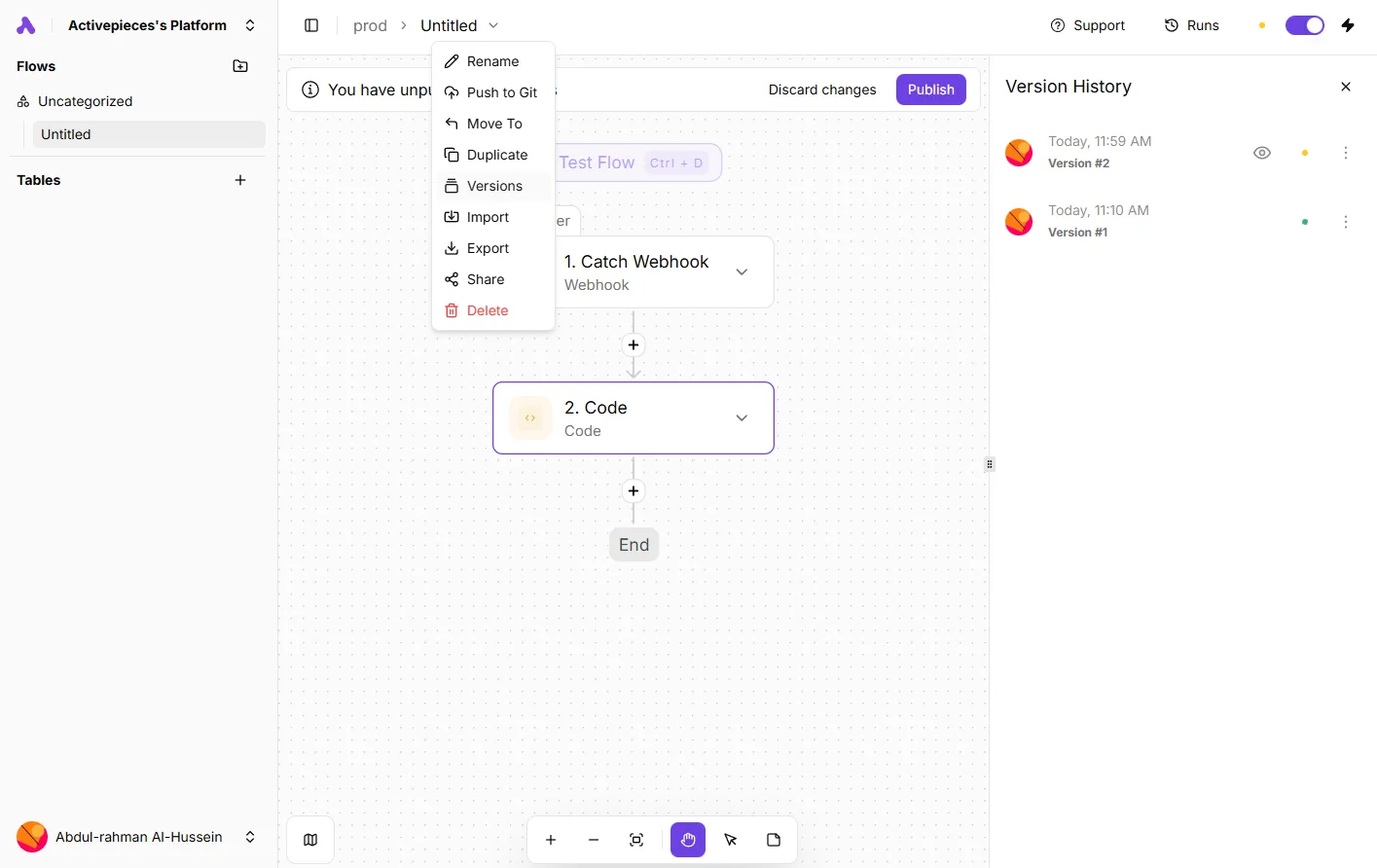 A botched update can be reverted to a known stable state immediately. Moving the automation logic into a version control system is possible via the "Push to Git" feature, where it can be peer-reviewed and audited alongside the rest of the company’s codebase. ### Direct access to the engineers building the connectors The open-source nature of the project allows your internal developers to communicate directly with the core contributors who write the integration logic. When a specific API endpoint is missing from a pre-built integration, your team can review the TypeScript files on GitHub to understand the limitation or contribute the necessary code themselves. ## The Monday morning vendor community checklist Evaluating a vendor’s public community reveals the delta between a marketing promise and the actual labor required to maintain the integration. To audit the viability of a new tool, use this three-step checklist to verify that the software functions in production environments similar to your own. ### Join the Slack or Discord before the first sales call Accessing the vendor’s real-time chat server allows you to observe the ratio of "how-to" questions to unresolved bug reports. If the help channel is populated entirely by users troubleshooting the same authentication error, your implementation team will likely lose days to that same bottleneck. ### Search for your specific 'must-have' integration name Locating the specific service you intend to connect uncovers whether the "native integration" is a finished product or a brittle beta. 1. Locate the 'Community' link on the footer of the vendor’s homepage. 2. Search the Discord or forum for the specific integration name to find historical failure points. 3. Filter by 'Recent' to see if the current version is generating more errors than the previous release. ### Ask the AE why specific community complaints remain open Presenting the Account Executive with a specific, unresolved community thread forces the conversation away from scripted scripts and toward technical accountability. When you point to a three-month-old thread regarding a memory leak in their Python SDK, the salesperson must either provide a concrete roadmap date or admit the limitation. ## Frequently asked questions about vendor community due diligence ### Is a private Slack channel better than a public Discord? A private Slack channel is a curated support line rather than a transparent ecosystem. You lose the ability to see how the software behaves when the vendor isn't looking. In a public Discord or forum, you can search for recurring error codes and deployment friction across a diverse set of user environments. Because private channels are siloed, you cannot verify if your specific integration struggle is a unique edge case. You also cannot tell if it is a systemic flaw that the vendor is currently obscuring. ### How much time should I spend auditing a community? You should dedicate enough time to trace at least three major feature releases. Follow them from the initial announcement to the subsequent bug reports to understand the actual stability of their development cycle. This audit prevents the day two shock where a promised feature exists in the documentation but is functionally broken in the wild. If you cannot find a clear history of user feedback within a single afternoon, the vendor likely lacks the operational maturity to support a complex enterprise rollout. ### What if the vendor doesn't have a public community at all? The absence of a public community forces you to rely entirely on the vendor’s internal professional services. This significantly increases your long-term total cost of ownership. Without a peer-to-peer knowledge base, your team will be unable to troubleshoot simple configuration issues via a search engine. This leads to increased ticket volume for minor administrative tasks, dependency on paid support tiers, and longer onboarding times as new hires have no external resources for self-study. ### Can community sentiment be faked by the vendor? While a vendor can seed a community with advocates, they cannot easily fake a long-term technical commit history or a deep backlog of resolved GitHub issues. Authentic communities are defined by technical friction. If every post is glowing praise with no mentions of API timeouts or schema limitations, you are looking at a marketing facade. A healthy, trustworthy community is one where users are actively arguing about the best way to work around a known limitation, providing you with a realistic roadmap of the obstacles your own team will eventually face.  ## Related reading - [GitHub Repository Health: How to Vet Automation Vendors](https://www.activepieces.com/blog/github-repository-health-how-to-vet-automation-vendors) - [Top 10 Open-Source Workflow Automation Software in 2026](https://www.activepieces.com/blog/top-10-open-source-workflow-automation-tools-in-2024) - [Top 3 Banking Automation Software Tools for Finance Teams](https://www.activepieces.com/blog/top-3-business-automation-tools-for-banks) ## References - [ECM Architect](https://ecmarchitect.com/archives/2012/02/29/1558)Community-led due diligence treats a vendor’s public forum or chat history as a living ledger of technical debt, revealing the hidden labor costs your team will inherit post-deployment.