# Tencent Hunyuan API Pricing: Every Model Tier (2026)
By Bethany Morrison · 2026-10-30 · Source: https://www.activepieces.com/blog/tencent-hunyuan-api-pricing-every-model-tier-2026
---
## Tencent Hunyuan API prices by model tier
### The direct answer and what the API is
From **15–50 yuan per million tokens** to about 1–4: that is how far Hunyuan's flagship text pricing has fallen, but the tier you pick matters more than the list price, whether you call the API directly or wire it into a workflow tool like [Activepieces](https://www.activepieces.com) where every step's token use adds up.
Tencent Hunyuan API pricing is the set of per-token rates Tencent Cloud charges for calling its Hunyuan large language models, which vary by model tier, by the region and billing console used to buy access, and by the rate and quota limits attached to each account.

The Hunyuan API is Tencent [Cloud](https://cloud.tencent.com/document/product/1729/111007)'s pay-as-you-go model service, billed per token for text.
Historic flagship figures below are in yuan. The current rates in the table are in US dollars per 1M tokens, taken from AM Compute and checked 30 Oct 2026.
### Price and context window by text tier
| Model | Input/1M | Cached input/1M | Output/1M | Context Window | Best Use Case |
|---|---|---|---|---|---|
| Hy4-preview | $0.834 | $0.042 | Not verified | 1,000K tokens | Whole-codebase or long-document work |
| Hy3 | $0.132 | $0.033 | Not verified | 256K tokens | General flagship text and reasoning |
| Hy3-standard | Not verified | Not verified | Not verified | 256K tokens | Everyday production traffic |
| Hy-lite | Not verified | Not verified | Not verified | 256K tokens | High-volume, low-stakes calls |

Only the Hy3 and Hy4 preview input rates have a source I can date. No output rate is verified for any tier, and Hy3-standard and Hy-lite have no verified number in any column, so those cells say so rather than guess.
Neither Hy-MT2-1.8B (translation) nor Hunyuan 3D belongs in a text-token comparison. Take current per-token rates for the newest tiers from the console for your region, because they can differ by billing console.
### Flagship price by release
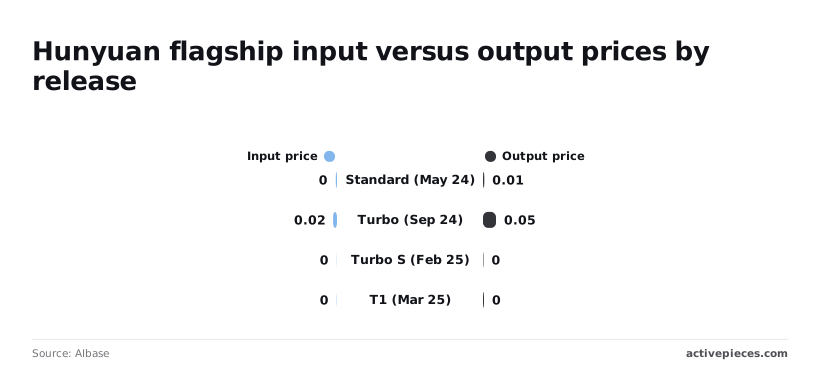
AIbase's [launch coverage](https://news.aibase.com/news/11556) gives the flagship history in yuan per 1,000 tokens: Standard (May 2024) cost 0.0045–0.005, or 4.5–5 per million, so it was already cheap, and Turbo (Sep 2024) cost 0.015–0.05, which is 15–50 per million.
In Feb 2025 Turbo S fell to 0.0008–0.002, so output cost roughly a twenty-fifth of Turbo's top rate. T1 (Mar 2025), the reasoning model, sat at 0.001–0.004, so reasoning cost only a little more than Turbo S.

### Context windows by tier
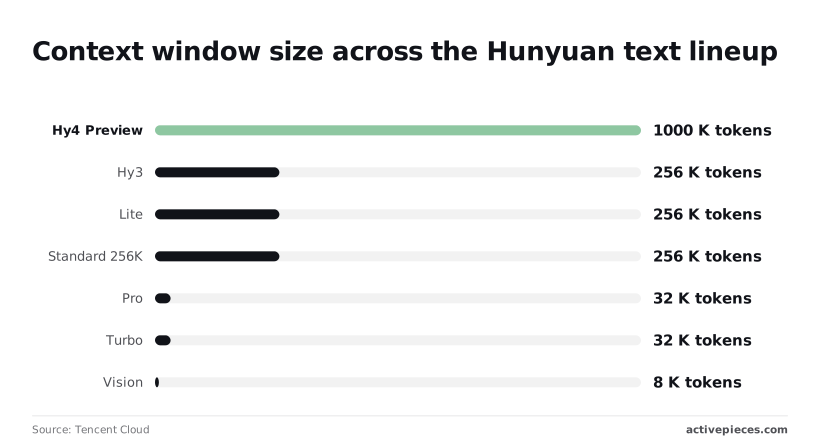
Per [Tencent Cloud's documentation](https://intl.cloud.tencent.com/document/product/1300/78934), Hy4 Preview takes 1,000K tokens, so it's the only tier here that can hold a very large corpus in one call. Hy3, Lite and Standard 256K each take 256K, so most long-document jobs fit without paying for the top tier.
Pro and Turbo take only 32K, so long contracts or transcripts need chunking, which multiplies calls.
For bulk classification or summaries, start with Hy-lite, since its 256K window removes chunking. Reserve Hy4-preview for inputs that exceed 256K.
## Fees and limits behind the Hunyuan list price
A default cap of 5 concurrent requests can limit throughput unless you explicitly request a higher limit. The list price's the least stable number on your bill, and caching can cut input costs by up to 95% on Hy4 preview.

### Hunyuan API concurrency and rate limits
Expect a modest production service to hit the default limits for Hunyuan text models:
- 5 concurrent requests per account: - 20 requests per second (QPS)
- Both limits shared across all sub-accounts
- 2-4 days to get a limit increase approved
**The sharing is the trap**. If you give each team its own sub-account to separate billing, they still draw from one pool, so one team's batch job can starve another's chatbot.
**The 2-4 day approval window means you must request more headroom before launch, not when the first 429 errors appear.**
### Hunyuan caching and batch discounts
Caching's where the published discounts are real. According to [AM Compute](https://www.amcompute.com/inference-providers/hunyuan), Hy3 input falls from $0.132 to $0.033 per 1M tokens on a cache hit, **a 75% cut**. Hy4 preview falls from $0.834 to $0.042 per 1M tokens, about 95%.
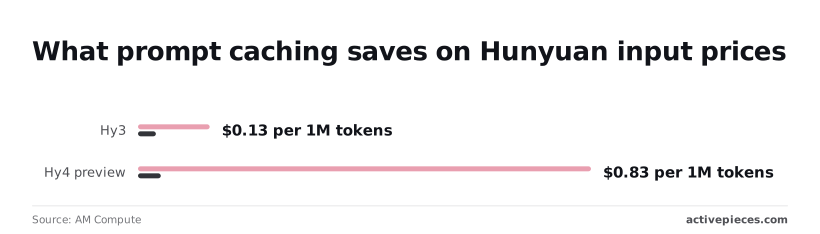
The Hy4 preview gap matters most. Its uncached input costs over six times Hy3's, yet its cached input's only about 27% higher, so Hy4 becomes economical only with reliable caching.
**I found no published batch discount** for Hunyuan, so I wouldn't assume one.
## What a Hunyuan workload costs per month
Multiply volume by tokens per unit by the rate of the tier you picked and you have your monthly bill; the tier moves the total more than volume does.
I have verified input rates for only two tiers, so the table shows how each cost is built, and the worked example after it prices input for those two. Fill in the last column from Tencent's pricing page for your region and console.
| Workload | Tokens/Unit | Total Tokens | Model Choice | Monthly Cost (USD) |
|---|---|---|---|---|
| 20k Ticket Summaries | Long input, short output | 20,000 × average ticket length | Cheapest text tier that holds summary quality | Input and output rates, billed separately |
| 5k Chatbot Conversations | Grows every turn | 5,000 × turns × resent history | Mid-tier chat model | Output-heavy, so output rate dominates |
| 1M Doc Embeddings | Input only | 1,000,000 × average document length | Embedding model | One input rate, no output charge |
### Hunyuan cost example with cached input
Take a pipeline that reads 200M input tokens a month, 150M of them cache hits. On Hy3 that is 50M uncached at $0.132 ($6.60) plus 150M cached at $0.033 ($4.95), so $11.55.
On Hy4 preview it is 50M at $0.834 ($41.70) plus 150M at $0.042 ($6.30), so $48.00.
With no caching, the same volume costs $26.40 on Hy3 and $166.80 on Hy4 preview. These totals are input only, so add output once you have a verified output rate for your tier. Rates rest on the AM Compute figures dated 30 Oct 2026.
### Hunyuan cost for a support-ticket summarizer
Because tickets are long and summaries short, input tokens dominate the count. On most per-token price sheets output costs more than input, which makes the summary length cap a cost control.
Test the cheapest tier on a sample of real tickets before assuming you need a larger one, because a step up in tier multiplies all 20,000 summaries.
If the summary runs on a schedule through [Activepieces](https://www.activepieces.com), the Hunyuan call is an HTTP step on your own Tencent key, and the token usage can be logged beside each run.
### Hunyuan cost for a customer chatbot
Because each turn resends the conversation so far, tokens per conversation grow faster than the turn count. Five thousand conversations of ten turns cost far more than twice those of five.
Trim or summarize history to keep the resent portion small.
Paid once, the cost of embedding an archive is archive size times the embedding rate, because it bills input only.
The catch's re-embedding: if you change models or chunking later, you pay for the whole million again. Fix your chunk size and model choice on a small slice first, then run the full archive.
## Hidden costs and account hurdles in Hunyuan billing
There're three hidden costs. An account may not be able to buy what you priced, reasoning models bill thinking as output, and versions get retired under a pipeline you already tuned.
### Hunyuan account, region and verification requirements
Don't expect one account to cover both: Tencent sells through separate international and mainland China consoles, and the two don't behave as one account. Price lists, currency, tax treatment, payment methods and available models can differ between them.
The international path runs in this order:
1. Register an international account.
2. Bind an overseas phone number.
3. Complete identity verification.
4. Select the regional endpoint.
5. Top up credits.
At step three schedules slip, because it depends on a human review you don't control.
Step four matters twice: the endpoint you choose decides where Tencent processes your requests, so check Tencent's data-residency terms before sending regulated or customer data.
It also decides which models your account can call. Top up last, and only after a test call succeeds on the endpoint you intend to use.
Also read the arrears terms. Tencent's docs describe suspension of service when a postpaid balance goes unpaid, which for a batch job means a run that halts partway through.
### Hunyuan reasoning tokens and output billing
Before they answer, reasoning models spend tokens on thinking, and those tokens are generally billed as output. Output's the dearer side of the price sheet, so a short visible answer can hide a long, expensive one.
Before they answer, reasoning models spend tokens on thinking, and those tokens are generally billed as output.
Read the usage fields in the response during your small-slice test. Compare the output tokens billed against the tokens you can see, then use that ratio to project the full archive.
### Model retirement and version changes
Pin a model name today and it may stop resolving, because Tencent versions its models and retires older ones. An unpinned alias may quietly point at a newer version with different behaviour and different billing.
**Record the exact model identifier in every job**, and watch the deprecation notices in the console. Re-run your slice whenever the version changes, before you re-run the archive.
## Hunyuan against DeepSeek, Qwen and GPT pricing
Hunyuan competes on list price, but the cheapest choice depends on your region, your console and the size of model your task needs.
### Price and context comparison table
No dollar figures appear in the table below, because each vendor's page quotes different prices by region and console, and a number I can't date to a page is worse than none.
| Model | Input/1M | Output/1M | Free Tier Quota | International Availability |
|---|---|---|---|---|
| Tencent Hy4 | Per token, set by the Tencent Cloud console and region you buy through | Per token, usually priced above input | Set per account and console; confirm on the console you use | Offered through Tencent Cloud; mainland and international consoles are separate purchases |
| deepseek-flash (V4.1 Flash) | Per token on DeepSeek's own platform, with cached input billed differently | Per token | Check the platform's current terms | Reachable from outside China through DeepSeek's API |
| Qwen Model Studio | Per token, varying by model tier | Per token, varying by model tier | Offered per model and per region | Alibaba Cloud runs separate international and mainland deployments |
| GPT-6 Luna | Per token on OpenAI's pricing page | Per token | Governed by account tier and usage limits | Available in OpenAI's supported countries |
### Where Hunyuan is cheaper and where it is not
If your stack already lives on Tencent Cloud, Hunyuan is strongest, because you avoid cross-cloud transfer and a second invoice. It's weakest when you need to buy internationally, since the console you choose changes which prices and limits apply.
DeepSeek is the simpler comparison: one platform, one price list, and cached input's billed separately, which matters for repeated long prompts.
Qwen gives the widest ladder of tiers, so a small task can sit on a cheaper tier than a flagship.
GPT-6 Luna is the clearest pick when you need a small, efficient model with the widest stated country coverage.
For a high-volume classification job, price the smallest tier at each vendor on your own slice. For a reasoning-heavy job, price the flagship and count retries, since a cheaper model that needs two passes isn't cheaper.
## What Activepieces does about this
Activepieces doesn't resell Hunyuan, so it can't hand you a tier or a price. What it does is make your tier choice, your model identifier and your spend visible in the flow itself.
[Activepieces](https://www.activepieces.com) calls Hunyuan through an HTTP step on your own Tencent key, in the console and region you bought through.
The model name sits in that step as a plain field, so the pinned version the retirement section warns about is written down in the flow, not buried in someone's script.
Tier choice is where the flow earns its keep. You can send each ticket to the cheapest tier first, read the usage fields in the response, and branch to a larger tier only when a check fails.
That check might be a missing field or a summary over the length cap. The same usage fields, saved to a table or a sheet on every run, give you the billed-versus-visible output ratio for reasoning models without waiting for the invoice.
The default cap of 5 concurrent requests is a flow-design problem too, so anything beyond five operations gets queued.
A delay step and one shared flow for all teams, instead of one per sub-account, keep batch jobs from starving a chatbot while your limit increase is pending.
I can't point to a built-in Hunyuan rate limiter, so that pacing is something you build and test, not something you switch on.
The code is MIT-licensed and self-hostable, so on that path the flow runs on your infrastructure, and only the Hunyuan request leaves for the endpoint you chose.
On Plus, at $20 a month with bring-your-own AI keys, the token spend stays on your Tencent bill, which is where you can check it against the console, meaning you don't pay the service provider's token markup.

## Frequently asked questions
### Is the Hunyuan API free to use?
Not as a standing arrangement that I can confirm. Tencent has offered trial allowances on some models and through some consoles. The allowance depends on the model, the region and the account type, so read the terms on the pricing page you buy through.
Treat a free allowance as a way to test, not as a budget line.
### Can I use Hunyuan from outside China?
Yes, in some configurations, but which one you get depends on the console you sign up through. Tencent runs a mainland console and an international one, and model availability, prices, payment methods and account verification can differ between them.
Check that the specific model tier you want is listed in the console and region you'll actually use, before you build against it.
### Are Hunyuan models open source?
Some are, and the API tiers aren't the same thing. Tencent has published open weights for part of the Hunyuan family, which you can run on your own hardware under the license attached to each release.
You pay per token for the hosted models, which are a separate product.
Read the license on any release you plan to deploy, because terms on use, redistribution and region can restrict commercial work.
### Does Hunyuan charge for failed requests?
I couldn't confirm a rule that covers every case, so don't assume one. In general, usage-based APIs bill for tokens that were processed, and a request rejected before processing, such as one with a bad key or a malformed body, normally consumes nothing.
When a request fails midway, or a response is cut off by a limit, the tokens already generated can still count.
Compare billing records against your own logs for a week, and raise a ticket with the request IDs if they disagree. Also count retries, because each retry's a new request at full price.
### How do I set a spending limit?
Look in the billing section of the console you buy through. Tencent's cloud platform has balance alerts and, on some account types, prepaid balances that stop service when they run out.
I couldn't confirm that every console enforces a hard cap on token spend, so assume an alert only warns you and doesn't stop anything.
If you need a firm ceiling, enforce it yourself. Track usage in your own gateway, set per-key quotas where the console allows them, and cut off traffic in your code when a threshold is reached.
## Related reading
- [n8n Pricing 2026: Plans, Free Tier & Costs Explained](https://www.activepieces.com/blog/n8n-pricing-2026-plans-free-tier-costs-explained)
- [Render Pricing 2026: Free Tier, Workers & Total Cost](https://www.activepieces.com/blog/render-pricing-2026-free-tier-workers-total-cost)
- [Supabase Pricing: Free Tier Limits, Pro Costs & Egress](https://www.activepieces.com/blog/supabase-pricing-free-tier-limits-pro-costs-egress)
## References
- [AIbase](https://news.aibase.com/news/11556)
- [AM Compute](https://www.amcompute.com/inference-providers/hunyuan)
- [Tencent Cloud](https://intl.cloud.tencent.com/document/product/1300/78934)