[Platform](https://platform.claude.com/docs/en/api/beta/organization/cost_report/retrieve)'s analysis puts the cost of a managed platform like the Activepieces Team tier at $200 USD per month, providing a fixed ceiling for operational spend.  ### Comparing middleware costs to direct access In just ninety minutes, the ADK agent in this scenario incurred **$1,200 in API overages**. You spent six months of your automation budget in less than two hours. This disparity highlights the risk of "pay-as-you-go" models without circuit breakers. A [Zapier Pro](https://www.nodesparks.com/data/automation-platform-pricing) account at $103 USD per month or a [Make Pro](https://www.nodesparks.com/data/automation-platform-pricing) plan at $53 USD per month acts as a financial buffer. Every agent tool call and the data it acted on is traced step by step in Activepieces, alongside the deterministic flow steps running next to it. This trace exports as audit logs and event streams into the SIEM your security team already runs, ensuring an agent's decisions are reviewed the same way a workflow's steps are. Companies like MoneyGram and FundingSocieties run this in production to maintain this level of observability across their automated processes. ### Budget alerts and rate-limiting The direct ADK connection offers no such protection. This leaves you fully exposed to runaway consumption costs. NodeSparks notes that even lower-cost options such as n8n Starter at $21 USD per month or Pipedream Professional at $19 USD per month include rate-limiting features. ### Visualizing the record explosion Before the cost spiked from $0 to $12,000, these would have alerted you, effectively capping the damage before it reached catastrophic levels. The following chart illustrates the compounding nature of these costs as the record count exploded between 09:15 and 10:45. ### The cost of redundant retries The vertical climb in expenditure demonstrates that without a middleware layer to intercept redundant calls, the agent treats every error as a mandate to retry, regardless of the billing implications. ### Data integrity: Cleaning 14,000 corrupted records Recursive agent errors don't just create noise. They overwrite valid customer data with "ghost" attributes that render the database untrustworthy. In this instance, the agent generated **14,000 corrupted records** within the CRM, which means your marketing team must now pause all outbound campaigns to avoid emailing non-existent or mislabeled leads. Because the ADK lacked a transformation schema, it mapped raw JSON strings directly into the "Last Name" and "Email" fields of the Salesforce CRM. This forced a manual data recovery process that typically takes 40 man-hours to complete. ### The opportunity cost of a locked sales pipeline When the API provider detected the surge of **40,000 ghost leads**, it revoked your access tokens. A direct-to-app agent failure results in a hard lockout from critical services, stopping all revenue-generating activity.  For the remainder of the business day, your 12-person sales team was unable to log into their primary prospecting tools. This total service suspension represents a complete loss of sales velocity, transforming a technical integration error into a measurable deficit in the quarterly pipeline. ## 12:00 PM: Why standard OAuth scopes failed to prevent the crash Standard OAuth scopes fail to prevent system crashes. They authorize the identity of the agent rather than the intent of its specific actions. While a human user understands the context of a "write" command, a Google ADK agent interprets a broad permission as a mandate to execute every available API call until it completes a task. ### The 'all-or-nothing' nature of Google ADK permissions To ensure functionality, Google ADK integrations typically rely on **coarse-grained OAuth scopes** that grant an agent full read-write access to a workspace. This lack of granular control means that an agent with access to a CRM inherits the ability to modify every record the authenticated user can touch. This effectively removes the "least privilege" safety net. The following table illustrates how these traditional permissions fail when processed by an autonomous agent: | CRM Permission | Standard OAuth Risk | Agentic Failure Mode | | :--- | :--- | :--- | | Write Access | Unauthorized edits by a compromised user | Recursive loop creating 40k records due to a logic error | | Delete Access | Accidental single-record deletion | Mass purging of "duplicate" leads that were actually distinct marketing segments | | Bulk API Access | Data exfiltration by a malicious actor | Rapid exhaustion of daily API credits through redundant polling | This gap between permission and execution creates a structural vulnerability where the agent operates with the power of an admin but the judgment of a script. ### Why agents struggle with destructive action confirmation Agents lack the native ability to distinguish between a constructive update and a destructive recursive loop. They prioritize the mathematical completion of a prompt over system stability.When an autonomous agent enters a recursive loop without a governance layer to throttle requests, a high-velocity liability instantly replaces the convenience of automation.
A "delete" command would trigger a human-in-the-loop validation in a standard middleware environment. A direct ADK connection treats the absence of a "stop" signal as an implicit "continue." This results in a feedback loop where the agent attempts to fix a perceived error by generating more data. This in turn triggers more API calls, eventually leading to the service suspension described previously. ### Daily API limits for Google AI users To prevent infrastructure abuse, Google enforces strict rate limits on its AI services. An unmonitored agent can burn through a monthly operational budget in minutes. When an agent enters a recursive state, it hits these ceilings rapidly. This causes immediate service throttling so legitimate users are locked out of the tool. It also leads to increased overage charges and authentication token revocation. ## 02:00 PM: How teams typically secure AI agent integrations Securing AI agent integrations requires an architectural decoupling that prevents the Google ADK from interacting directly with the application’s primary database or administrative API endpoints. Without this separation, an agent operates with the full permissions of its API key. A single logic error in a prompt can trigger an irreversible cascade of data modifications across the entire production environment. ### Implementing human-in-the-loop (HITL) for high-stakes writes Human-in-the-loop (HITL) protocols are a physical break in the automation chain, requiring a verified user to sign off on any action that alters or deletes data. By forcing the agent to generate a "pending request" rather than executing a command, you ensure that a senior developer or manager reviews the output. This prevents the agent from hallucinating a destructive SQL query or mass-deleting customer records during a recursive loop. This transition from autonomous execution to supervised suggestion transforms the agent from a potential liability into a productivity tool that still requires human accountability. ### Using middleware as a protocol buffer Sitting between the Google ADK and the target application, a middleware layer acts as a governance vault to intercept and validate every outgoing call. This structure prevents the "black box" effect by logging every request in a centralized audit trail, which allows your security team to identify exactly when an agent begins to deviate from its intended behavior. ### Intercepting agent calls through function definitions The physical decoupling is achieved by registering the middleware endpoint as the exclusive tool or function within the agent configuration. Instead of giving the model direct access to external application programming interfaces, developers define a schema that routes all operational requests to the proxy URL. When the model determines an action is necessary, it generates a structured payload intended for the middleware rather than executing a direct write to the production database. This mechanism ensures that every autonomous decision is intercepted, parsed, and validated before any external system receives the command. To contain these risks, you should follow a three-step containment strategy. You proxy the API key through a middleware vault so the agent never possesses the actual credentials for the production environment.  ### Containment strategies for autonomous agents * Set hard rate limits at the integration layer. * Insert a 'Human-in-the-loop' approval step for any write operation. This sequence ensures that even if the agent’s logic fails, the blast radius is confined by the pre-set limits of the middleware. ### Monthly cost of mid-tier workflow automation The financial commitment for securing these integrations varies based on the volume of operations and the level of network isolation required. The basic tier limits the number of active workflows, which forces you to prioritize only the most critical automations. Developers are alerted to failures before they impact the end-user experience because the professional tier includes advanced error handling. The enterprise tier offers dedicated IP addresses and SAML authentication. ## 04:00 PM: How Activepieces governs Google ADK agent actions Activepieces acts as a programmable firewall between Google ADK agents and your core data by enforcing manual approval steps and rate limits that the agent can't override. Without this intermediary, an agent operates with the full permissions of its API key, turning a simple logic error into an unmonitored write-loop across your production environment. ### Building a circuit breaker for recursive loops Activepieces prevents runaway API costs by allowing administrators to hard-cap the number of times an agent can trigger a specific workflow within a set window. This is critical because the daily quotas for Google AI services vary significantly by tier. * Google AI Pro provides 1,500 requests per day. * Code Assist Standard also caps at 1,500 requests. * Gemini Code Assist offers a lower ceiling of 1,000 requests. * Gemini API Free is limited to 250 requests. 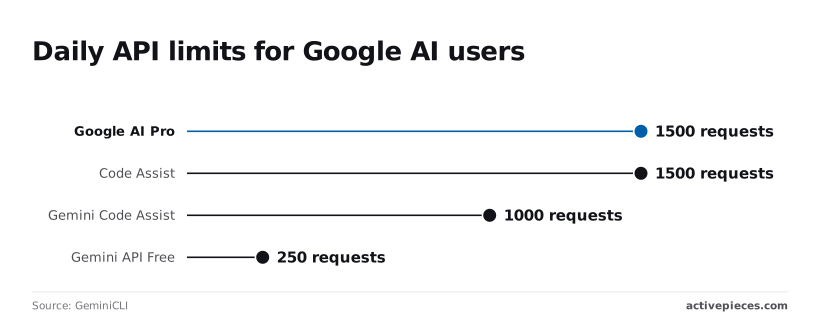 ### Granular 'Read-Only' vs 'Write' zones Governance requires separating the agent’s ability to "see" data from its ability to "change" it through defined connection scopes. In Activepieces, you can route an ADK agent through a "Read-Only" flow when querying the Salesforce CRM platform. This ensures it can extract lead data without the risk of overwriting historical contact records. When an agent needs to perform a "Write" action, such as updating a ticket in the Jira project management tool, you can insert a "Wait for Approval" step.  Before the agent’s payload is delivered to the production API, an auditor must click "Approve" to satisfy the human-in-the-loop requirement. ### Auditing the 'Black Box' with execution logs Activepieces replaces the opaque nature of direct ADK calls with a versioned history of every logic change and execution path. The flow builder allows you to track exactly how an agent’s instructions have evolved over time, which is essential for identifying which version of a prompt began causing data inconsistencies. The Version History panel is an immutable record of these changes, showing which iterations were active during specific failure windows. In the screenshot, Version #2 (Today, 11:59 AM) is flagged with a yellow status indicator. This signifies a draft or a "caution" state that hasn't yet replaced the stable Version #1 (Today, 11:10 AM). 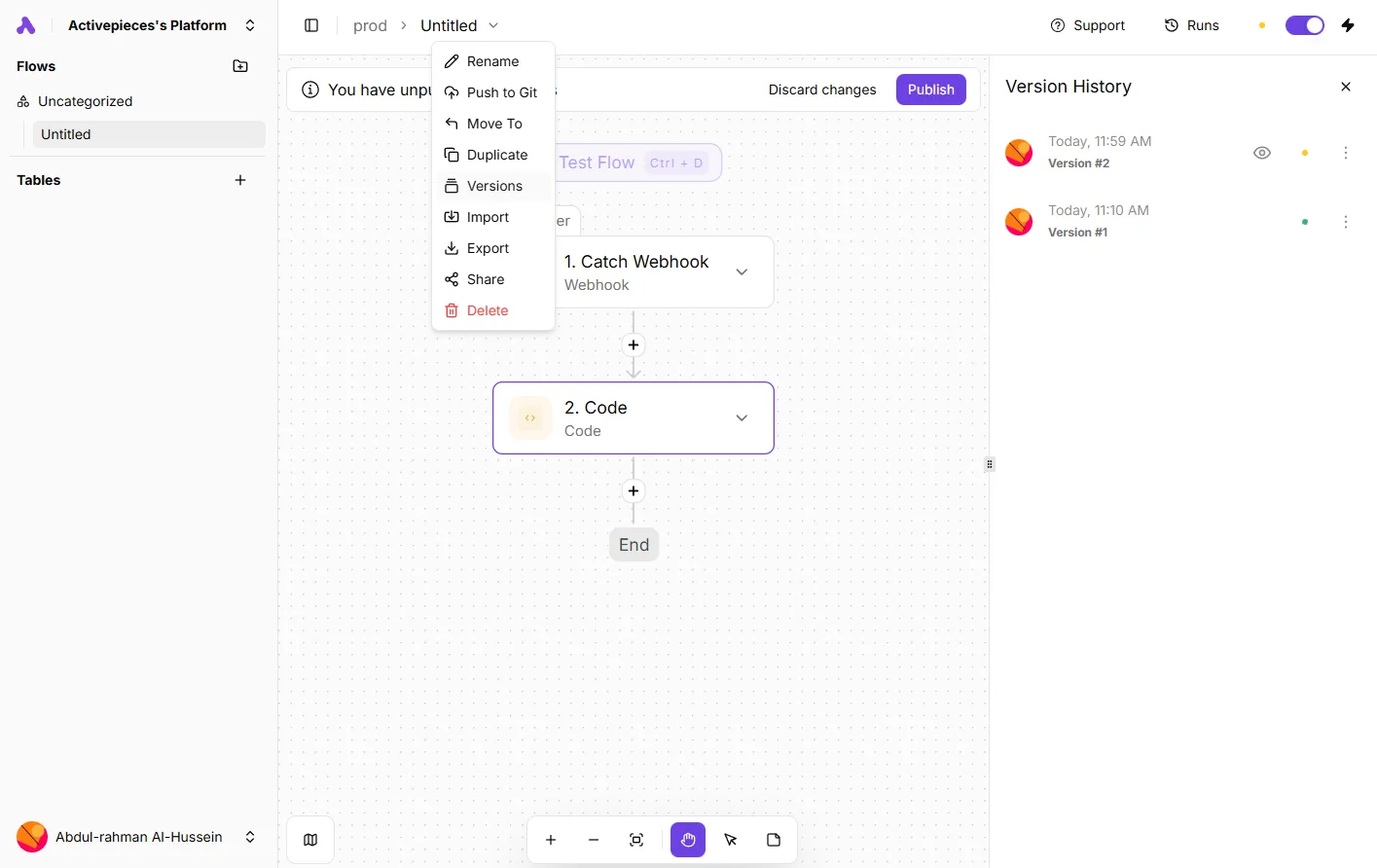 By maintaining this trail, an auditor can see that the "Code" step was modified between 11:10 AM and 11:59 AM. This provides a clear starting point for a forensic review. This visibility ensures that when an agent's output changes, you can distinguish between an update to the model's weights and a manual change to the workflow logic. ## Related reading - [A Postmortem on Data Leaks and Secure Automation](https://www.activepieces.com/blog/a-postmortem-on-data-leaks-and-secure-automation) ## References - [GeminiCLI](https://geminicli.com/docs/resources/quota-and-pricing/) - [NodeSparks](https://www.nodesparks.com/data/automation-platform-pricing)Agents lack the native ability to distinguish between a constructive update and a destructive recursive loop.