Friction arises in these advanced environments because Vellum lacks native hooks into the standard tools teams use to maintain system health. GitHub can't natively track changes made within a Vellum visual editor, so teams lose the ability to perform code reviews on prompt iterations. Datadog can't see the internal latency of individual nodes within a Vellum workflow, which prevents DevOps from identifying specific bottlenecks in the AI pipeline. Terraform can't manage Vellum resources, so scaling an environment requires manual configuration rather than automated scripts. ## The case for specialized prompt management platforms ### Enabling non-technical collaboration on AI prompts Specialized platforms bridge the gap between product managers who understand customer intent and engineers who manage production code. When a subject matter expert can adjust a system prompt in a visual playground without touching a repository, the feedback loop for tone and accuracy shrinks from days to minutes. This decoupling means a non-technical stakeholder can iterate on edge cases in real-time, preventing the engineering team from becoming a bottleneck for simple linguistic adjustments. ### The high cost of building custom evaluation tools Building an internal framework to measure prompt performance requires a significant diversion of engineering resources away from core product features. A team opting for a custom build must develop their own versioning systems, side-by-side comparison views, and semantic similarity scorers. DevOps teams face a permanent maintenance burden in this scenario. Vellum provides these testing suites out of the box, allowing teams to verify that a new prompt version doesn't regress on previous successes before it ever hits a production environment. 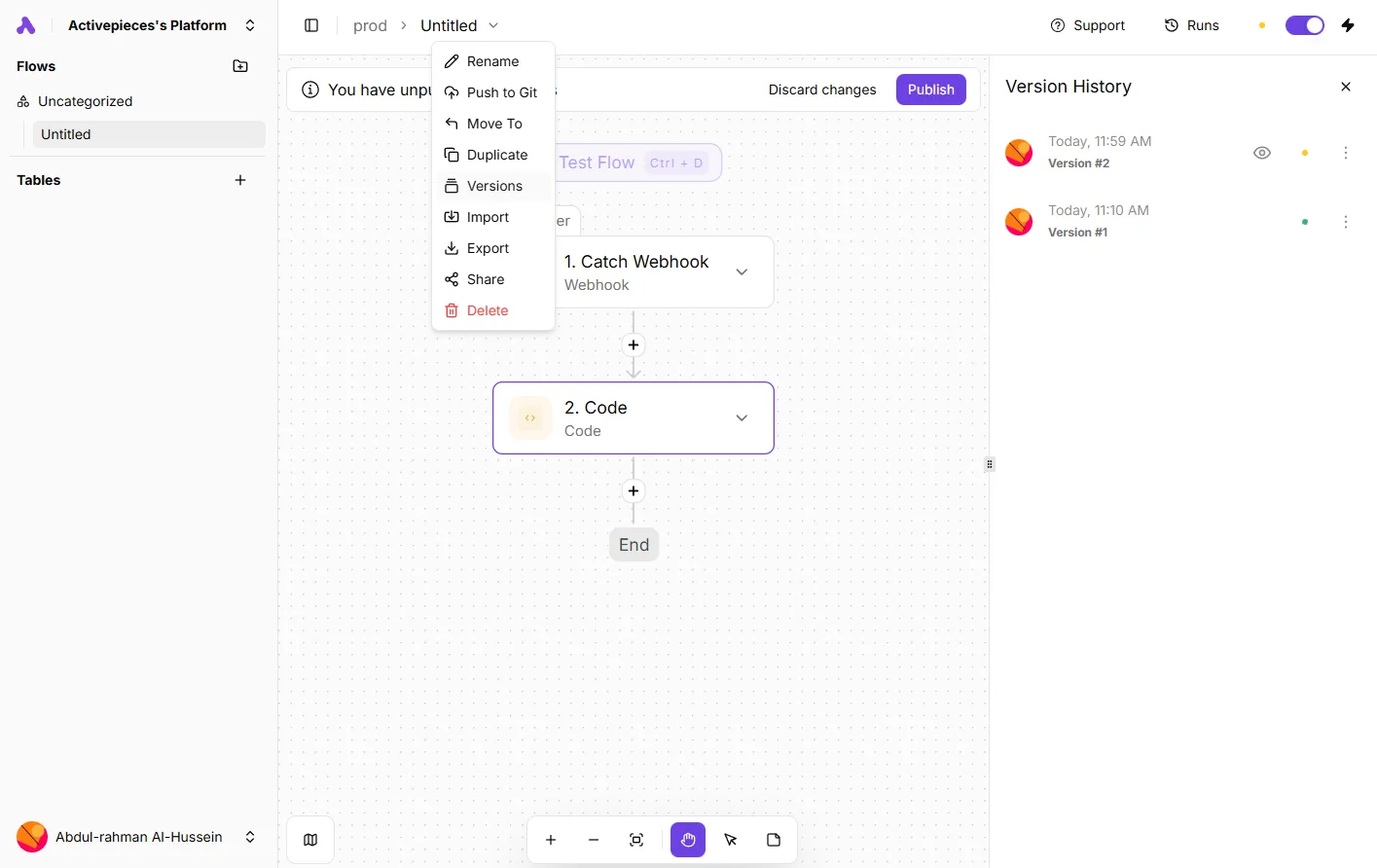 The screenshot below illustrates how professional prompt management tools handle this complexity by providing a dedicated version history panel. This specific view shows two iterations of a logic flow. It shows that Version #1 is the active production baseline while Version #2 is a draft currently under review. By surfacing these distinctions visually, teams avoid the risk of accidentally deploying untested logic to their users. Every change is tracked and reversible through this visibility, providing a level of control that's difficult to replicate in a homegrown system. ### Vellum's speed advantage for AI prototyping Vellum accelerates the transition from a concept to a functional API endpoint by providing a pre-configured infrastructure for prompt execution. Because the platform handles the boilerplate of model provider integrations and logging, a startup can move from a blank slate to a customer-facing demo in a single afternoon. This immediate availability allows a team to validate their business model with real users before committing to the long-term architectural overhead of a fully custom AI stack. ## Architectural rigidity drives the migration to open ecosystems Vellum’s managed environment creates a ceiling for engineering teams because it treats the LLM as an isolated node in a complex enterprise network. While centralized prompt management offers initial speed, it eventually forces a choice between simplifying the business logic to fit the platform or building expensive workarounds to bypass its structural constraints.As raw intelligence becomes a baseline utility, the premium paid for a management wrapper gets harder to justify as the volume of calls increases.
### Why function calling limits LLM integrations Directly querying internal infrastructure becomes a security and latency bottleneck when the prompt management layer can't natively speak to your internal stack. Relying on external function calling means every retrieval-augmented generation (RAG) cycle must traverse the public internet, adding 200ms to 500ms of round-trip latency. User-facing agents are often pushed past the threshold of perceived responsiveness by this delay. This Integration Wall manifests in three specific risks. Developers are unable to query production SQL databases directly for RAG context, which forces them to maintain redundant, synced vector stores that are often minutes behind the source of truth. The platform lacks support for proprietary or legacy authentication protocols, so teams must build custom bridge APIs just to let the LLM talk to internal services. Furthermore, latency overhead from multiple API hops compounds with every additional step in a chain, making complex reasoning loops too slow for production environments. ### Data privacy concerns in third-party prompt logging Housing sensitive PII or proprietary trade secrets within a third-party wrapper introduces a permanent compliance debt that open-source alternatives avoid. When you use a managed platform, your raw prompt data and model responses live on their infrastructure, meaning a single platform breach exposes your entire interaction history. Open automation ecosystems, in contrast, allow for self-hosting on private VPCs, providing a broader range of connectivity without the data egress. In Activepieces, the logic that governs how an agent behaves sits in an MIT-licensed core, where every tool call is visible in the run trace and the execution engine itself is open for inspection in the public monorepo.  n8n provides 500 integrations, ensuring that data stays within the corporate firewall while still benefiting from a visual logic builder. ### The hidden cost of per-request middleware pricing Scalability is often throttled by a pricing model that taxes every interaction between the application and the model. When a platform charges a premium on top of the raw token cost, a successful product launch becomes a financial liability. **20% to 30% of the total AI OpEx** can be accounted for by middleware fees. This creates a perverse incentive to limit the number of times an agent checks its context or validates its output, directly degrading the quality of the AI's performance to keep margins sustainable. ## Activepieces restores control over the full automation stack Activepieces functions as an open-source AI automation platform that treats large language models (LLMs) as modular steps within a broader infrastructure. MoneyGram and FundingSocieties run Activepieces in production to manage these complex environments where logic must remain portable. This architecture allows teams to move their AI operations inside their own virtual private clouds without losing the ability to sync back to a managed service. Sensitive data never touches a third-party middleware layer before reaching the model provider. ### Self-hosting for total data sovereignty By deploying the Activepieces self-hosted edition, organizations retain complete ownership of their execution environment. This eliminates the compliance risk of routing proprietary data through an external prompt management platform. Every API key, customer record, and system prompt stays within the company’s managed firewalls under this deployment model. Security teams don't have to audit a new vendor's data retention policies every time a workflow changes. Because the engine is open-source, developers can inspect the underlying code to verify how data is handled, providing transparency that proprietary wrappers can't match. ### Combining LLMs with 100+ native app integrations Activepieces bridges the gap between AI reasoning and operational action through a library of 735+ integrations, including native connectors for tools like the PostgreSQL database or the Slack communication platform. This allows teams to build workflows where an LLM is merely one node in a sequence, rather than the entire system. The following table illustrates how this architectural shift impacts the flexibility of the automation stack: | Dimension | Vellum (Middleware) | Open Automation (Activepieces) | | :--- | :--- | :--- | | Data Source Access | Restricted to pre-defined connectors or webhooks | Unlimited via custom code pieces and local network access | | Custom Auth Support | Limited to platform-supported methods | Extensible through custom piece development | | Logic Execution | Managed within the Vellum sandbox | Runs natively on your own infrastructure | While middleware limits you to a vendor's roadmap, an open engine allows you to build any integration your internal APIs require. ### Moving from prompt-centric to logic-centric workflows Shifting to Activepieces allows engineers to prioritize the surrounding business logic (such as conditional branching and error handling) over the specific wording of a prompt. When the wrapper is removed, the LLM becomes a replaceable commodity that can be swapped or upgraded without rebuilding the entire automation. The long-term value of the system lives in the documented business process rather than a fragile collection of prompts stored in a third-party dashboard. ## The Monday morning plan for migrating AI workflows A successful migration requires decoupling your business logic from the proprietary dashboard before the next billing cycle triggers. By treating prompts as code rather than configuration, you ensure that your intellectual property remains portable across any execution environment.  ### Auditing prompt dependencies before migration Mapping every touchpoint where an external API calls a managed prompt identifies exactly which services will break during the cutover. Because these platforms often act as a black box for version history, you must manually export the system instructions, temperature settings, and few-shot examples into a centralized version control system like GitHub. By moving this logic into a repository, your engineering team can track changes through standard pull requests. This prevents the silent failures that occur when a non-technical user tweaks a production prompt in a third-party UI. ### Building a local AI evaluation baseline Creating a suite of representative test cases allows you to prove that your new, self-hosted workflows match or exceed the quality of the legacy system. You should compile a dataset of historical inputs and the gold standard outputs the previous system generated, which serves as your performance floor. Drift in model behavior is caught during development by running these tests through an open-source evaluation framework. Your customers never experience a regression in response quality once you flip the switch. ### Select a long-term infrastructure host Choosing where your AI logic lives determines your future ability to scale without hitting arbitrary seat limits or data privacy ceilings. Depending on your security requirements, you should choose one of the following environments: * A dedicated Virtual Private Cloud (VPC) on an enterprise provider like AWS, which keeps all prompt data within your existing security perimeter. * A containerized deployment using Docker, which allows you to move the entire workflow between different cloud providers without rewriting the integration code. * A serverless execution environment, which reduces operational overhead by only charging for the compute time used during a specific inference call. ## Frequently asked questions about Vellum alternatives ### Is it possible to export Vellum prompts directly? Exporting from Vellum requires a manual migration process because the platform stores prompt versions and provider-specific variables in a proprietary database format. This lack of a native "export to code" function means that teams must manually copy templates into version-controlled repositories like GitHub. For the rest of the engineering organization, this repository serves as the primary source of truth. Transitioning away from this lock-in allows developers to treat prompts as standard text files. Every change is automatically tracked by existing CI/CD pipelines rather than hidden inside a third-party dashboard. ### How does self-hosting affect LLM latency? Self-hosting the orchestration layer typically reduces total request latency by eliminating the extra network hop between your private cloud and Vellum’s managed servers. In a standard managed setup, every user query must travel to the middleman’s infrastructure before reaching the model provider, such as OpenAI or Anthropic. Milliseconds are added to every round trip by this hop. By deploying an open-source alternative within your own Virtual Private Cloud (VPC), you ensure that sensitive data stays behind your firewall. Your security team doesn't have to audit a new set of external data processing agreements. ### How do licensing costs compare The primary cost difference lies in the shift from per-seat or per-workflow licensing to infrastructure-based pricing. Vellum charges based on the number of users and the volume of executions, which means your monthly bill scales directly with your product’s success. These costs shift to your existing cloud provider, such as AWS or Google Cloud, when you move to a self-hosted model. Your AI overhead becomes a predictable line item in your compute budget rather than a variable tax on your growth. ## Related reading - [Open Source Alternatives to Azure Logic Apps](https://www.activepieces.com/blog/open-source-alternatives-to-azure-logic-apps) - [Popular Open Source Tools in 2025 and Their Uses](https://www.activepieces.com/blog/popular-open-source-tools-in-2024-and-their-uses) - [Using Open Source for Business Process Management](https://www.activepieces.com/blog/using-open-source-for-business-process-management) ## References - [Activepieces](https://www.activepieces.com/pieces)Vellum’s managed environment creates a ceiling for engineering teams because it treats the LLM as an isolated node in a complex enterprise network.