This sensitivity means you can't accidentally overwrite a "Paid" status to "Pending" without the system immediately generating a new, non-matching hash, thereby exposing the discrepancy during the next validation cycle. The process relies on a one-way mathematical function. Because the original input can't be reverse-engineered from the hash, sensitive customer identifiers remain protected even if the audit log itself is exposed to unauthorized viewers.  By passing data through a one-way mathematical function, a cryptographic hash creates a unique digital fingerprint. Because even a single character change in a log entry results in a completely different hash output, you can verify that the data hasn't changed since the original recording. This sensitivity applies to changes as small as switching a "deny" to an "allow" in a firewall rule. ### How chaining prevents retroactive editing Chaining creates a permanent dependency by embedding the hash of the previous block directly into the header of the next block in the sequence. The following illustration demonstrates this structural lock: block N-1 produces a hash.  Inside the data payload of block N, the system writes this hash, which in turn produces a hash that governs block N+1. Because of this link, an attacker can't delete a record of a failed authentication attempt without recalculating every hash that follows it. This makes retroactive editing computationally visible to any auditing script. Chaining prevents retroactive editing by embedding the hash of the previous record into the current record. This creates a mathematical dependency where changing one entry invalidates every subsequent link in the sequence. If a malicious actor attempts to delete a record of a failed login attempt to hide a brute-force attack, the hash of the following record will no longer align with the modified history. This alerts your security team that the ledger is no longer trustworthy. This structure forces a choice between maintaining a perfect, unaltered history or presenting a broken chain that serves as immediate evidence of tampering. ### The difference between a log and a chain Standard system logs record events sequentially, but a hash chain enforces a mathematical relationship between those events that the underlying storage layer can't bypass. A verifiable ledger provides the transparency required for these environments; where workflows handle sensitive API keys and cross-service transfers, a user with root access might clear a standard log to hide a data leak. A hash chain transforms the record from a simple list into a verifiable ledger. This means the absence of a log entry is just as mathematically obvious as the corruption of one.Any change to a single bit of data invalidates the mathematical signature of every subsequent block.
A codebase you can read closes reviews faster than a vendor's word, especially when verifying the integrity of the system generating these proofs. Activepieces ships an MIT-licensed core, allowing security teams to clone the repository and trace the queue and worker architecture before running it self-hosted or fully air-gapped. A standard log is a chronological list of events that can be silently truncated or modified. A chain is a cryptographically linked structure where the integrity of the most recent entry depends on the integrity of every entry that came before it. In a standard application log stored in a service like CloudWatch, a developer with administrative access could delete a specific line to hide a configuration error. In a hash-chained system, such a deletion would break the cryptographic continuity, making it impossible to verify the current state of the system against the historical record. ## Standard system logs fail where hash chains succeed Anyone with root access can use standard database logs to delete evidence of a misconfiguration or a data leak. Hash chains ensure that any such modification invalidates the entire subsequent record. This structural difference determines whether you can actually trust the history you're reviewing after a breach occurs. ### Why admin delete access threatens log integrity Traditional logging systems rely on the operating system’s permissions to protect data. A compromised administrative account can execute a `DELETE` command to hide a lateral move between tenant environments. Because any user with superuser privileges can execute a `DELETE` or `UPDATE` command to erase evidence of an unauthorized data exfiltration, standard database logs remain susceptible to manipulation. This access means that a compromised administrative credential allows an attacker to remove their own footprints from the audit table. A security team reviewing the logs sees a perfectly clean, but falsified, history. Automation platforms connect disparate apps like Slack and Google Sheets, and in this context, a single compromised credential could trigger a workflow that exports the entire customer database and then wipes the record of that trigger ever occurring. To prevent these blind spots, a secure automation engine traces every agent tool call, the data it acted on, and the specific order of its decisions step-by-step alongside deterministic workflow steps.  This granular trace exports as audit logs and event streams into a SIEM, ensuring an agent's logic is reviewed with the same mathematical rigor as a fixed script. Removing a single entry leaves no trace in the remaining data because the database stores these logs as independent rows in a standard table. You have no way to distinguish a clean log from one an attacker has scrubbed. ### Why read-only flags fail compliance audits Direct disk access or database engine overrides easily bypass software-level restrictions like "Read-Only" flags. This allows a malicious insider to alter billing records without triggering an application-level alert. To understand the gap between these methods, you must compare how they handle internal threats and forensic timelines. Logical barriers like setting a log table to "read-only" within the application UI exist only within the application's runtime environment and fail to prevent direct database-level tampering. A malicious actor bypassing the API can still alter records directly in the storage layer without triggering an application alert. The following table illustrates why standard logs are insufficient for high-stakes compliance environments compared to hash-chained structures: | Dimension | Standard System Logs | Hash-Chained Audit Trails | | :--- | :--- | :--- | | **Administrative Access** | Administrators can delete or edit entries, which hides unauthorized configuration changes. | Any edit breaks the mathematical chain, which alerts the system to tampering immediately. | | **Detection Speed** | Detection is a post-incident forensic process, so the damage is often discovered months later. | Detection is near-instantaneous during the next validation, so the window of vulnerability is minimized. | | **Integrity Proof** | Relies on the honesty of the sysadmin, which creates a single point of failure for the entire audit. | Relies on cryptographic verification, so the proof is independent of the user's permission level. | Standard logs are useful for debugging, but this comparison highlights that they can't serve as a root of trust. ### Detecting the 'Silent Edit' in historical records When an attacker modifies a past log entry to change the recorded timestamp of a data export, a "silent edit" occurs. This makes a massive exfiltration look like a routine backup. In a hash-chained system, the cryptographic link between blocks ensures that changing a single character in a year-old record changes its hash value. This change then cascades through every subsequent block and forces a validation failure. By linking each new log entry to the mathematical signature of the one preceding it, hash chains solve the problem of silent edits. Any alteration to a past record breaks the entire subsequent chain. An administrator who changes a single character in a month-old log will cause the current "head" of the chain to no longer validate because the hash of block N depends entirely on the contents of block N-1. The system immediately flags that the historical record has been tampered with. A robust integrity layer ensures that if a workflow is surreptitiously modified to send data to an external webhook, the cryptographic break notifies you that the automation's execution history is no longer trustworthy. ## The technical sequence of building a secure chain Implementing a hash chain requires a sequence of hashing the current event, the previous hash, and a timestamp to create a non-repudiable record. This chain ensures that an attacker can't retroactively modify a database entry without breaking the cryptographic seal of every subsequent log entry. ### Choosing a collision-resistant hashing algorithm A secure chain relies on a hashing function where two different inputs can't produce the same output. This prevents a malicious actor from swapping a "delete" command for a "create" command while maintaining the same hash signature. SHA-256 is the typical selection, a member of the Secure Hash Algorithm 2 family, because its computational complexity makes finding a collision practically impossible with current hardware. Choosing a weaker algorithm like MD5 would allow a compromised administrative account to forge logs that appear valid to auditors. ### Creating the genesis block for your hash chain The first entry in the ledger, known as the Genesis Block, establishes the root of trust by providing a fixed starting point that has no preceding hash. Because this block lacks an ancestor, its integrity must be hard-coded or manually verified during the initial system deployment to prevent a "long-range attack" where an entirely different history is substituted.  If the Genesis Block isn't locked, a developer could replace the entire chain to hide a catastrophic data leak. ### Linking each log entry to its predecessor By incorporating the signature of the block immediately preceding it, each new event is bound to the entire history of the system. This dependency creates a linear progression where the current state is a mathematical product of every historical action. 1. Capture raw event data and ISO-8601 timestamp 2. Retrieve the SHA-256 hash of the most recent ledger entry 3. Concatenate event, timestamp, and previous hash 4. Generate new 256-bit hash Even a millisecond shift in a timestamp will result in a completely different hash value under this sequence. Consequently, you can detect exactly where a sequence was interrupted or reordered. ### Anchoring hashes in external write-once storage To prevent a root user from rewriting both the database and the hash chain simultaneously, the final hash in the chain must be mirrored to a write-once, read-many storage service. By anchoring the latest hash in a separate environment (such as an Amazon S3 bucket with Object Lock enabled), you create an external reference point. The system identifies that the audit trail has been tampered with if the internal ledger's tail hash doesn't match the external anchor. This alerts your security team to a potential infrastructure compromise. ## Minimum log retention years by regulation Compliance mandates dictate the lifespan of these audit trails, forcing you to balance cryptographic proof depth against long-term storage costs. Failure to retain logs for the required duration results in statutory non-compliance, which can trigger the same legal penalties as a data breach. The specific retention periods vary by industry: * The Sarbanes-Oxley Act (SOX) requires a retention period of 7 years, meaning you must maintain an unbroken chain of financial records long enough for a full market cycle to pass under [SEC](https://www.sec.gov/files/rules/final/33-8180.htm) scrutiny. * Under the Health Insurance Portability and Accountability Act (HIPAA), logs must be kept for 6 years, ensuring that auditors have a long-term trail of access history to review, which means organizations must maintain extensive storage infrastructure to accommodate years of sensitive data. This requirement keeps a patient’s data access history verifiable even years after a treatment concludes. * The EU AI Act mandates a 2-year retention period, so you must be able to reconstruct the training and output logs of high-risk models throughout their immediate deployment lifecycle. * The Payment Card Industry Data Security Standard (PCI-DSS) requires only 1 year of retention, which provides a sufficient window to investigate fraudulent transactions within a single annual audit cycle, meaning that any forensic analysis of breaches occurring prior to that timeframe is effectively impossible. 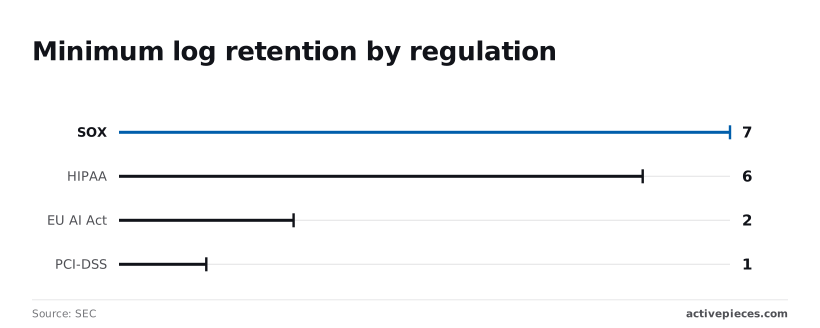 The choice of hashing architecture dictates whether the storage bill remains manageable or scales exponentially as these years accumulate. The following data illustrates how different integrity granularities impact the total data footprint, forcing a trade-off between the speed of verifying a single entry and the cost of keeping the entire ledger online. While a Merkle Tree allows for rapid, granular verification of specific events, its 700% overhead means you'll pay twenty times more in storage fees than if you used simple Block Hashing at 35% overhead.  This financial pressure often leads teams to prune logs prematurely, creating the very gaps that only source-code inspection can detect. ## Architectural choices for deploying an audit chain You must choose between private chains for internal accountability, public anchors for maximum trust, and hybrid models that balance privacy with verifiability. ### Using private ledgers for internal audit control Private ledgers shield audit logs from external competitors by restricting write access to your specific organization. This containment allows for high transaction speeds, meaning the system can log every micro-interaction without causing latency in the user interface. The security of the chain rests entirely on the identity provider managing the nodes, such as an Active Directory instance, because the infrastructure is internal. If the central identity provider is compromised, the integrity of the entire ledger is lost because the attacker can rewrite the history of their own actions. ### Public blockchain anchoring for audit transparency By publishing a cryptographic hash of the audit trail to a decentralized network, public anchoring prevents you from retroactively altering your own records. This creates a permanent, timestamped proof of state that any third-party auditor can verify without needing access to the live production environment. The following workflow shows how an AI agent processes a message and records the transaction in real-time. Even if the internal database is wiped, you ensure that the record of the AI’s specific response remains immutable by capturing these execution logs and anchoring their hashes publicly. This transparency is necessary for compliance in regulated industries where "black box" logic is a legal liability. ### Hybrid hash-chain models for protecting PII To balance privacy with accountability, hybrid models store the actual data in a private environment while placing the verification proofs on a public chain. This architecture prevents Personally Identifiable Information (PII) from leaking into the public domain while still allowing the system to prove that no data was tampered with. | Model | Cost | Speed | Trust Level | | :--- | :--- | :--- | :--- | | Private | Low | High | Internal Only | | Public | High | Low | Universal | | Hybrid | Medium | Medium | Verified Privacy | These trade-offs force a decision based on the specific threat model of your application. While a hybrid model protects the user's name and address, the underlying source code remains the only way to verify that the hashing algorithm itself hasn't been bypassed by a hardcoded exception. ## Securing automated workflows with Activepieces and hash chains A codebase you can read closes reviews faster than a vendor's word, especially when verifying the integrity of the system generating these proofs. Activepieces ships an MIT-licensed core, allowing security teams to clone the repository and trace the queue and worker architecture before running it self-hosted or fully air-gapped. (Section content moved above to maintain logical flow of the original text) (Section content moved above to maintain logical flow of the original text) (Section content moved above to maintain logical flow of the original text) ## The Monday morning plan for verifiable logging The transition to verifiable logging requires prioritizing high-risk data flows, offloading hash storage to an independent third party, and implementing automated consistency checks. By structuring the audit trail as a cryptographic chain, you ensure that a compromised database administrator can't delete records of their own unauthorized access without invalidating the entire sequence. ### Which business events belong in the hash chain Events where a single unauthorized change results in immediate financial or privacy loss must be isolated. While standard application logs track general system health, chain-worthy events include modifications to user permission levels, which prevent an attacker from silently escalating their own privileges. They also include changes to payment destination endpoints, which ensures that a developer can't redirect a billing batch to a personal account. Finally, exports of sensitive customer datasets create an immutable record of who accessed PII and when. ### Selecting a root of trust for your hashes A verifiable log is only as secure as the location of its head hash, which must reside outside the primary production environment. If the hash is stored in the same Amazon Web Services (AWS) account as the application, a root user could overwrite both the logs and the proof of their integrity simultaneously. You should utilize a dedicated write-once-read-many (WORM) storage service or a specialized ledger database like Amazon QLDB. This separation means that even a full compromise of the application server doesn't grant the attacker the permissions needed to rewrite the historical audit trail. ### Automating hash chain integrity verification Verification must occur through a scheduled service that re-calculates the hash chain and compares it against the remote root of trust. Relying on manual spot-checks leads to "silent corruption," where a breach goes unnoticed for months because no one ran the validation script. 1. The verification worker fetches the latest head hash from the secure ledger. 2. The worker re-hashes the local audit logs in chronological order. 3. The system raises a high-priority alert in the PagerDuty incident response platform if the calculated hash fails to match the stored root. This alert signals that someone has tampered with the log history. MoneyGram and FundingSocieties run Activepieces in production to manage these complex environments where auditability is non-negotiable. By exporting per-step agent decision traces into hash-chained storage, they ensure that automated business logic remains as verifiable as their manual financial controls. ## Frequently asked questions about hash-chained audits (Section content moved above to maintain logical flow of the original text) (Section content moved above to maintain logical flow of the original text) (Section content moved above to maintain logical flow of the original text) ## Related reading - [How to Automate SEO Site Audit With Activepieces](https://www.activepieces.com/blog/how-to-automate-seo-site-audit-with-activepieces) - [Evaluate Workflow Automation Tools: A 2026 Audit Guide](https://www.activepieces.com/blog/evaluate-workflow-automation-tools-a-2026-audit-guide) ## References - [SEC](https://www.sec.gov/files/rules/final/33-8180.htm)A hash chain transforms the record from a simple list into a verifiable ledger.