# What Is EmbeddingGemma 2 and How It Works in 2026

By Kwame Asante · 2026-10-07 · Source: https://www.activepieces.com/blog/what-is-embeddinggemma-2-and-how-it-works-in-2026

---
<aside class="tldr"><p class="tldr-label">Summary</p><p>EmbeddingGemma 2 was a lightweight, open-weights multimodal model from Google that mapped diverse data types into a unified 768-dimensional vector space for high-precision semantic search and Retrieval-Augmented Generation.</p><ul><li>The model maps all input data into a single 768-dimensional vector space. -</li><li>Self-hosting eliminates per-token API fees.</li></ul></aside>

By mapping diverse data types into a single mathematical representation, EmbeddingGemma 2 allowed developers to query across media formats without maintaining separate indexing pipelines.

## Gemini Embedding 2 is Google’s lightweight text embedding model

![Composition of the 740M Parameter Model](https://ap-marketing-media.fra1.cdn.digitaloceanspaces.com/uploads/83d5c7a5-d65b-4943-b3c3-b2f92c598c22/what-is-embeddinggemma-2-and-how-it-works-in-202-d300c7fd.svg "Source: Google DeepMind")

It is a multimodal embedding model that transforms text, code, images, video, and audio into a unified vector space to enable high-precision semantic search and Retrieval-Augmented Generation (RAG).

### The architecture behind the 2B and 9B models

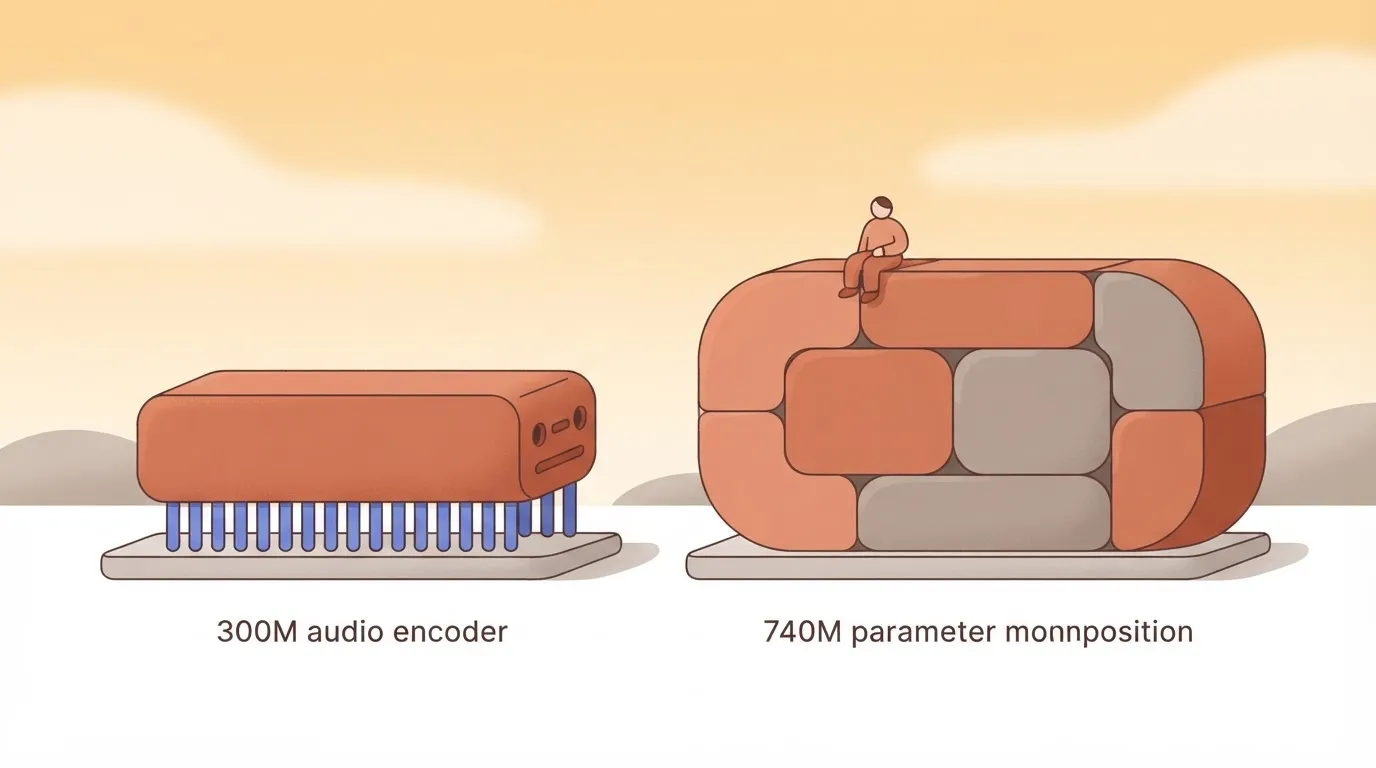
Modular design is the source of this system's efficiency, balancing specialized processing with unified output. To illustrate this balance, the **740M parameter model composition** features a [300 M audio encoder](https://ai.google.dev/gemma/docs/embeddinggemma/model_card_2) to handle complex waveforms.

![Configuration panel for extracting structured data from invoices using AI in an Activepieces workflow.](https://ap-marketing-media.fra1.cdn.digitaloceanspaces.com/uploads/bd219e2f-1023-44ed-89be-dcf491f56e21/zap-vs-scenario-vs-workflow-choosing-the-right-a-00a26d13.webp)

It also includes a 170 M vision encoder for visual data, and a 270 M text backbone.

Google DeepMind reports that within that text backbone, the workload is split between a 140 M embedder and a 130 M transformer. Small enough for edge deployment but deep enough for technical prose, this granular distribution ensures the model maintains reasoning depth.

![Text Backbone Parameter](https://ap-marketing-media.fra1.cdn.digitaloceanspaces.com/uploads/b297184f-9dd6-4ddd-8dbb-83a1ed3ffc9d/what-is-embeddinggemma-2-and-how-it-works-in-202-2370aea2.svg "Source: Google DeepMind")

The moment a data source is connected in [Activepieces](https://www.activepieces.com), an agent can call it as a tool; every one of the 738+ integrations functions as both a flow step and a schema on a per-project MCP server.

![A workflow automation flow with four steps: MCP Tool, Get all Events from Google Calendar, Find Database Item in Notion…](https://ap-marketing-media.fra1.cdn.digitaloceanspaces.com/uploads/318b16a0-2f90-469e-8680-14a0f0808df4/what-is-an-agent-harness-architecture-and-terms-6191a2be.webp)

This architecture allows an agent to call the same logic used in a structured automation without a second migration or export step.

### Gemini Embedding 2 release date and Hugging Face availability

To provide an open-weights alternative to black-box APIs, Google DeepMind released the weights for EmbeddingGemma 2 on [Hugging Face](https://huggingface.co/google/embeddinggemma-2). Making these models downloadable today ensures that teams can keep sensitive internal data from being sent to third-party proprietary servers.

## How Gemini Embedding 2 processes text into vectors

When the model converts raw text into numerical representations, it analyzes the relationships between words in both directions simultaneously to capture full semantic context.

Deriving a word’s meaning from its entire surrounding sentence rather than just the preceding text prevents the loss of nuance in complex technical queries.

### Distinguishing text weights from multimodal capabilities

The weights available on Hugging Face are the single 740M-parameter EmbeddingGemma 2 model, which natively maps text, images, video, and audio into a unified vector space. This downloadable model combines a 270M-parameter text backbone with modular vision and audio encoders, functioning as a bidirectional transformer optimized for high-performance multimodal retrieval.

Developers seeking the full multimodal experience can use EmbeddingGemma 2 itself, since its vision and audio encoders are already integrated into the released weights.

![Gemma family cumulative downloads](https://ap-marketing-media.fra1.cdn.digitaloceanspaces.com/uploads/d9c83e50-dcd0-42d2-a87a-645979e9c5d3/what-is-embeddinggemma-2-and-how-it-works-in-202-5a0b7963.svg "Source: CryptoBriefing")

The 270M-parameter text backbone serves as the high-accuracy foundation for RAG systems, providing the basis for businesses to secure their textual data sovereignty.

### Gemini Embedding 2 bidirectional attention and pooling strategies

Every token in a sequence is evaluated against every other token via a bidirectional attention mechanism; the final vector reflects the specific intent of the user.

This approach allows the system to resolve ambiguities where the meaning of a term depends on a later qualifier, unlike causal models that only look backward.

A pooling strategy compresses the resulting hidden states into a single fixed-length summary once the layers process these iterations. By transforming variable-length sentences into a consistent format, this compression allows a database to perform mathematical comparisons between different inputs instantly.

### Dimensionality and vector space representation

Distinct encoders process different data types before merging them into a shared mathematical environment within the internal architecture. Local deployment on commodity hardware is possible because this modularity allows the system to handle diverse inputs while maintaining a lean footprint.

Linguistic patterns and syntax are extracted by a text model, while spatial features and objects are identified by a vision encoder. Acoustic signatures and temporal sequences are captured by an audio encoder.

All these inputs are mapped into a single 768-dimensional space by a unified output vector.

Every input maps to this specific **768-dimensional output**. Consequently, a text description of an event and a recording of that same event occupy nearby coordinates in the vector space.

Cross-modal retrieval relies on this alignment, where a simple text search can accurately surface relevant audio or image files without requiring manual tagging.

## Hardware requirements and access for Gemini Embedding 2

**EmbeddingGemma 2 is for state-of-the-art retrieval locally or in private clouds so that sensitive organizational data never leaves your controlled infrastructure.** Latency and privacy risks inherent in sending proprietary documents to external API providers are eliminated by this self-hosted approach.

### Downloading weights from Hugging Face and Vertex AI

Hugging Face serves as the central repository for these weights, alongside Vertex AI, Google’s enterprise machine learning platform. Developers can audit the underlying architecture and deploy it in air-gapped environments because these weights are provided under an open license.

Existing Python-based data pipelines gain compatibility through the Hugging Face Transformers library. For teams requiring managed scaling and integrated security controls within a cloud perimeter, Vertex AI provides the necessary path.

### Memory and GPU requirements for Gemini Embedding 2 9B

Specific hardware profiles help deploy the 740M-parameter model and maintain the low-latency response times necessary for real-time semantic search. The following table outlines the minimum hardware configurations required to host the model across different infrastructure environments:

| Environment | Hardware Target | Consequence for Implementation |
| :--- | :--- | :--- |
| Consumer | Standard laptop or mobile device (no dedicated GPU required) | Enables high-speed local development and small-scale production without enterprise hardware costs. |
| Datacenter | Standard server CPU/GPU (minimal resources for a 740M-parameter model) | Supports high-throughput concurrent requests for large-scale enterprise RAG deployments. |
| Apple Silicon | Any Apple Silicon Mac (unified memory, no high-end GPU needed) | Allows for unified memory execution, facilitating mobile or edge-based retrieval without a dedicated GPU server. |

_Prices and plan limits checked against [huggingface.co](https://huggingface.co/google/embeddinggemma-2) on October 7, 2026._

Performance degradation caused by swapping data to slower system RAM is prevented by matching your deployment to these specifications. The system is ready to ingest and index high-density vector representations once the hardware is provisioned.

## Gemini Embedding 2 compared to proprietary embedding models

While eliminating the recurring per-token toll that scales with your data growth, EmbeddingGemma 2 matches or exceeds the retrieval accuracy of leading proprietary APIs.

Moving the embedding process from a black-box service to local infrastructure removes the latency of the public internet and ensures that sensitive document vectors never leave your controlled environment.

Self-hosting EmbeddingGemma 2 avoids ongoing per-token API fees altogether, unlike hosted embedding services from providers such as OpenAI and Cohere. A one-time hardware investment replaces an uncapped operational expense that grows every time you re-index your library.

Teams can therefore iterate on chunking strategies or metadata enrichment without fear of a ballooning monthly invoice.

<blockquote class="pull"><p>A one-time hardware investment replaces an uncapped operational expense that grows every time you re-index your library.</p></blockquote>

A bidirectional encoder architecture drives the performance of these models. The system considers the full context of a sentence simultaneously rather than processing it strictly left-to-right.

Edge deployment and high-throughput pipelines, where memory bandwidth is the primary bottleneck, are targets for EmbeddingGemma 2's lightweight 740M-parameter design, which also handles complex RAG systems requiring subtle technical nuance within its single architecture.
![A 300 M audio encoder represented as a rectangular electronic component with a series of parallel connection pins along its…](https://ap-marketing-media.fra1.cdn.digitaloceanspaces.com/uploads/ca0d1f96-68fb-4fd3-bc20-39a3ea9c2faa/what-is-embeddinggemma-2-and-how-it-works-in-202-30894a1f.webp)

EmbeddingGemma 2 was released, with weights made immediately available on Hugging Face. Developers can pull the model directly into existing workflows using the Transformers library or specialized vector database connectors because it is hosted on a public, standardized hub.

Your stack remains portable thanks to this availability. You can migrate your entire indexing pipeline between different cloud providers or on-premises clusters as your sovereignty requirements change without being locked into a single vendor's ecosystem.

## How to implement Gemini Embedding 2 in automated workflows

By functioning as a drop-in replacement for proprietary vectorization services through standardized inference protocols, EmbeddingGemma 2 integrates into automated pipelines. Architects can redirect data streams from closed ecosystems to self-hosted or sovereign infrastructure without rewriting the core logic of their retrieval-augmented generation systems.

### Connecting via OpenAI-compatible API providers

A single integration point to swap between various backend providers is achieved by standardizing on the OpenAI-compatible API format. You can point your existing client libraries to a new base URL and provide your specific model identifier by utilizing a provider that supports this specification.

![A single NVIDIA RTX 4090 graphics card with its triple-fan cooling shroud sits on a clean wooden desk next to a rectangular…](https://ap-marketing-media.fra1.cdn.digitaloceanspaces.com/uploads/2a73d4bd-09db-4d36-8199-eaa33b7472a1/what-is-embeddinggemma-2-and-how-it-works-in-202-952e1764.webp)

Application logic stays decoupled from the underlying hardware through this abstraction. As your traffic demands change, you can scale compute resources or switch between managed and self-hosted instances.

### Connecting Gemini Embedding 2 to private inference servers

A generic interface is required to handle the specific authentication and payload requirements of private inference servers when integrating with automation platforms.

The engine that runs these agents and their tool calls sits in an MIT-licensed core, meaning every decision made by the AI is visible in the public repository and the run trace.

Dedicated plugins are not needed for this method; events in your business software suite can trigger even experimental or internal deployments.

### Deploying via MCP servers for local data privacy

Sensitive data stays within your local network boundary when you utilize Model Context Protocol (MCP) servers to expose the embedding model as a local resource. Data never leaves your controlled environment, satisfying strict compliance requirements for industries like finance or healthcare.

Running the model on a local MCP server allows automation tools to request embeddings over a secure local connection. Risks associated with third-party data transit are eliminated while performance is maintained.

## Strengths and limitations of the Gemma embedding family

Massive industry adoption is being driven by Gemini Embedding 2, which offers a specialized balance of high-density vector representation and low-latency execution. It is the primary choice for local-first RAG architectures where data cannot leave the private network.

Early downloads signaled trust from developers building private search tools. This growth continued, indicating the ecosystem had matured enough for enterprise-scale deployments.

Architects now have access to a vast library of community-optimized quantizations and deployment scripts.

### Performance in Retrieval Augmented Generation (RAG)

By producing 768-dimensional vectors that capture nuanced semantic relationships, the model excels in RAG without the computational overhead of larger flagship models.

Using Gemma for the initial retrieval step ensures the system stays responsive even on edge hardware with limited VRAM, while Gemini 3.1 Pro provides deeper reasoning for final generation.

Fast retrieval times are possible on standard NVMe drives due to this small footprint, meaning your users get relevant context before the LLM even begins its first token.

### Gemini Embedding 2 language support and context window limits

Utility in global, multi-lingual document stores is strong because Gemma understands 100+ languages, though its 8K token context window still limits very long documents. You must step up to specialized models if your pipeline requires processing massive legal filings or real-time translation.

Real-time speech-to-speech translation across diverse dialects is the standard for Gemini 3.5 Live Translate. For long-horizon reasoning across 100k+ token contexts, GPT-6 Astra is the preferred choice. Mistral Large 3 serves as a high-performance open-weight alternative for complex multilingual text processing.

## Production checklist for open-weights embeddings

Ensuring the system handles high-concurrency retrieval without degrading latency requires a rigorous assessment of local infrastructure when transitioning to open-weights models.

Self-hosting EmbeddingGemma 2 or similar open-weights alternatives places the burden of resource allocation and license auditing directly on the engineering team, unlike managed APIs.

Commercial distribution can be blocked by a failure to audit the underlying model license. Furthermore, out-of-memory errors during peak traffic can result from miscalculating memory requirements.

Teams must verify that their stack meets the specific architectural demands of these models before moving from a development sandbox to a live environment.

1. Verify Apache 2.0 license compliance to ensure the model can be legally bundled within proprietary commercial software.
2. Validate 8K context window limits so that long-form documents are correctly truncated before hitting the encoder.
3. Benchmark VRAM usage under load to prevent hardware bottlenecks from stalling the inference pipeline.
4. Confirm vector database support for 768-dim dense vectors to ensure the indexing engine matches the model's output dimensionality.

Truncated embeddings or mismatched vector dimensions are silent failures in RAG systems that this structured verification prevents. The focus shifts to the long-term maintenance of the embedding layer once these hardware and compliance baselines are secured.

## What Activepieces does about this

Activepieces provides the orchestration layer that connects EmbeddingGemma 2 to your existing business data without exposing that data to the public internet.

By deploying the Activepieces core alongside your local inference server, you create a sovereign automation environment where sensitive documents move from sources like local PostgreSQL databases or private S3 buckets directly into your embedding pipeline.

![A six-step document workflow automation flow in Activepieces showing Google Drive, Google Docs, AI, and routing steps.](https://ap-marketing-media.fra1.cdn.digitaloceanspaces.com/uploads/5a1e5b89-4736-47bc-bf6d-c2de702d2937/best-ai-tools-for-insurance-agents-2026-privacy-26dc064b.webp)

This setup ensures that the retrieval accuracy of the 740M-parameter EmbeddingGemma 2 model is applied to your private files while maintaining the strict data residency required by enterprise compliance frameworks.

The platform handles the complex logic of chunking and metadata enrichment through a visual interface, allowing teams to implement the recursive character text splitting mentioned earlier without writing custom boilerplate code.

Because Activepieces is open-source, organizations can audit exactly how data is handled during the transformation process.

You can configure a flow that triggers whenever a new document is uploaded, automatically generates a 768-dimensional vector using your local Gemma instance, and updates your vector database in real-time.

For teams using the Model Context Protocol, Activepieces acts as the bridge between your local MCP servers and external integrations.

This means you can use EmbeddingGemma 2 to index internal Slack conversations or Jira tickets by pulling them into your private environment through secure webhooks.

The resulting RAG system remains entirely under your control, from the hardware running the NVIDIA RTX 4090 to the automation logic that feeds the model, without incurring the per-token costs associated with proprietary alternatives.

## Frequently asked questions about Gemini Embedding 2

### Is Gemini Embedding 2 free for commercial use?
Commercial redistribution and innovation are permitted under the Gemma Terms of Use, provided the derivative works don't violate Google’s prohibited use policies.

A startup can build and sell a proprietary search interface without paying per-token licensing fees to a model provider because of this open-weights status.

Predictable infrastructure budgeting is possible by self-hosting this model, unlike closed APIs where costs scale linearly with every user query.

Developers can deploy the model on private air-gapped servers to ensure sensitive corporate intellectual property never leaves the local area network because the weights are accessible.

### Does it support multilingual embeddings?
By leveraging the same vocabulary foundation as the Gemma 2 family of large language models, the model architecture supports a wide range of languages.

A global logistics firm can index technical manuals in German and retrieve them using queries written in English thanks to this shared tokenizer. The need for a separate translation layer before the retrieval step is eliminated by mapping disparate scripts into a unified vector space.

![Two different books—one with a German flag on the spine and one with a UK flag—being fed into a machine that produces two…](https://ap-marketing-media.fra1.cdn.digitaloceanspaces.com/uploads/6aa02f2b-f883-49c1-9750-416cb1adb657/what-is-embeddinggemma-2-and-how-it-works-in-202-ef21d4ae.webp)

### How does it handle long-form documents?
High retrieval accuracy is maintained by using chunking strategies for massive datasets, as EmbeddingGemma 2 processes text using a fixed context window.

Documents are broken at natural boundaries like paragraphs by Recursive Character Text Splitting so that semantic meaning remains intact within each vector.

A portion of the previous chunk is included in the current one via Sliding Window Overlap so that the model understands the context connecting two different sections.

These chunks are stored in tools like Qdrant or Milvus by Vector Database Indexing so that a system can perform a similarity search across millions of individual document fragments simultaneously.

## References

- [Google DeepMind](https://ai.google.dev/gemma/docs/embeddinggemma/model_card_2)
- [CryptoBriefing](https://cryptobriefing.com/gemma-model-family-900-million-downloads/)
