# What is Tray Embedded? A 2026 Guide
By Ossian Kettunen · 2026-10-13 · Source: https://www.activepieces.com/blog/what-is-tray-embedded-a-2026-guide
---
Deploying native-looking integrations without building each connector from scratch is the primary promise of Tray Embedded. This low-code infrastructure allows software companies to offload the maintenance of third-party APIs to a managed service.
## Use tray embedded for b2b products
By doing so, your team can focus on their core product. You'll provide users with automated workflows between their platform and external tools.
### The difference between Tray.io and Tray Embedded
Standard Tray.io handles internal enterprise automation, but Tray Embedded is a multi-tenant solution built specifically for product teams to ship integrations to their own end-users. The architecture relies on an Integration Manager hub that acts as the central control plane.
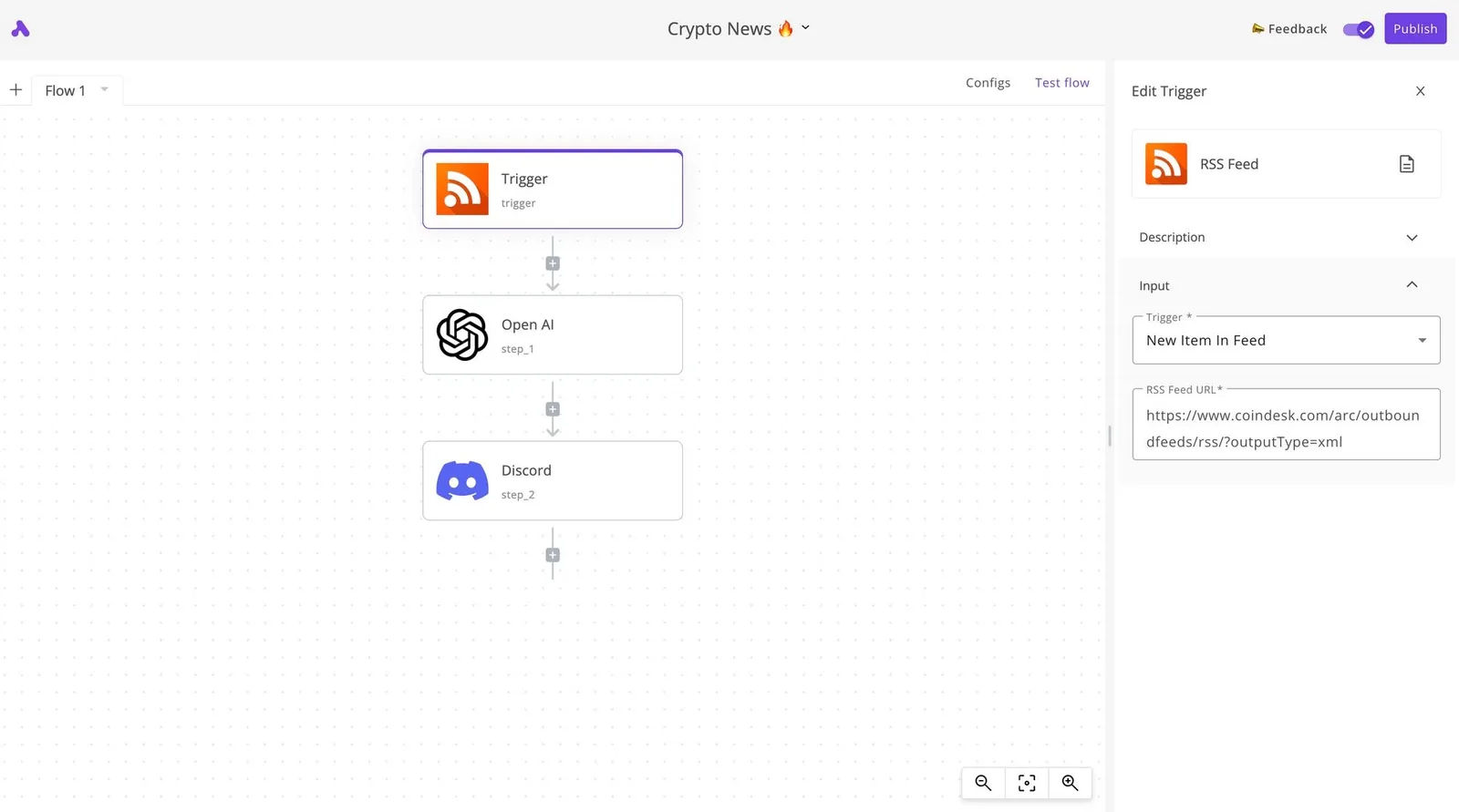
The Parent App (your primary software product) connects through this hub to the End-User Auth layer for managing OAuth credentials. Finally, it reaches Third-Party Connectors like Salesforce.
This flow ensures each customer's data remains isolated. Because this setup requires programmatic user provisioning and white-labeling, it's a backend service rather than a standalone productivity tool.
### Who uses embedded iPaaS solutions?
Bypassing the high cost of manual API development is why product managers and engineering leads use these platforms, though the entry price for managed infrastructure is significant.
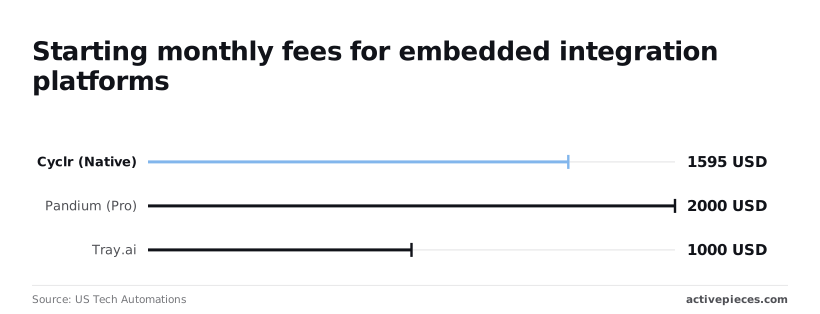
According to [US Tech Automations](https://ustechautomations.com/resources/blog/automate-make-vs-workato-for-smb-mid-market-2026), the starting monthly fee for [Tray.ai](https://tray.ai/) is 1,000 USD, which establishes a high baseline for small startups before they even ship their first connector.
Other vendors in the space demand even higher upfront investment. Cyclr (Native) starts at 1,595 USD per month, meaning a team must be confident in their integration adoption rates to justify the overhead.
Pandium (Pro) reaches 2,000 USD, which forces a clear trade-off between speed-to-market and long-term margin. For teams seeking an open-core alternative, Activepieces runs the same automation engine on your own infrastructure or ours to avoid these rigid enterprise floors.
## How tray embedded architecture functions production-side
Tray Embedded functions as a multi-tenant orchestration layer that abstracts API complexity into a visual logic builder for rapid deployment.
By decoupling the workflow logic from the underlying code, engineering teams can offload the maintenance of individual connectors to the platform while retaining control over the data mapping.
### The Integration Manager and low-code builder
Developers publish master workflow templates to specific customer groups through the Integration Manager, which serves as the centralized version control and distribution hub. This structural separation is critical because the average business now manages 144 SaaS applications according to [Vertice](https://www.vertice.one/insights/saas-apps-per-business).

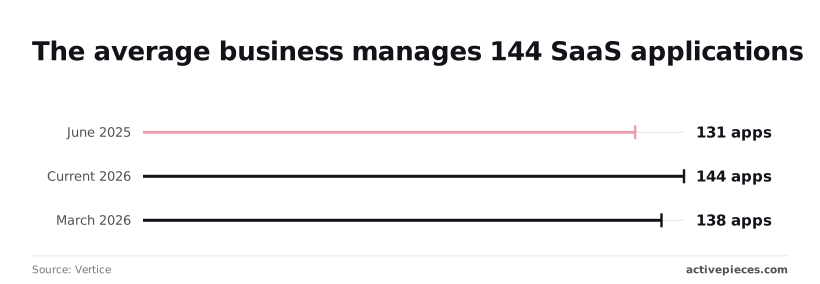
A manual approach to updating individual customer scripts isn't scalable. Since this count has climbed steadily from 131 in June 2025 and 138 in March 2026, the builder uses a "drag-and-drop" interface. It allows non-engineers to adjust field mappings without touching the core codebase.
The risk of this abstraction is that the vendor owns the rights to the logic you build on their infrastructure.
Activepieces provides a different legal foundation by publishing its core under an MIT licence, which you can verify by reading the LICENSE file in the activepieces/activepieces repository.
This ensures that the code powering your integrations remains yours to run, fork, or embed regardless of the vendor's future pricing changes.
### Presenting the interface to end users
The end-user interacts with these workflows through a Config Wizard, a pre-built UI component that you embed into your application via an iframe or a JavaScript SDK.
This wizard guides the user through the necessary authentication steps and configuration settings required to activate a Solution Instance.
By using this embedded component, your team avoids building custom frontend forms for every new integration. The wizard dynamically generates fields based on the workflow requirements, allowing users to map their own data or set specific toggle options.
### Handling end-user authentication with Auth Slots
Unique credentials for each customer's third-party services are stored in secure, encrypted containers called Auth Slots.
By using these slots, a developer writes the integration logic once using a placeholder. The system can dynamically inject the correct OAuth tokens or API keys at runtime.
This architecture ensures that sensitive customer data remains isolated within their specific environment, preventing cross-tenant data leaks during high-volume executions.
### Merlin AI for automated workflow generation
Merlin AI utilizes advanced reasoning models like Claude Sonnet 5.5 to translate natural language requirements into functional step-by-step automation logic. This reduces the initial build time for complex branching paths.
1. Input natural language prompt
2. Merlin generates workflow logic
3. Engineer reviews/edits visual steps
4. Deploy to Integration Manager
Describing the desired outcome allows a team to prototype a new connector in minutes. Once the engineer validates the logic, they push it to the production environment for immediate end-user activation.
## Connector depth varies across major CRM integrations
Tray's pre-built connectors provide immediate access to external APIs, but the functional depth of these integrations determines whether a developer can avoid writing custom code.
While the platform covers a broad catalog, the specific triggers and actions available for a service like Salesforce often exceed those found in smaller, niche platforms.
### Why trigger count matters for b2b roadmaps
Real-time responsiveness of a product's integration features is dictated by trigger availability. If a connector lacks a specific webhook trigger, such as a status change in Jira, the developer must build a manual polling mechanism.
It checks for updates on a schedule. This architectural pivot adds immediate technical debt. The team must now manage state and deduplication logic rather than relying on the platform's native event-driven architecture.
### Mapping the 'must-have' vs 'nice-to-have' connectors
Selecting a vendor based on logo count alone ignores the reality that core B2B workflows depend on a few high-utility platforms. Teams prioritizing speed often look for deep support in three areas:
* Integration Capabilities, ensuring the platform supports complex multi-step logic across diverse APIs.
* Pricing Transparency, allowing for predictable scaling as end-user volume increases.
* AI-Assisted Development, utilizing models like Gemini 3.8 Flash to generate boilerplate scripts or map fields automatically.

For teams requiring this level of agentic support, leveraging models like Claude Sonnet 5.5 within the development workflow can significantly reduce the time spent debugging field mappings in complex CRM schemas.
## Licensing and maintenance costs for tray
The total cost of ownership for Tray Embedded involves a high entry price that trades immediate speed for long-term operational complexity.
While the platform accelerates the initial shipment of a connector, it shifts the financial burden from pure development hours to recurring licensing and per-execution overhead.
### Starting monthly fees for embedded integration platforms
Licensing Tray Embedded requires a significant upfront investment that typically acts as the baseline for a multi-year partnership. This platform fee is the cost for access to the low-code builder.
It's the mechanism for white-labeling the experience for end-users. The cost remains the same regardless of whether you have one customer or one hundred using the features.
### Platform fees versus usage-based task credits
The core financial risk lies in the decoupling of the platform access fee from the variable cost of task credits. The platform fee covers the infrastructure and the right to embed the service.
Every workflow step execution consumes task credits. This means a high-frequency polling trigger on a service like Jira can deplete your budget before a single high-value conversion occurs.
Overage charges apply once the monthly credit ceiling is breached. A sudden spike in customer data volume directly impacts your product's gross margins.
### The 'integration debt' of maintaining custom connectors house-made
Building custom connectors within Tray to support niche APIs often creates a proprietary form of technical debt.
If a vendor changes their authentication method from API keys to OAuth2, your engineering team must manually update the connector logic within Tray's specific environment.
This maintenance requires developers to stay fluent in a third-party domain. The "low-code" promise is frequently offset by the need for specialized staff to manage versioning and error handling at scale.
## Common failure modes in embedded integration deployments
Embedded integration platforms fail when the abstraction layer between the vendor’s API and the end-user’s workflow becomes opaque. While low-code tools accelerate the initial build, they often hide the granular telemetry required to diagnose why a specific sync stopped moving data.
Embedded integration platforms fail when the abstraction layer between the vendor’s API and the end-user’s workflow becomes opaque.
### The visibility gap for end-user error logs
End-users can't fix what they can't see. This turns every minor data validation error into a high-priority support ticket for your engineering team.
When a workflow in Tray Embedded hits a snag, such as a required field missing in a HubSpot CRM record, the platform may log the event internally.
Unless you have built a custom dashboard to surface these logs, the customer simply sees a "pending" status. This lack of transparency forces your developers to manually query execution histories to explain simple user errors.
### Authentication refreshes and 'silent' workflow failures
Authentication failures represent a significant portion of integration downtime because OAuth token refreshes can fail without triggering an immediate system alert.
If a user revokes access to an application like Google Drive or if a refresh token expires due to inactivity, the workflow enters a silent failure state where triggers no longer fire.
| Failure Mode | Impact | Frequency/Context |
| :--- | :--- | :--- |
| Silent Auth Expiry | High | Common transient error during token refresh cycles |
| Version Conflict | Medium | Occurs during platform-wide connector updates |
| Data Mapping Mismatch | High | Triggered by upstream schema changes in the provider API |
### Version control during connector updates
Updating a connector to a newer version can break existing workflows if the underlying API has deprecated specific endpoints or changed its payload structure.
When a platform pushes a mandatory update to a service like Stripe, any workflow relying on a removed field will fail immediately upon deployment.
This necessitates a rigorous staging process where developers must test the new connector version against a sandbox environment before rolling it out to the entire customer base.
## Comparing Tray Embedded with build-it-yourself and Activepieces 2026 options
### How to lower your task costs
Activepieces syncs flows to git and promotes them through Release Management to ensure that updates to production are versioned and reviewed like software, not just saved in a private history.
According to WizardCost, the cost for 1,000 tasks on Zapier, a popular automation tool, is 12.90 USD, which establishes a baseline price for scaling automated workflows.
WizardCost's analysis puts the cost of running the same volume on Activepieces at just 0.80 USD. This means a platform can scale its integration offerings by a factor of 16 without increasing its infrastructure budget.
This price delta stems from the MIT-licensed core. It allows teams to bypass the "success tax" where higher customer engagement leads to exponential billing increases.
### Comparing developer control vs low-code speed
Activepieces provides 739 integrations with roughly 60% contributed by the community, offering a middle path where teams maintain the speed of pre-built connectors without losing the ability to self-host the environment for maximum data control, so developers can customize their infrastructure while benefiting from collective maintenance.
| Hosting | Connector Count | Control Level |
| :--- | :--- | :--- |
| **Tray Embedded** | Cloud-only | 700+ | Low (Proprietary) |
| **Activepieces** | Self-host / Cloud | 739 | High (Open Source) |
| **Build-it-Yourself** | Internal | 0 | Absolute |
This comparison shows that while Tray is the widest immediate reach, Activepieces provides 739 integrations with roughly 60% contributed by the community, meaning users must weigh breadth of service against the collaborative nature of the platform.
The ability to self-host ensures that sensitive customer data never leaves the internal VPC, a requirement for many enterprise security audits.
### When to choose open-source over proprietary ipaas
Activepieces allows companies like MoneyGram and Moneypenny to run complex automation in production while maintaining a white-labeled builder that functions as a native feature rather than a third-party redirect.
Because it uses JWT (JSON Web Token) for user provisioning, you can programmatically sign customers into the workflow designer without forcing them to manage separate credentials.
For teams that need this level of deep embedding, the sales-led annual tier is the source for necessary enterprise support.
Activepieces offers a free forever plan on its managed cloud that includes 1,000 credits a month and unlimited flows, while teams requiring enterprise-grade support and directories can move to the commercial tiers.
## The Monday morning integration roadmap audit checklist
A rigorous pre-contract audit prevents the "integration debt" that accumulates when a platform’s connector library fails to match the specific API behavior of your customers' tech stacks.
### Step 1: define the end-user configuration experience
Whether you require a white-labeled visual builder or a simplified form-based setup is determined by the complexity of your customers' technical staff.
If your end-users are non-technical, a "black box" deployment where they only provide API keys is their only way to prevent high churn caused by configuration fatigue.
Conversely, if you serve DevOps teams, they will require visibility into the underlying logic. This makes a JWT-secured embedded designer necessary so they can modify steps without leaving your application.
### Step 2: calculate the projected task volume for 12 months
Projected task volume dictates your long-term margins because most proprietary vendors move users into higher-cost tiers as soon as synchronization frequency increases.
High-frequency polling, such as checking Jira for ticket updates every minute, can consume a monthly task quota in days. This leads to unexpected overage fees that erase the ROI of the integration.
### Step 3: audit the 'silent failure' mitigation plan
When a webhook is missed or an API returns a success code despite a partial data mismatch, silent failures occur, resulting in corrupted records.
You must establish a "Dead Letter" policy that defines where failed payloads are stored and how the end-user is notified.
The following checklist summarizes the technical requirements for a resilient deployment:
1. Audit existing API rate limits to ensure high-volume syncs won't trigger provider blocks.
2. Zapier reports that mapping required triggers reveals a CRM like HubSpot provides 9 standard triggers while Microsoft Dynamics offers 16, creating functional gaps in cross-platform parity.
3. Define the 'Dead Letter' storage policy to prevent permanent data loss during downstream outages.
4. Verify end-user visibility into execution logs to reduce support ticket volume.
## Frequently asked questions about Tray Embedded
### Does Tray Embedded support white-labeling for the entire UI?
End-users can authenticate their own accounts, such as a Snowflake data warehouse or a Slack messaging workspace, without seeing Tray branding via a Configuration Wizard.
While the CSS can be modified to match your product’s color palette, the underlying workflow builder is a Tray-hosted experience.
This means your customers interact with a third-party interface for complex logic changes, rather than a native component of your own application.
### Can i host Tray Embedded on my own VPC?
Tray Embedded is a multi-tenant SaaS platform, which means you can't install the execution engine on your own Virtual Private Cloud (VPC) or private data center.
All workflow logic and data processing occur on Tray’s managed infrastructure.
For teams with strict security mandates requiring that data never leaves their own network perimeter, this architecture necessitates a comprehensive third-party risk assessment of Tray’s production environment.
### How does Tray Embedded handle GDPR and data residency?
Data residency is managed through regional silos, where you must choose a specific geographic region, such as the US or EU, at the time of account provisioning. Because data stays within the selected region's infrastructure, you can meet specific jurisdictional requirements for data sovereignty.
However, once a region is selected, moving existing workflows and customer credentials to a different territory requires a manual migration process. Tray doesn't offer automated cross-region replication.
## Related reading
- [Embedded iPaaS: The Complete Guide for 2026](https://www.activepieces.com/blog/embedded-ipaas-the-complete-guide-for-2026)
- [7 MCP Use Cases in Product Management](https://www.activepieces.com/blog/7-mcp-use-cases-in-product-management)
- [Tray.io Pricing 2026: What Mid-Sized Companies Pay](https://www.activepieces.com/blog/trayio-pricing-2026-what-mid-sized-companies-pay)
## References
- [US Tech Automations](https://ustechautomations.com/resources/blog/automate-make-vs-workato-for-smb-mid-market-2026)
- [Vertice](https://www.vertice.one/insights/saas-apps-per-business)
- [WizardCost](https://wizardcost.com/automation/make-vs-activepieces)