### The trap of building in personal developer sandboxes Building in personal sandboxes creates a disconnect between the code and the infrastructure. When an engineer uses a trial account on a payment processor like Stripe, the configuration settings exist outside the company's managed environment. The three pillars of shadow integration risk: * Private developer accounts holding production tokens. * Hardcoded personal API keys in undocumented scripts. * Webhook endpoints pointing to local tunneling URLs. ### Why integrations need ongoing maintenance Every integration requires active maintenance because SaaS vendors regularly deprecate API endpoints. A script that works today will fail when the vendor moves from v1 to v2. Logs documenting these failures are trapped in the builder's private terminal if the integration is not hosted on a centralized server. ### The difference between code ownership and execution rights A company may legally own the intellectual property of a Python script in GitHub. However, if that script requires a developer's personal API key to run, the company does not have execution rights. True ownership requires that a central platform manages the execution environment.  ## Standard industry frameworks for integration handover Handover requires a defined protocol for credential rotation, code access, and error monitoring. ### Method 1: The Shared Service Account approach Administrators create a generic identity, such as an "Integration User" in Salesforce. This prevents a workflow from breaking when an individual is deactivated, but often leads to credential sprawl where multiple team members know the same password. ### Storing integration code in a Git repository Moving integration code into GitHub or GitLab establishes a central source of truth. This ensures the business retains the blueprints for its automation, allowing a new hire to resume maintenance immediately. ### Managing integrations with iPaaS platform governance Managed iPaaS providers offer a graphical interface to manage permissions across the company. These platforms typically use Role-Based Access Control (RBAC) to separate the people who build logic from those who view live customer data. | Method | Credential security | Visibility | Offboarding effort | | :--- | :--- | :--- | :--- | | Shared Service Accounts | Low; passwords are often shared among teams | Poor; logs show the service account, not the human | High; requires manual password rotation across all apps | | Version Control (GitHub/GitLab) | High; secrets are stored in environment variables | Excellent; full commit history shows every change | Low; revoke repository access via SSO | | Managed iPaaS Platforms | Medium; encrypted but stored within the vendor cloud | Good; centralized dashboard for all active flows | Low; deactivate the user in the platform UI | ## Securing long-term stability with Activepieces project governance Activepieces prevents workflow abandonment by anchoring execution rights to the project level rather than individual user accounts, a structure that ensures automated processes remain functional when a contributor leaves. Activepieces publishes its core under an MIT licence, meaning the rights to run, fork, or embed the logic stay with the business rather than the vendor. Open the LICENSE file in the activepieces/activepieces repository to see the MIT designation on the core, which contrasts with source-available licences that restrict how a company can use its own infrastructure. ### Moving from private workflows to team-owned projects In many SaaS automation tools, a workflow created by a contractor exists in a private folder. Within the Activepieces dashboard, administrators assign users to specific Projects so that logic and history are owned by the Project container.  Companies like MoneyGram and FundingSocieties run Activepieces in production to maintain this continuity. ### Audit logs: Seeing what the contractor actually built The platform provides a centralized view of every step execution. Because every API call is recorded in the run history, an admin can verify how data is handled without the original author. 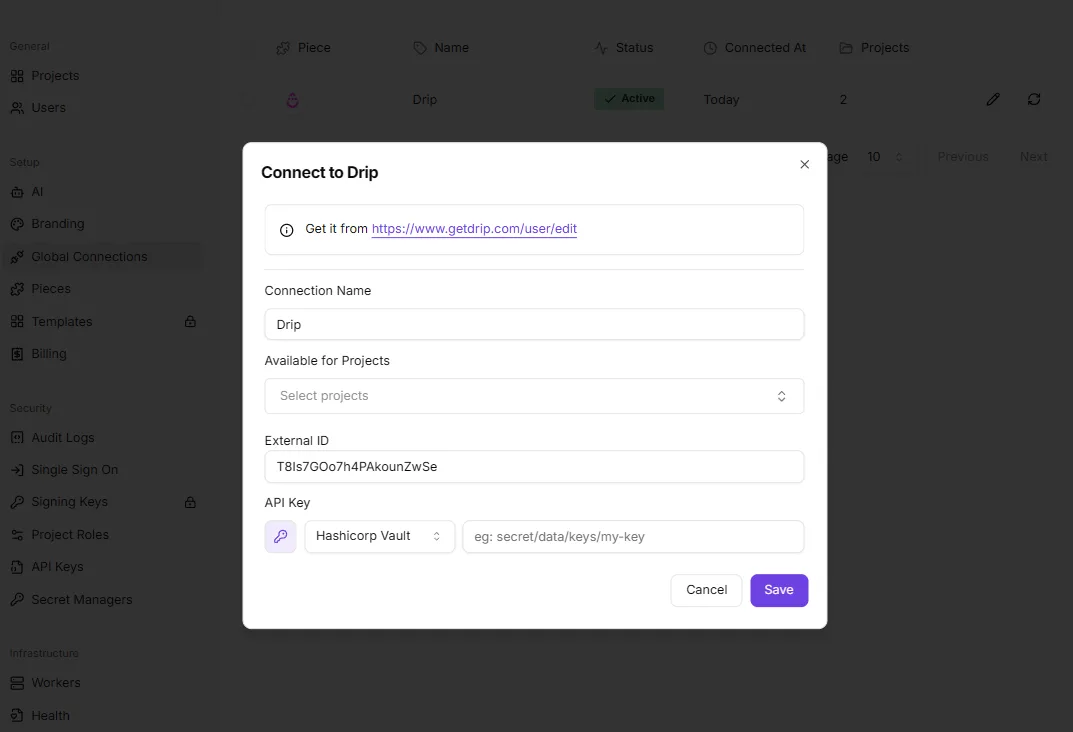 Activepieces syncs flows to git and promotes them through Release Management, allowing versioned changes to move from test to production environments as a deliberate administrative step. Check the Activepieces documentation for Git Sync and Release Management to see how workflows are treated as software assets rather than private UI entries. ### Credential rotation without touching the workflow logic Decoupling authentication from workflow steps allows administrators to update API keys in a single location. The connection management interface allows an admin to map a Connection Name to a specific External ID and pull secrets directly from an external provider like Hashicorp Vault. When a security policy requires a key rotation, the admin updates the Vault reference. Every workflow using that connection instantly inherits the new credential. ## The Monday morning integration audit checklist Securing technical execution rights begins by identifying every instance where a workflow is tied to an individual identity. ### Identify every workflow running on a personal email address Audit logs must be filtered by the "Owner" field to flag any workflow associated with an individual user email. 1. Inventory all active contractor API tokens. 2. Map endpoints to business-critical workflows. 3. Migrate credentials to a centralized platform. 4. Revoke the original individual tokens. ### Migrate credentials to a managed vault Move all discovered secrets into a dedicated tool like HashiCorp Vault using OIDC. Storing a Stripe API key directly inside a workflow's configuration means any user with "View" access can exfiltrate that key. Moving it to a vault ensures the key is injected only at runtime. ## Frequently asked questions about integration ownership ### Does the contractor legally own the workflow logic? Standard Master Service Agreements (MSAs) usually assign Intellectual Property (IP) rights to the client upon payment. This legal ownership is functionally void if the code resides in a proprietary builder the client cannot access. A contract might state the business owns the Work Product, but if that product is a sequence of steps inside a closed-loop automation platform, the business cannot execute those steps without the contractor’s active seat license. Legal ownership fails to provide operational continuity in three specific scenarios: * The contractor uses a private sandbox for development, which means the client has no visibility into the version history or logic changes during the build phase. * The integration relies on custom scripts hosted in the contractor's personal cloud functions, which prevents the client from debugging errors when the contractor is off-clock. * The workflow uses third-party connector accounts owned by the agency, which forces the client to re-authenticate every node if the relationship terminates. To secure actual ownership, the IT admin must enforce these requirements: 1. Require all logic to be built within a company-owned environment using Single Sign-On (SSO) via OIDC or SAML 2.0 to ensure access can be revoked by the internal team. 2. Mandate that all custom code snippets be committed to a company-controlled Git repository so that the internal engineering team can audit the logic for security vulnerabilities. 3. Specify that all API keys and secrets must be stored in the company's managed secret manager, which keeps the contractor from ever seeing the raw production credentials. ## Related reading - [10 Top API Integration Platforms for 2026](https://www.activepieces.com/blog/10-top-api-integration-platforms-for-2025) - [Top 5 Integration Platforms For 2026 And Beyond](https://www.activepieces.com/blog/top-5-integration-platforms-for-2025) - [Zapier ChatGPT Integration Tutorial for Beginners](https://www.activepieces.com/blog/how-to-use-zapier-with-chatgpt-examples-included) ## References - [Paradigm Solutions](https://www.paradigm-solutions.io/article/predictive-maintenance) - [open-integrations.dev](https://open-integrations.dev/explore)Integration ownership defaults to the builder because most SaaS platforms tie API authentication to individual user profiles.