# Workday Pricing: Costs, Tiers and Discounts (2026)
By Marielos Chévez · 2026-10-26 · Source: https://www.activepieces.com/blog/workday-pricing-costs-tiers-and-discounts-2026
---
[Workday](https://workday.com/en-us/products/adaptive-planning/pricing.html) pricing is quote-based.
Workday's pricing page, read on 26 October 2026, prints a price for one offer, a free 30-day Adaptive Planning trial, and nothing for HCM or Financial Management, so buyers comparing it with tools like [Activepieces](https://www.activepieces.com) will find the figures only after a sales conversation.

You can't put a Workday line on a budget, or on a client invoice, until a sales conversation has produced a number.
## Workday pricing plans and what the vendor publishes
### Workday pricing plan table and published prices
One trial and two blanks: that is how little is printed across the three products Workday lists. Read each "quote required" as a cost you can't estimate in advance.
| Product | Plan Name | Published Price | Inclusions |
|---|---|---|---|
| Workday HCM | Quote required | Quote required | Quote required |
| Financial Management | Quote required | Quote required | Quote required |
| Adaptive Planning | Free Trial | Free for 30 days | 30-day access to Workday Adaptive Planning |
_Prices and plan limits checked against [workday.com](https://workday.com/en-us/products/adaptive-planning/pricing.html) on October 26, 2026._
After day 30 you're back to a price you can't see. Thirty days of access is a short window to test the product, and the only row with a figure tells you about fit, not budget.
If you plan to use the trial, line up your test data and the people who'll judge it before you start. Otherwise the clock runs out before you've learned anything about cost.
### What quote-based Workday pricing means for buyers
In that sample Workday is an outlier, not the norm, so a rival that publishes its prices is usually easy to find and makes a fair benchmark.
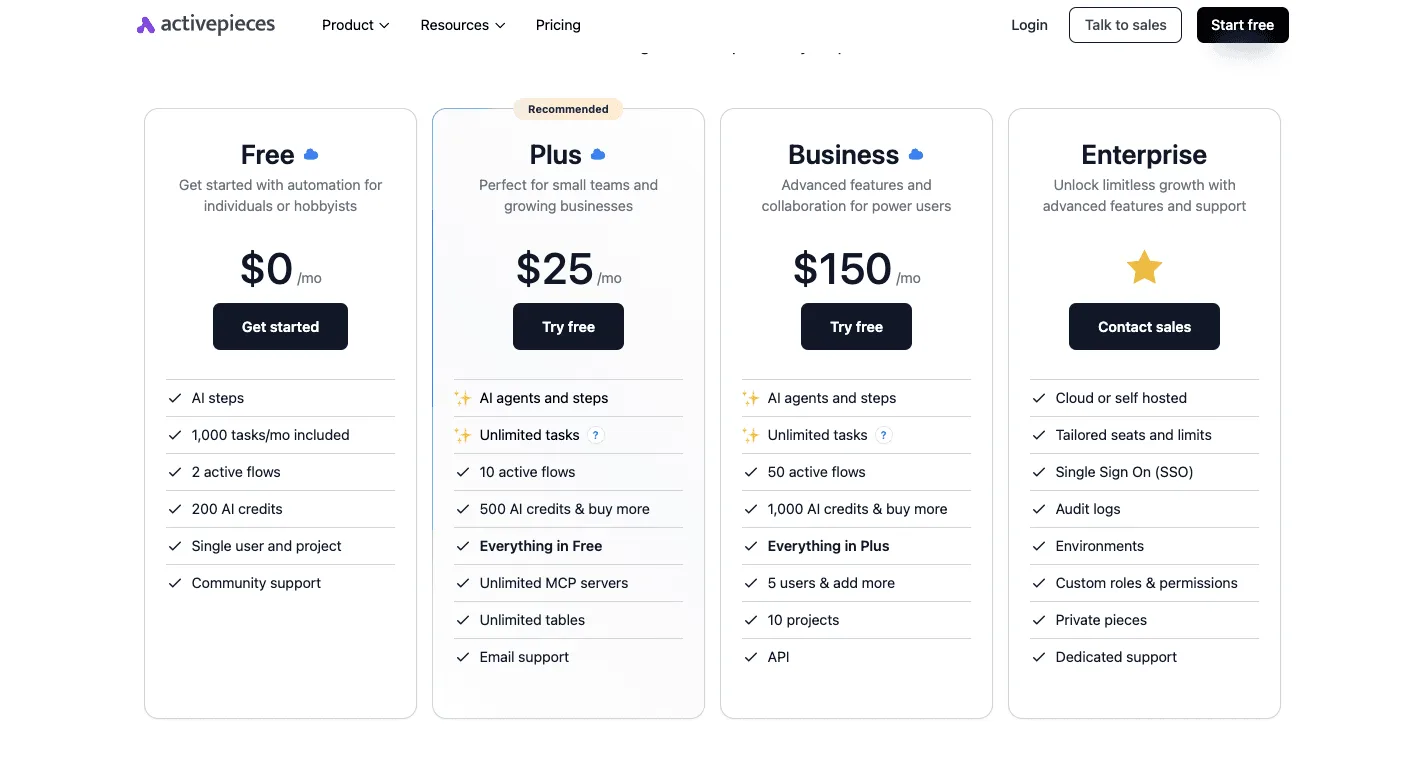
[Activepieces](https://www.activepieces.com) lists its rates openly: the Free plan is $0 with 1,000 credits a month, and Team is $200 a month flat with 50,000 credits.
Once there is a quote, the work moves onto you. With a published plan, you read the price and multiply by seats.
With a quote, the vendor chooses which variables set the number, and you find out which ones only by asking. Price the run from the bottom up, the way you would a retainer:
1. Decide what the finished invoice has to cover.
2. Ask which variables build the quote, and which costs sit outside it.
3. Put the answer next to a vendor that publishes a price.
Skip any of these and a shared cost can end up in the wrong place, with one team's usage quietly paid for by another's budget. The sections that follow take those variables one at a time.
## Workday per-employee pricing and additional costs
Get four separate lines. The subscription is a unit count multiplied by a per-unit rate, and the real bill adds implementation, add-on modules and renewal terms that never appear on that line.
### Workday per-employee cost at three company sizes
For those above 3,501 the figure is $117.02.

I couldn't verify them against a Workday quote, so treat them as a reference point.
Nobody charges the small company a premium for being small, exactly. It has no volume to spread the fixed cost of the relationship across, so it should ask which of its costs are fixed.

Multiply the rate by your FSE count, not your headcount. Ask how part-timers and contractors convert, because that conversion can move the total more than the rate does.
I have no confirmed figure for implementation, which is billed separately from the subscription, usually through a services partner. Price it as its own project with a scoped statement of work.
Ask what the quote assumes about the number of integrations, data-migration volume and who owns testing. If any of these is vague, the client absorbs the overrun.
### Workday add-on modules and renewal price increases
Because Core HR doesn't include every module, the base quote may cover less than the buyer thinks. List every module you expect to use in year one and get each priced, even if you switch it on later.
A module bought after signing is bought without the leverage you had during negotiation.
At renewal, the other quiet cost arrives. Ask for the cap on annual increases in writing, and ask whether FSE counts are trued up mid-term or only at renewal. I have no confirmed uplift figure, so the contract language is your only protection.
After go-live, the costs that surprise teams are the ones nobody owns:
- extra environments for testing
- ongoing partner support for configuration changes
- the internal admin time to run releases
Ask which environments the quote includes. A team that shares one environment across projects is cross-subsidizing its riskiest changes with its production data.
## Workday against SAP SuccessFactors, Oracle HCM and BambooHR
Compare them and Workday gives you no more than the others. Oracle's gap between list and negotiated price shows why: a published rate is an opening position, much like a shared environment is a default nobody has priced.
The table shows what each vendor puts in front of a buyer before a sales call. Take from it that only Oracle's figures can be read as numbers, and even those are mostly list prices beside a negotiated range.
| Vendor | Annual price per employee | Pricing unit | Minimum company size |
|---|---|---|---|
| Workday | Quote only | Set in the quote | Not stated publicly |
| SAP SuccessFactors | Quote only | Set in the quote | Not stated publicly |
| Oracle HCM | $168 to $360 list; $72 to $180 negotiated | Per employee, per year | Not stated publicly |
| BambooHR | Quoted on request | Set in the quote | Not stated publicly |
A blank minimum-size column means you can't screen yourself out of a vendor. You learn your fit only after a sales conversation has started. Figures were checked in October 2026.
### Where published prices change the decision
To see how far sticker and invoice drift apart, look at Oracle's numbers, from [isvcosell's benchmark](https://isvcosell.com/benchmarks/vendors/oracle-hcm-cloud-pricing). At the low end, list is $168 per employee per year and negotiated enterprise rates come in at $72.

That's less than half at the low end and half at the high end, so a buyer who budgets from list overstates the bill by about double or more.
At the high end, list is $360 against $180 negotiated: again half, but on a base that's $108 higher per head. On 1,000 employees, the spread between the two high-end figures is $180,000 a year.
Read that as a warning about Workday's quote, not a discount to expect. The discount depends on headcount, modules and how well you negotiate.
A buyer who pays the list rate is quietly subsidizing the customers who pushed back, the same way a shared account carries a client who should be paying more.
This sorts buyers fairly cleanly:
- Large enterprises with procurement staff can use Workday, SAP or Oracle, because they'll negotiate anyway. Oracle's published range gives them an anchor for the other two.
- Mid-sized firms that need a budget before a sales cycle should start with the vendor that shows numbers, then ask Workday to beat them.
- Small firms have the weakest case for any quote-only vendor. Without a stated minimum size, they're too small to spend sales time to learn they are.
Before any call, write down the per-employee figure you'd accept on an invoice. Hold every quote, Workday's included, against that number.
## Connecting Workday to other systems with Activepieces
It won't lower what Workday quotes you, but [Activepieces](https://www.activepieces.com/pricing) can shrink the integration line that tends to sit outside that quote.
It's a workflow automation tool with 744 integrations in an MIT-licensed core, and its pricing page lists what it costs before you add it to the comparison.
### Where integration cost appears in a Workday budget
Stop at the subscription and you've seen only the first invoice. Every hire that has to reach your payroll provider, your ticketing system or your chat tool is work someone gets paid to build and maintain.
That means a consulting statement of work, an internal admin's hours, or a middleware license, and none of them appear in the Workday quote.
If you price a retainer the way I do, you'd never hand a client a flat fee and then bill the glue work to a shared account.
Do the same here: put the glue on its own line, so one department's custom sync doesn't quietly ride on everyone else's budget.
### How per-run billing reduces workflow costs
Activepieces bills one credit per flow run, however many steps the flow has, so a ten-step sync costs the same as the two-step shortcut it replaced.
Zapier's per-task billing and Make's per-module billing, both on their own pricing pages, charge more as a flow is split into smaller parts, which taxes the builder for doing the job properly.
Here the run is the meter, not the steps inside it, and the glue line on your Workday budget doesn't grow when you make a flow more reliable. MoneyGram and Moneypenny run Activepieces in production, and the $20-a-month Plus plan includes 10,000 credits.
The run log on the left marks the step completed and the run as succeeded. The takeaway is how small the unit of work is: one event in one system, one message in another, with the mapping visible and testable.
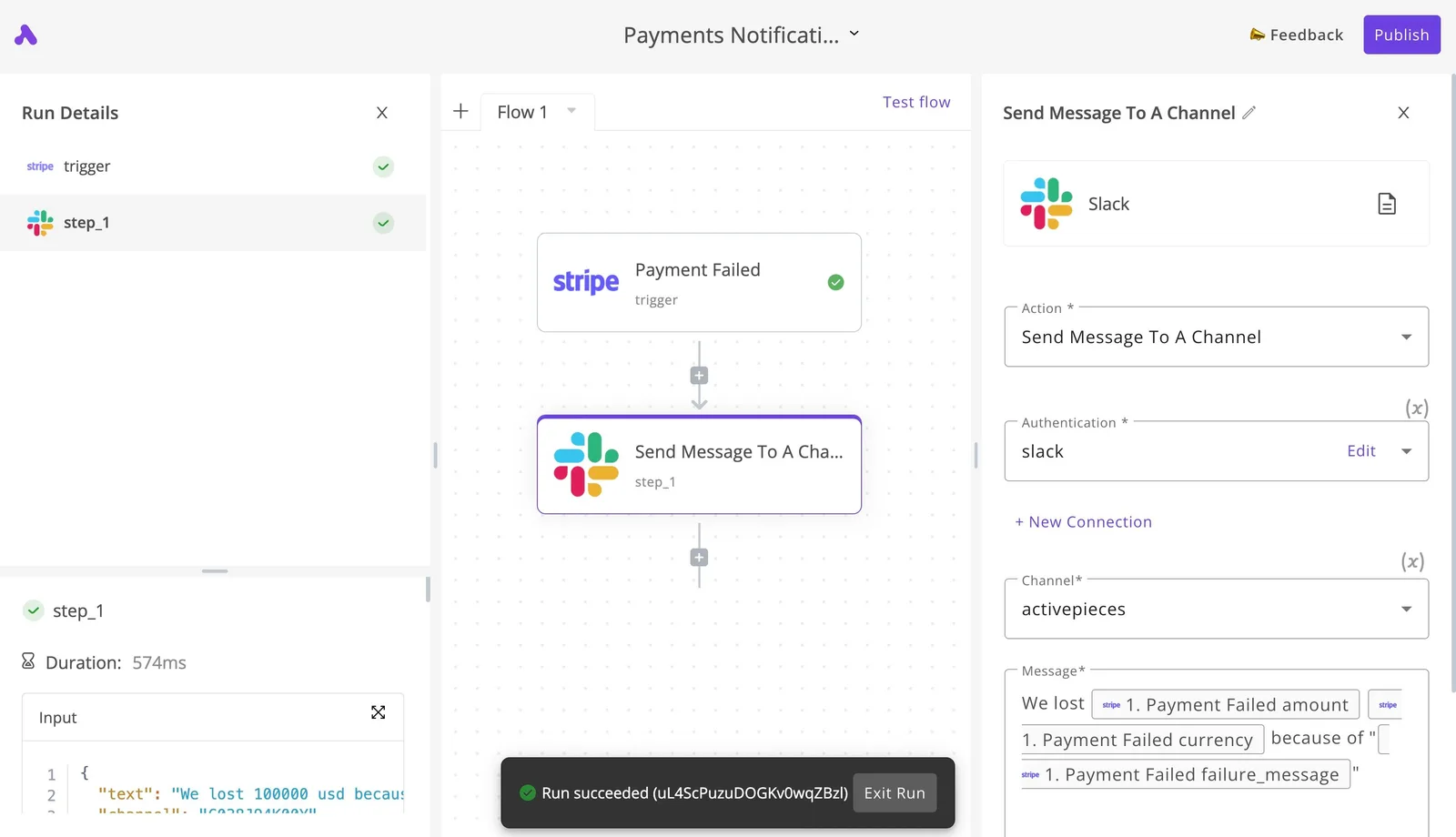
Try the same shape on Workday-adjacent jobs. A new-hire event can create an account in another tool. An approval can post to the channel where approvers actually look.
Open any flow and you'll find a trigger, an action and a field mapping, which a non-developer can usually read and check.
The run history also gives you evidence of what fired and when, so you can see where the effort goes before you pay for more.
That's the scope: notifications, record handoffs and approvals between tools.
A run is 1 credit however many steps it has, and the Free plan gives you 1,000 credits a month with unlimited flows, so you can count your monthly runs against that allowance before paying anything.
### When not to use it
Skip it when the job is core to Workday itself: payroll logic, financial postings, or anything an auditor expects to trace inside the system of record.
Workday's own integration tooling, or a certified partner who already knows your tenant, is the better choice there, because accountability sits with one party.
Also skip it if nobody on your side will own the flows after launch. An unowned automation is a cost that moves from the invoice to an outage.
## Steps to take before signing a Workday quote
Sign nothing until every cost has a line on paper and a named owner: a headcount forecast, a module list, itemised quotes from Workday and two alternatives that publish prices, and implementation estimates in writing.
An unowned automation is a cost that moves from the invoice to an outage.
Anything left unpriced reaches you later as a change order or a surprise renewal.
### Questions to ask Workday sales about pricing
Ask how Workday counts headcount: employees only, or contractors and former staff too. Your forecast has to use the same definition as the quote, or the comparison sheet is meaningless.
Ask what a sandbox costs and how often it refreshes. If it's extra, you're paying for the place where changes get tested before they reach payroll.
Then send the same headcount and module list to the two alternatives, so each quote lands in one sheet with identical columns. A quote that can't fill a column is a cost still hiding.
### Contract terms to negotiate
Treat Workday's first offer as an opening position. [VendorBenchmark](https://vendorbenchmark.com/blog/workday-hcm-pricing-benchmark-enterprise) reports negotiated discounts off that offer of 37% on Financials, 31% on HCM, 25% on Payroll and 18% on Adaptive Planning.

If you accept the first offer on Financials, you're probably paying well over a third more than a buyer who pushed.
Spend your leverage on HCM and Financials, because Adaptive Planning has the least room. Trade for renewal caps rather than chasing a few more points there.
Ask for the renewal cap in the contract, as a percentage ceiling on annual increases. A deep first-year discount with an open renewal simply moves the cost to year two.
Get the implementation estimate in writing, tied to the tier you're actually buying:
1. Launch Express: 10 to 20 weeks.
2. Mid-Market: 6 to 12 months.
Since services fees scale with duration, the spread matters, and so does the gap between signing and go-live. Ask when subscription billing starts. If it starts at signing, an enterprise rollout can mean a year or more of paying for seats nobody is using.
Put the chosen tier, the billing start date and the estimate into the comparison sheet beside each alternative's figures. Whichever quote still wins at that point is the one worth taking to signature.
## Frequently asked questions
**Does Workday have a free trial or free tier?** Workday offers a free 30-day trial of Adaptive Planning, but publishes no free tier or trial for HCM or Financial Management.
Evaluation happens through sales: demos and scoped conversations. Ask whether a hands-on sandbox is available before signing, and get the answer in writing so it isn't a verbal promise.
**Is Workday too expensive for a 100-person company?** Workday publishes no price, so no public figure says so either way.
The fit question is whether the quote plus implementation and partner costs beats alternatives that do publish prices. At that size, a fixed-fee, self-serve HR or payroll product often costs less to run, so compare totals, not the subscription line.
**How long does a Workday implementation take?** Workday publishes no standard timeline, though enterprise implementations are commonly reported to take 12 to 24 months, with implementation costs billed separately.
Duration depends on the modules you buy, how many countries and legal entities you run, how much data you migrate, and how many integrations you need. Ask for a timeline tied to your scope, and find out who bills for delays on either side.
**Does Workday charge per employee or per user?** Workday quotes by FSE, but doesn't publish its rates. Ask the quote to state the unit, what counts toward it, and how contractors, part-timers, and leavers are handled.
### Can I negotiate a Workday renewal price?
Yes. Since every contract is a quote, the renewal is one too, and nothing on a public price list caps it.
Your leverage comes from a credible alternative with a published price, and from knowing which modules and headcount you use.
Start well ahead of the renewal date, and ask for any increase cap to be written into the contract rather than left to the renewal conversation.
## Related reading
- [Simplify Your Workday: 9 Best Workflow Automation Apps](https://www.activepieces.com/blog/workflow-automation-apps)
- [Active Directory integration options for hybrid teams](https://www.activepieces.com/blog/active-directory-integration-options-for-hybrid-teams)
- [SAP S/4HANA Purchase Order Workflow for MS Teams](https://www.activepieces.com/blog/sap-s-4hana-purchase-order-workflow-for-ms-teams)
## References
- [VendorBenchmark](https://vendorbenchmark.com/blog/workday-hcm-pricing-benchmark-enterprise)
- [Topickz](https://topickz.com/research/saas-pricing-cliff-2026/)
- [isvcosell](https://isvcosell.com/benchmarks/vendors/oracle-hcm-cloud-pricing)