# Workflow Automation Custom Roles: Plans Compared
By Renuka Bhattacharya · 2026-11-22 · Source: https://www.activepieces.com/blog/workflow-automation-custom-roles-plans-compared
---
A custom role is a permission set you define yourself, picking which actions a person may take, instead of choosing from the admin, editor and viewer roles the vendor ships, much as teams using automation tools like [Activepieces](https://www.activepieces.com) often do when they need someone to run flows without being able to change them.

On most platforms the answer to "is it included?" is no: **custom roles usually sit on a higher tier** or behind a sales conversation, and only the vendor's own page can settle it.
Fixed roles are a menu. Custom roles are a build-your-own, and that difference is why vendors price them separately. Buyers ask for them for four reasons:
## Custom Roles in Workflow Automation: The Short Answer
- Least privilege: a person gets only the permissions their job needs, not a whole admin role because one setting came bundled with it.
- Separation of duties: the people who build a workflow can't also approve it into production.
- Audit evidence: you can show an auditor which role could do what, rather than asserting it.
- Change control: you decide who may edit a live workflow, so a one-line change can't break a running process unreviewed.

If you can't edit the roles, "has roles" is not an answer, because each reason above names a control you must be able to point to.
### What the premium looks like elsewhere in SaaS
To see the premium, look at pricing elsewhere in SaaS. $2,250 a month is what a 50-person team pays for the tier that carries them, per [Slack](https://slack.com/help/articles/29800891169939-Create-custom-roles), the team messaging tool, which lists custom roles at [$45 per user per month](https://docs.github.com/en/enterprise-cloud@latest/organizations/managing-user-access-to-your-organizations-repositories/managing-repository-roles/about-custom-repository-roles).

According to Slack, Jira Service Management, Atlassian's help-desk product, lists at [$14.54 per user per month](https://docs.github.com/en/enterprise-cloud@latest/organizations/managing-user-access-to-your-organizations-repositories/managing-repository-roles/about-custom-repository-roles), roughly a third of that. The same 50 people cost about $727. The spread means you can't assume the cost of this feature from the tool category.
### Which Platforms to Shortlist for Custom Roles
Choose by the plan that unlocks custom roles, not by the platform's reputation. If you need builder and approver separation, shortlist only platforms whose page names custom roles on a plan you can afford.
If your data can't leave your network, add a second test: does the feature still work when self-hosted?
Most vendors monetise control with a stripped self-hosted build, and [Activepieces](https://www.activepieces.com) doesn't: SSO, SCIM, custom RBAC, audit logs, release management and secret managers run air-gapped just as they do on its managed cloud, and MoneyGram and Moneypenny run Activepieces in production.
I read every plan and price in this article from the vendor's own pages on 22 November 2026. Where a page doesn't state which plan includes custom roles, or doesn't say how it behaves when self-hosted, I mark it unconfirmed rather than infer it.
The next section shows how to get that confirmation in writing.
## Comparison Table of Custom Role Support by Platform
Until you hold written confirmation, only what the vendors' own pages state can go in a comparison, and the table below records exactly that, checked on 2026-11-22.
| Platform | Custom roles | Plan | List price | Strength | Limit | Self-hosted | Best for |
|---|---|---|---|---|---|---|---|
| Zapier | not confirmed 2026-11-22 | Professional listed; role unlock not confirmed 2026-11-22 | 19 to 29.99 USD per month | not confirmed 2026-11-22 | not confirmed 2026-11-22 | not confirmed 2026-11-22 | not confirmed 2026-11-22 |
| Make | not confirmed 2026-11-22 | Core listed; role unlock not confirmed 2026-11-22 | 9 to 10.59 USD per month | not confirmed 2026-11-22 | not confirmed 2026-11-22 | not confirmed 2026-11-22 | not confirmed 2026-11-22 |
| n8n | not confirmed 2026-11-22 | not confirmed 2026-11-22 | not confirmed 2026-11-22 | not confirmed 2026-11-22 | not confirmed 2026-11-22 | not confirmed 2026-11-22 | not confirmed 2026-11-22 |
| Workato | not confirmed 2026-11-22 | not confirmed 2026-11-22 | not confirmed 2026-11-22 | not confirmed 2026-11-22 | not confirmed 2026-11-22 | not confirmed 2026-11-22 | not confirmed 2026-11-22 |
| Power Automate | not confirmed 2026-11-22 | not confirmed 2026-11-22 | not confirmed 2026-11-22 | not confirmed 2026-11-22 | not confirmed 2026-11-22 | not confirmed 2026-11-22 | not confirmed 2026-11-22 |
| Activepieces | Yes, custom roles (custom RBAC) on Ultimate | Ultimate | Custom price through sales | 750 integrations, MIT-licensed core, unlimited flows on every plan | Custom roles need the sales-quoted Ultimate plan; enterprise directories are under a separate commercial licence | Yes, on Activepieces Cloud or on-prem; free Community Edition under the MIT licence | — |
Read the "Custom roles" column first, then the "Plan" column beside it. A listed price only matters if the plan it belongs to is the one that unlocks roles.
In the two rows where we hold a price, we haven't confirmed that link, so the table can't tell you which prices meet that requirement.
### The two prices we hold
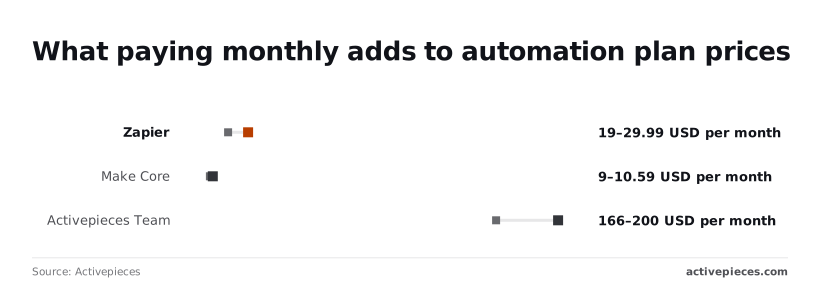
Pay monthly and Zapier's Professional plan costs 10.99 USD more, roughly 58%.
Per [Activepieces](https://www.activepieces.com/docs/admin-guide/guides/permissions), it runs [19 to 29.99 USD per month](https://www.activepieces.com/blog/activepieces-rbac-pricing-plans-and-roles-2026), the low figure being the annual-billing rate and the high one the monthly rate. Budget at the monthly figure unless you can commit for a year.
On the same comparison, Make's Core plan runs [9 to 10.59 USD per month](https://www.activepieces.com/blog/activepieces-rbac-pricing-plans-and-roles-2026), according to Activepieces. The monthly premium is only 1.59 USD, about 18%, so the billing choice matters far less here than at Zapier.
Neither figure shows that the plan includes roles. Both are the cost of a plan whose role entitlement you still need to verify.
### What 'not confirmed' means here
"Not confirmed 2026-11-22" means we found no statement on the vendor's own pages that we can quote, so we make no claim either way. It doesn't mean the feature is absent, and it doesn't mean it is present.
For each empty cell, you have a question to put to the vendor. The most consequential is the self-hosted column, because a feature listed for a vendor's cloud plan may not carry over to a deployment you run yourself.
Treat any cell that stays unconfirmed after you ask as a no, and price your decision accordingly.
## Platform-by-platform Notes on Roles and Limits
Where I give no role name, plan or price, treat it as unconfirmed and therefore a no; each entry below records only what a vendor's own documentation can settle.
I haven't printed page URLs or check dates here, because an entry without a page you opened yourself is a claim you can't audit.
Write the address and the date you read it beside each entry before you rely on it.
### Zapier roles and plan limits
Open the help-center article on team and member permissions and the pricing page. Quote the role names verbatim, then note which plan the permissions article attaches them to.
If the page names only fixed roles, custom roles don't exist on that plan, so the main limit to test is whether you can define your own role or only assign fixed ones. Choose Zapier if fixed roles already match your approval chain.
### Make roles and plan limits
Read the roles page and the pricing page together, and ask whether you can edit any role or only assign it; Make's documentation describes access at organization and team level.
Fixed roles that cover your separation of duties are enough. If they don't, you're asking for something the page doesn't state, and the answer is a sales conversation.
### n8n roles and plan limits
Of all the entries, n8n is the one where self-hosting changes the answer. Read the documentation on user roles and ask a pointed question: are the role features in the free self-hosted build, or do they need a licensed edition with a key?
Ask for the license text and read the clause that gates the feature. Choose n8n only after that clause confirms your deployment, not the vendor's cloud, receives the roles.
### Workato roles and plan limits
According to its documentation, Workato offers role-based access with configurable collaborator roles. The main limit is commercial: Workato quotes its pricing rather than listing it, so the plan that unlocks custom roles is whatever your order form says.

Ask for the role entitlement as a named line in the contract. Choose Workato if you need granular roles and accept a quoted price. If the paper lacks the line, you've bought nothing.
### Power Automate roles and limits
Under Microsoft's environment model, security roles on the environment govern access to Power Automate, rather than the automation product alone. Read Microsoft's security-role documentation and the licensing guide, and confirm which license the environment requires.
Test for dependency: custom roles may require a licensed environment, not the per-user plan you priced. Choose it if your organization already administers those environments.
## Where Activepieces Fits for Custom Roles
Activepieces lists custom roles (custom RBAC) on its Ultimate plan, which is priced through sales, and in its self-hosted or fully air-gapped enterprise control offering, also quoted by sales.
The self-serve Team plan below it, at **$200 a month with 25 users included**, lists SSO and standard roles, not custom ones.
### What the Activepieces pricing page shows
On the pricing page there are four options: Free at $0 a month with 2 active flows and 1,000 tasks, and Plus at $25 marked "Recommended" with 10 active flows and unlimited tasks.

Business is $150 with 50 active flows, and Enterprise is on contact sales.
Six times the price: that is **the jump from Plus to Business**. If custom roles sit above Plus, the entry plan won't cover you.
Read the feature rows tier by tier before trusting any summary, including this one. Where a row is ambiguous, ask the vendor in writing.
### What a custom role is, versus fixed roles
Take a fixed role such as admin or member: it is a bundle of permissions the vendor defined. A custom role lets you choose the permissions yourself, for example letting a contractor edit flows (Activepieces' term for an automation) but not touch connections.
Activepieces' custom RBAC is that second kind, and it is listed on the Ultimate plan, not the $200 Team plan.
Only the second answers a least-privilege requirement.
The Team plan lists "standard roles", but I found nothing on the pages I used that names which roles those are, so I don't list them.
For price context, custom roles elsewhere cost per user. [Jira Premium](https://slack.com/help/articles/29800891169939-Create-custom-roles) is $14.54 per user per month, about $1,454 a month for 100 users. GitHub Enterprise is $21, or $2,100 for the same 100. Slack Enterprise+ is $45, or $4,500.
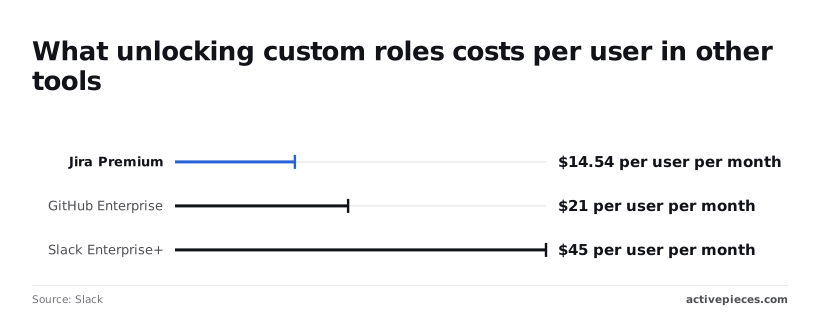
Unlike the per-user prices above, Activepieces prices Team at a flat $200 a month with 25 users included, so the comparison depends on your headcount.
- Activepieces suits you if you need an MIT-licensed core you can self-host (the enterprise directories sit under a separate commercial licence), and you've confirmed in writing that custom roles work in your edition.
- A per-user platform suits you if you want the role behaviour documented before you sign and can absorb the per-seat cost.
- An enterprise contract suits you if the vendor will put custom roles, and their self-hosted behaviour, into the order form.
I don't recommend Activepieces on role controls alone. Recommend it only where the MIT-licensed core and self-hosting are the real requirement, since the free self-hosted Community Edition is that core and the roles come with the paid tiers.
Whatever figure appears here comes from the vendor's own pricing or help page; the Activepieces figures, Team at $200 a month and Ultimate quoted through sales, come from its pricing page. I mark anything those pages don't state as unconfirmed rather than inferring it.
## Verifying a vendor's Custom Role Claim Before Buying
Four checks matter, and re-checking the live page is only one of them: read the roles documentation, match it to a named plan, get the clause in writing, and test a restricted role yourself. Each stage catches a claim the previous one can't.
### Stage 1: find the roles page in the docs
Search the vendor's documentation, not the marketing site, for "roles", "permissions" or "access control". Marketing pages say "advanced permissions". Documentation says what a role can actually restrict.
Look for whether you can define your own role or only assign fixed ones such as admin and member. If the docs only list fixed roles, the vendor doesn't offer custom roles, whatever the pricing page implies.
viz type=pictogram title="Custom role pricing on Slack and Jira Service Management" unit="$ per user per month" source="GitHub Docs - https://docs.github.com/en/enterprise-cloud@latest/organizations/managing-user-access-to-your-organizations-repositories/managing-repository-roles/about-custom-repository-roles"4.54 on Jira Service Management, both on paid upper tiers."
Slack: 45
Jira Service Mgmt: 14.54
### Stage 2: match the feature to a named plan
Find the sentence that names the plan the feature belongs to. A docs page that says "available on select plans" hasn't answered the question. Copy the plan name exactly as written, then check the pricing page for the same name.
If the two pages disagree, or one is silent, treat the feature as unconfirmed. A role you can't tie to a named plan can't be budgeted, because you don't know which price you'll pay for it.
### Getting a Custom Role Claim in Writing
Ask the vendor for the contract clause or order-form line that names the feature, and quote it verbatim in your records. A sales email saying "yes, that is included" is not a control.
**If the feature is absent from the order form, the vendor can remove it at renewal without breaching anything.**
Ask the vendor what happens to your role definitions if you drop to a lower plan, since that tells you **whether you're buying the feature or renting it**.
**If the feature is absent from the order form, the vendor can remove it at renewal without breaching anything.
### Stage 4: test a restricted role yourself
In a trial, create a role that denies something specific, such as editing a live workflow or viewing stored credentials. Then sign in as that user and attempt the forbidden action.
If a role hides a button but still permits the action through a direct link, it hasn't met the requirement. If the trial plan lacks custom roles, you've learned that before paying.
On a self-hosted deployment the same four checks apply, with one addition: the licence terms. Run them in this order:
1. Find the roles page in the docs.
2. Match the feature to a named plan.
3. Request the contract clause that names the feature.
4. Test a restricted role in a trial.
5. Confirm the self-hosted licence terms, because a feature on the hosted plan may sit behind a separate licence key, or not exist, when you run the software yourself.
Whatever you can't confirm in writing at step five goes into the comparison table as "not confirmed", not as a yes.
## Frequently asked questions
Nothing marked unconfirmed should be read as a yes; each answer below either points to a vendor page you can read or is marked unconfirmed.
### Do custom roles cost extra on top of the plan?
Usually the cost is the tier itself, not a separate add-on line, but for the platforms in our table that is unconfirmed unless the vendor's pricing page says otherwise.
Take from it that you should price the plan that unlocks roles, not the plan you start on.
For Zapier, which tier includes roles is unconfirmed here; ask for the plan name in writing. For Zapier, where a sales call is the only route to a price, record it as "quote required", not as a figure.
Having priced the tier, the next question is whether what it unlocks is actually a role.
### Are custom roles the same as folder or project permissions?
No. Folder or project permissions decide who can reach a set of workflows. A custom role defines which actions a person may take at all, such as publishing, editing connections or viewing run data.
Because a platform can offer the first and not the second, a feature called "permissions" doesn't settle the requirement.
Ask the vendor which actions a role can be built from. Whether n8n's insights feature amounts to audit logs is unconfirmed, and usage reporting is not a record of who changed what.
### Does self-hosting remove the plan restriction on roles?
Not by default, and for most platforms in the table this is unconfirmed. Self-hosting changes where the software runs, not what your licence entitles you to. Where a vendor gates roles by plan, the same gate may follow the licence key onto your own server.
Whether n8n keeps custom roles when self-hosted is unconfirmed; ask for the licence clause that names the feature and the edition it belongs to. Quote the clause itself in your comparison, not a summary of it.
### Can I limit who sees connection credentials?
Treat it as unconfirmed until the vendor names the specific control. The question has two halves: who can use a connection inside a workflow, and who can view or edit the stored secret.
When a contractor builds workflows against your production accounts, the difference matters: many tools allow the first without the second.
Ask which role can create, share, view and delete a connection, and ask for that answer in the vendor's documentation or contract, not in a call. Don't record "compliant" or "secure" for credential handling unless the answer names the control it satisfies.
## Related reading
- [EU Hosted Workflow Automation: Best Platforms 2026](https://www.activepieces.com/blog/eu-hosted-workflow-automation-best-platforms-2026)
- [n8n Custom Variables: How They Work and Plan Limits](https://www.activepieces.com/blog/n8n-custom-variables-how-they-work-and-plan-limits)
- [Automation Templates: 6 Platforms Compared (2026)](https://www.activepieces.com/blog/automation-templates-6-platforms-compared-2026)
## References
- [Activepieces](https://www.activepieces.com/blog/activepieces-rbac-pricing-plans-and-roles-2026)
- [Slack](https://slack.com/help/articles/29800891169939-Create-custom-roles)
- [GitHub Docs](https://docs.github.com/en/enterprise-cloud@latest/organizations/managing-user-access-to-your-organizations-repositories/managing-repository-roles/about-custom-repository-roles)