By isolating these experts, the model avoids the compute cost of dense architectures, allowing for higher throughput in automated agentic workflows. ### Comparing xing4.0 to mixtral and deepseek architectures As a next-generation model in the series formerly known as [TeleChat](https://github.com/Tele-AI/TeleChat3), Xing4.0 provides a more aggressive efficiency ratio than its predecessors or larger competitors. While it maintains a total of 29 billion parameters, its **4 billion active parameters** represent a significant reduction in memory bandwidth requirements compared to other popular MoE models. 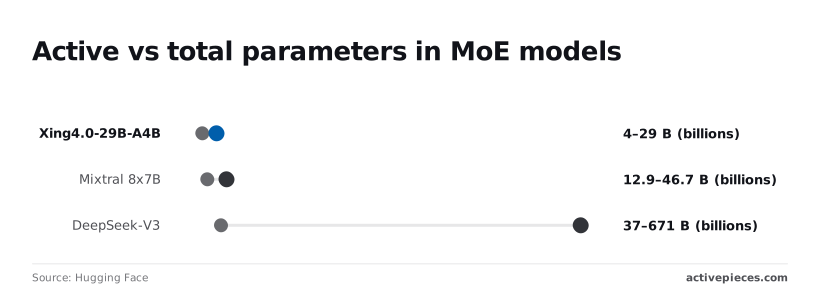 | Model | Active Parameters | Total Parameters | | :--- | :--- | :--- | | Xing4.0-29B-A4B | 4 billion | 29 billion | | Mixtral 8x7B | 12.9 billion | 46.7 billion | | DeepSeek-V3 | 37 billion | 671 billion | _Prices and plan limits checked against [huggingface.co](https://huggingface.co/XingChen-AGI/Xing4.0-29B-A4B) and [huggingface.co](https://huggingface.co/xingchen-agi/xing4.0-29b-a4b) on September 29, 2026._ For a finance operations team, these figures translate directly to the bottom line. Xing4.0 delivers a 29B knowledge depth at a 4B resource cost, so your operational budget stretches significantly further for the same intelligence output.  ## Connecting xing4.0-29b-a4b to your Activepieces workflows To translate the 4B active-parameter reasoning of Xing4.0-29B-A4B into executed business logic, Activepieces makes every connected integration available to the AI as a tool. Once a connector is registered in this MIT-licensed platform, it is simultaneously available as a flow step and as a tool schema on a per-project MCP server, reachable by any agent you build. This removes the need for a second migration or manual schema exports, as the same integration code in the `packages/pieces` directory of the open-source repo powers both deterministic flows and agentic tool calls. By utilizing this model within an automated framework, you move from static chat interfaces to dynamic agents that can independently update ledgers or trigger procurement cycles. Since the platform doesn't yet feature a dedicated Xing4.0 button, you must utilize the generic connector blocks to bridge the model’s inference capabilities with your operational data. ### Step 1: Obtain your API endpoint and key Before the automation platform can securely route requests to the model, you must obtain a valid authentication token and the specific URL for your inference provider. Access your provider’s dashboard to generate a secret key, which acts as the digital handshake between the workflow and the GPU cluster. Ending typically in `/v1`, the Base URL ensures the traffic is directed to the correct API version rather than a legacy port. ### Step 2: Use the OpenAI-compatible provider block Activepieces runs whatever model you already chose (on your own provider key, at your own rate) so model spend for high-volume Xing4.0 inference lands on your provider account, not ours. This compatibility allows you to skip manual JSON coding for basic prompts, speeding up the initial deployment of the agent. 1. Add the OpenAI integration to your workflow canvas. 2. Select the "Ask Assistant" or "Chat" action to define the model's role. 3. Click the "Change Connection" button to input your custom Base URL and API Key, which redirects the call from standard endpoints to your Xing4.0 instance. 4. Type `xing4.0-29b-a4b` manually into the model field so the provider knows exactly which weights to load for your task. ### Step 3: Configure the HTTP request for custom tools To handle complex agentic workflows where the model must call external functions, you must use the HTTP Request integration to define precise JSON payloads. This step is necessary because high-volume tool use requires specific headers that standard blocks might strip away.  Set the method to POST to send data to the model. Append `/chat/completions` to your Base URL to reach the endpoint for dialogue and tool calls. Include `Authorization: Bearer [Your_Key]` and `Content-Type: application/json` in the headers. Define your `tools` array in the body, outlining the specific SQL queries or API calls the model is permitted to execute. ## Performance in complex reasoning and tool use **By utilizing a Mixture-of-Experts architecture that activates only 4B parameters per token, Xing4.0-29B-A4B delivers efficient reasoning.** Complex logic doesn't incur the latency typically associated with high-density weights.  Because of this efficiency, the model can handle the nested logic required for multi-step tool execution without the memory overhead that usually forces infrastructure teams to choose between reasoning depth and throughput speed. ### Xing4.0-29b-a4b vs Gemini 3.8 Flash tool-call accuracy Whether an automated workflow successfully triggers an external API or fails due to a malformed JSON object is determined by precision in syntax generation. When compared against models like Gemini 3.8 Flash, Xing4.0-29B-A4B demonstrates a similar capacity for maintaining strict schema adherence during long-context operations. Because a single misplaced bracket in a database query can halt a production pipeline, necessitating manual intervention from a DevOps engineer, this reliability is critical. In tests involving the Snowflake data platform, the model consistently maps natural language requests to the correct SQL parameters. Automated reports pull the exact datasets requested by the finance team. ### Why reasoning density matters for agents To maintain its internal state across multiple turns without losing the original objective, an agent relies on high reasoning density. This is a requirement for any task that involves more than a single API call. If a model lacks this density, it often hallucinations parameters or forgets previous constraints, which leads to redundant API calls and wasted compute costs. Before deciding on the next step, the model must evaluate the output of one tool. This logical coherence means the thought process must remain stable even as the context window fills with raw data logs. When an agent is told to update a record in the Salesforce customer relationship management platform only if the last contact was more than thirty days ago, the model must satisfy that constraint. It must hold that temporal logic in its active weights while simultaneously formatting the update command. If a tool returns a 403 Forbidden error, a high-density model can autonomously pivot to an alternative authentication path for error recovery rather than simply repeating the failed request and depleting the API credit balance. By concentrating its intelligence into a smaller active footprint, the model navigates these technical hurdles without the cost of running a full-scale flagship model like GPT-6 Astra for every minor transactional update. ## Frequently asked questions about xing4.0-29b-a4b ### Can i run xing4.0-29b-a4b on local hardware? Because its architecture uses an activated parameter count that fits within the memory limits of standard professional graphics cards, you can deploy this model on enterprise-grade local hardware. This local deployment capability means a firm can process sensitive financial data without sending packets over the public internet, satisfying internal data residency requirements. Unlike massive flagship models that necessitate a multi-node cluster, this model functions on a single workstation. A small DevOps team can maintain the stack without specialized infrastructure engineers. ### Is xing4.0-29b-a4b compatible with the OpenAI API? By supporting the standard OpenAI-compatible chat completions schema, the model allows teams to swap it into existing agentic pipelines without rewriting their core integration logic. Because it adheres to this common interface, developers can use popular orchestration libraries to manage the model.  To transition from a proprietary service to this self-hosted alternative, you only need to change the base URL and API key. This compatibility ensures that existing prompt templates and system instructions remain functional, so the organization avoids a costly multi-week refactoring sprint. ### Does this model support multi-turn tool calling? To execute a sequence of functions and refine its next step based on the output of the previous action, this model natively supports multi-turn tool calling. This capability is essential for workflows that require a loop of feedback, such as querying a database, receiving an error, and then correcting the SQL syntax automatically. By handling these iterative cycles, the model can complete complex tasks without human intervention. It can query a customer database to retrieve a unique identifier. It can use that identifier to pull transaction history from a separate billing system. It can cross-reference those transactions against a shipping log to identify a specific delay. This logical chaining ensures that the agent reaches a final resolution rather than stopping after the first API response. ## Related reading - [When Not to Use an AI Agent: Limits of Agentic Automation](https://www.activepieces.com/blog/when-not-to-use-an-ai-agent-limits-of-agentic-automation) - [What is Intelligent AI Process Automation?](https://www.activepieces.com/blog/ai-process-automation) - [What Is a Business Process Automation Platform?](https://www.activepieces.com/blog/business-process-automation-platform) ## References - [Hugging Face](https://huggingface.co/xingchen-agi/xing4.0-29b-a4b)An enterprise can pay for the inference power of a 4B model.