The prices here are as of 2026-10-24, the date of the check against Zhipu's pricing. Vendors change rates and plan limits without notice, so re-verify on the live page before you commit a budget. ### The table: every model and plan, with price, context window and limits Read the table as a map of which price columns apply to which purchase, because the plan rows have no per-token rate to compare against the model rows. | Row | What you buy | Price columns that apply | Check date | |---|---|---|---| | GLM-5.3 | Current open-weight text model, 1M-token context | Input, cached input, output per 1M tokens | 2026-10-24 | | GLM-4.7 | Older-generation model | Input, cached input, output per 1M tokens | 2026-10-24 | | GLM-4.6 | Older-generation model | Input, cached input, output per 1M tokens | 2026-10-24 | | GLM-4.5 | Older-generation model | Input, cached input, output per 1M tokens | 2026-10-24 | | Coding Plan Lite | Entry subscription | Monthly price only | 2026-10-24 | | Coding Plan Pro | Mid subscription | Monthly price only | 2026-10-24 | | Coding Plan Max | Top subscription | Monthly price only | 2026-10-24 | A 1M-token context on GLM-5.3 means long inputs fit in one call, but Zhipu bills every token you send, so a full window is also a full input charge. ### Cheapest option for each common job If your calls are occasional or bursty, such as a nightly summarisation run, per-token billing on a GLM model is cheapest because **you pay nothing when idle**. For all-day interactive coding above the break-even volumes, a Coding Plan is usually the safer bet, since a flat fee caps spend even when reasoning output balloons. ## Free tier, batch, cache and rate limits List price is only the starting rate. Free allowances, cache and batch discounts, and concurrency caps decide what you pay, and Zhipu publishes few of them as hard numbers, so verify each one before you budget. ### Zhipu free models and quota limits Any free model or free quota on Zhipu's platform is a testing allowance, not production capacity. Free access typically comes with tighter request limits and no service commitment, so a prototype that works on it can stall when real traffic arrives. ### Zhipu cached input and batch discounts If your workload resends the same long prefix, such as a system prompt, a codebase summary or a fixed tool schema, cached-input pricing rewards it. Batch pricing rewards work that can wait for results, such as bulk classification or overnight evaluation. Neither helps an interactive agent whose context changes on every turn. ### Zhipu concurrency and rate limits by account level **Spend is not usually the first wall**. Concurrency is how many requests you can have in flight at once, and it often binds before the budget does. The coding plans are metered in credits that reset on a five-hour window and a weekly window, so heavy sessions can exhaust the short window while the weekly pool is nearly full. The table shows what is published for each plan; every numeric cell reads "not published" or "not applicable", so the takeaway is to size by testing, not by tier name. | Plan | Five-hour credits | Weekly credits | Concurrency | Recommended use | |---|---|---|---|---| | Lite coding plan | not published | not published | not published | One developer, occasional sessions | | Pro coding plan | not published | not published | not published | Daily assistant use in an editor | | Max coding plan | not published | not published | not published | Long agentic sessions with heavy output | | Pay-as-you-go API | not published | not applicable | not published | Bursty or programmatic traffic, parallel jobs | The recommended-use column is our judgment, not Zhipu's. Run a representative day of work against a plan, record when throttling starts, and only then compare that against metered cost. ## Monthly pricing for three named Zhipu workloads For a coding agent, a subscription most clearly beats metering: [LLMLearner](https://llmlearner.com/models/glm-5-3/pricing) puts one on GLM-5.3 pay-per-token at $507.40 a month, against $168 for the top coding plan, which means **metering would cost three times as much**. That gap is what you're deciding.  The other reference workloads are cheaper. A RAG pipeline with long inputs comes to $440 a month, a support chatbot to $430, and a research agent to $268, so coding is your most expensive application of these. 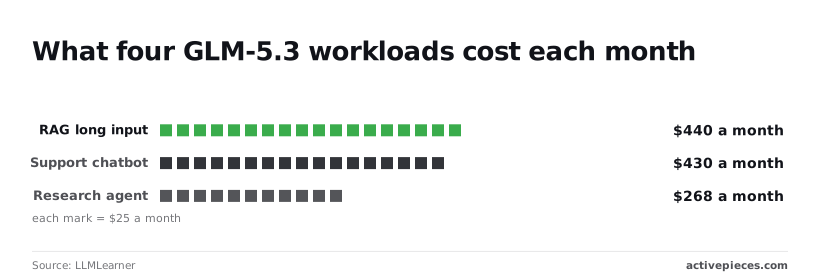 Reselling you a model is deciding your AI strategy for you: the vendor has picked the model and set its price before you open the product. If you build the ticket summariser in [Activepieces](https://www.activepieces.com), you bring your own provider key, so the token charge lands on your own provider account at the rate you picked; if there's no ready-made Zhipu integration, you can generate one with AI and add it privately to your instance. On the Plus plan ($20 a month, 10,000 credits, bring-your-own-AI-keys) every AI step is 1 credit, and you can reach it from Claude, ChatGPT, Cursor or any MCP client, limiting you to 10,000 steps per month. ### Break-even volume for each coding plan [Sovyron](https://sovyron.com/plans/glm-5-turbo/) publishes the volume at which each plan stops costing more than metered billing. Those thresholds are for GLM-5-Turbo, not GLM-5.3, so treat them as the shape of the curve and convert your own token count before comparing. 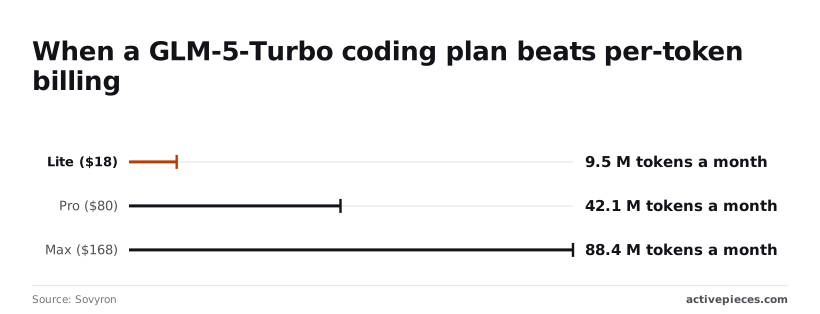 | Plan | Monthly price | Break-even volume | |---|---|---| | Lite | $18 | 9.5 M tokens | | Pro | $80 | 42.1 M tokens | | Max | $168 | 88.4 M tokens | **Below 9.5 M tokens a month, pay-per-token is cheaper than even the $18 plan, which is where a modest summariser or a one-off extraction batch will land.** **Between 9.5 M and 42.1 M, Lite wins**, but it throttles first, so test it against a real day of traffic. Pro earns its $80 only past 42.1 M tokens, so you need that volume to make Pro affordable. Max needs 88.4 M tokens before the $168 pays back. ## Hidden costs and limits affecting Zhipu bills Five things push a Zhipu bill above its list price. They're reasoning tokens billed as output, long-context tiers, tool and web-search fees, the peak-hours 3x credit multiplier on coding plans, and prepaid expiry combined with the split between bigmodel.cn and Z.ai currencies. ### Thinking tokens and long-context tiers Because **reasoning models bill their thinking as output**, output share's the figure to measure on your own traffic. [Agent Planners](https://www.agentplanners.com/blog/input-tokens-drive-ai-agent-costs) found output took 41 % of agent-task spend on Gemini 2.5 Flash, 29 % on GPT-6 Luna, 12 % on DeepSeek V4 Flash and 8 % on Llama 3.3 70B, showing that your model choice determines how much output tokens matter to your bottom line. 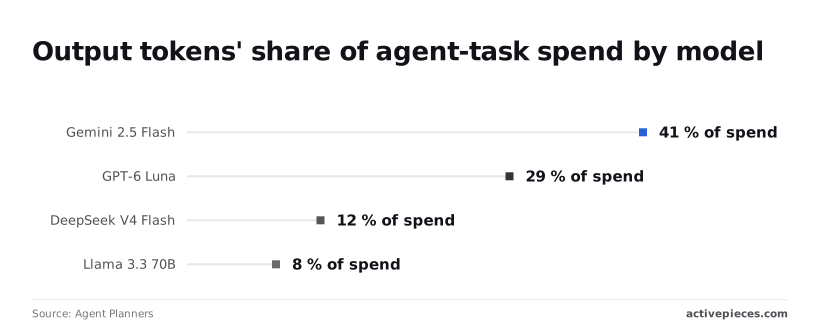 Those figures cover other vendors' models, not Zhipu's. They show the spread: a thinking-heavy model lands near the top, a terse one near the bottom. If your reasoning model sits at the high end, trimming output is the cheapest saving available. Long-context tiers work the other way. Where a model's pricing row steps up by input length, one oversized prompt is billed at the higher rate for the whole request, so trim history before it crosses a tier boundary. ### Zhipu tool fees and multimodal input pricing An agent that searches in a loop pays twice, once for the calls and once for the results it reads back as input. Web search and other built-in tools carry their own per-call fees, separate from token charges. Image and other multimodal inputs use their own units, so a per-token estimate built from text prompts will understate them. ### Zhipu bigmodel.cn versus Z.ai platforms and currencies Don't assume bigmodel.cn and Z.ai match line for line: they are separate platforms with separate accounts. Compare quotes in one currency from the same platform, because a cheaper-looking rate in another currency may not be a cheaper rate. ### Zhipu prepaid balance and quota rules A large top-up bought for a discount may lapse unspent, since prepaid balances can expire. Buy what you'll use in the validity window, not what the bonus tempts you to. On coding plans, the 3x credit multiplier at peak means a quota sized from off-peak usage runs out roughly three times faster for work done in those hours. Check the peak window against your team's working hours before you rely on the plan's headline allowance.  ## Zhipu pricing versus DeepSeek, Qwen and OpenAI Peak-window rules are one of several terms that stop list price from deciding this comparison. Against DeepSeek, Qwen and OpenAI's small model, Zhipu's per-token rate matters less than the cache discount, how much output your task generates, and whether a flat plan covers the work. ### Price per million tokens side by side No rates are quoted in this section, because a figure copied from memory goes stale faster than any other part of a pricing comparison. The table shows what each vendor positions the model for, and so which price line will dominate your invoice. Take the input, output and cache-hit rates from each vendor's own pricing page on the day you decide, and write that date next to them. | Model | How the vendor positions it | Price line to read first | |---|---|---|---| | GLM-5.3 | Open-weight text model with a 1M-token context | Output rate, since long contexts invite long answers | | GLM-4.7 | Earlier Zhipu generation, not on the current model list | Whether it is still sold at all | | DeepSeek V4.1 Flash | Fast, cheap, supports vision | Cache-hit rate on repeated prompts | | A Qwen flagship | Alibaba's top-tier model; tiers differ by release | Which tier the quoted price belongs to | | GPT-6 Luna (OpenAI small model) | Cost-sensitive, high-volume work | Input rate at high request counts | ### Coding plans compared The two bill on different logic. Zhipu sells a subscription coding plan alongside its pay-per-token API. A plan caps usage by allowance and time window. The API caps nothing but charges for every token.  Equivalent subscription products from the other three vendors are unconfirmed, so check whether each one offers one before you assume a like-for-like comparison. A lower input rate loses in three situations: 1. The cheaper model needs more output tokens to reach the same answer, usually because it reasons at length, and output is the expensive side of the bill. 2. Your prompts repeat a large shared prefix, so a deeper cache discount on the dearer model beats a lower base rate. 3. The cheaper model fails often enough that retries and review cost more than the saving. Measure cost per completed task on a sample of your own work. That figure, not the list price, is what you're buying. ## What Activepieces does about this Activepieces is an open-source automation platform, and its community edition is MIT-licensed, so you can self-host it and read how a flow runs. It doesn't resell tokens. You attach your own Zhipu key, and the charge lands on your account at whichever plan type you chose. That separation suits this article's advice to price the workload first. Build the ticket summariser as one flow and run a representative day through it. Record the tokens, then compare the result with the break-even table before you commit to a plan. If the numbers favour a different model, you change the key or the step and leave the flow as it is. Because each flow is its own unit, you can watch spend per workflow rather than per account. The Plus plan costs $20 a month for 10,000 credits, with one credit per AI step. 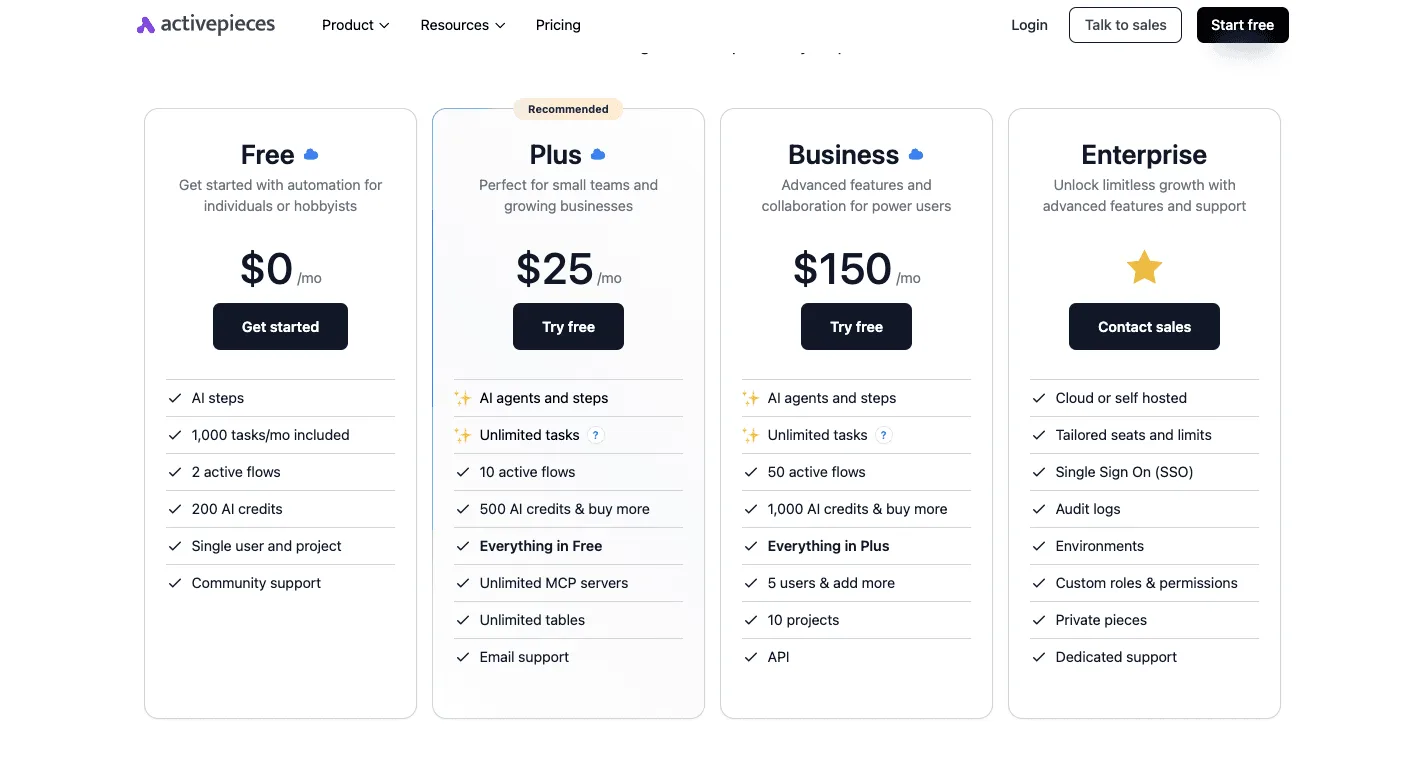 That makes the automation overhead a fixed, countable number beside your Zhipu bill. ## Frequently asked questions ### Is the Zhipu AI API free to use? Not as a general rule: paid usage is metered per token, though Zhipu has offered some lightweight Flash-tier models at no charge and has given new accounts trial credit. Treat free access as a prototyping allowance. When a workload passes a test, it can still stall in production, because free models usually carry tighter rate limits. Check the vendor's pricing page for what's free on the day you read it. ### Is the Z.AI API compatible with the OpenAI SDK? Yes, for chat completions: Z.ai exposes an OpenAI-style endpoint, so you can usually point the OpenAI client at its base URL, swap the key and change the model name. Compatibility covers the common request shape, not every feature. Reasoning controls, tool-calling details and streaming of reasoning output can differ, so run your real prompts through it before committing. Don't assume a drop-in swap will bill the same, either: reasoning tokens still count as output. ### Do Zhipu prices differ outside China? They can, because the vendor runs separate surfaces: the mainland platform (BigModel) and the international one (Z.ai). They list in different currencies and may not offer the same models, plans or promotions on the same day. Price against the platform your account is registered on, not against a figure copied from the other one. A comparison across the two is only valid if you convert currency and confirm both lists carry the same model. ### How do I stop a Zhipu workflow overspending? Cap output first, since output-heavy reasoning is where the bill grows. Set an explicit maximum on output tokens per call, and where a model offers a switch for thinking, turn it off for tasks that don't need it. Then bound retries, because an agent loop that re-sends a long context on every failure multiplies cost faster than any list price suggests. Route bulk, non-urgent work through discounted channels where they exist. Finally, track spend per workflow rather than per account, so one runaway job is visible before the invoice arrives. If your usage is steady and coding-heavy, compare a subscription plan against metered billing, as the earlier sections lay out. ### How often does Zhipu change its prices? Often enough that a price you saved last quarter shouldn't be trusted. Changes tend to arrive alongside new model releases, new tiers or promotional periods, and the vendor doesn't promise a fixed schedule. Record the date next to every price in your cost model, and re-check the official pricing page before each budget review or contract renewal. Build your estimates so that a shift in output price, the line that matters most, is a single parameter you can change rather than a rewrite. ## Related reading - [Claude API Pricing 2026: Rates for Every Model](https://www.activepieces.com/blog/claude-api-pricing-2026-rates-for-every-model) - [OpenAI API Pricing 2026: Cost Per Model Compared](https://www.activepieces.com/blog/openai-api-pricing-2026-cost-per-model-compared) - [d1 Ultra Decision Model: Specs, Pricing, and License](https://www.activepieces.com/blog/d1-ultra-decision-model-specs-pricing-and-license) ## References - [Agent Planners](https://www.agentplanners.com/blog/input-tokens-drive-ai-agent-costs) - [Sovyron](https://sovyron.com/plans/glm-5-turbo/) - [LLMLearner](https://llmlearner.com/models/glm-5-3/pricing)The model you pick matters less than the billing mode you attach it to.