> ## Documentation Index
> Fetch the complete documentation index at: https://www.activepieces.com/docs/llms.txt
> Use this file to discover all available pages before exploring further.
# Latency
> What Activepieces adds to a synchronous webhook, warm versus cold, so you can set expectations before building on it
A **synchronous webhook** holds the connection open until your flow returns, so the caller waits for the orchestration around your flow plus your flow's own work. These are floor numbers, slow paths included.
**Scope:** the recommended production setup (`SANDBOX_CODE_ONLY`, `AP_REUSE_SANDBOX=true`, one flow per worker), which self-hosted deployments and **dedicated Cloud workers** run. The shared Cloud freemium pool uses a different sandbox. See [Production Setup](/install/configure-operate/production-setup).
## What to expect
| Situation | Caller waits |
| ------------------------------------------ | -------------------------------- |
| **Warm** (the normal case) | **\~0.2 s** |
| **Cold** (first request on a fresh worker) | **\~2 s** |
| **Under heavy load** (every worker busy) | **\~0.5 s** |
| **Timeout** (flow never responds) | 30 s, then the connection closes |
## Warm vs cold
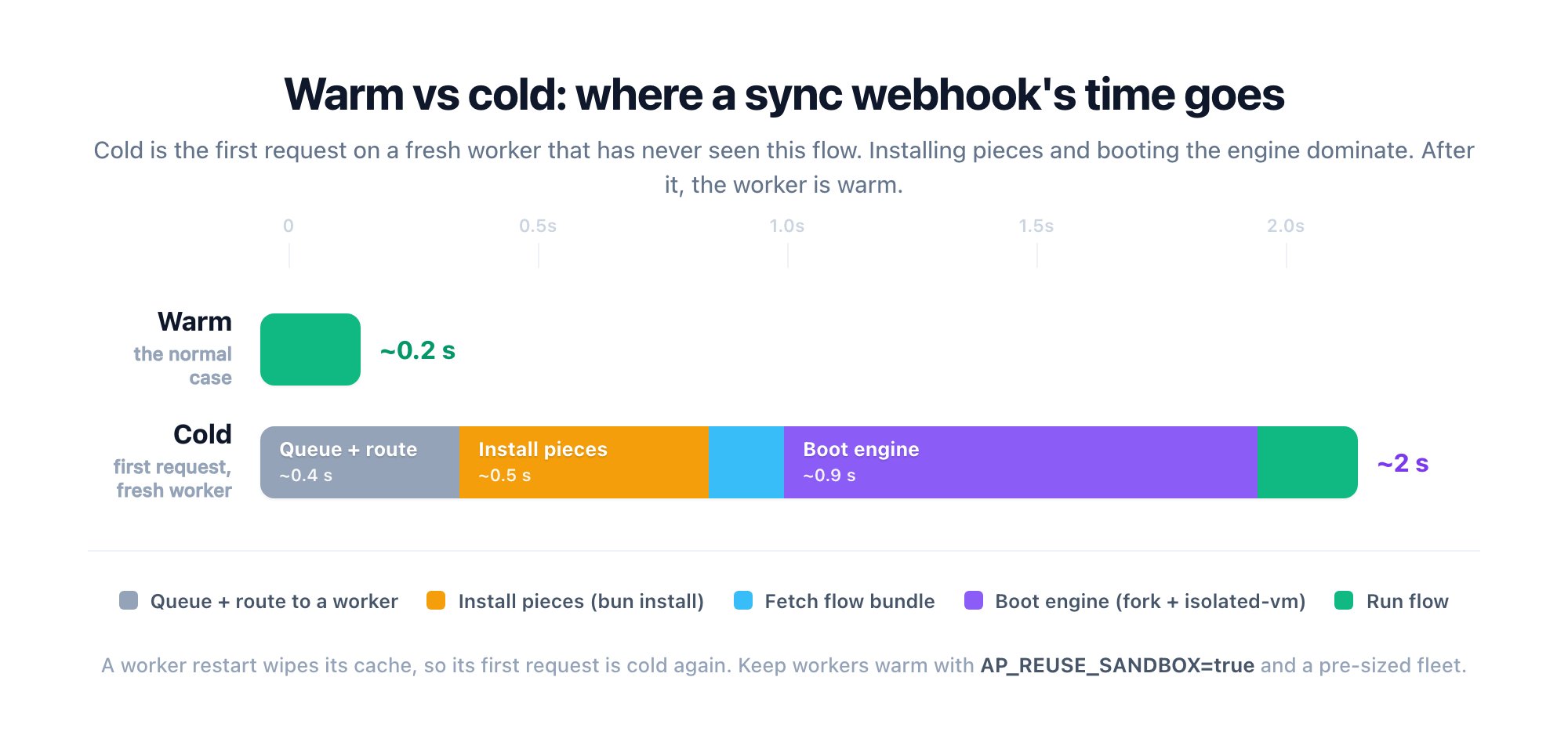 **Cold** means a worker that has never seen this flow: it installs the pieces, fetches the bundle, and forks an engine first. **Warm** reuses all three. You hit cold when:
* It is the first request after a deploy, restart, or scale-up.
* `AP_REUSE_SANDBOX` is off (then every request is cold).
* A burst exceeds your warm worker count. Each worker runs one flow at a time, so the surplus queues or starts cold.
Size **statically for peak** so a warm slot is always waiting. Autoscaling's boot lag cannot defend a 30 s sync budget. Cold starts are not Cloud-specific, they are how the engine boots, and you will see them anywhere.
## Your own work usually dominates
A warm call is almost entirely per-step bookkeeping, not your code: a progress callback per step, tens of ms each. A step that calls a third-party API waits on that API, often far longer. Next to a real outbound call, the Activepieces overhead is the smaller number.
## Measured (warm)
Four-step flow (webhook, math, code in `isolated-vm`, response), single warm call, no contention:
| p50 | avg | p95 | p99 |
| ------ | ------ | ------ | ------ |
| 163 ms | 176 ms | 260 ms | 343 ms |
The same setup measures \~165 ms unloaded but \~505 ms under sustained peak: the app tier saturating, not the flow slowing. Always ask which load a figure was measured under. Throughput view: [Benchmark](/install/architecture/benchmark).
## Reduce it
* **Keep workers warm:** `AP_REUSE_SANDBOX=true` plus a statically sized, always-on fleet.
* **Size for peak concurrency:** N concurrent requests need N warm workers ([sizing](/install/configure-operate/production-setup#sizing)).
* **Fewer, heavier steps:** each step adds overhead.
* **Don't let a slow third party block the response:** use an async webhook and callback instead of holding against the 30 s ceiling.
**Cold** means a worker that has never seen this flow: it installs the pieces, fetches the bundle, and forks an engine first. **Warm** reuses all three. You hit cold when:
* It is the first request after a deploy, restart, or scale-up.
* `AP_REUSE_SANDBOX` is off (then every request is cold).
* A burst exceeds your warm worker count. Each worker runs one flow at a time, so the surplus queues or starts cold.
Size **statically for peak** so a warm slot is always waiting. Autoscaling's boot lag cannot defend a 30 s sync budget. Cold starts are not Cloud-specific, they are how the engine boots, and you will see them anywhere.
## Your own work usually dominates
A warm call is almost entirely per-step bookkeeping, not your code: a progress callback per step, tens of ms each. A step that calls a third-party API waits on that API, often far longer. Next to a real outbound call, the Activepieces overhead is the smaller number.
## Measured (warm)
Four-step flow (webhook, math, code in `isolated-vm`, response), single warm call, no contention:
| p50 | avg | p95 | p99 |
| ------ | ------ | ------ | ------ |
| 163 ms | 176 ms | 260 ms | 343 ms |
The same setup measures \~165 ms unloaded but \~505 ms under sustained peak: the app tier saturating, not the flow slowing. Always ask which load a figure was measured under. Throughput view: [Benchmark](/install/architecture/benchmark).
## Reduce it
* **Keep workers warm:** `AP_REUSE_SANDBOX=true` plus a statically sized, always-on fleet.
* **Size for peak concurrency:** N concurrent requests need N warm workers ([sizing](/install/configure-operate/production-setup#sizing)).
* **Fewer, heavier steps:** each step adds overhead.
* **Don't let a slow third party block the response:** use an async webhook and callback instead of holding against the 30 s ceiling.