> ## Documentation Index
> Fetch the complete documentation index at: https://www.activepieces.com/docs/llms.txt
> Use this file to discover all available pages before exploring further.
# S3 Storage
> Configure S3-compatible storage for files and run logs
Run logs and files are stored in the database by default, but you can switch to S3 later without any migration; for most cases, the database is enough.
It's recommended to start with the database and switch to S3 if needed. After switching, expired files in the database will be deleted, and everything will be stored in S3. No manual migration is needed.
## How It Works
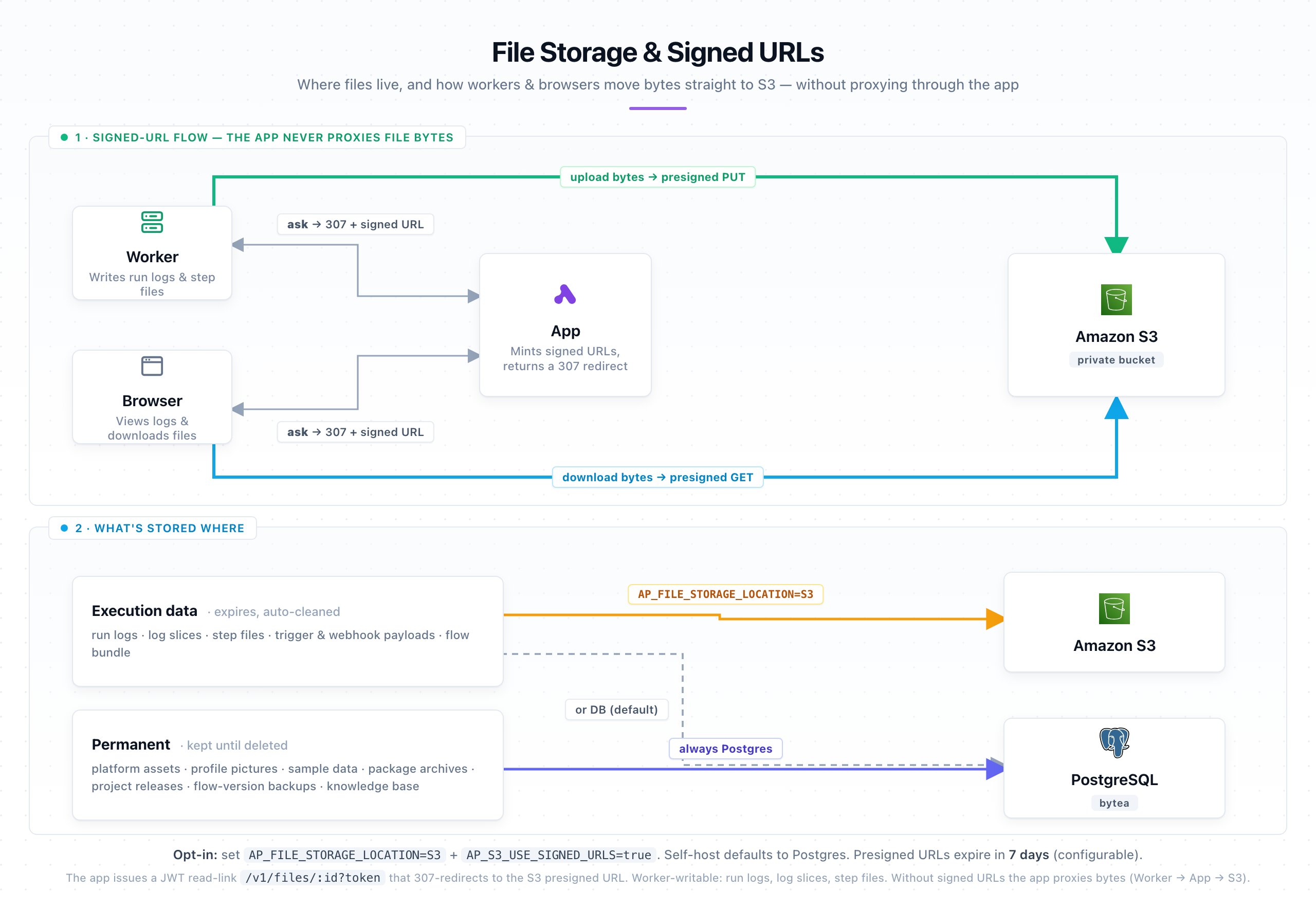 When `AP_S3_USE_SIGNED_URLS` is enabled, the app never proxies file bytes. It mints a short-lived **pre-signed URL** and returns a `307` redirect, so the worker uploads (and the browser downloads) directly to S3. This keeps heavy file traffic off the API server. Without signed URLs, the app streams the bytes itself (worker → app → S3).
Files split into two groups:
* **Execution data** (run logs, step files, trigger & webhook payloads, flow bundle) — expires and is auto-cleaned. Its location follows `AP_FILE_STORAGE_LOCATION` (`S3` or `DB`).
* **Permanent files** (platform assets, profile pictures, sample data, package archives, project releases, flow-version backups, knowledge base) — always stored in Postgres.
## Environment Variables
| Variable | Description | Example |
| -------------------------- | ------------------------------------------------------------------------------------------------------------------------------------------------------------------------- | -------------------------- |
| `AP_FILE_STORAGE_LOCATION` | The location to store files. Set to `S3` for S3 storage. | `S3` |
| `AP_S3_ACCESS_KEY_ID` | The access key ID for your S3-compatible storage service. Not required if `AP_S3_USE_IRSA` is `true`. | |
| `AP_S3_SECRET_ACCESS_KEY` | The secret access key for your S3-compatible storage service. Not required if `AP_S3_USE_IRSA` is `true`. | |
| `AP_S3_BUCKET` | The name of the S3 bucket to use for file storage. | |
| `AP_S3_ENDPOINT` | The endpoint URL for your S3-compatible storage service. Not required if `AWS_ENDPOINT_URL` is set. | `https://s3.amazonaws.com` |
| `AP_S3_REGION` | The region where your S3 bucket is located. Not required if `AWS_REGION` is set. | `us-east-1` |
| `AP_S3_USE_SIGNED_URLS` | Routes file traffic directly to S3 using pre-signed URLs, bypassing the API server. The bucket should remain private; signed URLs provide temporary authenticated access. | `true` |
| `AP_S3_USE_IRSA` | Use IAM Role for Service Accounts (IRSA) to connect to S3. When `true`, `AP_S3_ACCESS_KEY_ID` and `AP_S3_SECRET_ACCESS_KEY` are not required. | `true` |
| `AP_MAX_FILE_SIZE_MB` | The maximum allowed file size in megabytes for uploads including logs of flow runs. | `10` |
**Friendly Tip #1**: If the S3 bucket supports signed URLs but needs to be accessible over a public network, you can set `AP_S3_USE_SIGNED_URLS` to `true` to route traffic directly to S3 and reduce heavy traffic on your API server.
When `AP_S3_USE_SIGNED_URLS` is enabled, the app never proxies file bytes. It mints a short-lived **pre-signed URL** and returns a `307` redirect, so the worker uploads (and the browser downloads) directly to S3. This keeps heavy file traffic off the API server. Without signed URLs, the app streams the bytes itself (worker → app → S3).
Files split into two groups:
* **Execution data** (run logs, step files, trigger & webhook payloads, flow bundle) — expires and is auto-cleaned. Its location follows `AP_FILE_STORAGE_LOCATION` (`S3` or `DB`).
* **Permanent files** (platform assets, profile pictures, sample data, package archives, project releases, flow-version backups, knowledge base) — always stored in Postgres.
## Environment Variables
| Variable | Description | Example |
| -------------------------- | ------------------------------------------------------------------------------------------------------------------------------------------------------------------------- | -------------------------- |
| `AP_FILE_STORAGE_LOCATION` | The location to store files. Set to `S3` for S3 storage. | `S3` |
| `AP_S3_ACCESS_KEY_ID` | The access key ID for your S3-compatible storage service. Not required if `AP_S3_USE_IRSA` is `true`. | |
| `AP_S3_SECRET_ACCESS_KEY` | The secret access key for your S3-compatible storage service. Not required if `AP_S3_USE_IRSA` is `true`. | |
| `AP_S3_BUCKET` | The name of the S3 bucket to use for file storage. | |
| `AP_S3_ENDPOINT` | The endpoint URL for your S3-compatible storage service. Not required if `AWS_ENDPOINT_URL` is set. | `https://s3.amazonaws.com` |
| `AP_S3_REGION` | The region where your S3 bucket is located. Not required if `AWS_REGION` is set. | `us-east-1` |
| `AP_S3_USE_SIGNED_URLS` | Routes file traffic directly to S3 using pre-signed URLs, bypassing the API server. The bucket should remain private; signed URLs provide temporary authenticated access. | `true` |
| `AP_S3_USE_IRSA` | Use IAM Role for Service Accounts (IRSA) to connect to S3. When `true`, `AP_S3_ACCESS_KEY_ID` and `AP_S3_SECRET_ACCESS_KEY` are not required. | `true` |
| `AP_MAX_FILE_SIZE_MB` | The maximum allowed file size in megabytes for uploads including logs of flow runs. | `10` |
**Friendly Tip #1**: If the S3 bucket supports signed URLs but needs to be accessible over a public network, you can set `AP_S3_USE_SIGNED_URLS` to `true` to route traffic directly to S3 and reduce heavy traffic on your API server.