

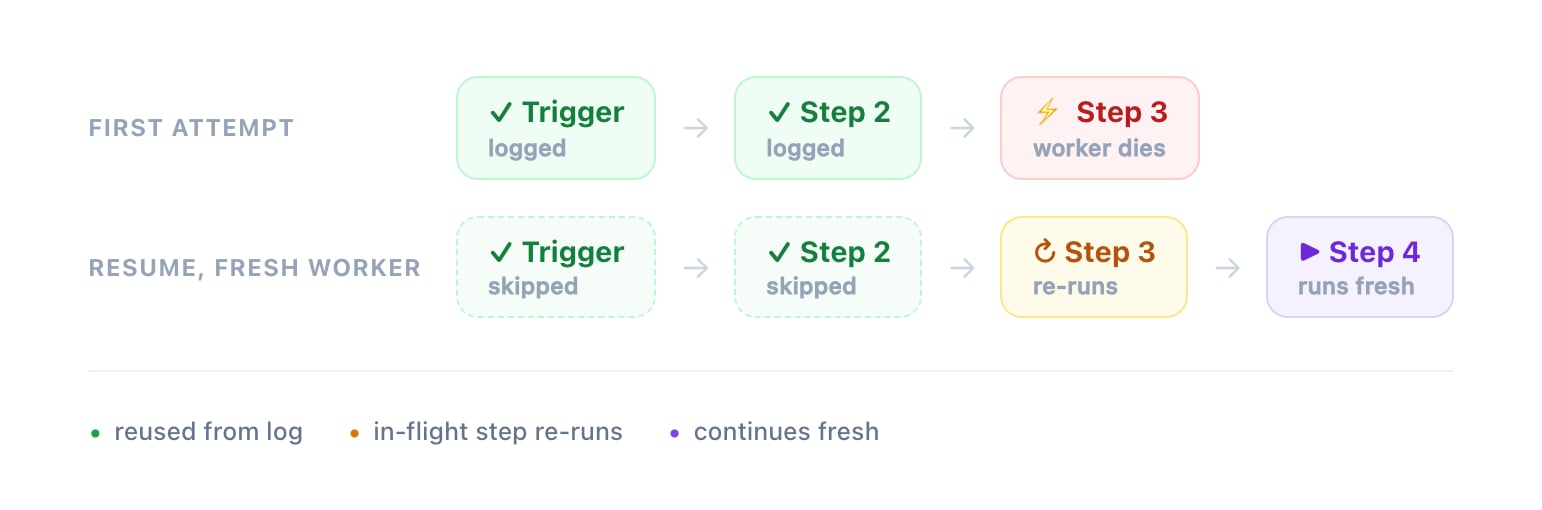
The run log
Every flow run has a run log: one compressed checkpoint file with everything needed to resume the run on a fresh worker. What is in it:- One entry per finished step, keyed by step name: input (secrets hidden), output, status, duration, and the error message for failed steps.
- Loop iterations and router branches use the same shape, nested under their parent step.
- Run-level tags.
- Once at the start, before the first step runs.
- Every 15 seconds while the run executes, from a background loop that snapshots whatever finished since the last write.
- Once on the final state (success, failure, or pause).
Replay and skip
Resume is not a special path. Each time a worker starts a run, it walks the flow graph from the trigger and asks at every step: is this step’s output already in the log?- If yes, and the step finished (
SUCCEEDEDorPAUSED), the engine returns the saved output and moves on. - If no, the engine runs the step, records its output, and continues.
What triggers a resume
Every interruption resolves through the same replay path. Only the trigger differs.- Worker crash or deployment. The queue reassigns the run to another worker, which loads the log and replays.
- Paused step. The piece creates a waitpoint. When the waitpoint fires, a resume job is queued and a worker replays the run.
- Retry from a failed step. The same log is reused. The run is re-queued and a worker replays from the failure point.
- Normal progression within one worker. Same replay model, without leaving the process.