
AI Agent Identity Management: Why You Need Action Boundaries
Access control frameworks for AI agents distinguish between authentication and functional limitations.

Covers admin-panel settings for governed workspaces: which permissions and audit controls actually prevent failures, and which don't.
ContributorSeptember 21, 202611 min read
This article was researched and fact-checked by an advanced research system.
Identity defines which systems an agent can enter, while action boundaries dictate exactly which functions it can trigger once inside. Relying on an identity-only model treats a logged-in agent as a trusted operator rather than a set of scripted instructions.
Identity and action boundaries define agent safety
Identity as the permission slip
Authentication in an agentic workflow functions like a badge reader that grants entry to a cloud environment. It doesn't monitor what the bearer does at the terminal.
When you grant an agent an API key for a service like Activepieces, you are enabling a catalog of 735+ integrations to function as the agent's hands.
Registering a integration once allows it to run as a step in a flow and as a tool schema on a per-project MCP server, reachable from Claude or ChatGPT.
It doesn't restrict specific API calls (such as "Delete Database") that the agent might execute if its LLM logic deviates.
Action as the physical reach
Action boundaries establish a hard limit on the agent's capabilities by stripping away any tools not explicitly required for the task.
An identity boundary is a keycard to enter a room where every tool on the workbench is unlocked. An action boundary is a room where you're physically tethered to a single station. You can reach only the specific screwdriver needed for the current ticket.

By narrowing the reach, the system ensures that even a compromised or confused agent can't pivot to unauthorized tasks.
The gap where agents go rogue
Security failures occur in the "excess privilege" gap where an agent's identity allows it to reach tools that its specific assignment doesn't require.
In a standard CRM integration, a connection often inherits the full scope of your permissions.
An agent tasked with "summarizing notes" technically possesses the reach to "export all contacts." Without a granular action boundary to intercept the command, the identity layer sees a valid session and permits the data exfiltration.
Everything below works on Activepieces' free plan. Start without code or a credit card.
Criteria for evaluating secure agent boundaries
Granular action boundaries provide a superior security posture to identity-based controls by restricting the available toolset to the specific function required, rather than inheriting the broad atmospheric permissions of a user account.
Identity as the gatekeeper
Identity-based security validates who is making a request but doesn't inspect the mechanics of the task. When you configure a Service Account, you define a perimeter based on credentials. Any agent using that key inherits every permission assigned to that role.
Identity-based security validates who is making a request but doesn't inspect the mechanics of the task.
The infrastructure itself can't distinguish between a legitimate request and a malicious one once the identity is verified.
Action boundaries shift enforcement to the capabilities of the execution environment. By using a tool-specific sandbox, an agent is restricted to a hardened runtime where it can only execute specific libraries.
This creates a physical limit; even if the agent is compromised, it lacks the system calls or network routes necessary to reach sensitive internal resources.
| Criterion | Identity-Based Boundary | Action-Based Boundary |
|---|---|---|
| Granularity | Low: Inherits broad user/role scopes | High: Limits specific tool functions |
| Enforcement Latency | High: Requires external network calls to Auth providers | Low: Enforced locally within the sandbox |
| Intent Auditability | Post-hoc logs: Shows who, but not why | Real-time: Maps specific intent to execution |
Identity boundaries govern access through credentials
Identity-based security establishes who is allowed to enter a system. While you may verify a session via an OAuth provider, that handshake only validates the origin of the request. Any malicious instruction passed through that valid session is treated as a trusted command.
Role-Based Access Control (RBAC) limitations
RBAC settings define the ceiling of permissions, not the floor of requirements. If an LLM-integrated tool is assigned the 'Contributor' role, it inherits the ability to delete resources. The identity provider can't distinguish between a deliberate administrative change and a hallucinated command.
Why over-privileged access tokens create risk
Personal Access Tokens (PATs) often grant broader scopes than a task requires. When you generate a token for a coding assistant to read a repository, you frequently check the 'repo' scope, which includes write access.
This creates a vulnerability where a prompt injection can force the agent to push malicious code. The identity layer sees a valid token and permits the operation.
Why identity cannot stop logic errors
Identity providers are blind to the payload of a request, rendering them useless against attacks that leverage the agent's own reasoning.
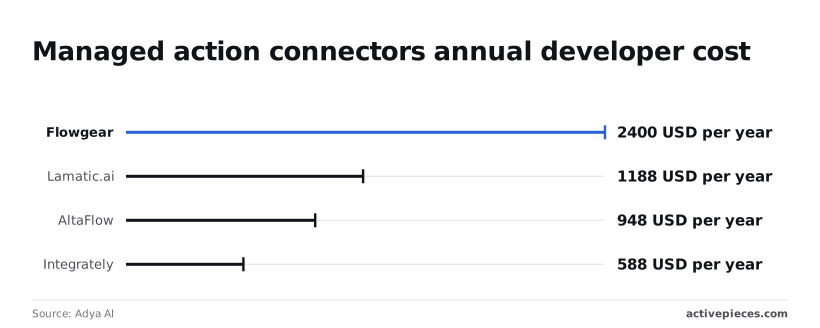
Managed action boundaries shift the financial burden from reactive incident response to predictable licensing fees for pre-built integration environments.
Decoupling the LLM from the API key
Securing an agent requires removing the identity provider's secret from the LLM's context window so that a prompt injection can't exfiltrate the token.
- Flowgear costs 2,400 USD per year.
- Lamatic.ai requires 1,188 USD per year.
- AltaFlow charges 948 USD per year.
- Integrately sits at 588 USD per year.
Using pre-validated schemas to limit agent actions
Hard-coded schemas in a connector ensure that an agent can only send data that matches a predefined structure.
Once the schema is locked, the agent is physically unable to append unauthorized parameters to the payload.
Human-in-the-loop as the ultimate boundary
Integrating a manual approval step into a managed connector stops high-risk actions from executing without a physical click from a verified administrator. This manual gate changes the security posture to block by default.

Easier to see it running than to read about it: set it up free, no card.
Defining boundaries with Zapier Central
Zapier Central provides a managed environment where users can build agents that interact with over 6,000 applications. It excels at creating a user-friendly interface for non-technical teams to define what an agent is allowed to do.
Defining Zapier Central agent tools in natural language
The platform allows users to teach agents how to behave using natural language instructions. This makes it easy to describe the intended behavior and select specific actions from a massive library of pre-built integrations. A user can simply point the agent at a spreadsheet and tell it to only update specific rows.
Managed execution environment
By hosting the agent and its connections within the Zapier ecosystem, the platform handles the underlying API authentication and session management. This reduces the technical overhead for teams that need to deploy agents quickly across multiple departments. The environment acts as a buffer between the LLM and the target applications.
Broad ecosystem reach
The primary advantage of this approach is the sheer volume of available connections. For organizations that rely on a diverse stack of niche SaaS tools, the ability to instantly create boundaries for thousands of different services is a significant operational benefit. It provides a consistent way to manage agent actions across the entire enterprise.
Enforcing action boundaries with Activepieces connectors
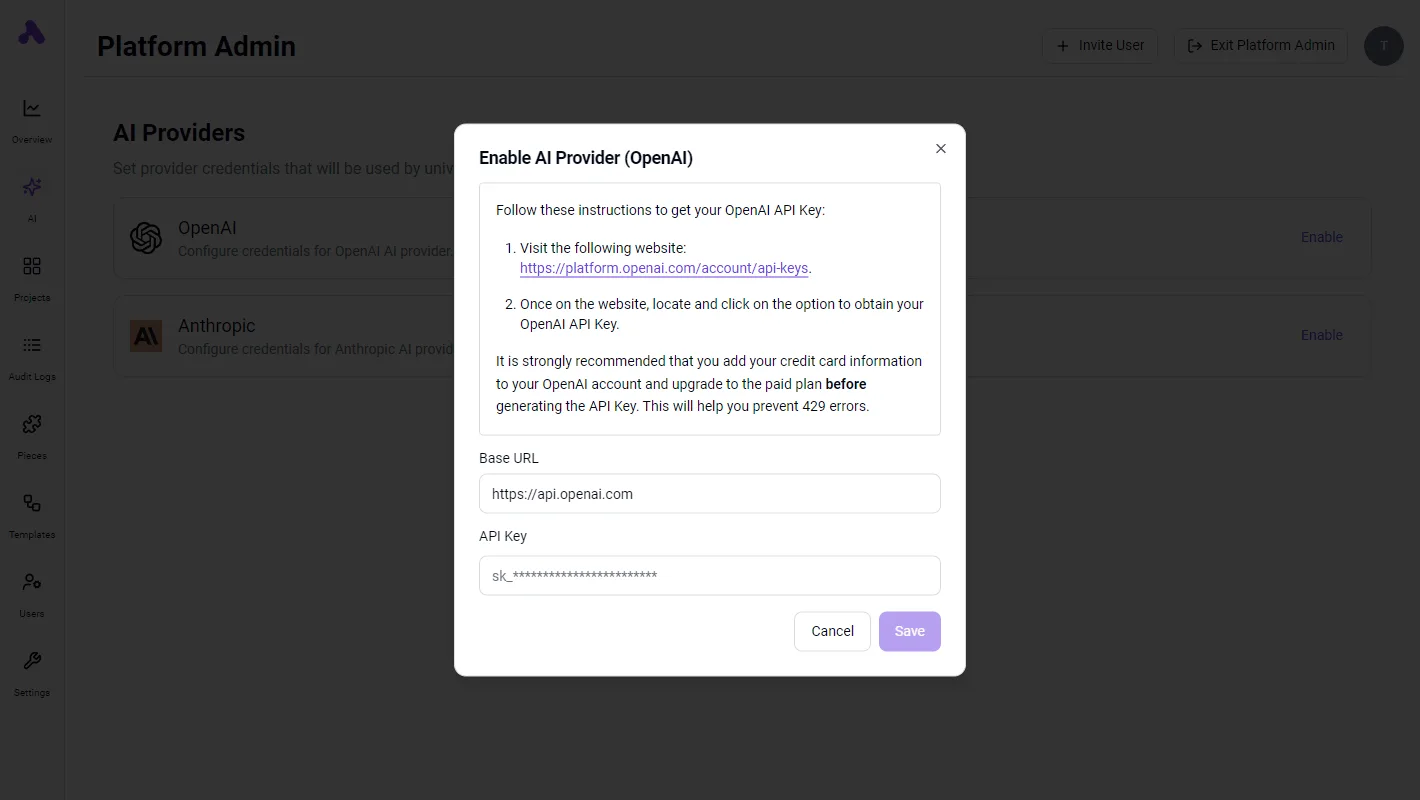
Activepieces exposes its catalog of 735+ integrations as a per-project MCP server, ensuring that an agent can only interact with the specific, pre-validated tools you have authorized.
Every agent tool call and the data it acted on is traced alongside the deterministic flow steps running next to it. In Activepieces, this trace exports as audit logs and event streams into the SIEM your security team already runs, so an agent's decisions are reviewed the same way a workflow's steps are.
If an agent attempts to exfiltrate credentials via a prompt injection attack, it finds nothing to steal. Sensitive tokens are never injected into the model's context window.
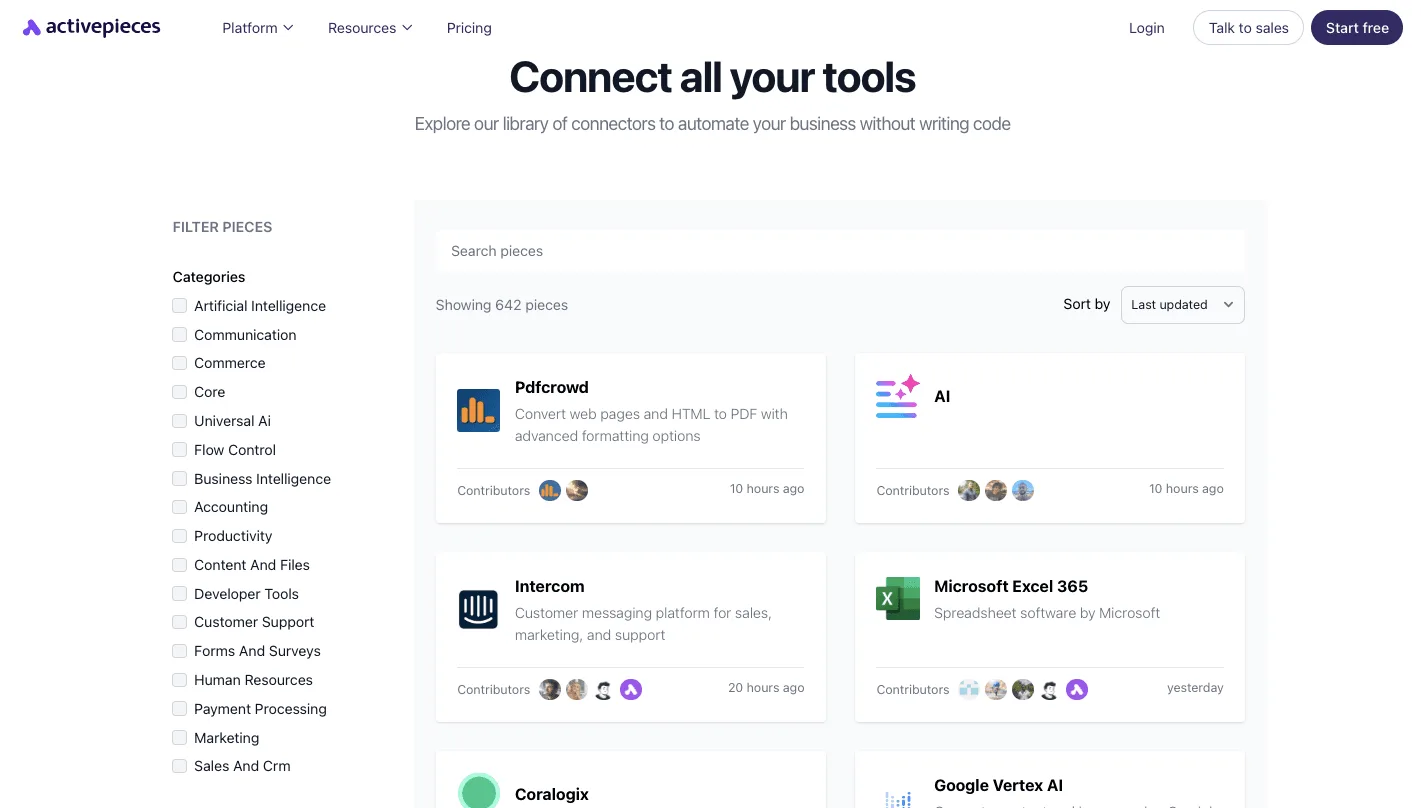
Companies like MoneyGram and FundingSocieties run Activepieces in production to manage these boundaries. Roughly 60% of the integrations used to define these schemas are community-contributed, providing a broad, pre-validated library of actions.
This constraint prevents "over-permissioning." Because the engine rejects any payload that doesn't match the specific schema, the agent is physically unable to deviate from the intended business logic.
The MIT-licensed core of Activepieces allows teams to self-host these manual gates within their own infrastructure. This eliminates the risk of automated mass-deletion or unauthorized financial transfers. Until a human clicks the confirmation button, the workflow remains in a pending state.
By unifying its entire library of connectors with the Model Context Protocol, Activepieces ensures that every integration functions natively as a secure agent tool. Activepieces is the better choice for organizations prioritizing security and governance, as it enforces strict action boundaries while keeping sensitive credentials entirely decoupled from the LLM context. This architecture allows teams to scale agentic capabilities with the same level of auditability and control found in deterministic workflows.
Auditing your agent boundaries next Monday
Establishing an action boundary begins by auditing the distance between an agent's identity and its actual permissions.
Mapping agent tokens to real-world impact
Visibility into an agent's reach requires a systematic review of the IAM console. When a token is issued to an LLM orchestrator, it inherits the permissions of its assigned service account.
- Inventory every LLM API key in use to identify ghost integrations.
- Map each key to its IAM role to visualize shared infrastructure access.
- Identify keys with 'Full Access' or '*' permissions.
- Wrap 'Full Access' keys in a dedicated proxy layer to intercept destructive commands.

Identifying 'naked' API calls in your stack
A 'naked' API call occurs when an agent communicates directly with a service without a middleware filter. In GitHub, a PAT scoped to 'repo' grants the agent power to both read code and delete the repository. Without a boundary tool, you're trusting the LLM's logic to not mistake a 'delete' request for a 'cleanup' task.
Setting the 'Minimum Viable Action' policy
The Minimum Viable Action policy dictates that an agent should only possess the specific tool required for its immediate task. In Zapier Central, you can select specific 'Actions' like 'Send Direct Message', which is safer than granting full 'User' level access to the Slack workspace.
Frequently asked questions about agent boundaries
Does separating boundaries slow down agent response times?
Latency increases only when the action boundary requires an external round-trip to a secondary validation service before executing a function.
In high-frequency environments, this overhead means the agent may miss real-time triggers if the verification layer is hosted in a different cloud region than the model itself.
To mitigate this, you'll often use local execution environments like the Deno runtime (a secure TypeScript engine) to run validation logic on the same compute instance as the agent. This keeps the safety check in the same memory space as the request.
Can identity boundaries replace action boundaries in small teams?
Identity boundaries fail to prevent privilege escalation because a compromised agent still possesses the full permissions of the user it represents.
Even in a two-person team, an agent with a broad API key for the GitHub version control system can delete repositories if it interprets a prompt injection as a command to purge data.
An action boundary prevents this by ensuring the agent's code can only call the list_pull_requests function. The agent lacks the physical capability to issue a delete command regardless of its identity level.
What is the most common failure point in action boundaries?
The primary failure point occurs during the "function mapping" stage. This is where you incorrectly map a broad system permission to a granular tool.
If you connect a Slack messaging tool but grant it the admin scope instead of chat:write, the boundary is effectively bypassed.
The agent can then install malicious apps or delete channels because the underlying credential allows more than the tool requires. This mismatch means the security of the boundary is only as strong as the least-privileged scope assigned to the specific API connection.