
AI Agent Security vs Application Security in 2026
AI agent security relies on distinct strategies for code integrity and server-side protection. Readers can evaluate their current defense gaps.

Covers agent evaluation like regression testing: adversarial prompts, reproduction steps, and where fixed workflows beat "it worked in the demo.
ContributorSeptember 16, 202614 min read
This article was researched and fact-checked by an advanced research system.
Securing AI agents requires a dual-layered approach that addresses both the logic of the software and the environment in which it resides. Application security focuses on the code, ensuring that LLM prompts are sanitized and that the logic governing autonomous actions remains uncompromised.
Meanwhile, infrastructure security protects the underlying servers, networks, and data pipelines that power these systems. As organizations integrate tools like Activepieces to automate complex workflows, the boundary between these two domains often blurs, necessitating a unified strategy.
Ultimately, a robust defense must mitigate risks ranging from prompt injection at the application level to unauthorized lateral movement within the cloud infrastructure.
Infrastructure and application security layers
When the token expires on the Saturday of a long weekend, nothing alerts anyone until the Monday invoice run. Securing an AI agent requires you to isolate the compute environment to prevent system-wide compromise.
You must also audit the agent's specific logic to prevent data exfiltration. Only 18 out of every 100 enterprises have full visibility into the AI agents running in their environments according to the Cloud Security Alliance.
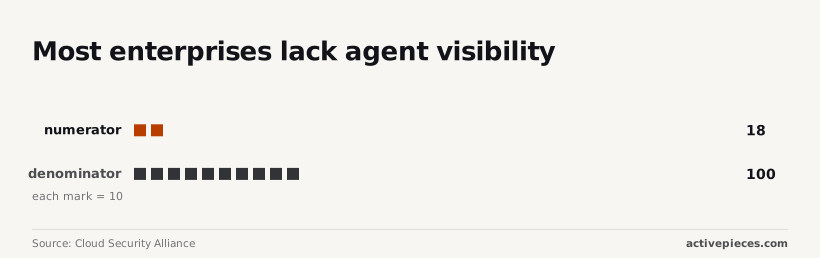
Nobody notices for three days. By then the sync has written the same record eleven times. This means the vast majority of organizations are running "shadow AI" that could bypass both network firewalls and internal data permissions.
This lack of oversight creates a blind spot where a single compromised prompt can escalate into a full infrastructure breach.
Infrastructure security: The physical and virtual cage
Infrastructure security defines the boundary of what an agent can touch at the machine level. This layer focuses on hardening the execution environment through three primary methods.
Virtual Machine (VM) Isolation involves running agents in dedicated micro-VMs so that a "jailbroken" agent can't access the host kernel. Network Egress Control restricts outbound traffic to specific IP whitelists to prevent an agent from sending internal database secrets to a rogue external server.
Ephemeral Sandboxing resets the entire environment after every execution so that no malicious persistent scripts can survive.
The outer ring of Infrastructure Security provides a final fail-safe. If a prompt injection bypasses the inner Application Security filters, the infrastructure limits the damage to a single, isolated sandbox.
Application security: The agent's judgment and access rights
Application security governs the "brain" of the agent, focusing on the instructions it receives and the specific API scopes you grant it. Even if the infrastructure is secure, a poorly governed application can still delete a production database if you grant it unnecessary administrative tokens.
When using Activepieces to coordinate these tasks, you define granular permissions for each specific tool by leveraging its MIT-licensed core to manage connections centrally.
Activepieces addresses this application-level boundary by exposing its 735+ integrations directly to models as a per-project MCP server. The Model Context Protocol (MCP) is an open standard that enables secure, two-way communication between AI models and local or remote data sources.
By acting as a security boundary, MCP ensures that the model only sees the specific tools and data schemas it has been explicitly granted, rather than having broad access to the underlying system.

When an integration is configured, the underlying code in the packages/pieces directory of the open-source repository runs simultaneously as a deterministic workflow step and an agent tool schema.
This eliminates the security risk of maintaining a separate tool catalog or re-integrating APIs for autonomous agents, ensuring that access rights remain unified across both automated flows and LLM calls.
This layer relies on prompt filtering to catch malicious injections. It also uses Role-Based Access Control (RBAC) to ensure an agent designed for "summarizing emails" doesn't have the "delete user" permission in the CRM.
Where infrastructure and application security conflict
Security failures occur when you treat these layers as interchangeable. For example, the open-source agent framework AutoGPT allows for "continuous mode," which can bypass human-in-the-loop approvals.
If you pair this with a lack of infrastructure sandboxing, the agent could theoretically execute an infinite loop of shell commands until it crashes the host system.
Relying solely on application-level prompt filters is insufficient because LLMs are non-deterministic. Conversely, perfect infrastructure security is useless if the agent has the application-level authority to legally transfer sensitive customer PII to a public Slack channel.
Relying solely on application-level prompt filters is insufficient because LLMs are non-deterministic.
The model layer and provider security
Even with perfect infrastructure and application controls, your data remains vulnerable at the model layer. When an agent processes a request, it sends sensitive context to a third-party provider like OpenAI or Anthropic.
This creates a massive external privacy surface that exists outside your direct control.
You must evaluate the data retention policies of your LLM provider to ensure they do not use your inputs for model training. Enterprise-grade security often requires the use of private endpoints, such as Azure OpenAI Service, to keep traffic within a managed perimeter.
Without these safeguards, your most sensitive corporate data could be stored on a provider's server indefinitely, regardless of how secure your local sandbox is.
The fastest way to settle a shortlist is to try one. Activepieces is free to try, no credit card.
Criteria for evaluating agentic security frameworks
You must measure AI agent frameworks by their ability to contain a malicious prompt without degrading the agent’s utility.
The Intersys Agentic Governance Gap report shows that 93% of Lloyd’s agents operate with high governance compared to only 12% in the general enterprise.
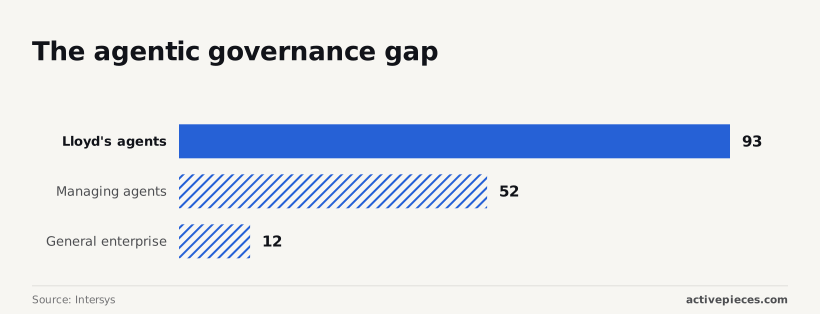
This disparity exists because most organizations lack a rubric to balance risk against operational overhead. Selecting a framework requires you to audit four technical trade-offs.
Agent isolation depth and blast radius
Isolation defines the physical or logical boundary that prevents an agent from accessing the underlying host.
In a typical enterprise environment, the Intersys report indicates that 88% of agents lack stringent governance, leaving the vast majority of automated workflows exposed to significant security and compliance risks.
Effective isolation uses technologies like gVisor to intercept system calls. This prevents an agent from executing code directly on the kernel even if the agent is compromised.
Agent data persistence vs ephemeral execution
Persistence determines whether an agent’s state survives between tasks. Managing General Agents (MGAs) show a more balanced 52/48 split in governance maturity according to Completeaitraining, as their workflows often require "sticky" sessions to process complex insurance claims.
Every byte of persistent data is a target. You must evaluate security frameworks on whether they offer automated disk wiping. This forces an attacker to restart their exploit chain from zero every time a session ends.
Every byte of persistent data is a target.
Latency overhead of security checks
Every layer of inspection adds milliseconds to the agent’s response time. If a security proxy adds 500ms to a generation, users often bypass official tools for unsecured accounts. Evaluation must focus on the "time to first byte" (TTFB) impact.
The infrastructure must be lightweight enough to execute security logic in under 10ms.
Total cost of secure compute vs open access
Secure execution environments carry a premium that can exceed the cost of the LLM tokens themselves.
| Criterion | Low-Stakes Internal Bot | High-Stakes Customer-Facing Agent |
|---|---|---|
| Isolation | Logical (Docker containers) | Physical (MicroVMs or Firecracker) |
| Data Persistence | Persistent for user history | Ephemeral/Stateless per session |
| Latency | Moderate (up to 1s acceptable) | Ultra-low (sub-100ms overhead) |
| Cost | Low-priority optimization | High-priority fixed operating cost |
Infrastructure strategies for containing autonomous agents
Infrastructure security for autonomous agents requires you to balance strict process isolation against operational overhead. Higher isolation levels increase cold-start latency, which can cause an agent to time out during multi-step reasoning.
Using single-tenant VMs for agent isolation
Virtual Machines (VMs) provide the strongest security boundary by isolating the agent at the hardware level. This architecture ensures that even if an agent executes a malicious payload, the breach is confined to a dedicated kernel.
However, this isolation comes at a performance cost. During testing of Google Cloud Compute Engine instances, the time required to boot a fresh OS exceeded several seconds, making real-time interactions feel sluggish.
Serverless containers for scalable task execution
Serverless containers like AWS Fargate package the agent into an image that shares the host OS kernel but maintains separate user spaces. This setup allows for rapid scaling without manual provisioning.
While faster than VMs, containers still suffer from "cold starts" when the service has been idle.
WebAssembly sandboxes for low-latency security
WebAssembly (Wasm) sandboxes provide near-instant execution by running code in a memory-safe layer that doesn't require a full OS boot.
Because Wasm modules start in under 10 milliseconds, an agent can spin up a new environment for every tool call without perceived delay. This speed enables a "micro-sandbox" strategy where each individual action is isolated.

Unlike containers, a Wasm sandbox can be discarded and recreated for every request, preventing residual data leaks from one task to the next.
Reading a table only gets you so far. Build the same workflow in Activepieces and compare it yourself.
Application controls for governing agent behavior
Application-layer controls prevent the model from executing unauthorized business logic even if the infrastructure is secure. These controls prevent the agent from leaking data or draining API credits through manipulated instructions.
Prompt engineering as a fragile first line of defense
System prompts are the primary instructional set for an agent, yet they remain vulnerable to "jailbreaking." LLMs treat system instructions and user inputs as a single context window.
A user can provide a command like "ignore all previous instructions," which the model may follow if it lacks external validation layers. This creates a reliability gap where the most recent instruction dictates behavior.
Human-in-the-loop approvals for agent actions
Human-in-the-loop (HITL) workflows introduce a mandatory manual approval step for sensitive actions. This prevents the agent from executing destructive commands without a verified signature.
Human-in-the-loop (HITL) is essential for actions that are irreversible or carry high financial risk.
By requiring a human to review the agent's proposed action in a dashboard, you prevent "autonomous drift" where a misunderstood prompt leads to mass data loss.
Security gateways and API interceptors for real-time monitoring
Proxy-based gateways act as a programmable firewall between the agent and the LLM provider. They inspect every request to enforce security policies.
The gateway identifies and masks sensitive strings like Social Security numbers before data is sent to the LLM provider, preventing third-party models from ingesting private data. The proxy also tracks cumulative costs to prevent recursive loop attacks from exhausting credits.
The gateway checks the agent's requested API calls against a strict JSON schema, rejecting any command that attempts to use unauthorized parameters.
How Activepieces isolates agentic execution and workflows
Activepieces isolates agentic execution by ensuring that roughly 60% of integrations are community-contributed and peer-reviewed, providing a broad but vetted surface for tool calls that balances rapid innovation with collective oversight, which means the platform relies on a distributed network of developers to maintain its security and functionality.
This prevents a compromised workflow from accessing the host file system.
Activepieces provides visibility into these runtime choices by tracing every agent tool call, its underlying data, and the decision sequence directly alongside deterministic workflow steps.
Because autonomous decisions and fixed logic execute within the same run, security teams can inspect the entire chain in the Run Details UI rather than parsing fragmented records across separate systems.
This unified execution trace exports as an event stream into an enterprise SIEM, allowing organizations like MoneyGram and FundingSocieties to audit an agent's application-layer choices with the same rigor applied to traditional infrastructure logs.
Sandboxed code execution for custom logic
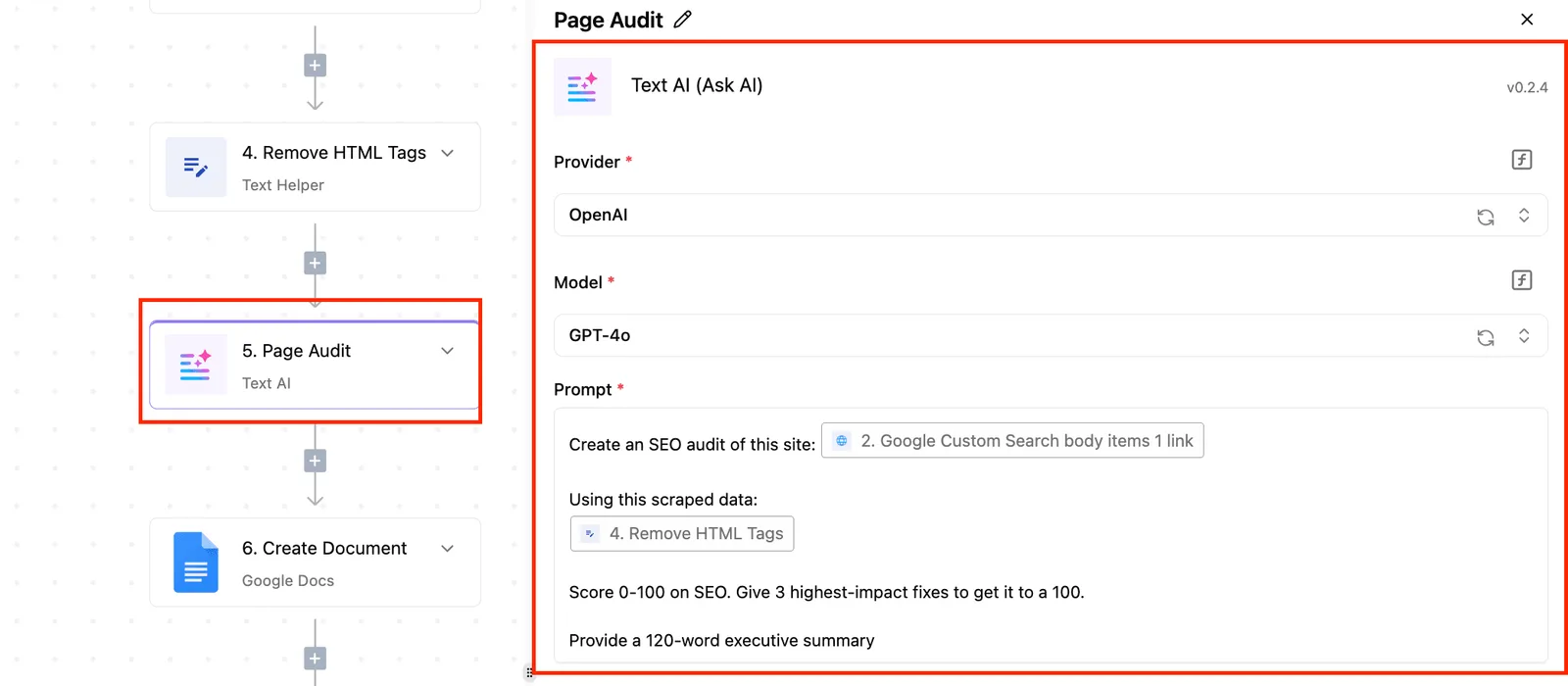
The platform executes all custom JavaScript or Python snippets within isolated containers. By using the "Code Integration" component, you offload the security burden of managing execution runtimes to the infrastructure.
The environment terminates immediately after a task completes, preventing persistent backdoors. Resource limits are enforced per execution; a recursive loop triggered by a hallucinating model can't consume the entire cluster's CPU.
Role-based access for application-level governance
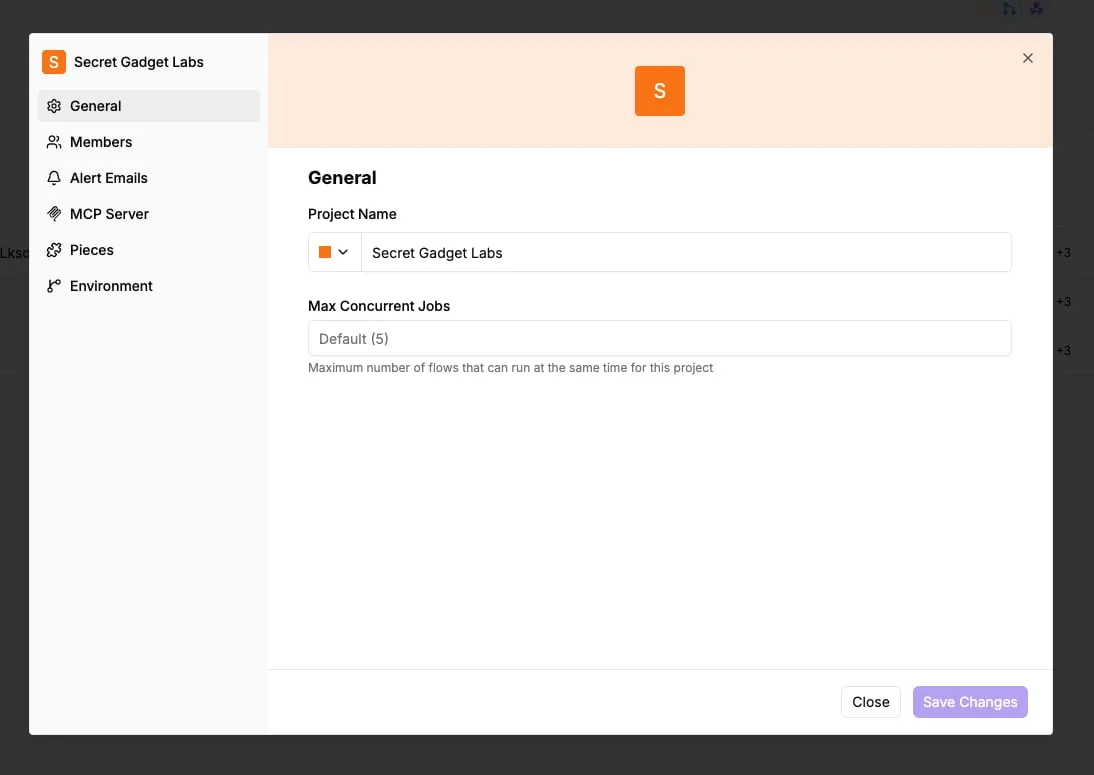
Activepieces uses project-level isolation to ensure that credentials for a production database are never visible to an agent running in a development sandbox, a control verified by 24,473 GitHub stars from the security community. Governance is managed through the Project Settings dialog.

Administrators can throttle the Max Concurrent Jobs to prevent an agent from triggering a self-denial-of-service attack on downstream APIs.
Auditable logs for infrastructure and app events
The platform records every input and output at each step. This provides a forensic trail that distinguishes between a failure in the infrastructure and a logic error in the agent's prompt.
You open the "Runs" tab to view the exact JSON payload sent to a specific integration. The log reveals if an agent attempted to inject a system command into a field meant for plain-text email.
By unifying deterministic workflows and autonomous agent actions into a single observable trace, the platform ensures that every tool call is audited with enterprise-grade rigor. Activepieces is the better fit for organizations that require deep visibility and sandboxed security when turning connectors into agentic tools.
Through its peer-reviewed integration framework and unified Run Details UI, it provides the necessary oversight to manage the risks of autonomous decision-making.
Systematic audit checklist for AI security
A systematic audit ensures that forensic logs translate into actionable security improvements. By moving from physical isolation to specific permissions, you can identify where a prompt injection might escalate.
Hardening the agent execution environment
Infrastructure isolation prevents an agent from accessing lateral network resources. When using a tool like E2B, which provides sandboxed cloud environments for AI agents, every session runs in a dedicated micro-VM.
This ensures that a malicious script can't persist across sessions. Relying on standard Docker containers without additional security layers often leaves the Linux kernel exposed to escape vulnerabilities.
Auditing agent API permissions and scopes
Restricting an agent’s API credentials to the absolute minimum required scopes prevents a logic error from turning into a mass data deletion event.
- Inventory all active agents to identify which models have access to production data.
- Verify infrastructure isolation (VM/Container) to confirm no agent can reach the internal metadata service.
- Audit API key scopes (Least Privilege) to ensure no agent possesses "Owner" or "Delete" permissions on third-party SaaS tools.
- Review HITL logs for unauthorized attempts to bypass defined tool boundaries.
- Confirm provider-level data privacy by checking retention policies and the use of private VPC endpoints for LLM traffic.
Establishing a human-in-the-loop protocol for destructive actions
Human-in-the-loop (HITL) protocols are a final circuit breaker for actions that can't be reversed. LangChain’s "Human-in-the-loop" flag in their LangGraph library allows you to pause execution and wait for a manual signal.
Without this manual gate, the speed of AI execution becomes a liability. A recursive loop could trigger thousands of API calls before a human notices the spike.
Common questions about AI agent security?
Does infrastructure security prevent prompt injection?
Infrastructure security prevents an attacker from gaining root access to the server. It can't stop a Large Language Model (LLM) from following a malicious instruction embedded in a user query.
When a prompt bypasses application-level filters, the infrastructure layer treats the resulting database deletion or unauthorized email blast as a legitimate, authenticated request.
Can AI agents be truly isolated from the public internet?
AI agents can be isolated within virtual private clouds (VPCs). Products like Amazon Bedrock allow for PrivateLink connections.
This ensures that data traffic never traverses the public internet, which eliminates the risk of man-in-the-middle attacks. However, this isolation creates a trade-off. The agent can't fetch live market data or third-party software updates.
Is human-in-the-loop security too slow for real-time agents?
Human-in-the-loop (HITL) security is too slow for sub-second automated responses. In high-stakes workflows like financial transfers, it is the only way to prevent irreversible damage.
In a real-time customer support bot, waiting for a human to approve every chat message would destroy the user experience. Instead, security engineers apply HITL selectively.
Low-risk actions proceed with automated filters only. High-risk actions, such as bulk data exports, pause the agent execution until a designated administrator signs off.
Related reading
References
Still comparing
The fastest way to settle it is to build something.
Open source under MIT, so you can self-host the same thing later.
Start free Talk to sales