Best AI Governance Tools for LATAM Enterprises in 2024
AI governance platforms help regional businesses align automated systems with local data sovereignty laws like Brazil's LGPD.

Covers self-hosted automation under data-sovereignty constraints: offline Kubernetes, air-gapped testing, and procurement-cycle realities.
ContributorSeptember 17, 202614 min read
This article was researched and fact-checked by an advanced research system.
AI governance refers to the strategic framework of policies and tools used by organizations to ensure that artificial intelligence systems are transparent, ethical, and compliant with regional data sovereignty regulations like Brazil's LGPD.
AI governance defines the guardrails for enterprise automation
Aligning your automated decision-making with regional legal requirements and internal security protocols requires AI governance as a mandatory operational framework.
Without these technical controls, you risk deploying "black box" systems that inadvertently leak proprietary data or violate consumer privacy mandates. Establishing this structure requires an integrated approach to how data flows between your local infrastructure and third-party intelligence providers.
The pillars of data residency and privacy
When sensitive information must remain within specific geographic or logical boundaries to satisfy national sovereignty requirements, data residency dictates the strategy.
While some vendors restrict their most robust security features to managed cloud tiers, Activepieces provides the same enterprise capabilities (including SSO, SCIM, custom RBAC, and release management) within its self-hosted, air-gapped edition.
This parity ensures that regulated organizations can maintain absolute data sovereignty without sacrificing the administrative controls found in cloud environments.
In practical terms, a self-hosted deployment means running the automation software directly on the enterprise's own physical servers or private cloud infrastructure. Air-gapping takes this isolation a step further by ensuring the entire system operates with absolutely no connection to the public internet.
For LATAM organizations navigating strict sovereignty mandates, this total isolation guarantees that sensitive citizen data never leaves local custody.
PII (Personally Identifiable Information) and execution logs stay inside your corporate firewall under this setup.
To prevent unauthorized cross-border transfers, Local Data Residency involves the physical storage of data within jurisdictions governed by LGPD. Model Transparency requires the implementation of audit trails to detect and mitigate linguistic bias in Spanish and Portuguese datasets.
Securing API keys and monitoring model outputs
Centralized management of API keys and secrets is the focus of Technical Security, preventing credential exposure during your automation cycles.
Operational Oversight ensures the continuous monitoring of model outputs to align with your corporate ethical standards.
Managing LLM data risk in cloud automation tools
A shift from permissive access to strict input-output validation is required to manage LLM risk and prevent data exfiltration.
When you use the cloud-based automation tool Zapier, the platform processes data on its managed servers. You must trust third-party encryption and retention policies rather than your own.
Stripping sensitive metadata before prompts reach the inference engine is the first step in sanitizing the process.
You should also use anonymization to replace specific identifiers with synthetic tokens. Finally, validation checks model responses against a predefined library of allowed formats to prevent prompt injection attacks.
Compliance with emerging LATAM regulations
Driven by the evolution of the Brazilian General Data Protection Law (LGPD), compliance in the LATAM region is a statutory requirement.
By default, the standard version of the integration platform Make stores execution history on its own infrastructure.
A governed environment requires the ability to purge or redirect these logs to a private internal database. This control ensures that you can produce necessary documentation during a regulatory audit without relying on a vendor's external dashboard.
Everything below works on Activepieces' free plan. Start without code or a credit card.
The governance resource gap in LATAM enterprises
When the cost of compliance exceeds your available budget, governance frameworks fail. According to a report by Ethisphere, 84 out of 100 teams operate with no dedicated AI budget.

General IT staff often inherit the responsibility for data safety. The same report indicates that only 16 out of 100 teams possess a dedicated budget for AI governance.
16% of teams can procure automated auditing software while their competitors rely on manual spreadsheets, meaning a significant portion of the industry remains vulnerable to preventable human oversight.
This disparity creates a two-tier market where the majority of enterprises are technically incapable of meeting the stringent logging requirements of Brazil's LGPD or Colombia's Law 1581 without sacrificing their operational margins.
How budget limits weaken AI governance guardrails
The following data visualizes how the lack of financial allocation directly restricts your ability to implement technical guardrails.
Resource scarcity often forces a reliance on managed services that abstract away control mechanisms. When you lack the capital for custom infrastructure, you often turn to the entry-tier of Zapier.
Because Zapier restricts data to US-based servers, your LATAM firm cannot guarantee that sensitive citizen data remains within national borders.
To close this gap, adopt a deployment strategy that prioritizes low-overhead, self-hosted environments.
First, identify all data touchpoints where PII interacts with an external LLM.
Second, replace third-party hosted connectors with self-hosted instances that run on local Virtual Private Clouds. Third, implement automated kill-switches that trigger when an API call attempts to route data outside of the approved regional zone.
Enterprise platforms for global compliance standards
Verifying that monitoring capabilities function within the specific regulatory and linguistic constraints of the LATAM market is the first step in selecting a governance platform.
IBM Cloud Pak for Data and OpenScale
Across heterogeneous environments, IBM OpenScale provides automated bias detection and explainability.
You can monitor models running on internal servers and third-party clouds from a single dashboard. This architectural flexibility allows sensitive data to remain within Brazilian borders while the governance metadata travels to the central monitor.
Microsoft Purview for ecosystem-wide visibility
If you are already committed to the Azure stack, Microsoft Purview centralizes data discovery and lineage tracking.
It tags every piece of PII used to train an LLM so that the data is searchable for "right to be forgotten" requests. This visibility prevents the accidental exposure of protected data during automated retraining cycles.
Using Arthur.ai to monitor model drift and bias
Focusing on the technical performance and ethical integrity of models, Arthur.ai offers specific tools to identify "drift" where a model's accuracy degrades.
Their platform includes specific workflows for detecting linguistic bias. This is necessary for your LATAM enterprise to ensure that models trained primarily on English-centric datasets don't penalize Spanish or Portuguese queries.
Regional data residency in major automation tools
To achieve sovereign automation using established cloud providers, you must utilize their specific enterprise-grade residency features. Zapier offers Data Residency for its Enterprise customers, allowing them to store data in specific regions such as AWS Europe to satisfy localized privacy mandates.

This ensures that while the logic is managed by a third party, the underlying data assets remain within a defined geographic boundary.
Similarly, Make offers a Private Instance option for organizations that require strict isolation from the public multi-tenant cloud. This environment allows you to select the specific AWS region where your data is processed and stored, providing a middle ground between public SaaS and full self-hosting.
For LATAM firms, selecting a region with high proximity or legal alignment is the primary method for maintaining compliance within these platforms.
| Feature | IBM OpenScale | Microsoft Purview | Arthur.ai |
|---|---|---|---|
| Multi-cloud Support | Supports AWS, Azure, and on-premises | Primary focus on Azure ecosystem | Cloud-agnostic via API integration |
| Spanish/Portuguese NLP | Native support for major LATAM dialects | Broad support via Azure Cognitive Services | Custom drift detection for non-English sets |
| Base Pricing | Tiered by VPC usage | Consumption-based per data asset | Annual subscription per model |
These platforms provide the oversight necessary to prove to regulators that automated decisions are transparent and fair.
Easier to see it running than to read about it: set it up free, no card.
Why governance actually accelerates long-term AI adoption
By establishing a repeatable framework that eliminates the need for individual security reviews for every new automation, governance accelerates AI adoption.
Stopping shadow AI use of personal ChatGPT accounts
Fragmented "shadow" deployments occur when employees use personal accounts for tools like the ChatGPT web interface to process corporate data. This creates a visibility gap that prevents your IT department from revoking access when an employee leaves.

Because these tools operate outside your corporate firewall, you lose the ability to audit data egress. A single prompt injection attack could leak proprietary intellectual property without leaving a trace in your internal logs.
Building trust with regional regulators and customers
By adhering to strict data sovereignty standards, your LATAM enterprise can pursue government and financial contracts that are contractually closed to non-compliant competitors. For companies operating under Brazil's LGPD, utilizing self-hosted environments ensures that personal identifiable information (PII) never crosses international borders.
Compliance acts as a market entry requirement. Without it, the procurement cycle for high-value clients often ends at the initial security screening.
Compliance acts as a market entry requirement.
Cutting technical debt from unmonitored AI models
Because fixing an AI logic error becomes exponentially more expensive as the model moves closer to the end-user, early governance is a direct cost-saving measure.
A logic error caught during the requirements phase is significantly cheaper to rectify than one discovered in production.
When models are deployed without monitoring layers, the resulting technical debt requires a complete teardown of the automation to find the root cause of a hallucination. By implementing a standardized evaluation layer, you ensure that errors are identified during development.
Activepieces for sovereign AI automation and control
By self-hosting Activepieces, which maintains an MIT licence on the core, you gain the technical infrastructure to execute complex automations entirely within your own virtual private cloud.
This ensures that no sensitive operational data ever leaves the jurisdictional boundaries of your enterprise, a requirement for firms like Alan and FundingSocieties that run the platform in production.
To satisfy the transparency requirements of LGPD, Activepieces traces every agent tool call and the specific data it acted upon in a step-by-step record.
These traces, which document the exact order of an agent's decisions alongside deterministic workflow steps, can be exported directly into a SIEM via audit logs to ensure that AI judgment is reviewed with the same rigor as fixed logic.
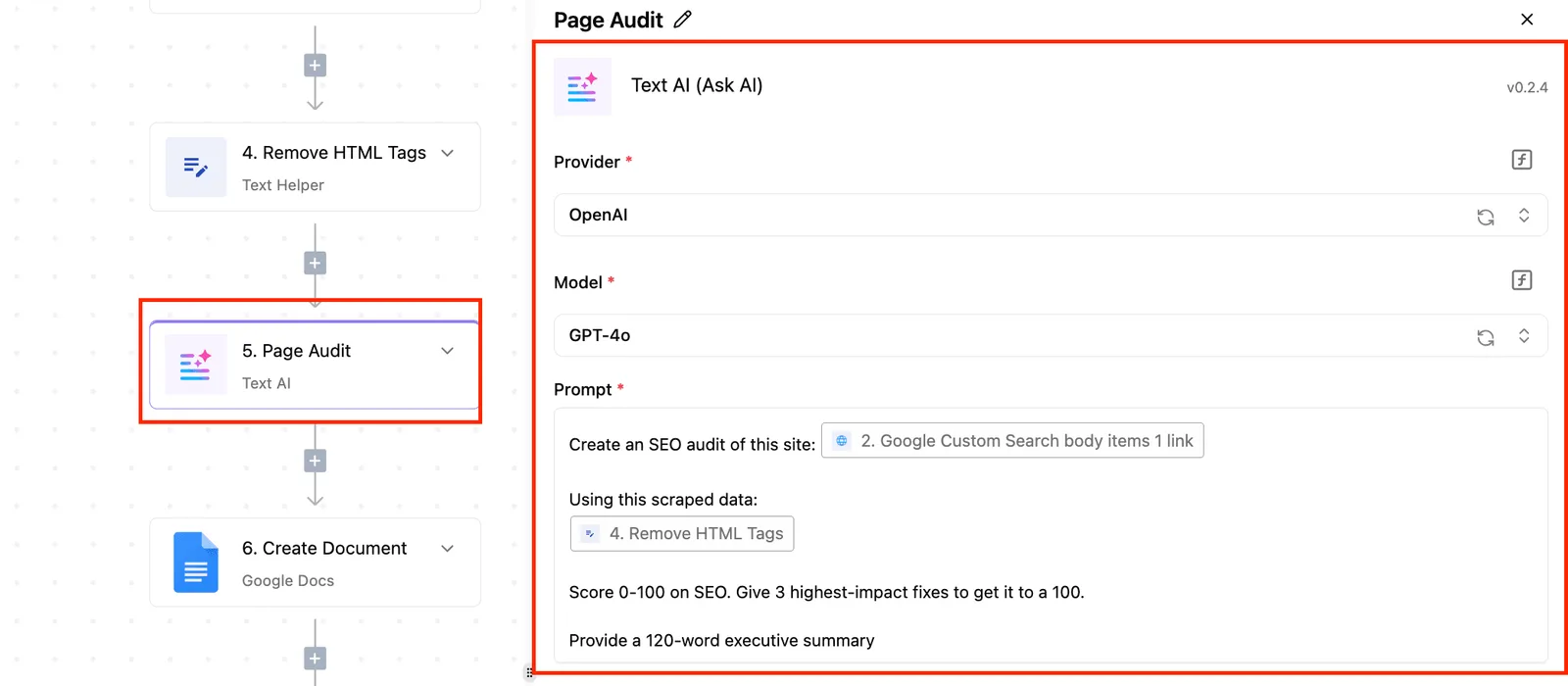
A Sovereign AI Stack is made possible by this architecture.
The orchestration engine, the local large language model, and the internal database reside behind a single private network boundary to prevent unauthorized data egress to the public internet.
This specific configuration satisfies the strictest interpretations of regional privacy mandates, as you retain physical and logical custody of the data throughout the entire automation lifecycle.
Self-hosting to meet strict data residency laws
To bypass the legal complexities of cross-border data transfers, LATAM firms use self-hosting to keep all processing localized to regional data centers.
When an automation platform resides on internal hardware, your legal team can sign off on AI projects without the lengthy procurement delays associated with evaluating the sub-processors of a SaaS provider.
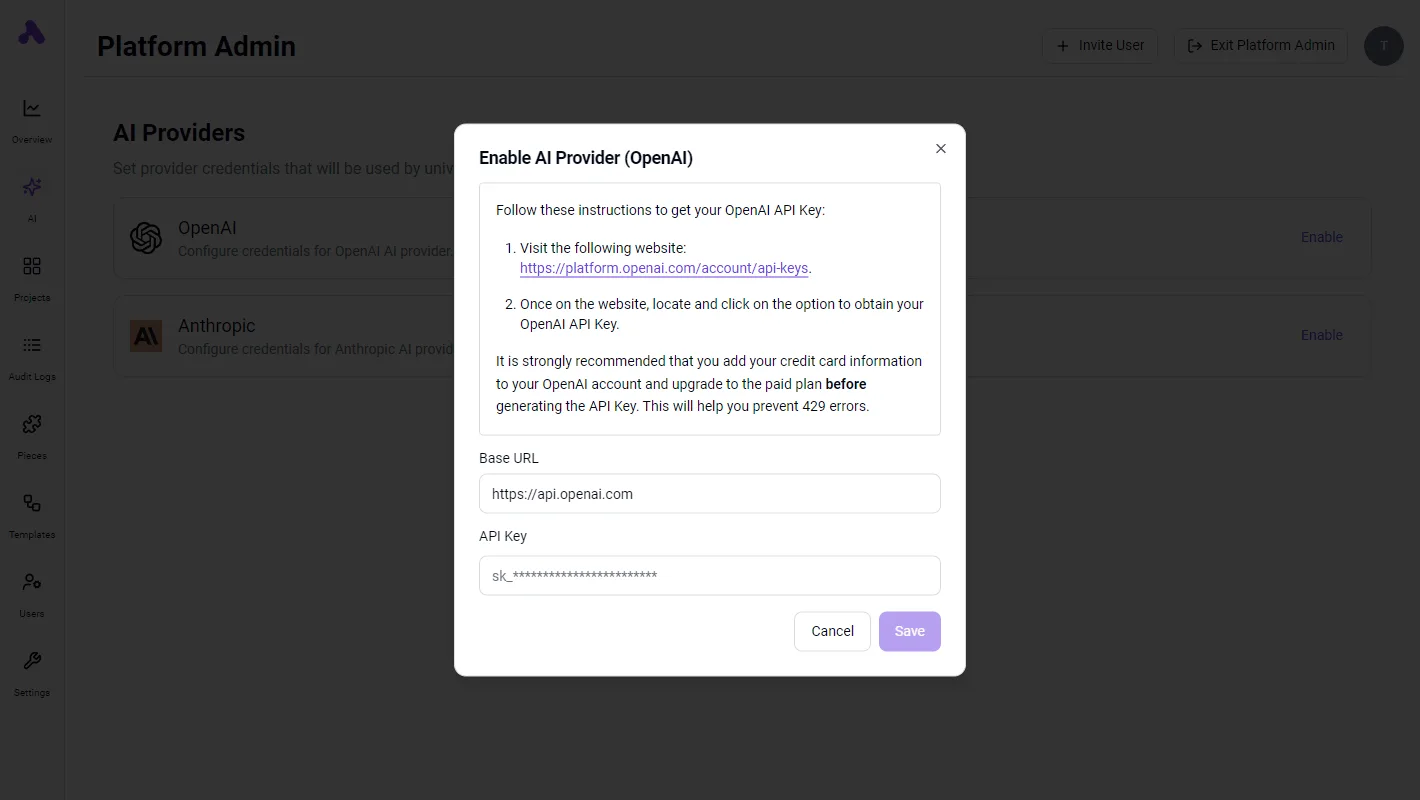
Proprietary business logic remains invisible to external platform telemetry under this deployment model.
Role-based access for AI prompt engineering
To ensure that only authorized personnel can modify the prompts and logic that drive AI-powered decisions, Activepieces implements granular role-based access control (RBAC) across its 735 integrations. Without these controls, any employee with access to the automation builder could inadvertently alter a system prompt.
By restricting the ability to edit flow steps to specific administrative tiers, you ensure that the core logic of your AI agents remains consistent across all departments.
Generating audit logs for LLM interactions
For every execution, the platform generates comprehensive audit logs that provide the forensic trail necessary to satisfy internal compliance officers and external regulators. These logs capture the exact input sent to an LLM and the raw output received.
When an automated agent provides incorrect or biased information, your engineering team can trace the failure back to the specific step and timestamp.
For organizations that demand absolute data sovereignty and the ability to audit AI decision-making within a private network, Activepieces is the better choice.
By offering an identical enterprise feature set across both cloud and air-gapped environments, it ensures that security protocols like custom RBAC and secret management are never compromised by the need for local hosting.
This architecture allows firms to maintain full control over their automation infrastructure without sacrificing the sophisticated administrative tools required for modern compliance.
A roadmap for implementing AI governance this week
Before the next billing cycle, you can patch documented vulnerabilities by conducting a comprehensive audit of existing API credentials and data pathways.
First, inventory all active LLM API keys to identify which services have access to your corporate credit card and production data.
Second, map data flows crossing national borders to ensure compliance with regional mandates like Brazil’s LGPD.
Third, identify 'Shadow AI' apps used by departments to consolidate these into a single, monitored environment.
Fourth, deploy a pilot monitoring tool on a restricted internal network to capture logs without exposing traffic to the public internet.
Inventorying unauthorized AI tool usage
By analyzing DNS logs and browser extensions, you can detect "Shadow AI" where employees paste company data into unmanaged interfaces.
IT can replace these touchpoints with enterprise versions of tools like GitHub Copilot. The Enterprise tier explicitly disables training on user code, ensuring efficiency gains don't cost ownership of your codebase.
Setting human-in-the-loop review requirements
To prevent legally binding commitments from a hallucinating bot, high-stakes automation must include a mandatory review step.
Governance frameworks should categorize tasks by risk. Low Risk tasks like internal document summarization require only periodic spot checks.
Governance frameworks should categorize tasks by risk.
Medium Risk tasks, such as automated email drafts, must be reviewed and sent manually by an account executive.
High Risk tasks like financial disbursements require two-factor authorization by a senior manager after the AI proposes a value.
Building a cross-functional AI ethics board
Weekly meetings between legal, IT, and department heads are necessary to review the "AI Incident Log" and update the allowed-use policy.
This board prevents "scope creep," where a tool approved for simple data entry is suddenly used for sensitive performance reviews.
By centralizing the decision-making process, you avoid a fragmented landscape where the marketing department operates under different privacy standards than the HR team.
Frequently asked questions about AI governance?
How does Brazil's LGPD affect AI data processing?
Under Brazil's General Data Protection Law (LGPD), data subjects have the right to request a review of decisions made solely by automated processing. This forces you to maintain a complete audit trail of every AI-generated output.
A "black box" approach to large language models creates a legal liability because the law requires transparency regarding the logic behind these decisions.
Without this data, you can't justify a loan rejection or a contract termination. To satisfy the principle of purpose limitation, data processed by an AI must be restricted to the specific task disclosed to the user.
Using customer support logs to train a general-purpose internal model without explicit consent constitutes a compliance breach.
You must therefore implement technical controls that strip personally identifiable information (PII) before data reaches the model inference stage. This ensures that sensitive Brazilian citizen data isn't permanently ingested into a provider's global weights.

Can AI governance tools detect hallucination in Spanish?
Detection accuracy in Spanish requires specific technical components, as effective hallucination detection depends on semantic cross-referencing against a localized knowledge base. While many governance platforms were built for English-first environments, Spanish-language support is specialized.
A retrieval-augmented generation (RAG) architecture compares the response to a verified Spanish-language source document.
Natural language inference (NLI) models specifically trained on regional dialects identify when a model is "hedging" or providing false positives in a local context. Finally, custom validation rules flag specific regional terminology or regulatory citations that a general model might invent.
What is the difference between AI observability and governance?
While AI observability focuses on the technical health and performance of the system, AI governance focuses on the legal, ethical, and policy constraints surrounding its use. Observability tools, such as the monitoring platform Arize, track metrics like request latency and token usage.
Engineers use this data to identify when a system is becoming too expensive or slow to remain functional.
Governance, conversely, operates as a policy layer that intercepts those requests to ensure they don't violate data sovereignty or safety rules.
While observability tells a developer that a model's output distribution has shifted, governance tells your legal department that the model has started leaking protected customer data in violation of regional privacy mandates.