Grok Pricing 2026: Every Plan, Rate, and Real Cost

Sep 29, 202614 min read
Grok pricing refers to the multi-tiered subscription model for xAI’s language model, ranging from a free basic access level to premium Enterprise plans designed for high-volume API integration and advanced computational tasks.
Grok pricing and plans for 2026 explained
Scaling from a $0/month entry point for casual social media interaction to a $100 monthly ceiling for enterprise users, Grok’s 2026 pricing structure matches its cost to the intensity of a user's technical demands.
While the floor is free, the ceiling is dictated by the compute costs of Grok 4.7’s massive context window.
The Free Tier: Basic access for social users
By offering the Free Tier at $0/month, xAI is able to use social media interactions as a low-cost RLHF (Reinforcement Learning from Human Feedback) pipeline.
When a user operates at this level, they receive limited rate-to-refresh cycles, meaning a standard research session will likely hit a "cool-down" period after just a few complex queries.
This tier is designed for discovery rather than production, as it lacks the dedicated compute priority found in the paid versions.
Grok Premium: The $20 standard for individuals
$30/month is the baseline for individual power users on SuperGrok, compared to the ChatGPT Plus plan which sits at $20/month, forcing consumers to weigh the $10 price difference against superior utility for their investment, as cost becomes a deciding factor alongside feature sets and model performance for the subscriber.
Consumers face an identical financial barrier when choosing between these two competing services.
While the $30 SuperGrok tier represents the standard individual tier, xAI brackets this option with the free tier and the $100 SuperGrok Plus configuration to capture different segments of the consumer market, so users are funneled into specific tiers based on their willingness to pay for varying levels of service.

The free tier provides basic access for casual users, whereas the $30 SuperGrok tier introduces priority queue access for heavier individual workloads, meaning that speed and responsiveness are gated behind a higher monthly commitment.
However, these low-cost entry points merely serve as a prelude to the true operational costs found in the Pro and Enterprise tiers. When users transition to high-frequency API usage and massive context windows, the monthly spend rapidly escalates toward the $300 ceiling.
This subscription unlocks Grok 4.7 for sustained use, though it still operates under shared hardware resources. For users who need to bridge these capabilities into automated workflows, Activepieces bills one credit per flow run regardless of the number of steps inside it.
By decoupling the cost from the granularity of the logic, it ensures that breaking a complex Grok prompt into a reliable multi-step chain does not increase the platform fee.
Grok Pro and Enterprise: Scaling to $300 monthly
Professional and Enterprise tiers scale costs based on context window utilization, where the true expense of long-horizon reasoning becomes visible. The following figures show how remaining token capacity diminishes as initial prompt size increases within the 1M context window:
A token represents the basic unit of data processed by the model, roughly equivalent to four characters of text or a single syllable in a word.
The context window defines the total number of these tokens that Grok can hold in its active memory during a single interaction.
When a user submits a massive prompt, the model must process and remember every single token simultaneously, which requires immense computational power and drives up the operational cost.
- After a 200k prompt, 800,000 tokens remain available, providing enough room for deep analysis of several large technical manuals.
- After a 500k prompt, 500,000 tokens remain, effectively halving the model's "memory" for the rest of the conversation.
- After an 800k prompt, only 200,000 tokens remain, forcing the user to either truncate their data or pay for a context refresh.
Because xAI must reserve significant VRAM to maintain state across such large datasets, these high-density prompts drive the monthly spend toward $300. Consequently, an enterprise running multiple 800k-token agents will find their "unlimited" access quickly gated by these tiered pricing increments.

If you are running this arithmetic for your own team, see what the same workload costs on Activepieces.
Current Grok subscription tiers at a glance
Grok’s pricing structure in 2026 functions as a ladder where each rung trades capital for the reduced latency and higher context ceilings required by autonomous workflows.
Furthermore, the jump to triple-digit monthly spends is the only way within Grok’s 2026 pricing structure to secure the high-frequency rate limits necessary for production-grade agentic work.
Grok’s pricing structure in 2026 functions as a ladder where each rung trades capital for the reduced latency and higher context ceilings required by autonomous workflows.
The following data illustrates the aggressive scaling of the 2026 Grok subscription model, showing how the cost of entry for hobbyists diverges sharply from the overhead required for heavy API integration.
| Tier | Monthly Price (USD) | Model Access | Rate Limits |
|---|---|---|---|
| Free | $0 | Restricted Grok 4.7 | Low-frequency bursts |
| SuperGrok | $30 | Full Grok 4.7 | Standard personal use |
| SuperGrok | $30 | Full Grok 4.7 | Priority queue access |
| X Premium+ | $40 | Full Grok 4.7 + Social | Enhanced social features |
| SuperGrok Plus | $100 | Full Grok 4.7 | High-volume API calls |
| SuperGrok Plus | $100 | Full Grok 4.7 | Enterprise-grade throughput |
Prices and plan limits checked against x.ai and docs.claude.com and openai.com and gemini.google on September 29, 2026.
This progression forces a specific choice: stay within the $30 range for manual prompting or commit to $300 to avoid the "gating" of agents mentioned previously.
For developers seeking a baseline for comparison, the Gemini Free plan offers several features: The Gemini Free plan costs $0 per month with a Google Account, allowing users to experiment with AI capabilities without any financial commitment. It provides 15 GB of cloud storage across Gmail, Drive, and Photos for immediate asset management, so users can integrate their existing digital archives directly into their workflow.
- Users can integrate development workflows without incurring recurring overhead. This sets a high bar for Grok’s $10 and $30 tiers, which must justify their cost through raw inference performance rather than bundled ecosystem storage, leaving little room for error in their value proposition, so users will likely migrate elsewhere if the speed gains are not immediately apparent.
- Subscribers are paying exclusively for computational output.
- When tasks shift to demanding reasoning and long-horizon agentic work, Claude Fable 5.1 serves as the primary benchmark for whether Grok’s $300 Heavy tier actually delivers superior logic per dollar spent, forcing a direct comparison between premium pricing and functional utility.
Comparing Grok to ChatGPT and Claude alternatives
Grok’s pricing structure positions it as a luxury utility rather than a commodity, with its top-tier plan costing three times more than the industry standard:
- While the base entry point remains competitive, the move to a $100 SuperGrok Plus tier means enterprise users are paying a significant premium for Grok 4.7’s high-frequency reasoning capabilities. This creates a distinct ceiling for individual developers who must choose between Grok’s uncapped API access and the $200 Claude Max plan, effectively narrowing the market to those with specific high-volume requirements, meaning the average hobbyist is likely priced out of these top-tier features.
- The Claude Max plan limits Anthropic’s Claude Opus 5.5 to specific message quotas, forcing users to weigh unlimited potential against a rigid operational bottleneck.
The following data illustrates the widening gap between general-purpose consumer tiers and the new "Heavy" enterprise class.
Premium AI subscription prices 2026 shows that while most frontier models have stabilized around the hundred-dollar mark, xAI has decoupled its pricing from the rest of the market.
This shift forces CTOs to justify a 200% price increase over ChatGPT Pro, which sits at $100 for access to GPT-6 Astra.
| Provider | Top-Tier Subscription | Monthly Cost |
|---|---|---|
| xAI | SuperGrok Plus | $100 |
| Anthropic | Claude Max | $200 |
| OpenAI | ChatGPT Pro | $100 |
| AI Ultra | $99.99 |

Even the most integrated ecosystems, such as the $99.99 Google AI Ultra tier, which provides Antigravity Agent for secure Linux sandboxing, are now positioned as budget-friendly alternatives compared to Grok, suggesting that Grok is targeting a premium segment that prioritizes raw power over bundled utility tools.
This signals a shift where premium enterprise tools are being marketed as cost-effective entry points. This pricing delta reflects a bet that xAI’s real-time data integration is worth the surplus.
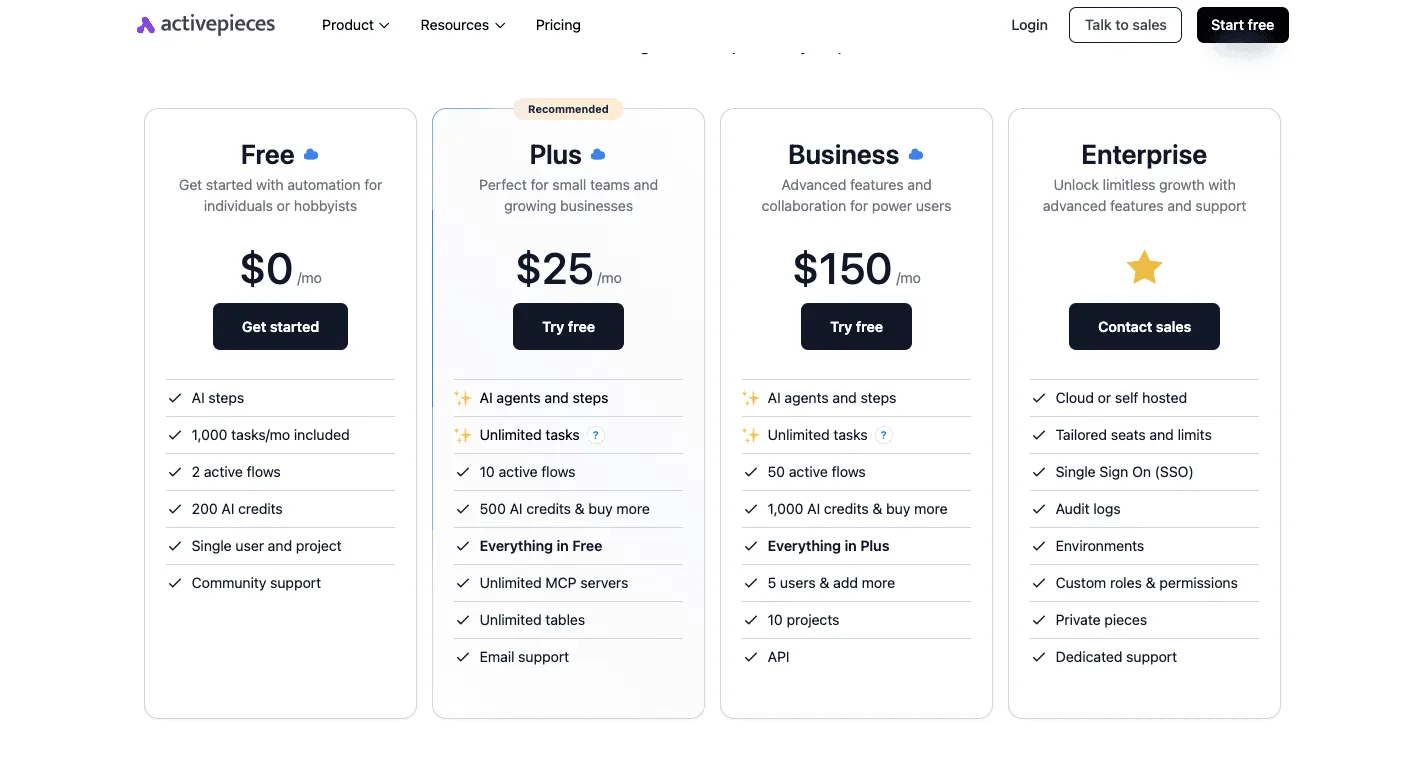
Worth checking against a plan that does not meter every step: one credit covers a whole run on Activepieces.
Hidden costs and usage limits in Grok plans
Unpredictable operational pauses and compounding token expenses often disrupt automated workflows, subverting the value proposition of these plans.
Grok API rate limits and cool-downs
Unpredictable
Scaling Grok usage through API automation
By ensuring that high-reasoning tokens are only consumed when specific business triggers are met, automating Grok API calls via a visual logic builder prevents financial leakage.
This approach stops the waste common in manual chat interfaces where every casual query incurs the same overhead as a complex data extraction.
Because Grok enforces strict request-per-minute ceilings on its API tiers, a sudden burst of automated tasks can trigger a service suspension that halts all active business processes.
Unlike the flexible limits found in the consumer interface, API rate limits are rigid; exceeding them results in immediate 429 errors, so developers must implement exponential backoff strategies to prevent workflow failure.

The following automation sequence demonstrates how to structure these calls by inserting a verification step before the model is engaged.
- The workflow shows a multi-stage reimbursement tracker where human input is structured by AI before being committed to a database, ensuring the expensive Grok 4.7 model only processes cleaned, relevant data.
- By selecting the extraction step, a user can configure exactly how the model interprets the input, which reduces the need for costly retries.
Grok context window pricing for long documents
Large-scale analysis in Grok 4.7 requires passing extensive context into the prompt, which creates a compounding expense as every previous message is re-processed in subsequent turns.
This "context bloating" means that a single long-form document analysis can cost significantly more than a standard query, so users must utilize automated trimming to keep the payload lean.
- Claude Fable 5.1: A reasoning-heavy model used for auditing the logic of Grok’s outputs to ensure accuracy.
- GPT-6 Luna: An efficiency-focused model used to summarize raw data before it hits the Grok API to save on input tokens.
- Gemini 3.8 Flash: A high-throughput model that handles basic categorization, leaving only the final reasoning to Grok.
API credits vs UI subscriptions
Organizations must manage a separate balance of pre-paid credits to keep their integrations live, as maintaining a Grok Pro subscription does not grant unlimited access to the API.
This dual-cost structure means that a team might pay for a monthly seat and still face a service outage if their API wallet hits zero, requiring a manual top-up to resume operations.
Because API pricing is strictly consumption-based, a single runaway script can exhaust a monthly budget in hours, unlike the predictable flat fee of the web-based Pro tier.
For teams requiring strict governance over these high-frequency API costs, Activepieces provides per-project and per-person AI cost caps to keep automated workflows within budget.
These controls, alongside custom RBAC and audit logs, are available in the self-hosted air-gapped edition just as they are in the managed cloud, allowing regulated organizations like FundingSocieties to maintain full oversight of their AI spend.
Estimating your total Grok pricing costs
To determine whether a Grok Enterprise plan reduces your total cost of ownership, you must audit your current multi-model API consumption against xAI’s flat-rate structures to identify hidden volume inefficiencies.
What Activepieces does about this
To mitigate the financial volatility of Grok’s $100 SuperGrok Plus tier and the dual-cost structure of API credits, Activepieces functions as an orchestration layer that enforces strict budget governance, so teams can avoid unexpected overages that might otherwise exceed their allocated monthly spend.
By utilizing the platform’s per-project and per-person AI cost caps, organizations can prevent runaway scripts from exhausting their API wallets.
These controls allow teams to set hard limits on token consumption, ensuring that automated Grok 4.7 workflows remain within a predictable monthly budget rather than triggering unexpected manual top-ups.
For enterprise users concerned about the high cost of context bloating, Activepieces allows for the construction of multi-model chains that protect the Grok context window.
A workflow can be configured to use a cheaper model, like Gemini 3.8 Flash, to summarize and clean raw data before passing only the essential reasoning tasks to Grok.
This ensures that the expensive 1M context window is only utilized for high-value logic, effectively lowering the total cost per run by reducing the input token count.

Because Activepieces is open source under the MIT license, organizations can self-host the platform to maintain full data sovereignty while managing their AI spend.
This self-hosted architecture includes custom RBAC and detailed audit logs, providing the same level of oversight used by regulated customers like FundingSocieties.
By centralizing Grok integrations within this framework, businesses can audit their total cost of ownership in real-time and pivot between models if Grok’s $100 ceiling no longer aligns with their operational ROI, ensuring that high-tier access remains justifiable based on actual performance metrics, so companies avoid overpaying for underutilized AI capacity.
Frequently asked questions about Grok pricing
Prioritizing a flat-rate margin over the tiered subsidies common in academic or retail software markets, Grok pricing structures remain rigid across individual and corporate accounts.
Does Grok offer a student discount?
Learners must pay the same overhead as professional developers because xAI does not currently provide a specific price reduction for students.
This lack of a subsidized tier forces students to choose between the full monthly subscription cost or utilizing free-tier alternatives from competitors who offer educational verification programs.
Can I use Grok API credits in the X app?
Funds deposited for developer tools cannot be applied to a premium social account because API credits and social media subscriptions exist in separate billing silos.
Because these balances are not interchangeable, a developer building with Grok 4.7 must maintain a credit balance for programmatic calls while paying a separate recurring fee to access the model’s interface within the X platform.
What happens if I exceed my monthly Grok limit?
When a user exceeds the usage cap on a standard plan, the system triggers a fallback to a less capable version of the model, which significantly degrades the quality of complex reasoning and coding outputs.
For API users, exceeding a pre-paid balance results in an immediate service suspension, meaning automated workflows will fail until a manual top-up or an automated billing threshold is met.
Is there a yearly discount for Grok Premium?
Annual billing is available for individual tiers to provide a lower effective monthly rate, though this requires an upfront commitment that locks the user into the current model suite.
While choosing the yearly option reduces the total annual spend compared to month-to-month billing, it eliminates the flexibility to pivot to a different provider if a model like Claude Opus 5.5 or GPT-6 Astra becomes more cost-effective for your specific stack mid-year.
Running the numbers
See what the same workload costs here.
Free forever plan, and every paid plan self-hosts at no extra cost.
See pricing Talk to sales