

Scope: the recommended production setup (
SANDBOX_CODE_ONLY, AP_REUSE_SANDBOX=true, one flow per worker), which self-hosted deployments and dedicated Cloud workers run. The shared Cloud freemium pool uses a different sandbox. See Production Setup.What to expect
Warm vs cold
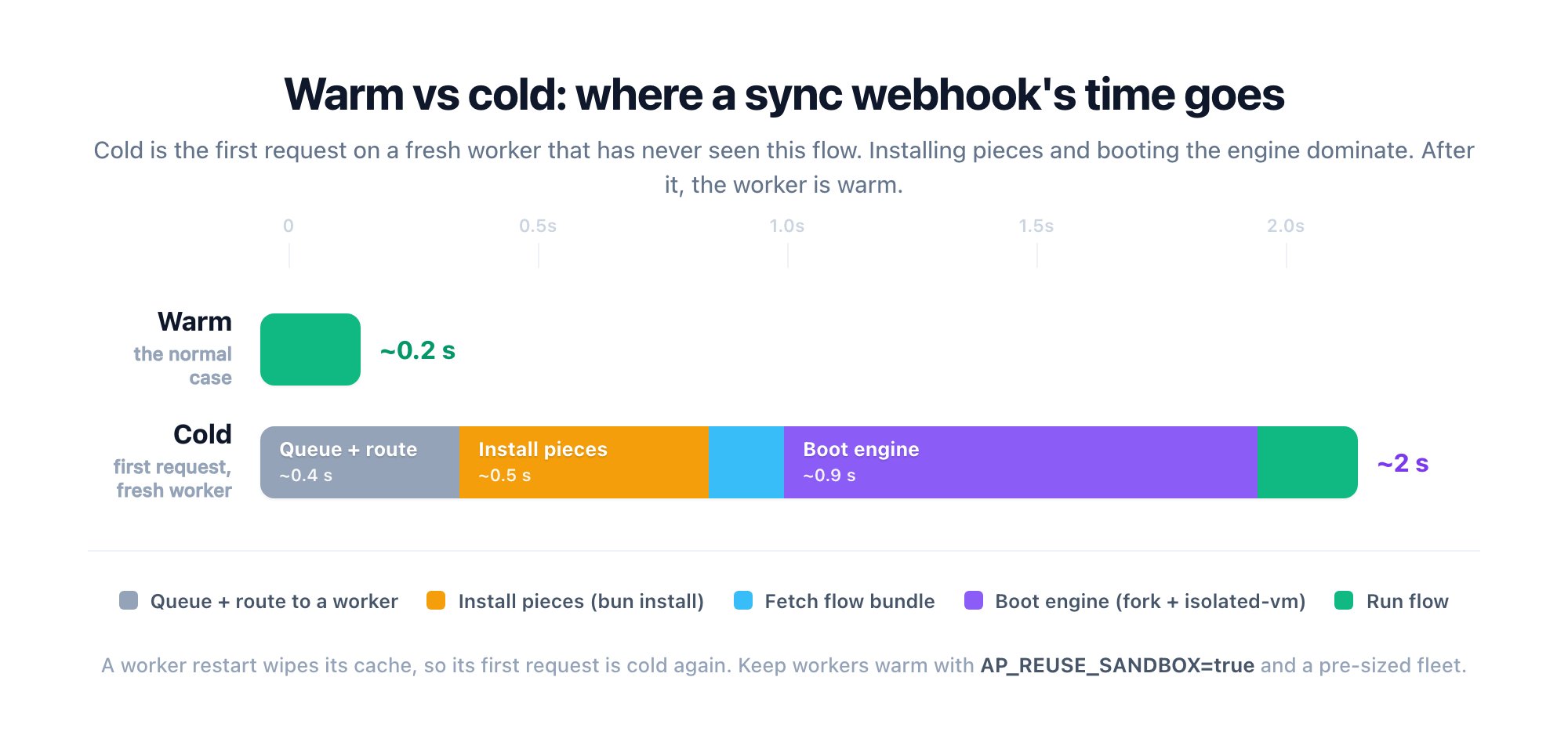
- It is the first request after a deploy, restart, or scale-up.
AP_REUSE_SANDBOXis off (then every request is cold).- A burst exceeds your warm worker count. Each worker runs one flow at a time, so the surplus queues or starts cold.
Per-run breakdown
Every run records where its wall-clock time went, shown as a four-phase bar. To view it, open any run and hover the info icon next to the run’s duration (“Took”) in the run header.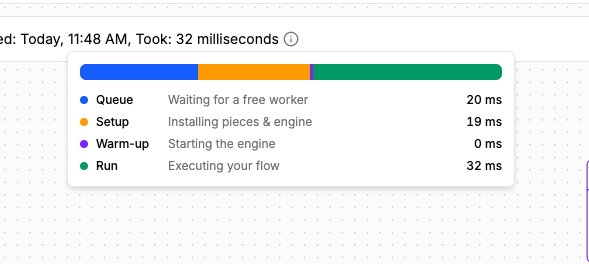
Queue, Setup, and Warm-up are the orchestration around your flow; Run is the flow itself. On a warm worker the first three collapse toward zero — the reused sandbox is already booted, so Warm-up is ~0 — and the bar is almost entirely Run, which is why warm calls are dominated by your own work.
Where the Run phase actually goes
For a flow that does real work — a step calling a third-party API — that outbound call dominates Run, and the Activepieces overhead is the smaller number next to it. For a bare flow (no external calls), Run is mostly persisting the run, not executing it. A production run makes a fixed set of network round-trips to the app and object store, independent of step count:- Two log-backup writes to your object store (S3/GCS) — an initial snapshot and a final one. With signed URLs on, each is a direct worker→object-store upload. On a warm in-region cluster this is the single largest slice of Run (measured ~45% of worker-busy time); on a distant or public object-store endpoint it grows proportionally.
- A handful of worker→app callbacks (send-response, run-log metadata) — each roughly one worker→app round-trip. Database and Redis touches ride inside these and are a few ms each.
Measured (warm)
Four-step flow (webhook, math, code inisolated-vm, response), single warm call, no contention:
The same setup measures ~165 ms unloaded and ~200 ms average under sustained peak (160 workers, p50 180 ms / p99 652 ms): the shared database absorbing load, not the flow slowing. Always ask which load a figure was measured under. Throughput view: Benchmark.
Reduce it
- Keep workers warm:
AP_REUSE_SANDBOX=trueplus a statically sized, always-on fleet. - Put the object store next to the workers: a bare warm run spends most of its Run phase on two log-backup writes to S3/GCS. In-region, same-zone, private connectivity to the object store is the biggest lever on that overhead — a distant or public endpoint multiplies it.
- Size for peak concurrency: N concurrent requests need N warm workers (sizing).
- Fewer, heavier steps: each step adds overhead.
- Don’t let a slow third party block the response: use an async webhook and callback instead of holding against the 30 s ceiling.