
Apty Pricing: Quote-Based Digital Adoption (2026)

Nov 22, 202613 min read
Apty is a digital adoption platform that sells by quote.
I found no list price on apty.com on 2026-11-22, so the number you pay is the one on your own proposal, much as with other Activepieces-adjacent software buyers weigh up, where the quote is the starting point rather than a sticker price.

It layers step-by-step guidance over business software, so employees learn a new system while they're using it. The buyer is usually whoever runs a rollout or a training budget. That's why it's bought through a quote tied to a project, not with a card.
Apty plans, prices and limits
| Item | What apty.com states | Checked |
|---|---|---|
| Plan names and tiers | Not published | 2026-11-22 |
| Price per plan | Not published | 2026-11-22 |
| Billing basis | Not published | 2026-11-22 |
| User and app limits | Not published | 2026-11-22 |
| Services and renewal terms | Not published | 2026-11-22 |
You can't compare Apty to a competitor line by line, because every row is blank. You compare first-year contract totals.
Why Apty doesn't publish its pricing
You will see this silence on price often at this end of the market:
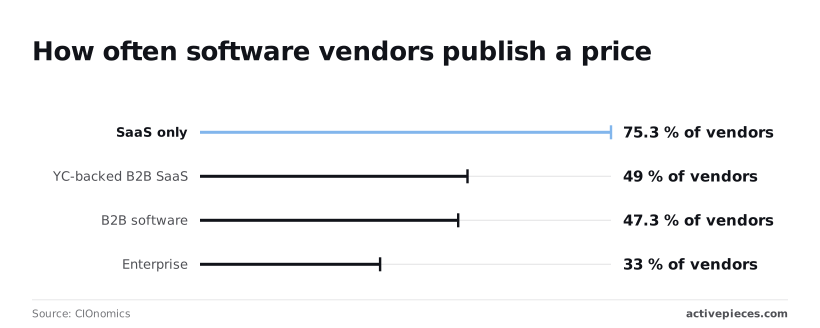
- CIOnomics found that 75.3% of SaaS-only vendors publish prices
- Only 49% of YC-backed B2B SaaS vendors publish prices, so buyers of venture-backed B2B SaaS often must request pricing from sales
- The figures are 47.3% for B2B software and 33% for enterprise software
- Two enterprise vendors in three keep the number private, so Apty's quote-only model isn't a warning sign
- Put the same questions to every vendor and judge the answers
When a vendor does publish, comparison is easy.
The pricing page of Activepieces sets four plans side by side: Free at $0, Plus at $20 a month, Team at $200 a month and Ultimate marked custom, so only the top tier needs a sales conversation before you learn its cost (activepieces.com/pricing, checked 2026-10-23).
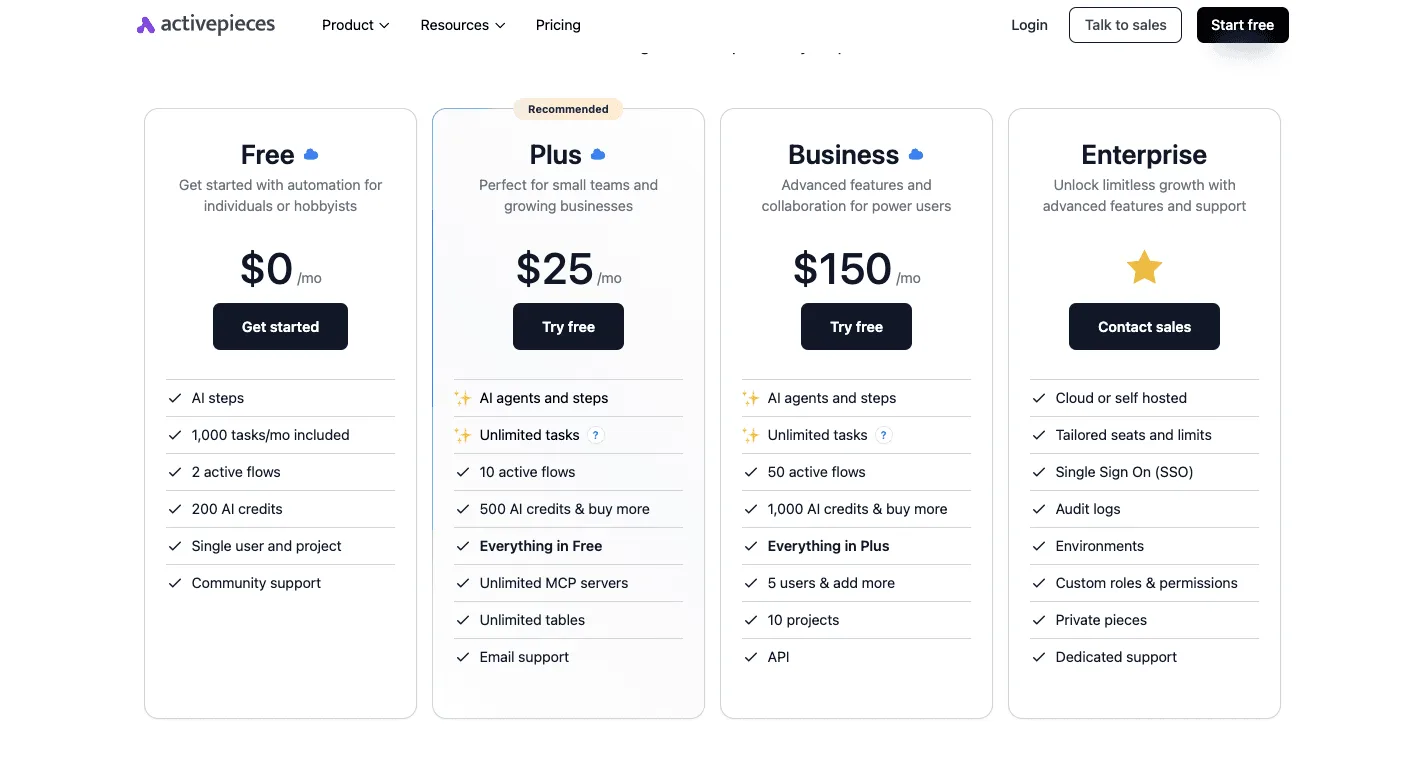
With Apty you can't read that comparison off a page until the quote arrives. Next comes what to ask for in that quote.
If you are running this arithmetic for your own team, see what the same workload costs on Activepieces.
What Apty costs at realistic company usage
At every size, first-year cost starts at Apty's contract minimum and grows with users, applications and services. Any figure you build is an estimate until a written quote replaces it. The table shows which inputs are published and which are assumptions you must test.
| Employees | Licence | Users | Apps | Services | Renewal |
|---|---|---|---|---|---|
| 100 | Published: Vendr's reported minimum is the floor | Assumption: only daily users of the application | Assumption: one | Assumption: light onboarding | Assumption: matches year one |
| 500 | Published: same floor, likely exceeded | Assumption: a subset by role | Assumption: several | Assumption: scoped training and content | Assumption: uplift possible |
| 2,000 | Assumption: negotiated, multi-year | Assumption: sized by department | Assumption: many | Assumption: dedicated rollout support | Assumption: capped in contract |
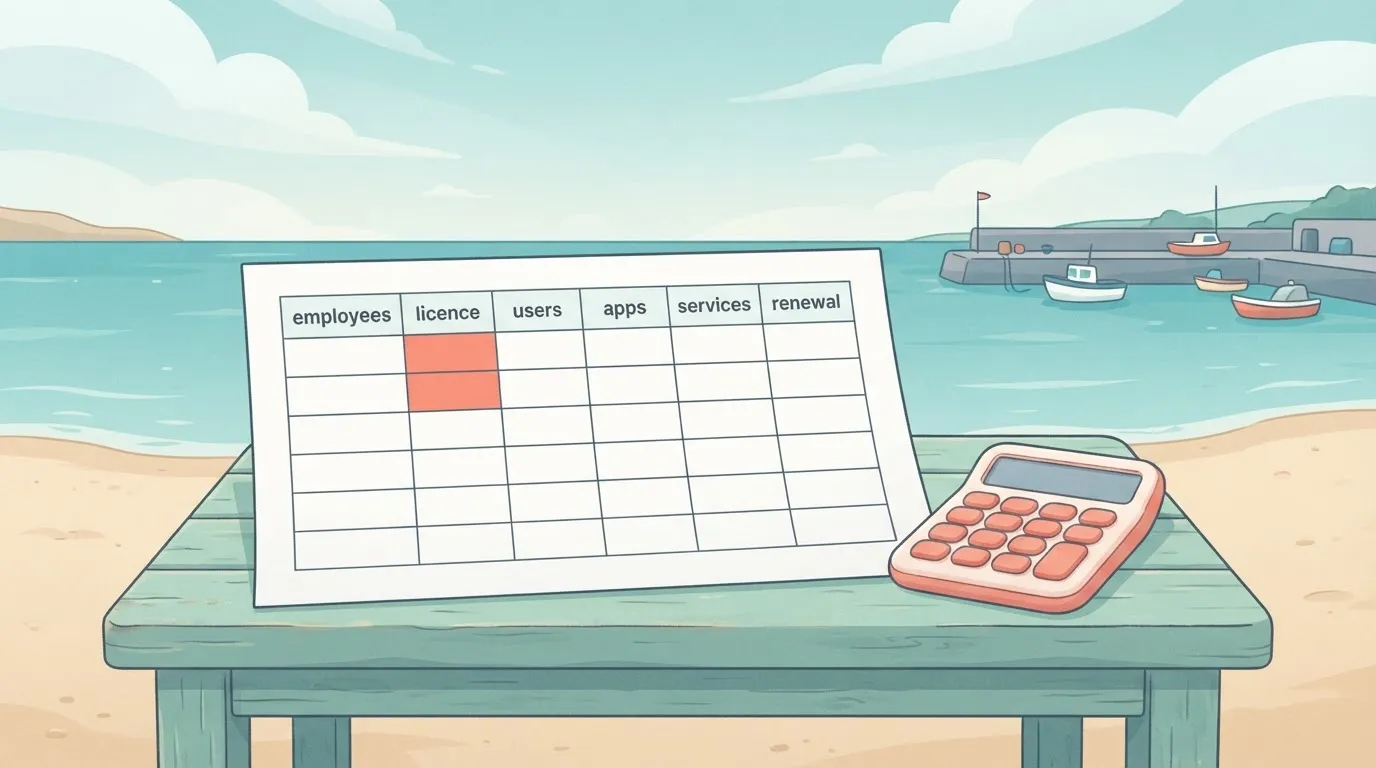
You will find only the floor published, and it comes from Vendr, a third-party buyer-data source, so confirm it on Apty's own pricing page and date it. Everything else is yours to pin down.
For a small team with one application, the floor does most of the work, so you're likely paying near the minimum. Count only people who use it daily; paying for the whole headcount is the commonest overspend.
In a mid-size rollout across several applications, each added application raises the scope, and services start to matter. Ask whether training and content setup are inside the licence or billed separately, because that line moves the total more than the seat count does.
At enterprise scale, a multi-year term can lower the annual rate, but it locks you in. Get the renewal cap written into the contract before you sign.
Vendors will tell you quoting lets them fit the deal to your applications, user mix and support needs instead of charging everyone for a bundle they won't use.
That's a fair argument, but it only holds if you get the quote in writing and compare the total first-year cost against alternatives.
Apty's hidden costs and usage limits
Ask about five costs before you sign, because the ones that change an Apty quote sit mostly outside the licence line. The list below is what to put in front of the sales rep.
Take each answer in writing, and treat anything the pricing page states, once you have dated it, as vendor-stated.
- Implementation: who does the setup, and is it billed separately? Question for sales.
- Content authoring time: how many hours your staff spend building guidance. Question for sales.
- User and app limits: what the plan caps, and what breaching a cap costs. Question for sales.
- Gated features and support level: which capabilities and which support tier need a higher plan. Question for sales.
- Renewal uplift: the percentage increase in year two, and whether it's capped. Question for sales.
Each item gets a short note below. On implementation, ask whether setup is included or quoted as services. A free licence with a paid rollout still lands in your first-year total.
Someone has to build and maintain every walkthrough, so authoring is your own labour. Seats matter just as much:
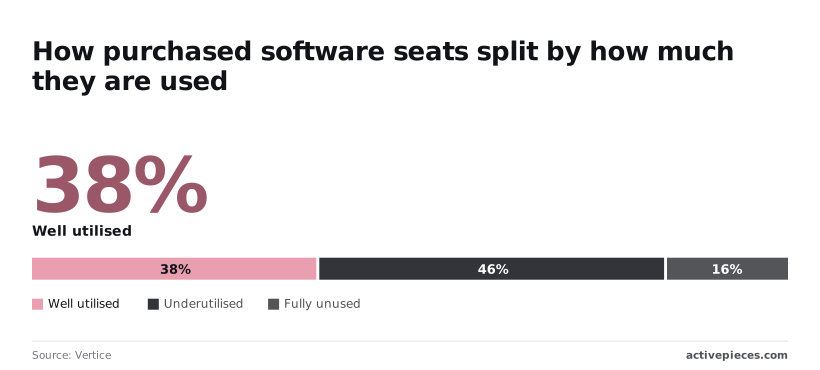
- Vertice found 38% of purchased licences well utilised, 46% underutilised and 16% fully unused
- That means 62% of seats aren't pulling their weight, so don't size the quote to your whole headcount
- Start with the people who will actually use it and negotiate room to grow

Get a feature-by-feature list of what each plan includes, and the support level attached to each. Assume nothing you saw in a demo is in the cheapest tier.
Year one is the price they want you to see. Get the renewal uplift capped in the contract, so year two doesn't arrive as a surprise.
Worth checking against a plan that does not meter every step: one credit covers a whole run on Activepieces.
How Apty stacks against rivals
As far as the public pages we can rely on show, Apty sells by quote, and so do the three rivals. The fair comparison is each vendor's first-year contract, with the cap on the renewal uplift written in, not a sticker price.
Apty pricing compared with rival vendors
Here is what each vendor publishes today. Where it says "not published", the number only exists in a quote, so you must ask for it in writing and treat the answer as the thing to compare.
| Vendor | Price or quote-only | Pricing unit | Features | Trial or demo | Contract term | Check date |
|---|---|---|---|---|---|---|
| Apty | Quote-only | not published | not published | not published | not published | Re-verify on Apty's pricing page |
| WalkMe | not published | not published | not published | not published | not published | Re-verify on WalkMe's pricing page |
| Whatfix | not published | not published | not published | not published | not published | Re-verify on Whatfix's pricing page |
| Userlane | not published | not published | not published | not published | not published | Re-verify on Userlane's pricing page |
You can't rank these four on public data, and the mostly empty cells are the finding. So put the same questions to each: unit, apps covered, services, term, renewal.
Whether Apty comes out cheaper depends on what its quote counts. If it prices by users and a rival prices by apps, the same rollout can flip order as you add either.
Ask each vendor to quote the identical scope, then compare the totals line by line.
For one application and a small team, a lighter tool with a shorter commitment will often cost less over the first year than a platform built for many apps.
Choose the heavier platform only when your roadmap needs the extra apps and reporting within the contract term.
Where Activepieces fits next to Apty
Activepieces is workflow automation, not digital adoption software, so even with 750 integrations it can't stand in for Apty and shouldn't appear in your quote comparison as an alternative to it.
That matters because a buyer squeezing a first-year budget will sometimes ask whether a cheaper tool can do the same job. It can't. The two products solve different problems, and treating them as rivals leads to a line item you can't justify later.
How user guidance differs from system integration?
Apty sits inside your business applications and guides users through screens, fields and processes while they work.
Activepieces sits behind the scenes and moves information between systems across its 750 integrations: when something happens in one tool, it triggers an action in another, meaning most of your existing tools probably have built-in connectors.
So Activepieces doesn't replace in-app walkthroughs, on-screen prompts or task guidance; its 750 integrations connect systems, not screens, which means you still need a separate tool for in-app guidance.
If your reason for buying Apty is to change what a user does inside a screen, no workflow tool will do that for you.
Cut Apty from the budget in favour of Activepieces' $0 Free plan and you have removed the guidance and kept only the plumbing, so you're now dependent on internal expertise.
Automation around an Apty rollout
Where the two do overlap, it is narrow but useful. Once Apty is live, you'll want adoption data and survey responses to reach the people who act on them, rather than sitting in a dashboard nobody opens.
A workflow tool can carry that data onward, and Activepieces does it at 1 credit per run however many steps the flow has, as its published pricing page states, so a flow that reads survey responses, opens a ticket and posts to team chat costs the same as one that only copies a row.

Zapier's per-task billing and Make's per-module billing both meter that three-step flow as three, while Activepieces counts it once. Its Free plan includes 1,000 credits a month and unlimited flows.
The illustration below shows the arrangement. Apty is on one side, Activepieces on the other, and one arrow carries adoption data and survey responses across, then on to a spreadsheet and a team chat tool, each reached through one of Activepieces' 750 integrations.
Take from it that the follow-up is the only part Activepieces carries, and on the $0 Free plan that is 1,000 credits a month; every piece of guidance, and the quote for it, still comes from Apty.
Before you count on this, check Apty's own pricing and documentation pages. Confirm that the export or integration route you need is included in your quote, and note the date you checked. If it's a paid extra, it belongs in your first-year total.
What to do before signing an Apty quote
Put every cost into one first-year total, and make Apty and two alternatives quote against the same list of applications and users. The six steps run in the order a negotiation does, so each one gives you something to use in the next:
- List your applications and user counts.
- Get written quotes from Apty and two alternatives.
- Ask the hidden-cost questions.
- Negotiate renewal caps.
- Pilot one application.
- Set a re-check date.
The first two steps make the quotes comparable, which means you must complete both before comparing them. The rest decide what you actually pay.
Write down every application you want covered and how many people use each one. A vendor quoting 200 users and another quoting 120 have given you two numbers you can't compare.
Send all three vendors the same sheet and ask for the answer in writing, so the quote is a document you can hold them to.
Questions to put to sales
Ask what sits outside the licence: implementation, training, extra applications, support tiers. Anything they name is a line to add to your total.
Then expect less room on price. Vendr found average enterprise SaaS negotiation discounts fell from 11% in 2022 to 9% in Q1 2023 and 7% in Q2 2023.
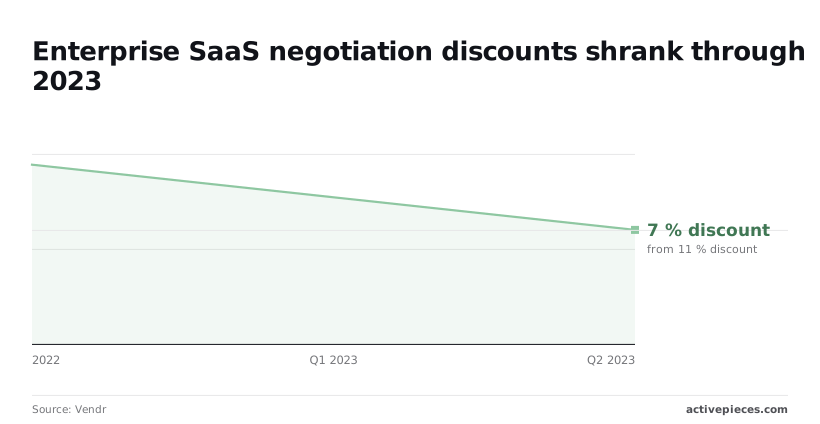
Opening-price haggling now buys you less, so spend your effort on a written cap for the renewal increase. That cap protects years two and three, where the savings compound.
**Opening-price haggling now buys you less, so spend your effort on a written cap for the renewal increase.
How to pilot before committing
Pilot one application with a small group before you pay for the full user count. If it fails, you have lost a pilot, not a contract.
Before signing, re-check every price on Apty's own pricing page and note the date. Then set a calendar re-check ahead of the renewal notice window, so the cap you negotiated gets tested while you can still walk away.
Frequently asked questions
Does Apty have a free plan or free trial?
Treat a free plan or trial as unconfirmed until Apty's own pricing page shows one on the day you check. Write down that date.
If the page offers none, ask for a time-boxed pilot in writing as part of the quote, and ask what it converts into when it ends.
Is Apty priced per user or per application?
Expect both to shape the quote, because users and the apps you guide are separate levers in the contract. Ask for each as its own line item.
Then you can see which one drives the total, and which one grows when your rollout does.
Can you buy Apty without talking to sales?
Plan on a quote, which means a sales conversation. Since the price is whatever the quote says, the useful move is to bring your user count, your application list and your services needs to that conversation.
That way the quote covers first-year cost and not a partial figure.
If the pricing page later shows a self-serve purchase path, trust the page over this answer.
Does Apty offer discounts for multi-year contracts?
Don't assume either way. Ask for the one-year and multi-year quotes side by side, with the same scope, and compare the total across the full term.
A lower annual rate only helps if the renewal terms are also fixed in writing and the cap on increases is stated in the contract.
How often does Apty change its pricing?
Apty doesn't publish a list price, so there's no price history to lean on. You'll feel any change at renewal, when the new quote lands.
Re-verify the pricing page before you sign and again ahead of the renewal notice window, and keep the dates beside the figures. That way you can tell what changed and when you could still walk away.
Related reading
Running the numbers
See what the same workload costs here.
Free forever plan, and every paid plan self-hosts at no extra cost.
See pricing Talk to sales