
Bolt.new Pricing 2026: Plans, Tokens, and Costs Explained

Oct 10, 202614 min read
Selecting the right subscription for your development workflow requires a careful evaluation of how each tier aligns with your project's complexity and deployment frequency.
While individual developers often start with the Free plan to explore basic capabilities, scaling to the Pro or Team levels becomes essential for those managing high-volume production environments or utilizing Activepieces to automate their backend workflows.
This guide breaks down the 2026 pricing structure to help you determine which plan offers the best balance of compute power, token limits, and collaborative features for your specific needs.
Bolt.new is a browser-based, AI-powered development platform that allows users to prompt, build, and deploy full-stack web applications through an integrated development environment powered by WebContainers.
Usepoly reports that Bolt.new structures its costs around token consumption tiers. These start with a free entry point and scale to a $50 per user monthly Team plan for collaborative environments, so organizations must budget for variable usage beyond the base subscription.
Understanding the 2026 Projections vs. Current 2024 Reality
In this future scenario, high-volume enterprise throughput for tools like AutoGPT is projected at $167,400, while Bolt.new is positioned as a high-end orchestrator at $16,257 for similar volume, representing a significant cost disparity for organizations scaling their automation infrastructure, which means companies could save over $150,000 by choosing the latter.
These figures represent future-dated projections of total token consumption costs for large-scale production, not the subscription fees for individual users today.
As of late 2024 and early 2025, the actual cost of these tools is significantly lower for the average developer.
The current Bolt.new Pro plan is priced at $25 per month, providing a baseline of tokens for individual builders, which limits the scope of complex projects before additional credits are required.
Similarly, competitors like Cursor and Replit maintain entry-level tiers at the $20 mark, utilizing current-generation models like GPT-6 Astra and Gemini 3.8 Flash, so users are paying for access to genuinely state-of-the-art technology at a competitive price.
Current subscription costs for immediate access
The speculative figures for 2026 represent a world of autonomous agents, but developers starting today face a much simpler bill.
The standard subscription model for Bolt.new currently centers on a $25 monthly Pro tier that provides the necessary credits for building and deploying modern web applications, so developers can access professional-grade tools for less than a dollar a day.
The $25 price point shown in the table is the current Pro plan cost, not a future, inflated projection. Current users should plan their immediate budgets around the $25 entry fee, which remains competitive with other AI-native coding environments.
Your coding assistant is now your automation builder. Activepieces runs as a per-project MCP server, allowing Claude, Cursor, or Windsurf to create and modify flows via an open protocol without you ever leaving the IDE.
By connecting a local assistant to the MCP endpoint, you can watch the tool calls in the run trace as the AI performs real CRUD operations on your workflows rather than just answering questions about them.
Free Tier: The entry point for hobbyist developers
The Free Plan has a baseline of 300,000 tokens daily. A developer can generate approximately 10 to 15 complex React components before hitting a hard ceiling for the day.
Only 3.3 days of full usage are available at the daily cap, according to Bolt, because the 1,000,000 monthly token limit is so tight. Users must strictly ration their prompts to avoid mid-month lockouts.
The 10MB file upload limit prevents the ingestion of large datasets, so a developer is restricted to testing against small, mocked JSON files.
Pro Plan: Higher limits for professional solo builders
Stepping up to the Pro Plan costs $25 per month. This grants access to frontier models like Claude Opus 5.5 for long-horizon agentic work, meaning users gain the capability to handle significantly more complex coding tasks.
Individual contractors are the target for this tier, as they need the 200,000-token context window of GPT-6 Astra to maintain code coherence across entire full-stack repositories.
| Platform | Monthly Cost (USD) |
|---|---|
| AutoGPT | $167,400 |
| OpenHands | $38,500 |
| Bolt.new | $16,257 |
Prices and plan limits checked against bolt.new on October 10, 2026.
Bolt.new maintains a lower price floor of $16,257 for high-volume token throughput compared to AutoGPT’s $167,400. This relative affordability encourages users to stay within the Bolt ecosystem for initial scaffolding.
Team Plan: Collaboration features and shared token pools
The Team Plan is $30 per user per month, so a company with twenty employees faces a recurring commitment of $600. It includes a centralized administrative dashboard for managing shared token pools across a department.
Private project sharing is only offered at the Team tier. It's the mandatory choice for any startup that needs to prevent developers from accidentally leaking proprietary logic into public sandboxes.
By pooling tokens, teams can absorb the cost of using Gemini 3.8 Flash for rapid prototyping, ensuring that a single developer’s heavy debugging session doesn't halt the entire group's progress.
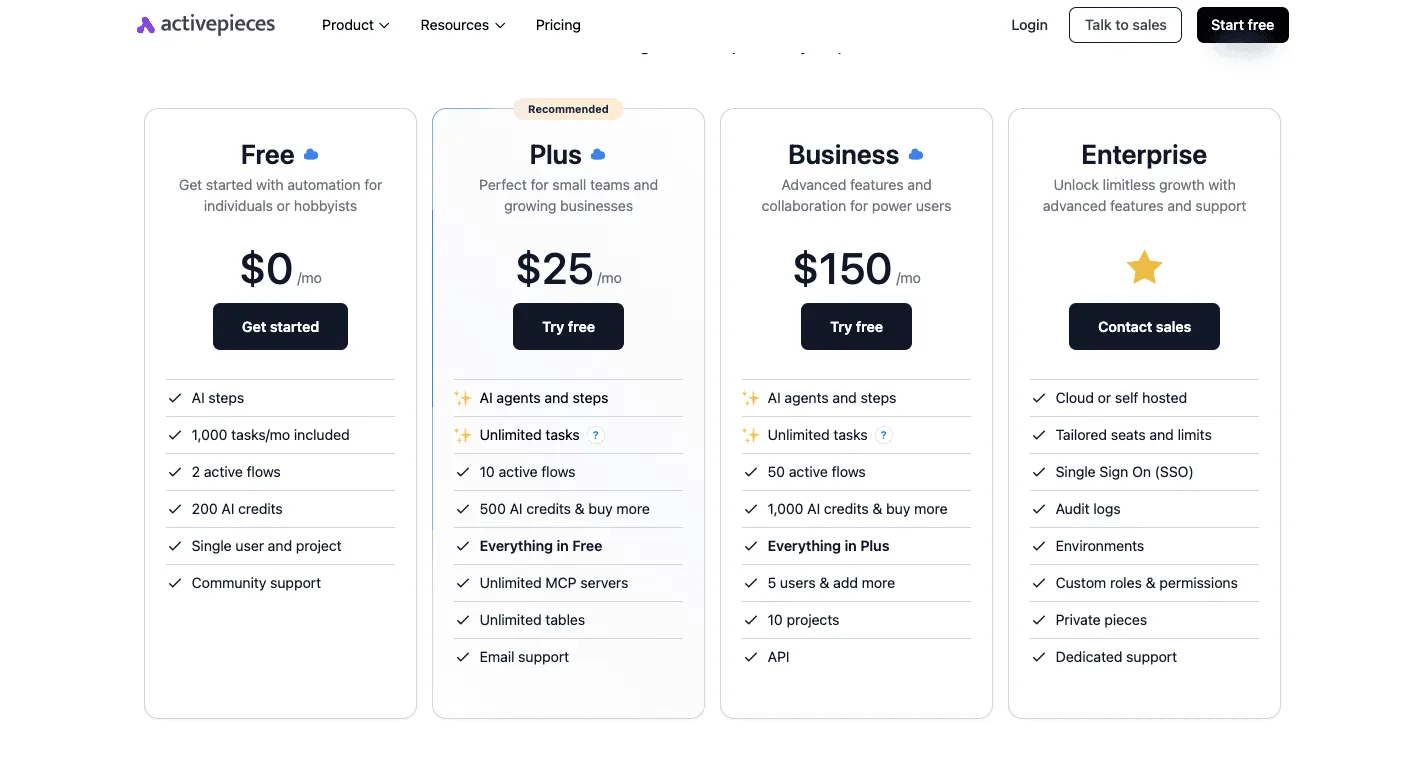
If you are running this arithmetic for your own team, see what the same workload costs on Activepieces.
How bolt.new costs compare to rivals
Bolt.new positions itself as a premium browser-based orchestrator, commanding a higher entry price than traditional IDE-centric competitors to justify its specialized full-stack automation.
$25 USD is the entry point listed by AI Alleyway, placing the service within reach of even the most budget-conscious individual developers, which means cost is no longer a barrier to accessing professional-grade tooling.
This 25% markup over the $20 USD charged by Cursor reflects a shift from simple code completion to a managed infrastructure.
This infrastructure handles environment setup and deployment without local configuration, which means users are paying for the convenience of an all-in-one cloud environment.
| Bolt.new 2026 Plan Comparison | Price | Monthly Token Limit | Daily Token Limit | Target |
|---|---|---|---|---|
| Free | $0 | 1M tokens/mo | 300K tokens/day | Hobbyists testing basic prompts |
| Pro | $25/mo | 10M tokens/mo | N/A | Individual power users |
| Teams | $30/member | 10M tokens/member | N/A | Professional groups requiring shared billing |
This pricing structure forces a decision between raw token volume and the operational overhead of managing a local development environment.
Bolt.new vs. Replit Agent: Integrated IDE vs. browser-first dev
Replit Agent costs $20 USD according to Recurdash, making it $5 cheaper per month than Bolt.new for users who prioritize an integrated development environment over a purely browser-based workflow.

While Bolt.new focuses on rapid, ephemeral prototyping, Replit’s $20 price point includes a persistent cloud sandbox, meaning your application remains live even when the AI agent isn't actively processing tokens.
Bolt.new vs. Lovable: Token efficiency and UI generation quality
Lovable matches the Bolt.new price point at $25 USD per month, creating a direct competition for users who need high-fidelity frontend components.
Because both tools utilize flagship models like Gemini 3.8 Flash, the $25 investment is a bet on which platform’s internal "system prompts" are more efficient. A less efficient orchestrator will burn through the 10M token limit faster by sending redundant code blocks.
Bolt.new vs. Vercel v0: Component focus vs. full-stack apps
Vercel v0 is the most expensive option in this cohort at $30 USD per month. This $5 premium over Bolt.new buys deep integration into the Vercel deployment ecosystem, so developers committed to that specific platform face a higher recurring cost for tighter workflow cohesion.
While Bolt.new attempts to build entire full-stack applications, the $30 v0 subscription targets developers who need perfect React components that deploy to production with zero refactoring, so users are paying a premium specifically for immediate code reliability.
Bolt.new token limits and usage rates
Bolt.new calculates credit consumption based on the total volume of code sent to the model with every prompt. Costs scale with the size of your repository rather than the complexity of your request.
Bolt.new calculates credit consumption based on the total volume of code sent to the model with every prompt.
Why 10 million tokens might vanish in a single project
Bolt.new includes the full text of every relevant file in the prompt to ensure the AI understands the application architecture. This can exhaust a high-tier token quota quickly.
When your codebase grows from a simple landing page to a multi-route application, the "tax" on every subsequent message increases.
If you're using a high-reasoning model like Claude Fable 5.1 for complex logic, the system must process the entire dependency tree to prevent breaking changes.
How context window size affects your bolt.new bill
The cost of maintaining an active session rises as the chat history and the generated code expand the context window. Unlike standard chat interfaces that might summarize previous turns, Bolt.new keeps the code state "hot" so that the browser-based preview remains synchronized.

When utilizing flagship models such as GPT-6 Astra or Grok 4.7, this persistent state management ensures high accuracy but forces the user to hit their monthly usage ceiling earlier.
Debugging and refactoring costs in bolt.new
Iterative debugging is the most expensive activity in a cloud IDE because every failed build and subsequent fix requires a full re-transmission of the corrected files.
If a developer uses Gemini 3.8 Flash for rapid prototyping, each "fix this error" command re-processes the codebase, multiplying the cost of the original generation.
This cycle creates a compounding expense where the final 10% of a project often consumes more credits than the initial 90% of the build.
Worth checking against a plan that does not meter every step: one credit covers a whole run on Activepieces.
The real-world ROI of bolt.new for business teams
Bolt.new eliminates the setup friction that typically stalls the transition from a conceptual wireframe to a functional interface. The platform automates the provisioning of a Vite-based development environment and the initial scaffolding of React components.
Using bolt.new to speed up MVP launches
Business teams realize the highest value from cloud-based IDEs during the prototyping stage where speed outweighs long-term architectural purity.
Because Bolt.new generates entire file structures from natural language prompts, a product manager can validate a user flow in a live browser environment before a dedicated engineering team even opens a ticket.
The developer oversight cost: Why AI code isn't free labor
The primary financial risk in replacing human hours with AI generation is the "hidden tax" of code verification and security auditing. Claude Opus 5.5 can generate hundreds of lines of code in seconds.
A senior developer must still review that output for vulnerabilities, such as insecure API handlings or inefficient state management. Without an audit, the business risks deploying "black box" logic that becomes impossible to debug once the original prompt context is lost.

Scaling from a Bolt prototype to a production environment
Transitioning a project from a browser-based sandbox to a managed enterprise environment reveals the limitations of automated scaffolding. Bolt.new excels at standalone features, but integrating these components into a complex existing stack requires manual refactoring to match specific CI/CD pipelines.
The run is the meter, not the steps inside it. Activepieces charges 1 credit per flow run regardless of how many steps are executed, which allows teams to build granular, reliable automations without being taxed for architectural discipline.
You can verify this on the pricing page, which offers unlimited flows on every plan, including the free tier.
Mistral Large 4 identifies architectural bottlenecks in the generated frontend logic. Gemini 3.8 Flash provides high-speed refactoring of styling files into standardized design system tokens.
Connecting Bolt.new apps to business logic with Activepieces
Activepieces provides an MIT-licensed core that offloads complex data processing from the Bolt.new context window to a dedicated execution environment.
By treating the AI-generated frontend as a simple data entry layer, users avoid the exponential token costs associated with asking Gemini 3.8 Flash to maintain thousands of lines of backend integration logic.

The following process establishes the bridge between the UI and the data layer:
- Export Bolt.new frontend code to GitHub to establish a version-controlled deployment pipeline.
- Create a Webhook trigger in Activepieces to receive incoming JSON payloads from the application.
- Map Bolt.new form fields to Activepieces steps to ensure data lands in the correct database columns.
- Select from 739+ pre-built connectors to route that data to external services.
Automating data flow from bolt.new forms to CRMs
Shifting CRM integrations to Activepieces prevents the "context bloat" that occurs when an LLM must track specific API schemas for tools like Salesforce or HubSpot.
Instead of hard-coding a specific POST request for every lead form in Bolt.new, the developer sends a single webhook to Activepieces. Shifting this logic reduces the risk of the model hallucinating deprecated API endpoints during a refactor.
Triggering backend processes without writing node.js boilerplate
Activepieces eliminates the need for manual Express.js route configuration by providing a visual designer for multi-step logic.
When a user submits a request in the Bolt.new app, Activepieces can sequentially trigger a Slack notification, update a Rowy spreadsheet, and generate a PDF without the user writing a single line of middleware.
Selecting your Bolt.new plan
Selecting the right Bolt.new tier requires matching your project’s architectural complexity to the specific token quotas of the underlying LLM providers.
- Project Scale: Determines if you need the expanded context windows of Gemini 3.8 Flash for production-ready refactoring.
- Team Size: Dictates whether you require seat-based management or if a solo developer plan provides sufficient concurrency.
- Token Velocity: Measures how often you trigger high-frequency debugging cycles, which can exhaust monthly credits in hours.
- Deployment Needs: Identifies if your workflow requires integrated hosting hooks or if manual export is more cost-effective.
Estimating your bolt.new token usage needs
Analyze your typical prompt length and the frequency of "full-codebase" refreshes to determine if a higher tier is necessary.
If your projects involve complex state management or deep nested directories, the IDE will pass larger portions of the file tree to models like Claude Sonnet 5.5. A lower-tier plan will hit its ceiling before you finish the feature.
Setting bolt.new budget alerts for overages
Establishing automated notification thresholds ensures that a runaway agentic loop doesn't result in a bill that exceeds your project’s allocated overhead.
Because models like GPT-6 Astra consume credits based on both input reasoning and output generation, a single complex debugging session can deplete a standard balance without warning.
Frequently asked questions about Bolt.new billing
Does bolt.new offer a student or educator discount?
Bolt.new doesn't maintain a public-facing discount program for students or educators on their primary pricing page.
While the platform utilizes high-compute models such as Claude Sonnet 5.5 for its agentic capabilities, the cost of maintaining the underlying browser-based container environment prevents the deep discounting found in traditional software-as-a-service models.
Academic users must typically rely on the free tier’s daily limits. They may also transition to a local integrated development environment where they can manage their own compute expenses.
Do unused tokens roll over to the next billing cycle?
Unused tokens or credits on Bolt.new expire at the conclusion of each billing period and don't accumulate. Because the service reserves capacity and pays for fixed-window context processing from providers like Anthropic and Google, the subscription operates on a "use it or lose it" basis.
When a subscriber performs no development work for several weeks, they still pay the full monthly rate. This effectively increases the per-token cost of any subsequent code generation.
Can I use my own OpenAI or Anthropic API keys in bolt.new?
The standard Bolt.new interface requires the use of their managed infrastructure. It doesn't allow users to input personal API keys for models like GPT-6 Astra or Claude Fable 5.1.
This restriction exists because the platform is a full orchestration layer that manages a WebContainer (a browser-based operating system). By routing all requests through their own API middleware, the platform maintains control over the execution environment.
This prevents users from leveraging their own volume-based discounts or enterprise credits.
Related reading
References
Running the numbers
See what the same workload costs here.
Free forever plan, and every paid plan self-hosts at no extra cost.
See pricing Talk to sales