
Claude API Pricing 2026: Rates for Every Model

Oct 24, 202616 min read
You pay per million tokens, with input and output at separate rates, and the rate depends on which model you call. That is what makes Claude API pricing pay-as-you-go, whether you call it directly or through a workflow tool such as Activepieces.
Everything below was read from Anthropic's pricing page on 2026-10-24.
Claude API pricing table for every current model
How token billing works
Two things get metered on every request: what you send and what comes back, and the unit is the token.
Anthropic prices output higher than input, so a workload that writes long answers costs more than one that reads long prompts and replies in a word.
Price and context window by model
Five times. That is how much more output costs than input on Claude Fable 5.1, which lists at $10 per million input tokens and $50 per million output tokens, so projects that generate large volumes of text face significant cost premiums.
For a drafting job the output side, not the prompt, sets the bill.
Before you open the rate sheet for input, output and context figures, the table below shows what each current model is for, which tells you where to start.
| Model | Anthropic's positioning | Cheapest suited job |
|---|---|---|
| Claude Haiku 5.5 | Fast, high-volume, latency-sensitive tasks | Classification |
| Claude Sonnet 5.5 | Best combination of speed and intelligence | Drafting, long documents |
| Claude Opus 5.5 | Long-running agentic coding and knowledge work | Agents |
| Claude Fable 5.1 | Demanding reasoning and long-horizon agentic work | Agents that fail on a cheaper model |
Prices and plan limits checked against platform.claude.com and docs.claude.com and claude.com and openai.com and gemini.google on October 24, 2026.
Which model is cheapest for which job
When a cheap model needs a retry or a human fix, it costs more than a dearer one that works the first time. So the cheapest model is the lowest tier that still gets the job right.
When a cheap model needs a retry or a human fix, it costs more than a dearer one that works the first time.
Start classification on Haiku, since the task is short and repetitive and speed matters.
Start drafting and long-document work on Sonnet, then test whether Haiku holds up on your own samples. Move to Opus for agents that run for a long time, and reach for Fable only after Opus fails on your task.
Test on a sample of your real inputs, not the list price, because each step up multiplies the cost of every call.
Anthropic bills Claude.ai subscriptions apart from the API. A chat plan doesn't give you API credit, and API usage doesn't draw down a chat plan.
Budget them as two lines. The rest of this article prices the API side, starting with the discounts and limits that change what the table says.
If you are running this arithmetic for your own team, see what the same workload costs on Activepieces.
Fees and limits behind the Claude list price

Batch halves the input price, cache reads cost a tenth of base input on most models (less on some), and rate tiers, tool fees and caps decide whether you can actually spend that money. The list below shows which line items move a bill and what each does to it.
- The batch discount halves both input and output on every model, so asynchronous work costs half as much.
- The cache write rate adds a premium on the first pass, so caching a prompt you never reuse loses money.
- The cache read rate is the saving, charging a fraction of base input on every repeat.
- Long-context and tool or search fees sit outside the token price, so they can grow while your token count stays flat.
- Spend limits cap the damage from a runaway loop, at the price of failed requests when you hit them.
- The free tier covers testing, not production volume.
The sections below price each one.
Claude API batch and prompt caching discounts
Half price, on every tier. That is what batch does to input.
Vantacalc lists it per million tokens at $0.05 for Haiku 5.5 (down from $0.10), $1 for Sonnet 5.5 (from $2), $2 for Opus 5.5 (from $4) and $5 for Fable 5.1 (from $10), making AI adoption newly affordable for resource-constrained organizations.
If a job can wait, you halve its input bill without changing models.
Claude Opus 5.5 prompt caching prices
On Opus 5.5, Anthropic's pricing page shows base input at $4 per MTok, a cache hit at $0.20, a 5-minute cache write at $5 and a 1-hour write at $8.
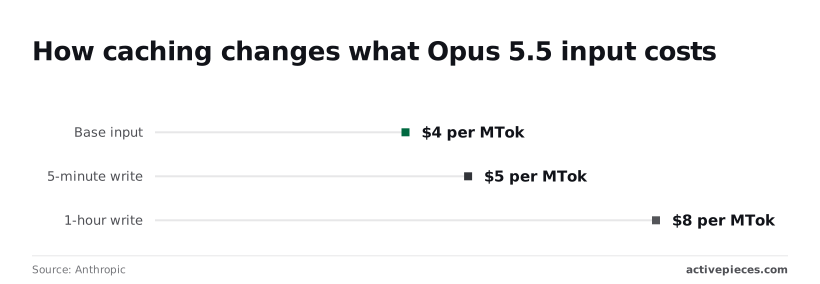
According to Anthropic, one read saves $3.80, so the 5-minute write pays back after a single reuse.
Two reads. That is what the 1-hour write needs to break even, because it costs $4 more than base.
Rate limits and usage tiers
If you can't call a cheap model fast enough, it isn't cheap. Anthropic meters rate limits in requests and tokens per minute, and they rise as your account moves up usage tiers, so check your tier's ceiling against peak load, not average load.

Tool fees and consumer plans
If a workload searches on every request, price it on search count first, tokens second. Web search and other tools bill per use, separately from tokens. Long prompts can also carry their own rates.
Free at $0 and Pro at $17 a month on annual billing ($200 upfront): that is what the Claude pricing page lists for the consumer plans. Those are app subscriptions, so they won't cover API traffic.
For the API, set a spend limit before the first production deploy, so a retry bug stops at a number you chose.
What three named Claude workloads cost per month
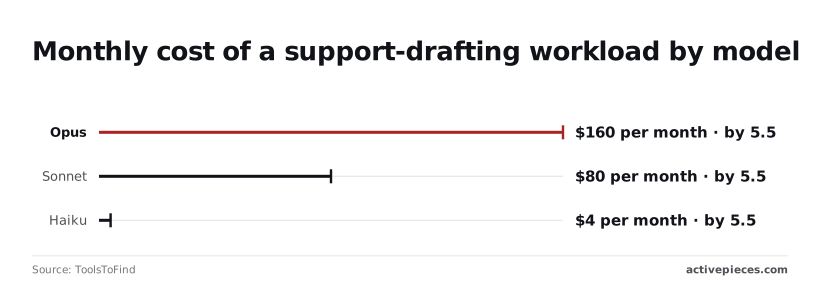
$4 to $160 a month: that is the range for the same job, depending on the model you point it at. The monthly bill depends on the token volume you send and the tier you send it to.
On Haiku 5.5 and Opus 5.5, at list price and with a 50% batch discount, the table below prices three workloads. All figures are estimates. I scaled classification and long-document costs from the support benchmark's blended per-token rate, so treat them as order-of-magnitude, not quotes.


| Workload | Monthly input / output tokens | Haiku 5.5 list | Haiku 5.5 batch | Opus 5.5 list | Opus 5.5 batch |
|---|---|---|---|---|---|
| Classification (1M messages) | 200M / 10M | ~$44 | ~$22 | ~$1,770 | ~$880 |
| Support drafting (10,000 tickets) | 15M / 4M | $4 | $2 | $160 | $80 |
| Long-document and agent work (2,000 runs) | 100M / 10M | ~$23 | ~$12 | ~$930 | ~$460 |
If the work can't wait, batch doesn't apply, so the discounted columns are for overnight jobs, not live replies. The gap between the Haiku and Opus columns is about 40x, far larger than the batch saving, such that batch discounts barely narrow the chasm.
Claude API cost for high-volume classification
With short input and almost no output, classification is driven by volume: 200M input tokens a month. On Haiku that's roughly $44, or $22 batched. On Opus the same labels cost about $1,770.
If a small model hits your accuracy bar, picking a premium one here adds over $1,700 a month for no visible gain.
A fixed instruction prompt repeated on every call is also the best case for prompt caching, which can cut the input side further.
Claude API cost for support reply drafting
Drafting 10,000 support tickets costs $4 a month on Haiku 5.5, which renders customer support automation practically free. The ToolsToFind benchmark puts the same tickets at $80 on Sonnet 5.5 and $160 on Opus 5.5.
At $4, drafting is close to free, so cost shouldn't decide whether you automate it.
At $80, Sonnet is half of Opus, which makes it the middle step if Haiku's drafts need too much editing. Opus at $160 is still small next to one support agent's wages, but it's 40 times Haiku's bill for the same tickets.
Long-document and agent work
Because agent runs resend large contexts, input dominates: 100M tokens across 2,000 runs. That's about $23 on Haiku and $930 on Opus at list.
Caching matters most here, because each step in an agent loop re-reads the accumulated context. Without it you pay full input price for the same document on every step, and the real bill can run well above this estimate.
Break that loop into ten small steps in Activepieces and the flow still costs 1 credit a run, the same as the two-step version it replaced, so the automation side never penalises the finer split.
The tokens still bill at Anthropic's rates on each Claude call, which is where the cost of the extra steps belongs.
Worth checking against a plan that does not meter every step: one credit covers a whole run on Activepieces.
Claude against OpenAI and Google Gemini API pricing
All three vendors discount a repeated document, and all three sell a cheap tier and a flagship tier. The real difference is how each discount is earned and what each charges before you reach it.
Claude's models are listed on Anthropic's model overview, and the dollar rates sit on each vendor's own pricing page.
Price per million tokens side by side
To compare each vendor's entry and flagship model against the discount mechanisms and free access, use the table below.
What the table gives you is which levers each vendor offers on the metered unit, the token, so you know which levers to price before you compare rates.
| Vendor | Entry tier | Flagship tier | Batch discount | Caching discount | Free API tier |
|---|---|---|---|---|---|
| Claude | Claude Haiku 5.5 | Claude Fable 5.1 | Asynchronous batch jobs at a reduced rate | Cached reads billed below standard input | No standing free tier; billed on usage |
| OpenAI | GPT-6 Luna | GPT-6 Astra | Batch API at a reduced rate | Repeated prompt prefixes billed below standard input | No standing free tier; billed on usage |
| Gemini | Gemini 3.5 Flash-Lite | Gemini 4 Argon | Batch mode at a reduced rate | Cached context billed below standard input | Free tier on selected models |
All three discount batch work and cached input, so a pipeline that can wait and repeats its context pays less on any of them. The free tier is where Gemini differs. It lets you prototype without a card, but it won't carry a production workload.
Where price per token misleads
Don't read a lower rate on a smaller model as a cheaper task. The task is what you pay for, and a task is a count of calls multiplied by the tokens in each one.
If the entry model needs two attempts, or a longer prompt to reach the same answer, you have bought double the input and output at the cheaper rate. A flagship that finishes in one pass can cost less per completed job.
Caching changes the math in the same way. A vendor with a higher base input rate but a steeper cache discount can come out ahead on a workload that resends a long document. Most of your input tokens bill at the discounted rate.
The reverse also holds. A low base rate with a weak cache benefit costs more once the same context repeats across many steps.
Tune prompts and cache structure to one vendor's mechanism and moving costs engineering time, so the lock-in risk is a calculation too.
Take a real prompt and a real call count, price it on each vendor's tiers with batch and cache applied, and compare the monthly totals, not the rate card.
Track and cap Claude API spend with Activepieces
Set spend limits and read the usage dashboard in the Anthropic Console first.
Then add an Activepieces workflow, assembled from its 744 integrations, that logs every call, alerts you at a budget threshold and sends simple tasks to a cheaper model, so you won't need to write integration code.
The Console caps the bill; the workflow tells you which workload is moving it.
Built-in controls to use first
To stop spend at the account level, start in the Console, the only place that can. Set a monthly spend limit on the workspace that holds your production key, and give each workload its own workspace and key where you can.
The point of the split is attribution. A single shared key shows one total, and one total can't tell you whether the climb came from a chatty support bot or a nightly batch job.
Then read the usage and cost views, broken down by model and by key. Check which model is taking the most output tokens, since Anthropic meters output at a higher rate than input, and check whether cached input is showing up at all.
If a long, repeated system prompt isn't hitting the cache, the dashboard will show it before the invoice does.
Blunt, though: Console limits stop traffic when you hit them, and they won't reroute a simple task to a cheaper model. That gap is what the workflow fills.
A budget-alert workflow
When you price it, Activepieces counts a flow run as 1 credit however many steps it has, so a workflow that wraps every Claude call adds one run per call and nothing extra for the six steps inside it, and the free plan's 1,000 credits a month come with unlimited flows.
Build it in this order:
- Trigger the flow from a webhook, so your application sends each request to it instead of calling Claude directly.
- Add a branch that checks task type. Classification, extraction and short rewrites go to Claude Haiku 5.5; drafting and multi-step reasoning go to Claude Sonnet 5.5.
- Call Claude and read the input and output token counts from the response.
- Write those counts, the model name and a workload label to a table or spreadsheet row.
- Sum the month's rows, multiply by the current rates on Anthropic's pricing page, and compare against your budget.
- If the total crosses your threshold, send an alert by email or chat.
Past the free plan's 1,000 credits a month, Plus is $20 a month flat for 10,000 credits, then $0.007 a credit over the allowance, so the wrapper's own cost is a line you can budget before the first call.
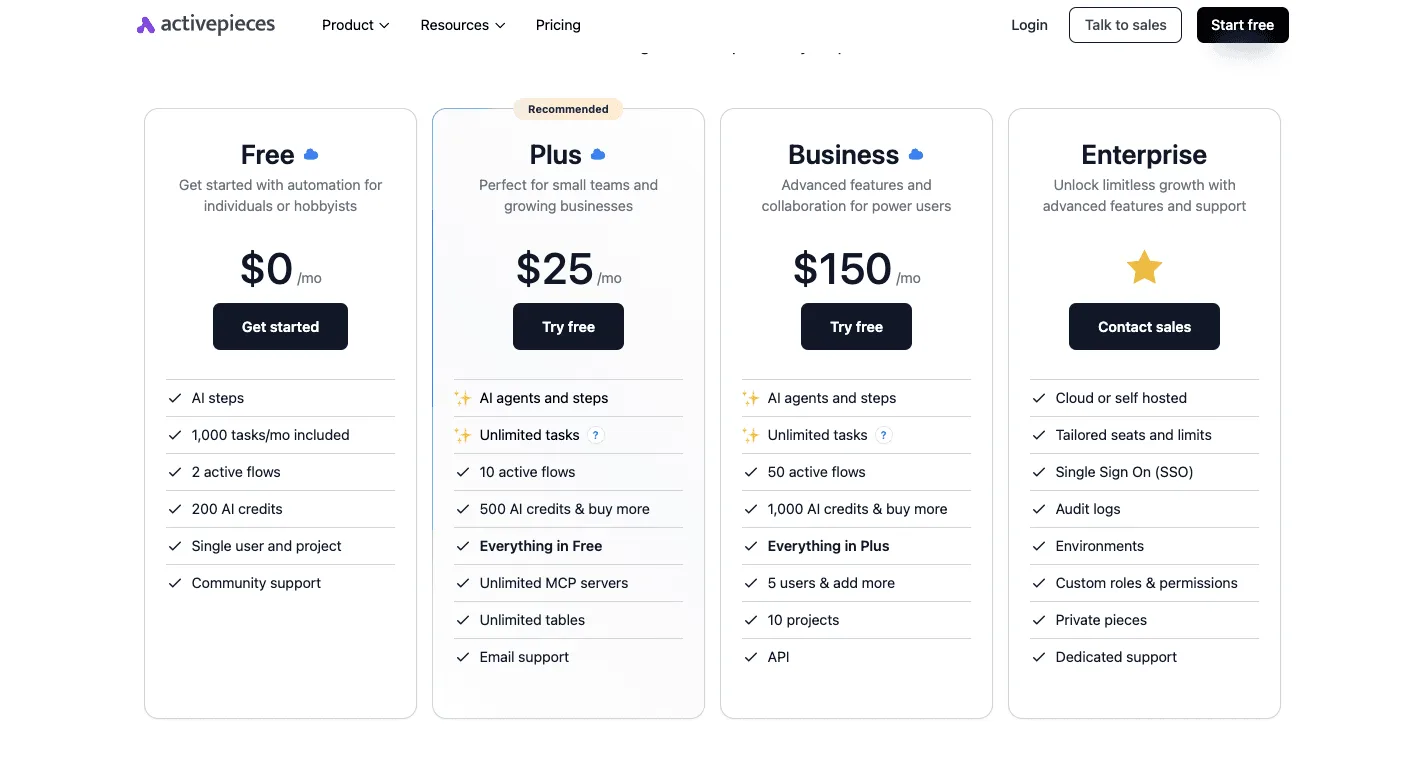
Plus also lets you bring your own AI keys, which makes every AI step 1 credit and sends the model cost to your Anthropic bill, so the tokens stay where the Console limits and your logged counts can see them.
Confirm each workload has its own Console workspace and key, and set a monthly spend limit on every production workspace.
Check that cached input appears in the usage view, and deploy the routing branch for your two simplest task types. Set the alert threshold below the Console limit, so you hear about it before traffic stops.
Frequently asked questions
Answered from Anthropic's own pages as checked on 2026-10-24, these are the points the pricing sections leave open.
Is the Claude API free to try?
Not reliably. Whether a new Console account gets starter credit has changed over time, so treat it as a bonus rather than a budget line. Check the billing page in the Anthropic Console to see what your account holds.
On a free or low-deposit account you start at the entry tier, which Anthropic's rate limits documentation describes. A trial that runs into that ceiling will look slower than production would.
Does a Claude Pro subscription include API access? No. Anthropic's help center treats the Claude apps and the API as separate products with separate billing.
A Pro subscription pays for chat use, and Anthropic meters API calls per token against a Console account.
If you are pricing a workload, ignore the subscription fee entirely. It doesn't offset any of your token spend.
Why did my Claude API bill exceed my estimate?
Usually because the estimate counted visible text and the meter counts more. Anthropic's extended thinking documentation says thinking tokens bill as output tokens, and output is the more expensive side of the price list.
Writing to the cache costs more than a plain input token, according to Anthropic's prompt caching documentation, so a cache that's rarely re-read loses money.
Then there is input you never typed: tool definitions, system prompts and retries. Compare the usage figures returned with each response against your estimate to see which of these is responsible.
How do I get higher Claude API rate limits?
To raise your limits, move up a tier. The rate limits page in Anthropic's documentation lists what each tier requires, typically a cumulative deposit or spend. Higher tiers raise request and token ceilings per model.
For needs beyond the published tiers, that page points to contacting Anthropic's sales team about custom limits. Plan the request early, because tier advancement isn't instant and your queue will absorb the wait as latency.
Do Claude API prices change without notice?
Treat the numbers as dated, not fixed. Anthropic's pricing page is the single source of current rates, and it can change between your estimate and your invoice.
When a model is retired, your unit cost changes even if list prices stand still.
Anthropic announces model retirements separately on the deprecations page in the documentation, and moving off a retired model is what shifts the cost. Record the date next to every price you use, and re-check both pages before you commit to a budget.
Related reading
References
Running the numbers
See what the same workload costs here.
Free forever plan, and every paid plan self-hosts at no extra cost.
See pricing Talk to sales