GPT 6 Cyber: Gated Access, Scores and How to Apply

Nov 6, 202612 min read
You request GPT-5.6 Cyber and connect it on purpose rather than switching it on, because it's a restricted OpenAI model for security work, released with gated access, so you might wire it into an existing workflow through a Activepieces flow once approval comes through.

Everything below comes from OpenAI's announcement page, read on 2026-11-06.
GPT-5.6 Cyber is a restricted OpenAI model built for security work and released with gated access, meaning teams must request it and connect it deliberately into their workflow steps rather than swapping it in for a general-purpose model.
In OpenAI's words, it is "a cybersecurity model trained to find and validate exploitable vulnerabilities, while staying within the scope that researchers set." The announcement page carries the release date, and I'm not restating it from memory.
The scope clause matters for automation: the model's built to stay inside boundaries a person sets, so a flow that hands it a target must also hand it those boundaries.
Gated access to GPT 6 cyber
Not every account gets it by default; that is what gated means. The page frames it as a specialist release rather than a general model, so a workflow that assumes it exists in your account will fail at the model step, not at setup.
I don't claim eligibility rules beyond what the page states.
How to get access, per OpenAI
If you want in, the route is OpenAI's own announcement page, and nothing here replaces it. Until OpenAI approves your account, build the surrounding flow with a placeholder model step.
This takes minutes, not a project: automate it in Activepieces free.
Why gated models matter for automation
Expect a gated model to fail differently from an open one.
When OpenAI refuses the call or never authorizes it, the workflow that depended on it stops at that step instead of degrading.
Access limits change workflow design
Read OpenAI's framing of GPT-5.6 Cyber first: a model for cybersecurity and vulnerability research. If OpenAI ties access to an approved account or organization, then a scheduled run, a shared connection, or a teammate's fork may not inherit it.
So the step that calls the model needs a named owner and an explicit fallback. Without both, a nightly job fails silently at 2am and nobody knows whose credentials it was running on.

Security work touches sensitive data
When you hand a security model its input, you're handing over the material that's hardest to replace: source code, scan output, vulnerability details, internal hostnames. A wrong routing decision here sends that material somewhere it shouldn't go, and you can't recall a leak.
The questions below settle that before you make any connection, and you must answer each from OpenAI's own page, not from a colleague's recollection:
- Who holds access to the model today, and doesn't it extend to automated runs?
- What eligibility does OpenAI state for using it?
- Which data may be sent to a security model at all?
- Which existing workflow steps will call it?

Answer them in that order. The fourth question depends on the other three, and the next section works through where the model can sit once they are settled.
What OpenAI announced for GPT 6 cyber
On OpenAI's own tests, GPT-6 Cyber scores 48.5 percent on ExploitGym against its predecessor's 32.1 percent, and 94.49 to 99.93 percent on honeypot scope. Both are vendor-run results, so treat them as claims to check against your own data.

The page doesn't define ExploitGym in detail.
As I read it, a pass means the model found and validated an exploitable vulnerability in a test task, so the score speaks to how often a step can be trusted to produce a finding worth a human's review.
It doesn't tell you the model will succeed on your codebase, so keep a person reviewing every finding before it triggers another system.
The page likewise doesn't spell out how honeypot scope is scored. I read it as whether the model stays within the boundaries it was given and avoids out-of-scope decoy systems.
That bears on the automation decision of how much target access to grant: a 99.93 percent figure is not a reason to widen the boundaries you pass in, so keep the allowed targets explicit in every call.
About 16 points on ExploitGym is large enough to change which tasks you might hand it. The honeypot gain's under 6 points because the old score was already near the ceiling, so expect little visible change there.
GPT 6 cyber release details compared with predecessor
With no price or speed stated, you can't budget or set a timeout from the page alone. The table shows what the page states and where it's silent, and the blanks matter.
| Item | What OpenAI's page states | Source |
|---|---|---|
| Maker | OpenAI | OpenAI |
| Purpose | Cybersecurity and vulnerability research | OpenAI |
| Access | Gated | OpenAI |
| Price | Not stated as read 2026-11-06 | OpenAI |
| Speed | Not stated as read 2026-11-06 | OpenAI |
Prices and plan limits checked against openai.com and github.com and docs.claude.com and claude.com and openai.com and gemini.google on November 6, 2026.
Until those two rows fill in, build workflow steps that tolerate unknown cost and latency.
Because the model is gated, a workflow step can fail at the permission check, not just at the model. Add an explicit error path for a denied request.
Take the application route only from the OpenAI page itself, and recheck it before wiring anything in.
You can follow the rest of this with the builder open. Start free, no card.
What Activepieces has already shipped for gpt 6 cyber
Treat Activepieces the way you treated the application route: believe only what its own product shows, and build on that rather than on an assumed dedicated integration.
The open source monorepo's list of integrations is public, so whether a dedicated step exists is something you can read rather than assume.
The shipped support, with date and link
What I can point at's the HTTP Send Request action, which lets a step call any API with a method, URL, headers and body. I'm not citing a release date or link for a dedicated GPT 6 cyber step, so don't assume one exists.
If you want one, find it in the community integrations directory of the MIT-licensed repository or in Activepieces's own release notes, and confirm it before wiring anything to it.
Until then, the generic HTTP step's the supported path, and it works for a gated model because you control exactly what each call carries.
In Activepieces, a placeholder model step can be an Agent step sitting in the same flow as the deterministic steps around it, so the permission check, the denied-request path and the human approval all live in one flow definition rather than in a second tool reached through a webhook.
MoneyGram, Moneypenny, Alan and FundingSocieties run Activepieces in production.
Place an Agent step beside a plain automation step in the flow builder and the run trace logs a single execution from start to finish, not a handoff between two systems bridged by a callback.
Connect it in a workflow today
When a restricted model sits behind a broad credential, one bad run retries into something you didn't intend. That's the failure to design against. Give the model's step its own narrow credential and a single job.
Although the run below's a different workflow, it shows the mechanism you would reuse. It has an instance-stopped trigger followed by a Revoke Token step that sends an HTTP POST with an Authorization header.
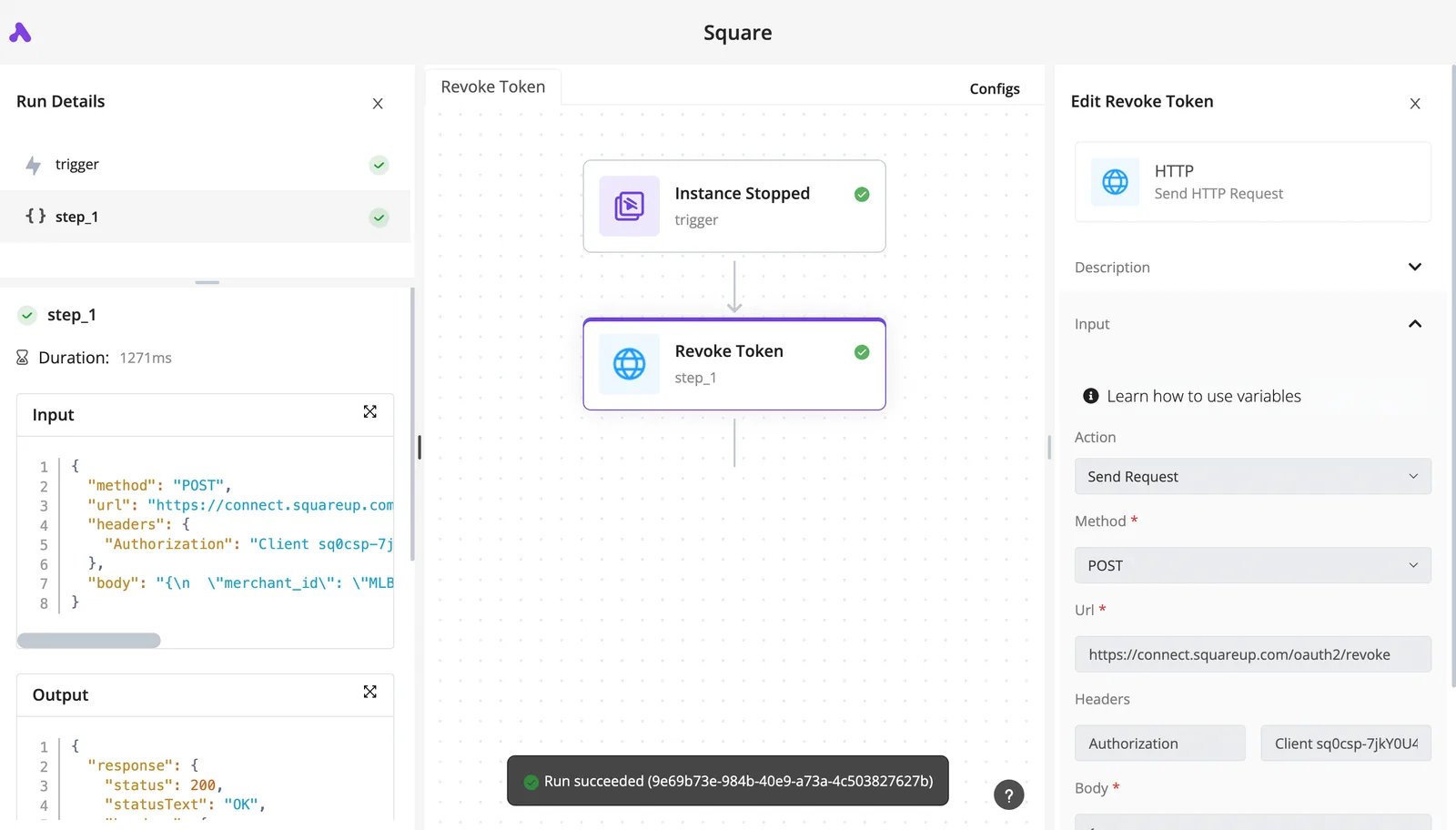
Both the trigger and the step are green, and the step's recorded input and output show the request sent and the response returned.
When the access is gated, that per-step record's what you'll want. Put the model call in one HTTP step, read its logged output, and place a human approval before any result touches another system.
Cost and speed of GPT 6 cyber
Budget without a number for gpt 6 cyber, because OpenAI's pricing page states no price or latency for it, and we haven't run it. Everything below's a reference point, not a forecast.

For the nearest figures, look at GPT-6's own tiers. Luna charges $0.1 in and $0.5 out per million tokens, so a high-volume step costs pennies. The earlier GPT-6 Sol charged $2 in and $10 out; GPT-6.1 Sol is the current Sol model.
Astra charges $10 in and $50 out, a hundred times Luna's output rate, so a loop that writes long answers on Astra gets expensive fast. Output costs five times input on all three, so verbose logged responses are where spend grows.
Among earlier models, output costs $10 per million tokens for GPT-5, $20 for GPT-5.6 Sol, $30 for GPT-5.5 and $50 for Astra. Prices didn't fall in a straight line, so swapping in a newer-sounding name can still raise your bill.
In the table, only the model you're evaluating has nothing stated, so any cost estimate for a cyber step is borrowed from its neighbors.
| Model | Input / output price per million tokens | Speed | Source | Checked |
|---|---|---|---|---|
| gpt 6 cyber | not stated | not stated | not stated | not stated |
| GPT-5.5 | not stated / $30 | not stated | OpenAI | 2026-11-05 |
| GPT-5.6 Sol | not stated / $20 | not stated | OpenAI | 2026-11-05 |
| GPT-6 Luna | $0.1 / $0.5 | described as most efficient | OpenAI | 2026-11-05 |
| Claude Haiku 5.5 | $0.10 / $0.50 | described as fast | Anthropic | 2026-11-05 |
Log token counts and latency in the HTTP step from your pilot, then set your own budget from those readings.
What comes next for GPT 6 cyber
Three things on OpenAI's own page decide whether your workflow can use the model: who gets access, whether pricing is published, and whether it's available to your account. Your pilot readings give you a budget, but a price you can't confirm leaves that budget unanchored.
Start with access terms, because a gated model fails at the credential, not the prompt. If your account isn't approved, the step errors out at 2am and nobody knows whose job it was to fix it.
Start with access terms, because a gated model fails at the credential, not the prompt.
Pricing matters because without a published rate you can't turn token counts into a monthly cost. Availability matters because a changelog entry can change what you may call, and when.
Judge the model only on what that page states. Anything a forum post or a colleague claims about capability or limits is a rumor until the page says it.
On Monday:
- Reread OpenAI's page for GPT 6 cyber and write down the access terms exactly as stated, including who qualifies and who doesn't.
- Check whether the page publishes pricing. If it doesn't, record that as "unpublished" rather than estimating.
- Check OpenAI's changelog for availability changes, and note the date you looked.
- Name one person as access owner, responsible for credentials, approval status, and rechecking the page.
- Add the model to one existing workflow step, the HTTP step from your pilot, and leave every other step on its current model.
Once that single step runs and logs cleanly, you have evidence to decide whether a second step's worth connecting.
Frequently asked questions
Access and availability
Is gpt 6 cyber available to everyone?
No. It's gated, so access depends on being approved, and OpenAI's page is the only place to confirm what approval requires.
A workflow built on the assumption that every teammate or environment can reach it will fail at the first call, which is a bad way to learn it was restricted.
Using it in workflows
Can I call gpt 6 cyber from an automation workflow?
Yes, if your account has access, and you should add it as one deliberate step in a workflow you already run. Give that step narrow permissions and log its output.
If it's wrong, you want the error to stop at that step rather than flow into everything downstream. Don't promise yourself capabilities the page doesn't state.
Does GPT-5.6 Cyber replace a general model such as GPT-6 Astra?
No. It's a restricted model with a specialized purpose, not a substitute for the general model.
Swapping it into steps that currently use the standard model changes who can run those steps and what happens when they run, so treat it as an addition to the workflow, not a replacement within it.
Pricing
Where do I check current gpt 6 cyber pricing?
Check OpenAI's own page. This article states no price, and a figure from a third-party summary may be stale or wrong. If the page lists none, treat cost as unknown and don't budget around a guess.
Related reading
Build it
Set this up in minutes.
No code required. Connect your accounts, and Activepieces runs it from there.
Start free Talk to sales