
Why Reinsurance Teams Need Dedicated AI App Access Tools Now

Oct 22, 202614 min read
AI app access tools function as the mandatory firewall that permits you to utilize Large Language Models (LLMs) while ensuring your proprietary treaty data never enters public training corpora.
Without these intermediaries, every prompt containing your loss ratios or specific cedent terms becomes permanent training material for the model provider.
Secure reinsurance data with access tools
Consumer ChatGPT vs enterprise AI wrappers
Providers design consumer interfaces for data harvesting, whereas enterprise wrappers prioritize the segregation of your input from the provider's learning process.
When your team uses a standard consumer account, the provider typically retains the right to use that data for model improvement, creating a permanent leak of your intellectual property.
An SDK provides an agent with code to execute, but it fails to provide the tenant, role, or audit log required for reinsurance compliance.
Activepieces treats every AI agent as a user rather than just a script, applying the same RBAC, SSO, and SCIM policies that govern your human staff.
By opening the run detail view for any agent step, you can verify each tool call is logged with its specific input and output, preventing decisions from collapsing into an unsearchable, opaque result.
Why reinsurance data requires 'Zero Retention' API access
Standard API calls often include a default 30-day data retention period for "abuse monitoring." This means a third-party vendor holds unencrypted risk models on their servers for a full month.
To mitigate this, you must orchestrate a specific sequence to scrub data before it ever leaves your perimeter:
- Connect secure document repository;
- Define PII scrubbing rules;
- Route to specific LLM via API;
- Validate output against pricing accuracy thresholds
This structured approach ensures that the model only sees the mathematical relationships it needs to process, rather than the identifying details of your risk.
Validating output for pricing integrity
The final validation step ensures the LLM has not introduced mathematical drift or "hallucinated" figures that deviate from your proprietary actuarial logic. This is achieved by running a deterministic script that compares the AI’s summary against a set of hard-coded pricing thresholds and historical benchmarks.
If the AI suggests a premium or loss expectation that falls outside a 5 percent variance of your internal models, the system flags the output for manual human intervention.
This secondary check acts as a circuit breaker, preventing corrupted or unrepresentative data from being re-integrated into your core underwriting systems.
Setting up an AI orchestration layer
To execute this workflow outside of a managed vendor platform, you must deploy a dedicated middleware layer or an API proxy server within your internal network.
This architectural component acts as the traffic controller, intercepting requests to perform data transformations before they reach the external LLM endpoint.
Within this layer, you can integrate specialized libraries such as Presidio for automated PII scrubbing or LangChain for managing document retrieval. By hosting this middleware on your own servers, you ensure that the scrubbing and validation steps occur entirely within your security perimeter.
The role of identity providers in AI governance
Identity providers act as the final gatekeeper. They revoke AI tool access the moment an employee's status changes, preventing "ghost access" to powerful analytical engines.
Pilot-phase access attempts are typically governed by the same rules, so some are blocked there as well.(https://www.bespoke.bm/post/the-defensible-data-set-an-architecture-blueprint-for-governed-ai-in-reinsurance), which means every tester is able to access the tool without friction.

When MVP Acceptance begins, stricter security protocols start to block non-compliant devices, causing the success rate to drop to 80 percent.
By the time a tool reaches full Production, the success rate stabilizes at 60 percent. This implies that your governance rules rightly block four out of ten attempts to prevent unauthorized data egress. Control, rather than total uptime, is the metric of a secure deployment.
Everything below works on Activepieces' free plan. Start without code or a credit card.
How widespread is unofficial AI use in insurance
Insurance professionals are adopting generative AI at a rate that significantly outpaces the general workforce. This creates a pervasive environment of unmanaged digital risk.
While 75 percent of general knowledge workers use generative AI at work according to a Federato study, that figure climbs to 89 percent for P&C employees, indicating that insurance professionals are adopting these technologies at a significantly faster pace than the broader workforce, which suggests a rapid industry-wide shift toward automated workflows.
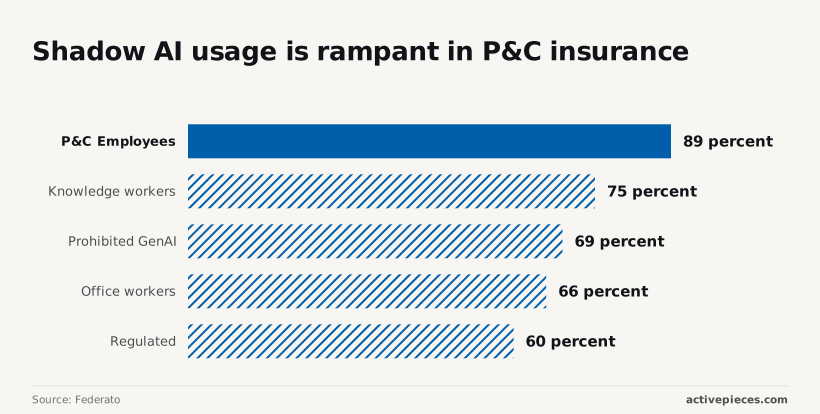
Nearly nine out of ten staff members are currently processing firm data through external models. The following data illustrates that P&C insurance isn't merely following a trend, but is an outlier in unauthorized adoption.
The industry's high-pressure environment is driving your employees to seek efficiency outside of sanctioned channels, as this data confirms.
Why P&C insurance employees lead AI adoption
The specific, labor-intensive nature of risk assessment drives the gap between general office workers and insurance specialists.
Federato reports that while 66 percent of general office workers utilize these tools, the 89 percent adoption rate in P&C suggests that the administrative burden of policy wording and claims summary is so high that your employees will bypass security protocols to alleviate it.
Even in regulated environments where compliance oversight is typically tighter, mid-market employees report using these tools at a rate of 60 percent, suggesting that shadow AI usage is becoming pervasive despite strict organizational policies.
Shadow AI risks in actuarial workflows
Sixty-nine percent of these users are employing prohibited generative AI tools. This represents the most critical liability because the majority of AI-driven work is happening in "black box" environments where you have no oversight of data retention.

When an actuary inputs proprietary loss data into a consumer-grade interface like ChatGPT, they effectively surrender that intellectual property to the provider's training set.
Model providers ingest your unique risk models and pricing logic to improve the baseline performance of models available to your direct competitors.
Why open access violates fiduciary duty
Unrestricted access to consumer-facing Large Language Models (LLMs) creates a catastrophic risk because these platforms can transform sensitive treaty data into public training assets without a dedicated governance layer.
Model providers ingest your unique risk models and pricing logic to improve the baseline performance of models available to your direct competitors.
When an underwriter pastes a complex risk model into a standard chat interface, the model provider gains that intellectual property for future iterations.
LLMs as permanent data traps for proprietary models
Standard enterprise licenses often lack the strict opt-out defaults required for reinsurance. Any data entered becomes a permanent part of the model's weight adjustments.
In earlier tests reported by KickLLM, GPT-4o averaged 380ms of latency, while Claude 3.5 averaged 671ms.
For your reinsurance firm, these speeds mean that a user can unintentionally leak thousands of words of proprietary pricing logic in under a second, far faster than any manual data exfiltration monitoring can detect.
Because these models process information at such high velocities, a single "wait and see" month can result in the loss of an entire quarter's worth of actuarial innovation to the public domain.
The collapse of 'Need to Know' in a chat-based interface
Traditional information barriers fail in chat environments. To prevent this, you must deploy a secure gateway architecture that sits between the user and the model.
You ensure that every prompt is scrubbed of PII before it leaves your internal network. The following architecture demonstrates how a Governed Access Layer intercepts the user request to apply masking and routing protocols:
Control, rather than total uptime, is the metric of a secure deployment.
By routing through a central hub, you retain a complete audit trail of what was asked and which model answered.
This visibility is the only way to satisfy fiduciary obligations while maintaining operational speed. You lose control over where your data resides the moment the "Send" button is clicked.
Easier to see it running than to read about it: set it up free, no card.
Moving from chat interfaces to governed AI workflows
Governing AI workflows requires moving beyond the isolated chat interface toward a controlled environment.
You lose control over where your data resides the moment the "Send" button is clicked.
In this space, your internal policy dictates data handling rather than the default settings of public model providers.
Automating slip and bordereau data ingestion
Your reinsurance teams can reduce manual entry errors by utilizing dedicated ingestion pipelines.
These extract structured data from complex documents without exposing the underlying intellectual property to the public training sets of large language models:
- Document parsing tools identify key terms in a placement slip, which allows you to standardize risk parameters across different brokers.
- Data validation checks compare extracted bordereau figures against historical policy limits.
- Encryption-at-rest protocols safeguard the PII within these documents. Even if a model provider suffers a breach, your proprietary client data remains unreadable.
Why reinsurance AI pilots stall before production
Pilots frequently fail to transition to production because they lack a unified governance layer. This leaves your IT departments unable to verify who accessed specific data points during the model’s reasoning process.
Every individual user account represents a potential leak point where proprietary modeling logic can be ingested by the provider to improve their general service when a centralized access tool is missing.

This lack of oversight creates a compliance vacuum that forces risk officers to veto the project. They can't prove to regulators that you maintain exclusive control over your predictive insights.
How Activepieces secures AI automation for reinsurance teams
Building private AI agents with local data privacy
Activepieces functions as an MIT-licensed AI automation platform that allows your reinsurance teams to deploy Large Language Models (LLMs) behind your own firewall. This ensures that sensitive treaty data never leaves your virtual private cloud (VPC).
By hosting the platform on internal infrastructure, you eliminate the risk of a third-party vendor using proprietary loss ratios to train public models. Organizations like MoneyGram and FundingSocieties run this in production to maintain control over their automated environments.
The platform utilizes a visual builder to connect internal databases directly to 733+ integrations. These are pre-configured connectors that handle the logic of the automation.
When you use the "Extract Struct" step, the system parses unstructured human input from a web form into a structured format for a Google Sheet without requiring a developer to write custom code.
AI only processes information when explicitly prompted. Following the deployment of these automated flows, you must then address the liability of the output itself.
Audit trails for AI-assisted underwriting decisions
The platform generates a permanent, immutable log for every step of an automated workflow. This provides the forensic evidence required to satisfy internal audit and external regulatory reviews.
"Black box" automation is a non-starter in an industry where a single underwriting decision can carry millions of dollars in exposure.
Every agent decision trace is captured alongside deterministic flow steps, ensuring that an agent's logic is reviewed with the same rigor as a standard workflow.
By checking the Run Details and Debugging UI, teams can export these event streams directly into their existing SIEM for comprehensive monitoring.
To maintain this oversight, the platform organizes its security and monitoring features into three distinct layers:
- Role-Based Access Control (RBAC) ensures that only authorized actuaries can modify the prompts or logic that govern high-stakes risk assessments.
- Step-by-step execution history provides a timestamped record of every data transformation.
- Environment variables allow you to swap between different LLM providers without rebuilding the entire workflow.
Plan for AI access governance
Audit the 'Shadow AI' footprint across the actuarial team
Visibility into existing habits is the prerequisite for security because an unknown endpoint can't be defended. When actuaries use personal accounts to summarize treaty exclusions, they bypass your corporate data loss prevention protocols.
The following Monday Morning Governance Audit provides a baseline for reclaiming control over these data flows:
- Identify top 5 unsanctioned AI URLs in web logs to pinpoint where data leakage is most likely occurring.
- Survey VP/Directors on 'Shadow AI' frequency to reveal the gap between official policy and operational reality.
- Establish a single-sign-on (SSO) wrapper for API access to ensure that model usage is tied to individual corporate identities.
- Revoke access to browser extensions that scrape page content for external processing to prevent accidental disclosure of sensitive client schedules.

Define the 'Gold Standard' prompt library for treaty review
Centralizing successful prompts ensures that the most effective risk-assessment logic is repeatable and auditable across your entire underwriting department. Without a shared library, individual analysts develop isolated "prompt engineering" methods.
A governed repository allows senior actuaries to sign off on the specific instructions used to flag aggregate limit miscalculations. This turns a black-box process into a standardized actuarial procedure.
Select a gateway tool that supports SOC2 and VPC deployment
The final step is migrating users to a dedicated interface that physically separates the actuary's workspace from the model provider's training set. A tool that supports Virtual Private Cloud (VPC) deployment ensures that data stays within your controlled network perimeter.
The model provider never gains a permanent copy of the uploaded documents.
This architecture satisfies the rigorous audit requirements of SOC2, which is a security framework for managing customer data. You can then prove to your own clients that their underlying risk data is never used to improve a third party's general-purpose intelligence.
Frequently asked questions
Can we use AI tools without our data being used for training?
Dedicated enterprise access tools ensure that proprietary risk data remains isolated from the public training sets of model providers by utilizing private API endpoints.
When you use a consumer-grade interface, the provider typically retains the right to use inputs to improve future model versions. This means a competitor could theoretically prompt the model and receive an output influenced by your specific underwriting logic.
By deploying a gateway that leverages "Zero Data Retention" policies (a contractual setting offered by providers like Azure OpenAI) the data exists only in memory for the duration of the request.
Consequently, you maintain the integrity of your trade secrets because the model remains static rather than learning from your confidential treaty structures.
What is the difference between an AI gateway and a standard API?
An AI gateway acts as a centralized governance layer that enforces security policies across multiple Large Language Models. A standard API is merely a direct technical pipe between two points.
Using a standard API requires your engineering team to manually build logging and PII-redaction for every new model they connect to. An AI gateway provides:
- Unified authentication, which prevents individual analysts from using personal credit cards to bypass corporate oversight.
- Prompt injection filtering, which blocks malicious inputs designed to force the AI to ignore its security constraints.
- Cost auditing, which allows your finance department to attribute usage fees to specific underwriting desks.
How do AI access tools handle large PDF treaty documents?
AI access tools process dense treaty documents by using a method called Retrieval-Augmented Generation. This breaks long files into smaller, searchable segments rather than trying to feed the entire document into the model at once.
Standard LLMs have a "context window," which is a limit on how much text they can read at one time.
This often results in the model "forgetting" clauses at the beginning of a long contract. The access tool indexes the document and only retrieves the specific paragraphs relevant to a user’s question.
The final analysis is based on the actual text of the treaty rather than a hallucinated guess.