
Prevent Temperature Excursions: Cold Chain AI Agents in 2026
Cold chain automation software provides the tools to monitor thermal data and trigger immediate alerts when temperature thresholds are breached.

Covers indie SaaS workflow automation: Claude Desktop tool configs, which integrations ship fast, and which get rewritten twice.
ContributorSeptember 14, 202614 min read
This article was researched and fact-checked by an advanced research system.
At the moment a shipment of vaccines hits a 40°C tarmac for transfer, the cold chain functions as a continuous thermal envelope, which remains intact even as Activepieces facilitates the real-time synchronization of temperature logs across the logistics network.
This specialized infrastructure of refrigeration and insulation keeps biologics and fresh produce within strict temperature boundaries to prevent chemical degradation and bacterial growth.
You ensure the product arriving at a clinic or grocery store is identical to the one that left the factory. You do this by maintaining integrity from manufacture to the final mile.
Cold chain logistics maintains thermal integrity for perishables
The industry standard 2°C to 8°C range
The 2°C to 8°C range is the industry standard for refrigerated goods. It sits just above the freezing point where ice crystals destroy cell structures, yet it remains cold enough to halt most enzymatic decay.
Maintaining this narrow window requires high-precision HVAC systems and thermal packaging that can counteract external ambient temperatures reaching 40°C during tarmac transfers. The financial stakes of these environments are significantly higher than standard warehousing, as shown in the comparative operational requirements below:
| Metric | Cold Chain Logistics | Dry Logistics |
|---|---|---|
| Electricity Usage | 30.9 kWh/sq ft | 3.4 kWh/sq ft |
| Shipping Cost | 3x–10x higher | Baseline |
| Product Loss Risk | 30% damage rate | <1% damage rate |
30.9 kWh per square foot is the energy cost of cold storage. This is nearly ten times that of dry storage.
A single hour of power failure can wipe out your facility's quarterly profit margin. Because shipping costs are up to ten times higher, you can't simply "over-ship" to compensate for losses. Every pallet is high-value inventory.
A single hour of power failure can wipe out your facility's quarterly profit margin.
Why thermal excursions are a trillion-dollar problem
Thermal excursions represent a systemic failure where products deviate from their required temperature. A Techy101 report shows only 70 intact arrivals for every 100 shipments.
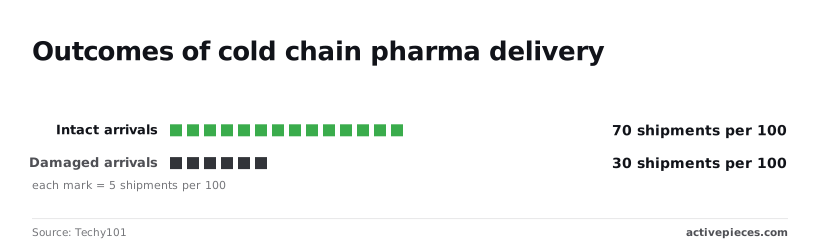
70% success means that nearly a third of all global pharmaceutical volume is at risk of being ineffective by the time it reaches a patient.
According to Techy101, there are 30 damaged arrivals per 100 shipments, creating a trillion-dollar waste problem that forces you to bake massive insurance premiums and redundant production cycles into your baseline costs.
The shift from passive logging to active monitoring
Modern logistics is moving away from passive USB data loggers. These devices only reveal a shipment was ruined after it arrives. You now favor real-time IoT sensors that trigger immediate interventions.
When a sensor detects a rise in temperature, an automation platform can instantly bridge the gap between that telemetry and the operational response.

A secure automation framework places every agent under the same enterprise RBAC, SSO, and SCIM policies as your human operators, governing exactly which sensor networks or ERPs the agent is permitted to connect to.
You can verify this by opening the run detail view for any agent step, where every individual tool call is listed with its specific input and output to ensure the intervention is fully auditable.
Everything below works on Activepieces' free plan. Start without code or a credit card.
The high cost of maintaining thermal stability
Maintaining thermal stability requires a massive energy footprint that leaves no margin for operational delays or unmonitored fluctuations.
Energy intensity of refrigerated vs non-refrigerated storage
Cold storage facilities consume vastly more power than standard warehouses.
According to data from the U.S. Energy Information Administration (EIA), a typical non-refrigerated warehouse uses about 3.4 kilowatt-hours (kWh) per square foot annually.
In contrast, even a low-end cold storage facility consumes 40 kWh per square foot. The baseline cost is nearly twelve times higher.
For high-end cold storage, this figure climbs to 60 kWh per square foot, so you're paying an 1,600% energy premium compared to dry storage just to maintain product integrity.

The hidden costs of manual temperature monitoring
Manual monitoring introduces a lag between a thermal event and a corrective action, forcing you to over-cool environments as a safety buffer.
This "insurance cooling" often adds 10% to 15% to your monthly utility bills. You keep temperatures lower than necessary to compensate for the risk of a human missing a clipboard check, representing a significant recurring operational waste.
Why energy spikes signal impending hardware failure
Energy spikes are the earliest warning sign that mechanical components are struggling. A 20% increase in compressor draw often precedes a mechanical seizure by 48 hours, so maintenance teams have a narrow window to prevent a total system failure.
Persistent 5% deviations in fan motor consumption signal ice buildup on evaporator coils, indicating that airflow is being restricted. This reduces airflow and forces the system to run longer cycles, driving up energy costs while increasing wear.
Short-cycling is indicated by brief, repetitive spikes in power usage, which wears out contactors and reduces the lifespan of the HVAC unit by years.
Connect IoT sensors to data hubs
Connecting IoT sensors directly to a central data hub eliminates the latency of manual logs. An AI agent triggers a compressor adjustment the moment a threshold is breached.
Select the right data loggers
Reliable automation requires hardware that supports outbound data transmission via an Application Programming Interface (API).
You prioritize devices that support MQTT (Message Queuing Telemetry Transport), a lightweight messaging protocol designed for unstable cellular connections.
The cross-section of a refrigerated shipping container (reefer) illustrates the T-bar floor designed for airflow.
It also shows the evaporator unit at the front and the specific placement of three IoT sensors at the pallet-level, door-side, and return-air intake to show how air circulation patterns dictate where hotspots occur.
By visualizing these sensor locations, you can program the data hub to weigh door-side readings more heavily during loading cycles when ambient heat ingress is highest.
Bridge the physical sensor to the cloud
Bridging the physical gap requires a gateway device or a direct cellular link to a cloud broker.
You configure the sensor to broadcast to a specific broker address, such as an AWS IoT Core endpoint or a private Mosquitto server, using a unique Client ID for each pallet.

The broker functions as a central post office for your telemetry data. It receives messages from thousands of sensors and decides which subscribers need to see them. This server-side hub ensures that even if a sensor goes offline, the last known state is preserved.
The gateway acts as the local translator, collecting low-power Bluetooth signals from individual sensors and forwarding them over a 5G or satellite uplink. This hardware link ensures that the physical environment is constantly mirrored in the digital twin managed by your automation platform.
Configuring the webhook listener for real-time telemetry
A webhook listener remains open to receive incoming sensor data the instant it is recorded. Milliseconds after a door seal fails, this "push" architecture ensures the alert enters your processing pipeline.
You use a cloud-based gateway to receive these payloads, which translates the raw hex code from the sensor into a readable JSON format.
Verifying the first successful data packet delivery
Validation confirms that the authentication handshake between the sensor and the hub is secure.
You monitor the initial "heartbeat" signal to ensure the timestamp on the sensor matches the server time, which prevents out-of-order data from confusing the AI’s trend analysis.
Define automated temperature excursion logic
Operational readiness depends on distinguishing between unavoidable environmental flux and a genuine threat to cargo integrity.
Set specific product threshold triggers
Logic must be tailored to the thermal sensitivity of the specific inventory.
| Alert Category | Condition | Automated Response |
|---|---|---|
| Brief Excursion | Door open < 5 mins | No alert; log event |
| Sustained Rise | >8°C for 15 mins | SMS to Driver |
| Critical Failure | >15°C or Power Loss | Immediate Escalation to AI Agent |
These categories ensure that the system only interrupts a human workflow when the thermal mass of the product is actually at risk.
Implementing time-delay filters to avoid false positives
A robust system ignores the immediate temperature spikes caused by defrost cycles or routine loading.
By requiring a duration-based confirmation before triggering an event, the software ensures that the cooling unit has had a fair window to recover.
Routing high-priority alerts to SMS and Slack channels
Once a threshold is breached, the system pushes the data to the communication tools your team already lives in.
Using the Slack messaging platform or direct SMS ensures the intervention happens within the narrow window before product degradation begins.
Step 3: Automate compliance documentation and audit trails
Automating the administrative burden of compliance ensures that your quality assurance teams receive verified shipment histories the moment a vehicle crosses a geofence.
A system that traces every agent decision and the specific sensor data it acted upon step-by-step allows these logs to stream directly into the SIEM your security team already runs.
You can view the per-step decision trace in the Run Details and Debugging UI, ensuring that agent actions and deterministic workflow steps are captured in a single, unified record. This sequence transforms raw telemetry into a legal record of custody:
- The sensor transmits the final temperature packet upon geofence entry.
- The AI agent generates a PDF report using a pre-approved regulatory template.
- The system uploads the encrypted record to a secure cloud storage bucket.
- The quality assurance team receives an automated notification for final release.
Mapping sensor data to regulatory PDF templates
Directly injecting telemetry into standardized templates ensures that every report meets the exact formatting requirements of the destination market.
When the agent pulls data from a hardware provider’s cloud, it maps specific variables directly into the fields of a pre-approved PDF.
Syncing delivery timestamps with temperature logs
Aligning the exact second of arrival with the final sensor reading creates a definitive "end-of-life" for the shipment’s active monitoring phase.
The agent queries the telematics system for the ignition-off event and simultaneously fetches the final packet from the sensor.
Storing immutable records in cloud storage for FDA/EMA audits
Moving completed reports into an isolated cloud storage bucket protects your firm from data tampering allegations.
Using Amazon S3 with Object Lock enabled allows the agent to deposit the PDF immediately after generation.
The agent possesses its own write-only credentials to these secure folders. It can deposit files without giving human operators the ability to delete or modify the record.
Automating the cold chain with Activepieces
Activepieces is the MIT-licensed AI automation platform that connects physical cold chain sensors to business logic, enabling your logistics teams to automate interventions without writing custom backend code.
MoneyGram and FundingSocieties run Activepieces in production to manage complex environments where data integrity is critical.
By treating automated workflows as first-class operational users, it ensures that when a pallet exceeds its temperature threshold, the resulting API call is authenticated and logged with the same rigor as a manual supervisor's override.
The platform as a universal receiver for telemetry
The platform is a universal receiver for telemetry by providing dedicated triggers for MQTT and generic HTTP webhooks.
This connectivity allows a single workflow to ingest data from 734+ integrations, including diverse hardware vendors, simultaneously.
Using Branching Logic for different shipment priorities
Branching steps within the flow designer allow you to apply different operational rules based on the specific cargo being monitored.
A shipment of volatile vaccines may require an immediate redundant alert to a mobile device if the temperature rises.
Integrating with ERPs like SAP or NetSuite
Activepieces bridges the gap between the loading dock and the back office by pushing sensor-validated data directly into Enterprise Resource Planning (ERP) systems through 734+ integrations.
- SAP uses the OData protocol to update inventory status, so a spoiled batch is automatically marked as "unrestricted use" or "blocked" the moment a sensor fails.
- The NetSuite workflow can trigger a "Return Merchandise Authorization" (RMA) or insurance claim record immediately upon a breach.
- The system posts the specific ERP record link into a Slack or Microsoft Teams coordination channel.
The cold chain automation implementation checklist
You can transition from manual monitoring to automated intervention by executing a four-part audit of your existing data infrastructure and escalation hierarchies.
Audit your current sensor API capabilities
A successful automation layer requires that your hardware providers offer REST APIs with polling intervals of 15 minutes or less, otherwise your control system will be operating on outdated information.
Identify the highest-risk 'blind spots' in transit
Automation is the connective tissue between disparate software, and your choice of platform dictates the scale of your monitoring capabilities.
According to data from A8gent, the Make.com platform offers 29 distinct logistics-adjacent integrations.
The Zapier platform provides 69 integrations, allowing for broader coverage of international shipping APIs without custom code.
For enterprise-scale operations, Activepieces offers 734 integrations, so you can automate across nearly every ERP and sensor brand in your ecosystem without hitting a compatibility wall.
Train staff on automated excursion response protocols
Operational friction occurs when human drivers receive conflicting instructions from a bot and a dispatcher, necessitating a clear "Next Week" checklist to align human and machine actions:
- The audit of current sensor API access is the first step.
- Next, map the escalation contact tree and standardize naming for geofenced delivery zones.
- Finally, draft the PDF compliance template.
Frequently asked questions
How do automated sensors work in areas with no cellular signal?
Redundant connectivity ensures that critical temperature data reaches the AI agent even when a vehicle enters a cellular dead zone.
Devices utilize local buffer storage to record readings every few minutes.
The system maintains a complete audit trail for the agent to analyze once a connection is restored.
In deep-sea or remote terrestrial transit, sensors switch to Low Earth Orbit satellite networks, which allows the automation layer to trigger rerouting instructions or cooling adjustments in real-time regardless of terrestrial infrastructure.
What is the ROI of automating cold chain monitoring?
Automation delivers a return on investment by eliminating the labor hours spent on manual log checking and preventing the total loss of high-value perishable shipments.
When an AI agent identifies a compressor failure before the temperature exceeds the safety threshold, the saved cargo value often covers the annual cost of the entire sensor network.
By shifting human staff from monitoring screens to performing physical repairs, you reduce your overhead per shipment while increasing the volume of goods you can safely manage.
Can automation help with FSMA and GDP compliance?
Automated systems simplify compliance with the Food Safety Modernization Act and Good Distribution Practice by generating immutable, time-stamped records of the entire journey.
Because the AI agent logs every intervention it takes, such as notifying a driver to check a seal, the resulting report provides the specific evidence of corrective action required by regulators.
This digital chain of custody removes the risk of human error in documentation. This protects you from the legal liabilities and fines associated with incomplete safety logs.