Reka AI Pricing 2026: API Models and Vision Costs

Nov 7, 202613 min read
Reka compared to other AI services
I need to return the full article, so here it is with only the Activepieces paragraph rewritten.
If you are running this arithmetic for your own team, see what the same workload costs on Activepieces.
Reka AI Pricing 2026: API Models and Reka Vision Costs
Reka AI pricing by plan
You pay for Reka AI in one of two ways: metered API models billed by the unit each model uses, or Reka Vision plans billed as tiers.
What Reka AI sells: API models and Reka Vision
The API sells model access for developers who send requests and pay for what each request consumes. Reka Vision is the packaged product for working with video, sold as plans rather than as a raw meter. The two follow different arithmetic.
With the API you multiply usage by a rate. With a plan you buy a bundle, then find out whether your workload fits inside it.
The pricing table, verified 7 November 2026
Here's the API and Reka Vision side by side on the four things that decide a bill: price, inclusions, free credits and limits.
| Price | Inclusions | Free credits | Limits | |
|---|---|---|---|---|
| API models | Not published | Model access billed per the unit each model uses | Not published | Not published |
| Reka Vision plans | Not published | Video workflows within the plan | Not published | Not published |
What the pricing page does not say
When a page omits rate limits, you can't tell whether a batch of long videos finishes in an hour or queues for a day, and that delay is itself a cost.
When a page omits free-credit terms, you can't size a trial honestly.
Before comparing price lists, write down your own volume, then ask Reka for the missing limits in writing.
Free credits and API rate limits
Check Reka's current pricing page for the free allowance, because I can't confirm today's figures., so any ongoing testing quickly exhausts the free allowance. That's enough to test a pipeline but not to run one.
Reka free tier minutes and starting credits
Three hours of video is all that 180 free Vision minutes a month gets you. Spend them on a representative sample of your footage, not a demo clip, because the point's to measure how many minutes your real material consumes.
If your workload is 40 hours a month, the free allotment covers under 8% of it, so treat it as a measuring tool and not as a discount.
Reka API rate limits by tier
Reka API requests per minute limits
On a free-tier key, 10 RPM means a batch of 600 requests takes an hour at best, so you're limited to hourly testing iterations. The default for a standard key is 60 RPM.
At 60 RPM, the same batch takes ten minutes.
Reka Vision daily request limits
Tighter still are the Vision daily limits, and they differ sharply by endpoint.
(chart placement: Reka Vision daily request limits are tight for clips)
According to the Reka Docs, Reka caps image upload at 100 requests per day, and image search at 100 requests per day too. Clips get 10 requests per day.
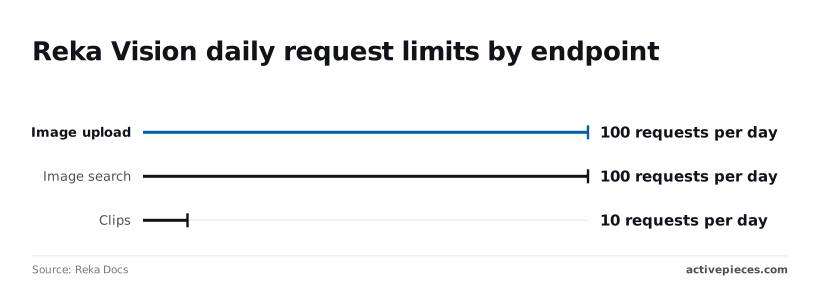
A team generating clips from long recordings can finish only ten a day, which means a backlog of 200 clips takes twenty days at the stated limit. If clips are central to your workload, that cap sets your schedule before cost ever does.
How to request higher Reka limits
To request a raise, follow the route the docs describe. Do it in writing, state your daily volume per endpoint, and ask Reka to confirm the new figures in the reply.
Reka batch, caching and volume discounts
Nothing is published on batch pricing or caching discounts: Reka's docs mark both as "not published."
For long-context work, where you often resend the same document or video context across many requests, a caching discount could change the bill substantially.
Until you have a figure in writing, model your monthly cost at list price with no discount applied.
Monthly costs by workload
The classifier and the research assistant are priced by tokens, so each bill is your token volume multiplied by the per-million rate on the price table.
| Workload | Assumptions | Input cost | Output cost | Monthly total | Dominant line |
|---|---|---|---|---|---|
| Ticket classifier (50,000 requests) | 400 input tokens, 5 output tokens per request | 20M tokens × input rate | 0.25M tokens × output rate | Sum of the two | Input |
| 500 hours Vision tagging | 30,000 minutes, 180 free | $1,491 (29,820 billable minutes × $0.05) | No separate line used | $1,491 | Indexing minutes |
| Research assistant | 2,000 queries, 150,000-token documents, 1,000 output tokens each | 300M tokens × input rate | 2M tokens × output rate | Sum of the two | Input |
Reka cost for 50,000 text classifications
Count a ticket plus instructions at about 400 tokens, and the label at about 5. Across 50,000 requests that's 20 million input tokens against 0.25 million output tokens.
Eighty to one is how far input outweighs output in volume, so unless the output rate is far higher than the input rate, the input rate sets your bill.
Video tagging at 500 hours
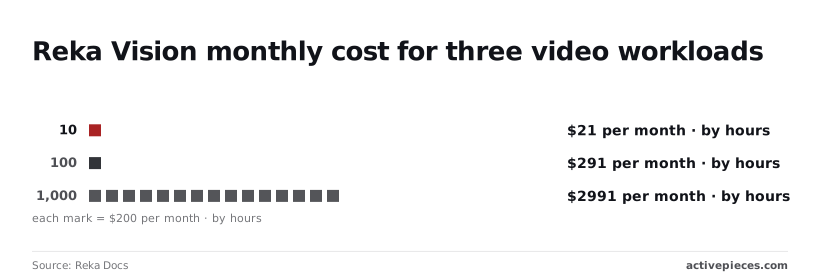
At $0.05 per minute after 180 free minutes, Reka Vision indexes your footage, per the Reka Docs. Ten hours costs $21 a month, so a pilot looks almost free.
One hundred hours costs $291, and 1,000 hours costs $2,991, so the bill grows with volume. Between 10 and 1,000 hours the bill grows 142-fold while the free allowance shrinks to a rounding error.
Our 500 hours is 30,000 minutes; removing the 180 free leaves 29,820 billable minutes, which is $1,491, at that scale, the free tier saves less than 1% of the total cost. Your pilot price tells you nothing about the production bill.

Long-document research assistant
Take 2,000 queries a month, each pulling a 150,000-token document, which is 300 million input tokens. That's fifteen times the classifier's input from fewer than a twentieth of the requests.
**Your pilot price tells you nothing about the production bill.
Worth checking against a plan that does not meter every step: one credit covers a whole run on Activepieces.
Hidden costs and limits teams hit with Reka
Those document sizes will understate your bill. You also have to count output tokens, retries, re-processed video and throttling, none of which show up when you multiply input volume by a listed rate.
Output tokens and long prompts
A workload that generates long answers costs more per request than the same workload returning short labels, because output tokens are priced above input tokens. A summarization job and a classification job over identical documents will land on very different bills.

Estimate the output length per call, not just the document size.
Long-context prompts add a second layer. If you resend the same large document with every question, you pay for those input tokens on every call. A chat interface that replays a growing history does the same thing, and the cost climbs with each turn.
Retries belong here too. A timeout or malformed response that you re-run bills the whole prompt again, so a modest failure rate quietly inflates the total.
Video re-processing and storage
Because video is billed on duration, anything that makes you process the same footage twice is a direct cost. Changing your index settings, fixing a bad ingest, or switching what you extract can all force a re-index of the whole library.

Budget for at least one full re-run before you trust a one-time ingestion number.
Storage is a separate question from processing. Before committing, ask whether indexed video is kept for a fee, how long it stays, and whether Vision plans carry minimums or per-seat charges.
Reka throttling and plan rate ceilings
Every plan has a requests-per-minute ceiling, and a batch job that ignores it won't fail cleanly. Requests above the cap get rejected or delayed, and your retry logic then sends them again.

Activepieces prices the run, not the steps inside it: a flow costs 1 credit whether it has two steps or ten, so a Reka job split into fetch, call, validate, retry and log costs what the single lumped step did.
Zapier's per-task billing and Make's per-module billing, as their own pricing pages state, charge more for that same split, which taxes the very discipline that keeps a throttled batch reliable. Only Reka's meter then moves with the work you send.
Peak hours are where this bites. A workload that averages comfortably under the cap can still exceed it during a burst.
Size your estimate against the busiest minute, not the monthly average, and check whether the next plan tier is a sensible fix or just a higher floor.
Reka wins when your workload is video-heavy or multimodal and its models are good enough for the task. It loses when you need the widest model range or discount machinery you can verify on a public page.
Multimodal API models: Reka vs Gemini vs OpenAI
They're Reka Edge, Reka Flash 3, Gemini 3 Flash and GPT-6 Luna, each taken from that vendor's own pricing page with its check date.
After the chart, compare on the dimensions that change a real invoice, in this order:
- Whether each vendor has a free tier, and whether it covers the modality you use.
- The rate limits at your plan level, since a throttled pipeline needs a bigger tier or a retry queue.
- Whether a batch discount exists and which endpoints it covers.
- Whether cached input is billed at a reduced rate for repeated long prompts.
Gemini and OpenAI publish these terms on their pricing pages, so you can fill in all four without talking to anyone. Where a Reka page leaves one of them vague, treat it as unknown and ask before you commit.
Each vendor is cheapest somewhere. Reka's small models suit high-volume multimodal calls where quality needs are modest. Gemini Flash suits very long inputs. GPT-6 Luna suits high-volume text work. Your own token counts decide among them.
Video understanding: Reka Vision vs Twelve Labs
Reka Vision is Reka's product for searching and analysing video. Twelve Labs is a company that builds video understanding models and sells them through its own API.
Because Reka Vision and Twelve Labs are billed on different bases, a per-token price can't be set directly against a per-video-minute price. You have to convert one into the other using your own average clip length and how often you re-analyse the same footage.
If you index a library once and query it many times, the one-off processing cost matters less than the cost of each query. If you re-process footage regularly, the processing price dominates and storage or indexing fees matter less.
Reka is the stronger choice if you're already using its models elsewhere and want one vendor and one invoice. Twelve Labs is the safer choice if video search is the whole product and you want a vendor whose pricing is built around that unit.
Run one representative day of footage through both before you choose.
What Activepieces does about this
The fix this article keeps arriving at is measurement, and Activepieces is where we'd put it. The core is open source under the MIT licence, so you can self-host it and read how it works.
A flow can sit in front of every Reka call, log the caller, the tokens and the video minutes to a table, and refuse new requests once a counter passes the ceiling you set.
The same flow handles the sample-clip check. A schedule trigger sends one fixed clip to Reka each day through an HTTP step and records what it consumed. If the same input starts costing more, you see it as a trend instead of an invoice.
Retries and pacing live in the flow as well. You can queue a batch to stay under your requests-per-minute cap, and a failed call goes back through a retry step you control instead of resending the whole prompt blindly.
Frequently asked questions
That day of footage gives you one cost-per-run figure, and the answers below are about keeping it honest once real traffic arrives. Where the body couldn't confirm a detail, I say so rather than guess.
On whether Reka AI has a free plan, check the current pricing page, because I can't confirm today's free allowance. Whatever it is, treat it as a test budget.
It tells you whether the API works for your clips, not whether the bill will hold at production volume, where rate limits and plan tiers bite.
On whether Reka Vision is priced separately from the Reka API, assume it's metered separately until the pricing page or your first invoice says otherwise. Video is billed on different units than text, so a token estimate won't predict it.
Price your footage in the units the vendor actually charges.
As for how often Reka changes its prices, often enough that a number you saved months ago shouldn't go into a budget.
I have no published schedule, so the safe habit is a monthly look at the pricing page, with the date you checked written next to every figure you rely on.
Can I cap my monthly Reka spend?
Look in your account's billing settings for a hard cap or alert, and confirm whether it stops requests or only emails you. If it only emails you, build the stop yourself: a counter in your code that refuses new calls past a ceiling you chose.
A warning at the end of the month is an invoice you've already agreed to.
To track Reka API usage across a team, log it yourself, per call, because the dashboard total won't tell you which project or person drove the spend.
Record one line per request with the caller, the tokens, and the minutes of video. Then you can attribute cost and spot the one pipeline that quietly doubled.
Here's the order I'd do it on Monday:
- Set a spend cap, in the billing settings if they offer one and in your own code regardless, so a runaway loop hits a wall instead of your card.
- Log tokens and minutes of video on every call, with a caller label, so every dollar traces back to a workload.
- Schedule a recurring Reka call that runs a fixed sample clip and logs its usage, so a change in what the same input costs shows up as a trend instead of a surprise.
- Re-check the pricing page monthly, and update your estimate and the checked date when anything moves.
Related reading
Running the numbers
See what the same workload costs here.
Free forever plan, and every paid plan self-hosts at no extra cost.
See pricing Talk to sales