
Retool Pricing 2026: Plans, Seats, and Overage Costs

Oct 10, 202613 min read
Retool pricing refers to a tiered subscription model that combines per-seat licensing for internal developers with usage-based charges for external portal users and automated workflow executions.
Retool pricing 2026: full plans, costs and billing explained
When looking at the 2026 pricing model, Wizardcost reports that Retool operates on a per-user basis that distinguishes between Builders who develop apps and Internal Users who only consume them.
While this ensures low overhead for prototyping, the cost structure creates a steep financial cliff once a department scales past a handful of seats or requires advanced security features.
Retool Free plan limits and features
A single developer can build and test administrative interfaces without an upfront budget because the Free plan costs $0 per month for both builders and internal users.
Retool documentation states that this tier has a cap of 5 total users, which limits your team size to a very small group.
Until the entire workspace moves to a paid plan, a sixth employee can't view a read-only dashboard. While this tier includes access to the MIT-licensed core of Activepieces for basic automation, it lacks the audit logs necessary for compliance in regulated industries.
Team and Business tiers for growing departments
By charging for every person who logs in regardless of how often they use the software, the mid-market tiers introduce a tax on growth.
| 2026 Retool Plan Comparison | Monthly Builder Cost (Monthly/Annual) | Monthly Internal User Cost (Monthly/Annual) | User Limit | Key Feature Inclusion |
|---|---|---|---|---|
| Free | $0 / $0 | $0 / $0 | 5 Users | Standard Components |
| Team | $12 / $10 | $7 / $5 | Unlimited | Protected Branches |
| Business | $65 / $50 | $18 / $15 | Unlimited | Granular Permissions |
| Enterprise | Custom | Custom | Unlimited | SSO & Airgapping |
Prices and plan limits checked against retool.com on October 10, 2026.
$65 per month is the builder cost for the Business plan according to Retool analysis, which forces agencies to bill higher developer rates to maintain margins.
This tier is the entry point for granular access control. A company must pay this premium just to prevent a support agent from seeing the Delete button on a database record.
Enterprise requirements and custom pricing
Only when a firm requires network isolation or Single Sign-On (SSO) to manage user lifecycle at scale does Enterprise pricing start. WizardCost, Ticker, and LiveMy note that for high-volume operations, the hidden cost lies in Retool Workflows.
50,000 tasks on Zapier costs $500, so you should budget accordingly for high-volume automation workflows. A more cost-effective alternative for the same volume can be found for as little as $10.
For high-volume operations, this 50x price difference means architectural choices, such as offloading heavy processing to external engines, are the only way to keep an Enterprise contract from ballooning alongside data volume.
If you are running this arithmetic for your own team, see what the same workload costs on Activepieces.
How Retool calculates your monthly billable users
To prevent high-frequency builders from subsidizing occasional portal visitors, Retool distinguishes between internal employees and outside stakeholders. This tiered approach ensures that your core development team pays a predictable flat rate while your client-facing tools scale based on actual engagement.
Standard users vs. External users
Daily staff who build, edit, or use apps are Standard users, costing a fixed monthly fee that makes them the most expensive seats for low-activity users. In contrast, Retool designs External users for clients or vendors who access a restricted portal.
You only pay when they log in to view their data because the platform bills these users on a usage-based per-session model. Retool splits the user once they hit the Login gate. Standard users remain at a fixed monthly cost.

External users enter a usage-based track where their monthly cap is lower than a full seat. This prevents a vendor who checks one invoice a month from costing you the same as a full-time developer.
Retool external user volume discounts
As your external population grows, Retool applies a regressive pricing scale that lowers the per-user cost to support massive client portals.
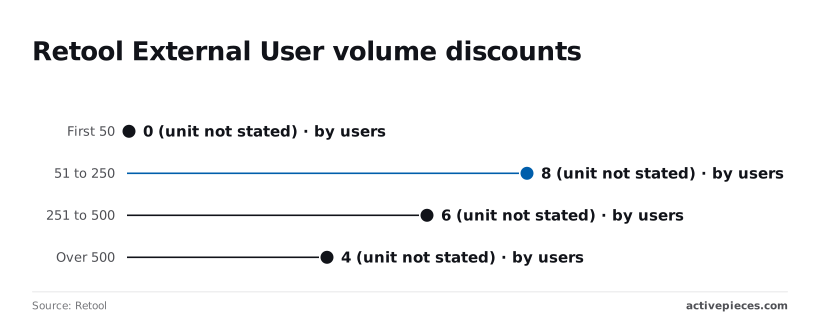
According to Retool, the first 50 external users cost $0 each, which allows you to launch a small pilot program with no additional licensing overhead.
$8 per user is the cost for the next bracket of 51 to 250 users once you scale. Efficiency improves as you reach 251 to 500 users at $6 each, meaning your per-seat cost decreases as you scale.
For any volume over 500, the price drops to $4 per user, so scaling your operations becomes significantly more affordable as your user base expands. This incentivizes moving all client interactions into the platform to achieve the lowest unit price.
Retool Business plan seat minimums and pricing
Committing to the Business tier is required to architect for these discounts, which mandates a 5-seat minimum for Standard users. This means even if you only have one developer, you'll pay for five.
$250 is the monthly floor created before you can even access the External User pricing model. Small teams must commit to a significant baseline cost regardless of actual usage.
Retool Business tier upgrade triggers
Once your application lifecycle requires professional governance or high-frequency background processing, the Business tier becomes a mandatory overhead. While the Team tier supports basic app building, Retool restricts the underlying infrastructure of Workflows and environment management to force growing organizations into the higher-priced bracket.
Retool Workflows: Execution credits and overages
Automated connective tissue between your UI and your data is provided by Workflows, but they carry distinct consumption limits that can spike an invoice without warning.
Every time a workflow triggers, it consumes execution credits. Retool applies overage charges for every subsequent run once you exhaust your monthly allotment.
A simple logic error that causes an infinite loop or a sudden influx of webhook data from a partner API can result in a direct financial penalty.
Pricing that scales with granularity often penalizes the exact discipline good automation depends on, such as breaking work into smaller, more reliable steps.
A platform that bills 1 credit per flow run regardless of the number of steps avoids this penalty, as shown on its published pricing page. This ensures that the meter is the run itself, leaving what happens inside it to the builder.
Pricing that scales with granularity often penalizes the exact discipline good automation depends on, such as breaking work into smaller, more reliable steps.
Retool staging vs production environment access
Higher tiers are where Retool restricts the ability to isolate development from live data. The Business plan is the entry point for safe deployment practices. On lower plans, you lack a native toggle to switch between a staging database and a production database.
To implement a standard software development lifecycle where changes are verified in a protected environment before going live, you must pay the Business tier premium for every seat.
Audit logs and SSO as Enterprise gates
Security features are treated as upgrades for teams that must meet compliance standards or centralized identity requirements. External stakeholder access is the primary cost driver.
Retool features requiring a Business upgrade
For separating Staging and Production data sources, Multiple Environments is the only way. Support for SAML or OpenID to manage logins via an identity provider like Okta requires Custom SSO.
Granular history of who viewed or modified sensitive data is provided by Audit Logs.
The threshold where high-frequency automation exceeds base credits is the Workflow execution volume. These gates ensure that as soon as your internal tool moves from a prototype to a regulated piece of company infrastructure, your per-user cost increases.
Worth checking against a plan that does not meter every step: one credit covers a whole run on Activepieces.
Retool compared to Appsmith and Superblocks costs
The financial burden shifts from the development phase to the production phase under Retool’s pricing architecture.
External stakeholder access is the primary cost driver. While a developer seat allows for the creation of limitless interfaces, the 2026 billing model makes every non-employee login a premium event.
Small teams use the entry-level tier as a low-risk testing ground. Because these plans often restrict production environments, a developer must test new features in the same space where live data is processed.
Retool has a generous seat count for internal users but limits Workflow complexity. Headcount can scale at a startup without an immediate increase in the software bill because Appsmith has unlimited internal users on its basic tier.
Superblocks focuses on developer experience by allowing full access to its IDE, though it restricts the number of active applications a team can deploy simultaneously.
Administrative controls necessary for departmental deployment, such as granular permissions and audit logs, are introduced in the mid-range tiers.
| Platform | Monthly Cost for 100 External Users |
|---|---|
| Retool | $1,600 |
| Appsmith | $0 (included in base) |
| Superblocks | $0 (builder-based) |
Retool bills for external access as a distinct, high-margin add-on, which is why this disparity occurs.
Appsmith maintains a predictable flat fee per user regardless of their status. Consequently, a firm building a vendor portal for hundreds of suppliers will find the Superblocks builder-based model more sustainable.
Network isolation and single sign-on (SSO) integrations are only accessible through Enterprise agreements, which are mandatory for any company subject to SOC2 or HIPAA compliance. Retool reserves its most robust self-hosting capabilities for this tier.
Evaluate the volume of external traffic to determine if Retool’s usage credits will trigger overage charges.
A modern automation engine provides the same SSO, SCIM, and custom RBAC features in its air-gapped edition as it does in the managed cloud. Regulated organizations like MoneyGram and FundingSocieties run this in production today.
The enterprise feature list in the self-hosted air-gapped docs matches the managed cloud exactly.
Reducing automation overhead with Activepieces
Complex logic can be offloaded from Retool to Activepieces, which provides 739 integrations to handle data orchestration without the compounding per-block execution fees found in Retool’s Business tier.
By shifting the heavy lifting of data orchestration to a dedicated workflow builder, teams can maintain Retool strictly as a frontend interface.
Cost of 50,000 workflow tasks
Tiered credit consumption is triggered when executing high volumes of automation steps within Retool’s native environment. This translates into a variable cost that is difficult to forecast.
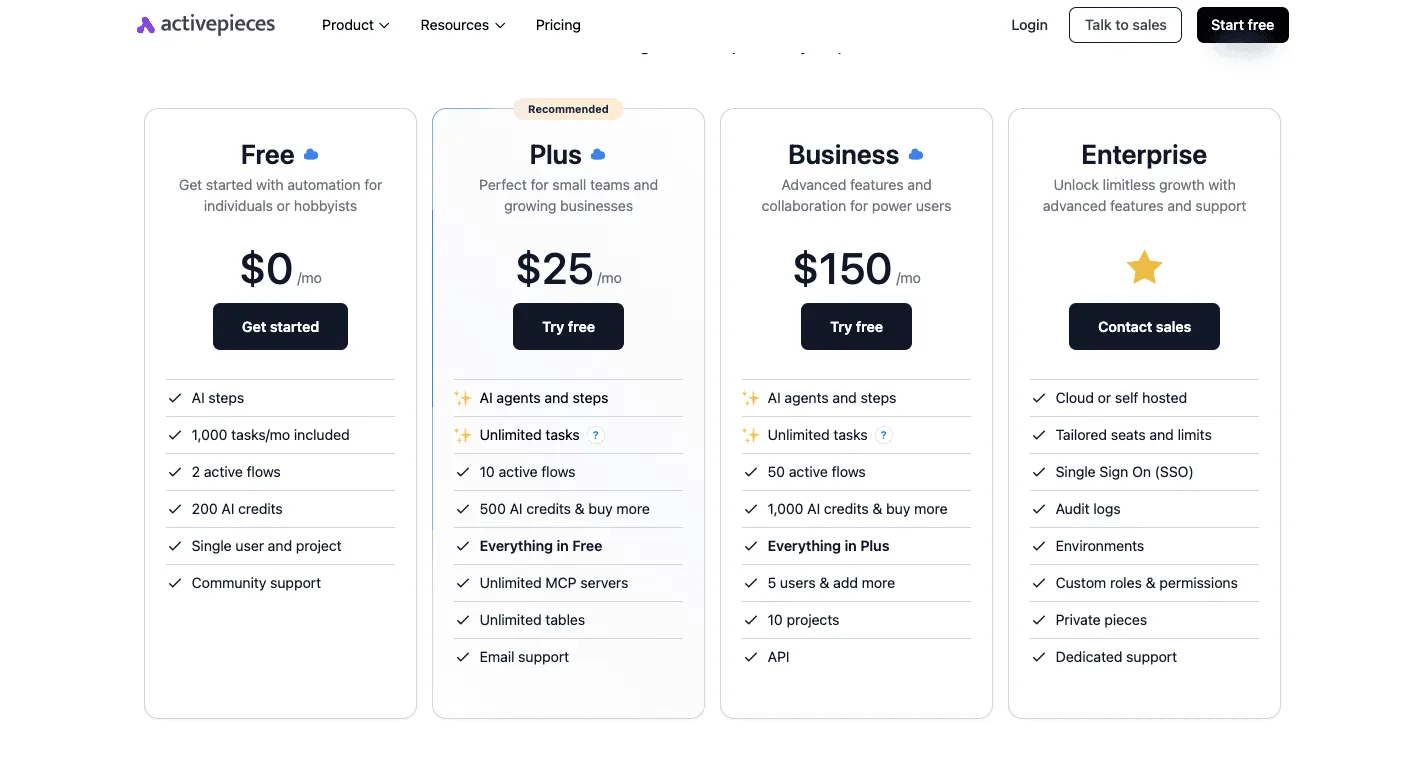
Activepieces, in contrast, offers unlimited flows on every plan, including free, which prevents a sudden spike in background tasks from resulting in an invoice that exceeds the project's allocated budget.
Bypassing Retool Workflow execution limits
Developers are forced to optimize for credit conservation rather than business logic because Retool enforces strict limits on concurrent runs and execution time.
Activepieces removes these constraints by allowing for unlimited steps per flow, which is how roughly 60% of its community-contributed integrations are utilized in complex sequences.
- A document from Google Drive is parsed by an Agent.
- It is analyzed using Gemini 3.8 Flash to determine risk levels.
- The data is routed based on the analysis.
Complex conditional branching is enabled by this granular control without the fear that adding a path will push the workflow into a higher pricing bracket.
Retool self-hosting and data residency options
For Retool's most flexible self-hosting and air-gapping features, Custom Enterprise contracts are the only way. Activepieces provides an MIT-licensed core that is deployable on private infrastructure without a high-entry price point.

Strict data residency requirements can be met by teams keeping sensitive API keys and customer data within their own Virtual Private Cloud (VPC).
The Monday morning Retool billing audit checklist
Weekly verification of user seats and resource consumption is required as the platform scales to prevent unbudgeted cost spikes.
The Monday Morning Audit:
- Filter Users by Last Active > 30 days to identify accounts that can be deactivated.
- Revoke Builder permissions for users with zero Edit events, converting them to lower-cost Viewer status.
- Check Workflow Usage against monthly credit balance to ensure automated tasks aren't on pace to trigger overage fees.
- Review API logs for high-frequency calls to expensive endpoints, such as the Google Gemini 3.8 Flash enterprise workflow model or OpenAI GPT-6 Astra reasoning agents.

Ops leads can justify the platform's ROI by standardizing these checks, ensuring every dollar spent correlates to a specific, active business process.
Frequently asked questions about Retool billing?
Understanding how the platform partitions user access and handles automated resource consumption is the key to billing predictability. Because the 2026 model treats every unique login and automated trigger as a potential line item, navigating these edge cases prevents unexpected spikes in your monthly retainer.
Does Retool offer a startup discount in 2026?
Significant credits for one year are provided by a program Retool maintains for early-stage companies. This allows teams to build complex internal infrastructure before the full cost of seat-based billing hits the balance sheet.
A company must typically be under a specific funding cap and employee count to qualify.
Established agencies can't use this to subsidize long-term client builds. Once the credit period expires, the organization automatically transitions to standard rates. Architectural decisions made during the free year must account for future scalability.
Can I mix Free and Paid seats in one organization?
A uniform tier for all users is required by Standard and Enterprise organizations. You can't assign a Free seat to a casual viewer while paying for developers within the same instance.

Based on their email domain and your plan's configuration, every person who logs in is categorized as either a Standard User or an External User. This forces a choice between paying for low-frequency users or migrating them to a public-facing portal.
Baseline costs for every other person in the organization are defined by the most expensive user type because of this lack of seat mixing.
What happens if I exceed my Workflow execution limit?
Retool applies overage charges for every additional run when a Workflow exceeds its monthly allotment to ensure your processes don't stop mid-cycle. A Workflow is the backend automation service used for scheduled tasks or data syncing.
To prevent business-critical failures, Retool applies these charges.
However, it creates a variable cost risk if a loop is poorly optimized or if a webhook from a service like the GitHub version control platform triggers more often than anticipated. Monitoring these credits is essential.
A single misconfigured automation can consume the entire month’s budget in a few hours.
Is there a discount for annual Retool billing?
Compared to the monthly pay-as-you-go rate, opting for an annual commitment reduces the per-seat cost. This provides a predictable floor for your fixed headcount.
Upfront payment for a set number of seats is required for this discount. You lose the flexibility to scale down during quiet months but gain protection against price fluctuations.
Provided the client’s user count remains within the pre-purchased volume, this locks in the margin on a retainer for agencies.
Related reading
References
Running the numbers
See what the same workload costs here.
Free forever plan, and every paid plan self-hosts at no extra cost.
See pricing Talk to sales