
Vapi Pricing 2026: The Real Cost Per Minute

Oct 10, 202616 min read
Vapi is a specialized voice AI platform designed to help developers build, deploy, and scale human-like voice assistants for customer support, sales, and automated outreach.
By providing a unified API that orchestrates speech-to-text, large language models, and text-to-speech, it simplifies the complex infrastructure required for real-time conversational AI.
As teams look to connect these voice capabilities to their broader tech stacks, many choose to integrate Vapi with Activepieces to automate data flows between their phone agents and CRM systems.
Understanding Vapi's pricing structure is essential for businesses to accurately forecast their operational costs as they transition from initial prototyping to high-volume production environments.
Vapi pricing is a usage-based cost structure that combines a flat per-minute platform fee with variable expenses for integrated telephony, large language models, and text-to-speech providers.
Polymarket-status-hub reports that Vapi separates its billing into a fixed $0.05 per minute platform fee and variable costs for external model providers. This forces developers to manage multiple fluctuating invoices for a single call.
The visible platform fee is often the smallest portion of the total operational expense.
Two ways to handle provider costs
Vapi offers two distinct methods for managing the variable costs of AI models and telephony. You can choose to have Vapi bill you for everything at a markup, which simplifies your accounting into a single invoice.
Alternatively, you can input your own API keys for vendors like OpenAI or Deepgram and pay them directly, leaving Vapi to only bill the $0.05 per minute platform fee, so your accounting department must manage multiple vendor relationships instead of a single invoice.
This choice dictates whether you prioritize convenience or cost-efficiency. Using your own keys allows you to leverage existing enterprise discounts with providers, while the managed option removes the need to maintain multiple balances.
Vapi's $0.05 per minute platform fee explained
Polymarket-status-hub reports that Vapi separates its billing into a fixed $0.05 per minute platform fee and variable costs for external model providers, so you must account for two distinct line items in your operational expenses.
A one-hour customer support call incurs a baseline cost of $3.00 before you add artificial intelligence models, so the final invoice will significantly exceed this amount once processing fees are included. This fee covers the synchronization of audio streams and the management of tool-calling logic.
When you use Activepieces to trigger external database updates during a conversation, for example, the orchestration remains consistent. While this fee is stable, it acts as a multiplier on every other cost component. Even efficient model configurations carry this overhead.
Platform subscription tiers: Free vs. Pro vs. Enterprise
Vapi has three tiers. The cost of security and support scales faster than call volume, so overhead increases as operations grow.
| Feature | Free | Pro | Enterprise |
|---|---|---|---|
| Monthly Fee | $0 | $499 | Custom |
| Included Credits | $10 | $0 | Custom |
| Concurrency Limits | 10 | 50+ | Unlimited |
The $0.05 per minute platform fee is a universal charge that applies to every tier, including Free and Pro, so no user can avoid this baseline operational expense.
While the Pro tier requires a $499 monthly base subscription to unlock higher concurrency and support, it does not waive the per-minute execution cost, meaning your total monthly bill will always exceed the base price.
According to TheExpertRanking, specific operational requirements carry heavy monthly surcharges. HIPAA Compliance costs $2,000 per month, which prices out smaller healthcare clinics, effectively limiting this feature to larger organizations with significant capital.
Data Retention is $1,000 per month, forcing a choice between regulatory compliance and margin, as the high cost makes it difficult for startups to justify long-term storage.
$999 per month is the price for the Pro Success Min support plan, while the Core Success plan is $29 per month, creating a massive budgetary gap between entry-level and enterprise-grade assistance that leaves mid-sized users without a middle-ground option.
This creates a steep financial gap for teams needing technical guidance.
Provider pass-through costs for LLMs and TTS
The total cost of a Vapi agent exceeds the $0.05 platform fee because you also pay for the models that power the voice.
| Component | Example Provider | Cost Impact |
|---|---|---|
| STT | Voxtral Mini Transcribe Realtime | Charged per minute for live audio-to-text conversion. |
| LLM | Claude Sonnet 5.5 | Charged per token for processing logic and generating responses. |
| TTS | Gemini 3.8 Flash TTS | Charged per character or minute for generating the agent's voice. |
| Telephony | Twilio | Charged per minute for the actual PSTN or SIP connection. |
Because of this multi-vendor dependency, a single minute of conversation could cost $0.15 or $0.50 depending on the model's verbosity and intelligence level.
How telephony and transcription affect Vapi's per-minute rate
The specific routing and transcription providers you select determine the total cost of a Vapi session. Vapi passes these external fees through alongside the platform's base usage rate.
While a developer might optimize their LLM prompt to save tokens, the underlying infrastructure costs remain rigid and highly dependent on the call direction and number type.
Choosing a Toll-free Inbound number costs $0.0220 per minute according to IDT Express, effectively increasing the per-minute operational overhead for every incoming customer interaction.
This represents a 158% premium over standard local lines to accommodate the convenience of a national presence, making accessibility a significant factor in monthly communication budgets. Standard Outbound (US) calls cost $0.0140 per minute.
Automated follow-up campaigns carry higher baseline overhead than reactive support lines. For high-volume support centers, standard Inbound (US) routing costs $0.0085 per minute. This rate keeps operational overhead predictable as call durations scale.
High volume connectivity
By utilizing SIP Trunking, large-scale enterprises can further reduce this to $0.0030 per minute. This effectively cuts the connectivity cost by more than half compared to standard inbound rates, allowing for significant margin improvement at high volumes.
These telephony choices establish the floor of the transaction before the AI even hears the user. The primary driver of the ceiling, however, is the Speech-to-Text (STT) layer required to turn audio into tokens.
| Provider Price Menu | Service Type | Rate (per minute) |
|---|---|---|
| Deepgram | STT (Transcription) | $0.0070 |
| Whisper | STT (Transcription) | $0.0050 |
| Twilio Inbound | Telephony | $0.0085 |
| Twilio Toll-Free | Telephony | $0.0220 |
Once the call is routed, the ongoing transcription fee adds another $0.0500 per minute. Even a silent minute where the model is processing still incurs this infrastructure cost.
This brings the total non-intelligence cost, telephony plus transcription, to nearly $0.06 per minute before a single word of Gemini 3.8 Live or Claude Haiku 5.5 is generated. This is a mandatory baseline expense for every session.
The choice of transcription engine is as critical to the margin as the choice of the reasoning model itself.
If you are running this arithmetic for your own team, see what the same workload costs on Activepieces.
Enterprise add-ons significantly increase the monthly floor
Enterprise-grade requirements transform a low-barrier entry into a significant fixed operational expense. Vapi locks the necessary security and support layers behind high-tier monthly commitments.
While a developer can experiment on a pay-as-you-go basis, moving to a production environment for regulated industries necessitates a shift to the Enterprise plan to access HIPAA compliance.

Through this regulatory requirement, the handling of Protected Health Information meets legal standards. This requirement also imposes a substantial monthly floor before a single minute of audio is processed.
The tiered structure of concurrency and technical assistance further complicates the financial predictability of a voice agent. High-volume deployments that require more than the standard capacity must move to the Pro or Enterprise tiers to avoid throttled calls.
Vapi support and capacity by pricing tier
Dedicated support channels are only accessible through these higher-cost agreements. These channels are essential for minimizing downtime in customer-facing applications.
This structure forces a choice between lower margins with professional safeguards or higher risk with basic self-service tools. Because of this escalation in fixed costs, the unit economics of a voice agent only stabilize once call volume is high enough to amortize the platform fee.
For smaller deployments, the cost of the platform itself can easily outweigh the combined per-minute expenses of transcription and reasoning models. The true cost of a voice agent is never just the sum of its tokens.
It's a calculation of how much volume is required to justify the enterprise-grade infrastructure.
The true cost of a voice agent is never just the sum of its tokens.
Calculate total costs at scale
The intersection of flat platform fees, per-minute orchestration costs, and the underlying consumption of large language models determines the total cost of ownership for a Vapi-powered agent.
Vapi charges a base $0.05 per-minute platform fee to manage the connection between components. The final invoice is dictated by the specific intelligence and latency requirements of the chosen stack, meaning your total expenditure will fluctuate based on the complexity of your AI agent's tasks.
Scenario A: The 500-minute monthly pilot
A low-volume pilot using a developer-tier subscription represents the entry point for testing basic conversational flows. At this scale, the primary cost drivers are the fixed monthly platform fee and the per-minute charges for basic speech-to-text and text-to-speech services.
Understanding the monthly floor
The Free tier allows developers to start with a $0 monthly fee and includes $10 in credits to offset initial testing.
However, the "fixed monthly fee" mentioned in Scenario A refers to the Pro tier's $499 requirement, which becomes mandatory once a pilot outgrows the Free tier's concurrency limits.
For users on the Free plan, there is no minimum spend, but the effective cost per minute remains high because the $10 credit is a one-time or non-recurring buffer that does not scale with usage.
If the developer utilizes a budget-friendly model like Gemini 3.5 Flash-Lite, the token costs remain negligible. Disproportionately, the total monthly spend is influenced by the platform’s minimum subscription requirements.
This influence is greater than the impact of actual talk time. This creates a high effective cost per minute for teams that don't exhaust their initial minute credits. Unused capacity in the base tier doesn't roll over to the next billing cycle.

Vapi cost for a 5,000-minute support agent
Scaling to a full-time support agent necessitates a move to higher-tier subscriptions that offer lower per-minute platform overhead in exchange for a larger monthly commitment.
In this scenario, the choice of a balanced model such as Claude Sonnet 5.5 introduces significant variable costs based on the complexity of the support scripts and the length of the system prompts.
Because support interactions often involve long-context retrieval from technical documentation, the input token costs can begin to rival the Vapi platform fee itself.
Incorporating a high-fidelity output like Gemini 3.8 Flash TTS adds a fixed per-character cost that scales linearly with every word the bot speaks.
Vapi cost for a 20,000-minute sales engine
An enterprise-scale sales operation requires the most aggressive pricing tier to minimize the margin-eroding effects of high-volume dialing. At 20,000 minutes, the infrastructure must support advanced reasoning and tool use.
This often requires a flagship model like GPT-6 Astra to handle objections and schedule meetings, so you must budget for premium model pricing rather than standard utility rates. This volume typically triggers the need for HIPAA-compliant environments or dedicated server instances.
These carry heavy monthly surcharges that must be amortized across the total minute count. $25 is the approximate total for a Tester at 100 minutes per month. The Support Bot costs approximately $1,500 total for 10,000 minutes per month.
The Sales Engine costs approximately $8,500+ total for 50,000 minutes per month plus HIPAA.
These figures demonstrate that as volume increases, the hidden costs of enterprise features and high-reasoning models eventually eclipse the base platform fees. A team's ability to maintain a profitable margin depends on their ability to optimize token usage without degrading the agent's capabilities.
Worth checking against a plan that does not meter every step: one credit covers a whole run on Activepieces.
Connect Vapi to your business tools with Activepieces
Activepieces routes call outcomes directly into operational software using 739+ integrations to ensure voice agent data does not become siloed.
Without this connective layer, the transcripts and metadata generated by Vapi remain trapped within its dashboard. This forces manual data entry that erodes the efficiency gains of using an AI agent.
Activepieces bills 1 credit per flow run regardless of how many CRM updates or email triggers are contained in the sequence, as shown on the published pricing page.
This prevents the cost of a complex follow-up from scaling with its granularity, unlike the per-task or per-module billing found in Make or Zapier. The run is the meter for these post-call automations, rather than the individual steps inside them.
The integration begins by configuring a Webhook trigger in Activepieces to capture the JSON payload Vapi broadcasts the moment a conversation terminates.
- This trigger ensures that the automation only fires once the full context of the call is finalized. This context includes duration, recording URL, and the final transcript.
- By selecting the Webhook integration as the starting node, you create a unique URL that must be pasted into the Vapi dashboard under the Webhooks settings. This handshake establishes a real-time data pipeline.
- Every completed customer interaction immediately initiates the downstream business logic without human intervention.

Step 2: Mapping call transcripts to Google Sheets or HubSpot
The next step involves parsing the unstructured transcript and routing it into a structured database or CRM once the webhook captures the call data.
The Activepieces flow builder is a visual canvas. You can drag an "Ask ChatGPT" action node to summarize the raw text using Claude Haiku 5.5. This identifies key customer pain points or intent before the data is saved.
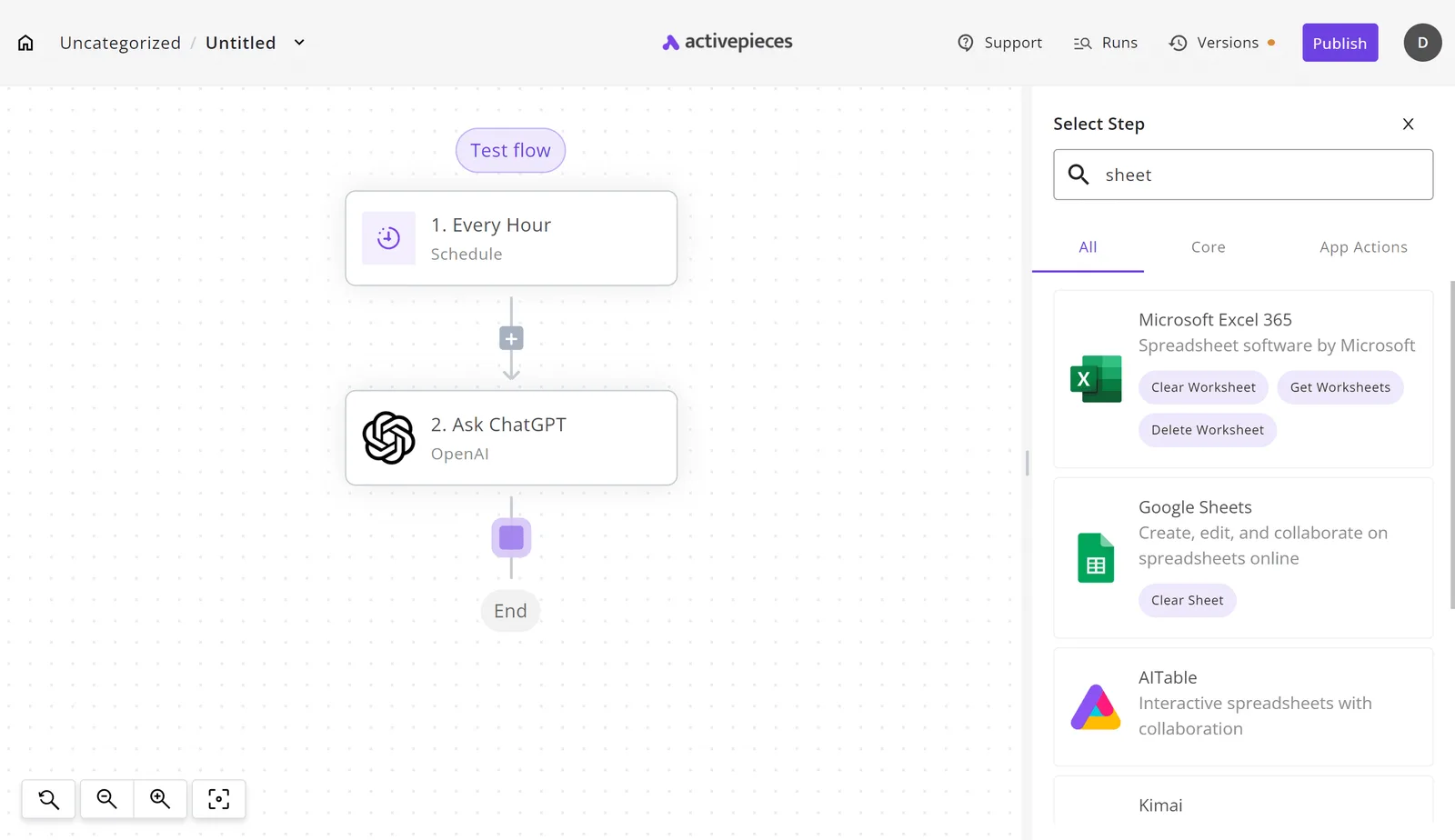
The screenshot of the Activepieces flow builder shows a three-step workflow on the canvas, consisting of an Every Hour trigger, an Ask ChatGPT action, and an End node.
On the right side, the "Select Step" panel is open, displaying a integration selector interface where a search for "sheet" reveals integrations for Microsoft Excel 365, Google Sheets, and AITable.
By selecting the Google Sheets integration, you can map the Summary output from the AI node and the Customer Phone Number from the Vapi webhook into specific columns.
This transformation turns a transient voice conversation into a permanent, searchable record that sales teams can use to track lead quality over time.
Automate SMS follow-ups after Vapi calls
The final stage of the workflow utilizes the processed call data to maintain momentum by sending an immediate SMS or email to the caller.
Adding a branch or a Twilio integration to the end of the Activepieces flow allows the system to send a personalized message containing a booking link or a summary of the discussed points.
This ensures the lead remains engaged while the conversation is still fresh. It effectively bridges the gap between a voice interaction and a closed sale.
Because Activepieces handles the retry logic and authentication for these third-party APIs, the voice agent's technical stack remains decoupled from the communication stack. This allows you to swap SMS providers without reconfiguring the underlying Vapi agent.
Regulated organizations like MoneyGram and FundingSocieties run these automations in production using an air-gapped edition for maximum control.
The enterprise feature list (including SSO, SCIM, and audit logs) is identical between the self-hosted air-gapped docs and the managed cloud, ensuring that security requirements do not force a compromise on functionality.
Frequently asked questions about Vapi billing
Does Vapi offer volume discounts for high usage?
Vapi has custom enterprise pricing for high-volume users. Organizations scaling past standard usage tiers must negotiate a contract to lower their effective per-minute rate.
Because the platform operates on a platform fee plus provider pass-through model, these discounts typically apply only to the Vapi service fee. They don't apply to the external costs for telephony or intelligence.
For high-volume users, securing an enterprise agreement is the only way to remove the standard per-minute markup. High-traffic applications should finalize these terms before a production launch to prevent margin erosion.
Can I bring my own LLM keys to reduce costs?
Users can connect their own API keys for supported providers. This allows them to bypass Vapi’s internal model markup and pay the model provider directly at their contracted rates.
This configuration shifts the cost burden of intelligence from a flat Vapi-managed fee to the specific token pricing of the chosen model.
Anthropic: Using Claude Sonnet 5.5 or Claude Haiku 5.5 via your own key ensures you pay only for the tokens consumed. OpenAI: Connecting a key for GPT-6 Luna or GPT-6.1 Sol allows you to use existing OpenAI credits and discounts.
DeepSeek: Integrating deepseek-v4-pro or deepseek-flash via a personal key uses their specific pricing structures.
What happens if I exceed my plan's concurrency limit?
When the maximum number of simultaneous streams is reached, Vapi will return an error code for any subsequent connection attempts until an existing call terminates.
Exceeding the concurrency limit results in the platform dropping new incoming or outgoing call requests. Users must monitor their active session count to avoid service interruptions.
This hard cap serves as a protective measure for infrastructure stability. It requires developers to implement their own queuing logic or upgrade their plan to accommodate peak traffic spikes.
Is there a free trial for Vapi Pro features?
Vapi has a starting credit balance for new accounts. This allows developers to test Pro features without an upfront financial commitment. These credits cover the costs of the platform fee, the LLM, and the speech-to-text and text-to-speech providers during the initial evaluation phase.
Once this balance is exhausted, the account reverts to a restricted state. Users must add a valid payment method to maintain access to the advanced voice synthesis and low-latency routing capabilities required for production-grade agents.
Related reading
References
Running the numbers
See what the same workload costs here.
Free forever plan, and every paid plan self-hosts at no extra cost.
See pricing Talk to sales