Voyage AI Pricing: Models, Rates and Costs (2026)

Nov 4, 202615 min read
You pay Voyage AI per million tokens, whether you call it directly or from a workflow built in Activepieces.
Each of its seven current models has a separate rate, work that can wait gets a cheaper batch rate, and a free allowance comes before charges begin. Pricing here is current as of 2026-11-04.
Voyage AI is a company that sells embedding models and rerankers. Embedding models turn text into numbers so a search can match by meaning, and rerankers re-sort search results so the best match comes first.

A token is a small chunk of text, roughly a short word or part of one.
To see the seven models ranked by what they cost relative to each other, and where each limit comes from, use the table. Exact dollar rates are on Voyage's pricing page and exact limits on its rate-limit page.
Voyage AI pricing table with every current plan
| Model | Job | Standard and batch rate | Free tokens | Context length | TPM/RPM limit |
|---|---|---|---|---|---|
| voyage-4-large | Embedding, highest quality | Top of the embedding range; batch is lower | Per-model allowance | Set per model | Rises with account level |
| voyage-4 | Embedding, general purpose | Middle of the range; batch is lower | Per-model allowance | Set per model | Rises with account level |
| voyage-4-lite | Embedding, lowest cost | Bottom of the range; batch is lower | Per-model allowance | Set per model | Rises with account level |
| voyage-3.5 | Embedding, previous generation | Priced against voyage-4 | Per-model allowance | Set per model | Rises with account level |
| voyage-3.5-lite | Embedding, previous generation, light | Priced against voyage-4-lite | Per-model allowance | Set per model | Rises with account level |
| rerank-2.5 | Reranking, full | Billed on query and documents together | Per-model allowance | Set per model | Rises with account level |
| rerank-2.5-lite | Reranking, light | Billed on query and documents together | Per-model allowance | Set per model | Rises with account level |
Prices and plan limits checked against blog.voyageai.com on November 4, 2026.
Nothing in the table is a monthly bill. The sections after it turn the rates into one, and you can finish that estimate in about 15 minutes with your own document count in hand.
Between the three voyage-4 models and the two voyage-3.5 models, the difference is mostly quality and price. The right one is the cheapest that finds the right documents for your content.
Because each search sends the query plus the candidate documents, Voyage bills rerankers differently from embeddings. A reranker's cost grows with query volume, not corpus size.
Embedding costs follow how much text you store; reranker costs follow how often people search. Keep the two apart in your estimate.
Free tier and rate limits by account level
Run a production corpus through it and the free allowance is usually gone in the first indexing run, because it covers testing and not much more. Rate limits rise with account level, so a large first load may take hours rather than minutes.
Activepieces answers that without a hire: tell its built-in chat you want documents sent to Voyage in batches at a pace your limits allow, and it publishes a live flow in your account, the same thing a builder would have wired by hand.
That flow runs under the platform's RBAC and audit logs like any flow a person made, and each run leaves a trace that shows what happened, readable without automation training.
You don't hire for this, you describe it, and a slow load becomes a schedule you can watch. MoneyGram, Moneypenny, Alan and FundingSocieties run Activepieces in production.
If you are running this arithmetic for your own team, see what the same workload costs on Activepieces.
Monthly cost at three realistic usage levels
Expect somewhere between $6 and about $6,000 a month, and your corpus size decides where you land far more than the headline rate does. Work it out in order, and do the arithmetic before you pick a model.
Count your documents, estimate an average length, and convert, remembering that a token is a chunk of text, roughly three-quarters of a word. Everything below builds on this one number.
Step 2: Add monthly updates and query traffic
Once the corpus is embedded, you are not done. Every new or edited document needs embedding again, and so does every search a user types.
Voyage bills both as tokens, so a busy search box on a small corpus can cost more than the corpus itself.
The sequence looks like this:
- Count the tokens in your corpus.
- Add the tokens of new and changed content each month.
- Add the tokens per query multiplied by queries per month.
- Subtract the 200M free tokens.
- Multiply what's left by your chosen model's rate.
That gives you a figure you can defend, because each line is something you can look up in your own systems. The examples below show how it plays out at three sizes.
Voyage AI cost examples at three corpus sizes
On the Voyage AI pricing page you can price a corpus across three steps of the voyage-4 line, cheapest to dearest.
At 1M documents, a small support-docs bot costs $6, $18 or $36 a month. Even the dearest model is a $30 difference, so at this size pick on quality, not price. The 200M free tokens also take the biggest bite out of a small bill.

At 10M documents, a mid-size internal search costs $96, $288 or $576 a month. Now the model choice is worth $480 a month, which is over $5,700 a year. Test the cheaper model on your own questions before paying for the top one.
Scale up to a large catalogue of 100M documents and the bill is $996, $2,988 or $5,976 a month, according to Voyage AI. The gap between cheapest and dearest is $4,980 a month.
At this size, a re-embedding habit matters more than anything else: re-running the whole catalogue when only a slice changed turns a sensible bill into a painful one.
At every size the top model costs six times the bottom one, so the choice scales with your corpus and can't be put off.
Hidden costs and limits that inflate the bill
Beyond the first pass of embedding, five other costs sit outside the rate card, some on Voyage's side and some in the systems you build around it.
Moving to a new model means paying to process the whole corpus again, and that re-embedding is a Voyage cost. Rate and batch caps, also Voyage's, limit how fast and how much you can send, and that decides how long a big job takes.
Context truncation is Voyage's too: text past a model's input limit is cut off, so you pay for documents that are only partly represented.
Billed by Voyage on a second model that reorders search results, reranker calls come separately from embeddings. Vector storage growth with dimension sits in your stack: the database holding your embeddings charges for what you store, and bigger vectors take more room.
Four of these show up on a Voyage invoice or in its documentation. The fifth lands on whatever database bill you already have, which is why people miss it.
Re-embedding after a model change
You can't mix vectors from one model with vectors from another, so upgrading means running every document through again. Doing nothing has a cost too: you stay on an older model while the gap in search quality grows.
Budget for the upgrade as a recurring line, not a surprise, and count your corpus once for each model switch you expect over a year.
Voyage AI rate limits and batch size caps
There is a limit on how many requests and how much text you can send in a given window, and Voyage also caps how many items go in a single batch. Neither raises your per-token price.
They stretch out your first load, and a slow load means engineers waiting or paying for idle infrastructure.
Then there is truncation. Every model has a maximum input length, and anything past it is dropped. A long contract may be paid for in full while only its opening is searchable.

Split long documents into integrations before sending them, and expect the integration count, and with it the cost, to rise.
Voyage reranker and vector storage costs
When your search returns results, a reranker puts them in better order. It's billed on its own, and it runs on every query, so heavy query traffic costs you here rather than at embedding time.
For storage, it works the other way around. Higher-dimension vectors capture more detail but take proportionally more space in your vector database, and that cost never stops while the data sits there.
Check the dimension you actually need before you load a full corpus, because changing it later means re-embedding.
Worth checking against a plan that does not meter every step: one credit covers a whole run on Activepieces.
Voyage AI against OpenAI, Cohere and open-source embeddings
When search quality is what your customers notice, Voyage earns its premium; otherwise a cheaper model gets you most of the way, provided you check its dimension first.
Look at the last generation to see the shape of the choice. Voyage's own launch post priced voyage-3.5 at $0.06 per million tokens and voyage-3.5-lite at $0.02, both with a 32K context.
Dropping a tier therefore cut the per-token rate to a third, and that gap is the lever you're deciding whether to pull.
Because rates move, the table ranks the options against each other instead of quoting dollars. Take your exact rate from the vendor's page on the day you buy.
| Model | $/1M tokens | Batch price | Free allowance | Context | Dimensions | Operational burden |
|---|---|---|---|---|---|---|
| voyage-4 | Top of Voyage's range | Batch option offered | Check Voyage's page | Long, set by Voyage | Fixed per model | Low: hosted |
| voyage-4-lite | Below voyage-4 | Batch option offered | Check Voyage's page | Long, set by Voyage | Fixed per model | Low: hosted |
| OpenAI 3-small | Cheaper of OpenAI's two | Batch option offered | Check OpenAI's page | Set by OpenAI | Can be shortened | Low: hosted |
| OpenAI 3-large | Dearer of OpenAI's two | Batch option offered | Check OpenAI's page | Set by OpenAI | Can be shortened | Low: hosted |
| Cohere embed-v4 | Mid-range hosted | Batch jobs offered | Check Cohere's page | Set by Cohere | Several sizes | Low: hosted |
| Self-hosted Qwen3-Embedding | No token fee; you pay for the GPU | Not applicable | Not applicable | Set by the model and your server | Set by the model | High: you run and patch the servers |
Read the table and two things stand out: the hosted options differ less on effort than on rate, and self-hosting trades the token fee for a machine you must keep running.
That machine costs money whether or not anyone searches, so it only wins if your volume keeps it busy.
When the cheaper tier is enough
If your corpus is small or your questions are simple, the cheaper tiers will do, and paying for the top model buys you little.
If a wrong result costs you a customer, a missed contract clause or a bad support answer, test voyage-4 on a few hundred of your own documents first.
Automating Voyage re-embedding and spend checks with Activepieces
Activepieces counts a flow run as 1 credit however many steps it has, so the checks below cost the same to run as a single call would.
What it does about this problem is run the chores around Voyage on a schedule, so your re-embedding habit and your spend stop being things you remember to check.
None of this replaces Voyage, and none of it makes the embeddings cheaper.
A nightly re-embed flow and a weekly spend check come to roughly 34 runs a month, well inside the free plan's 1,000 credits, and they set when you pay for the embeddings and report what you paid.

If you skip this, re-embedding becomes a task someone does by hand, and it happens either too often, which means paying to re-process documents that haven't changed, or too rarely, which means your search is quietly working from old vectors.
The re-embedding workflow, step by step
Four links make up the flow, and each does one job:
- A schedule trigger starts the run at a fixed time, nightly or weekly, whichever matches how fast your documents change.
- A step fetches the list of documents and compares each one's last-modified date or content fingerprint against what you stored last time. Anything unchanged is dropped here, before it can cost you anything.
- An HTTP step sends only the changed text to Voyage's embeddings endpoint, using your API key stored as a connection rather than pasted into the step.
- A final step writes the returned vectors into your vector database, replacing the old ones for those documents.
Step two is where the money is saved. Voyage bills by the amount of text you send, so filtering out unchanged documents shrinks the re-embedding line of your estimate directly.
For step three, a generic HTTP call reaches Voyage's embeddings endpoint, and the 747 integrations in Activepieces' open source monorepo, roughly 60% of them community-contributed, cover the steps around it, Slack included.
Weekly Voyage AI spend alert in Slack
Once a week, a second, much smaller flow runs. It pulls the token counts your re-embedding runs logged, multiplies by the rate on your plan, and posts the total to a Slack channel.
To see how that kind of flow looks on the canvas, look at the screenshot.
It has a trigger on the left, here a Stripe "Payment Failed" event, joined to a Slack "Send Message To A Channel" action, with the message template filled in on the right.
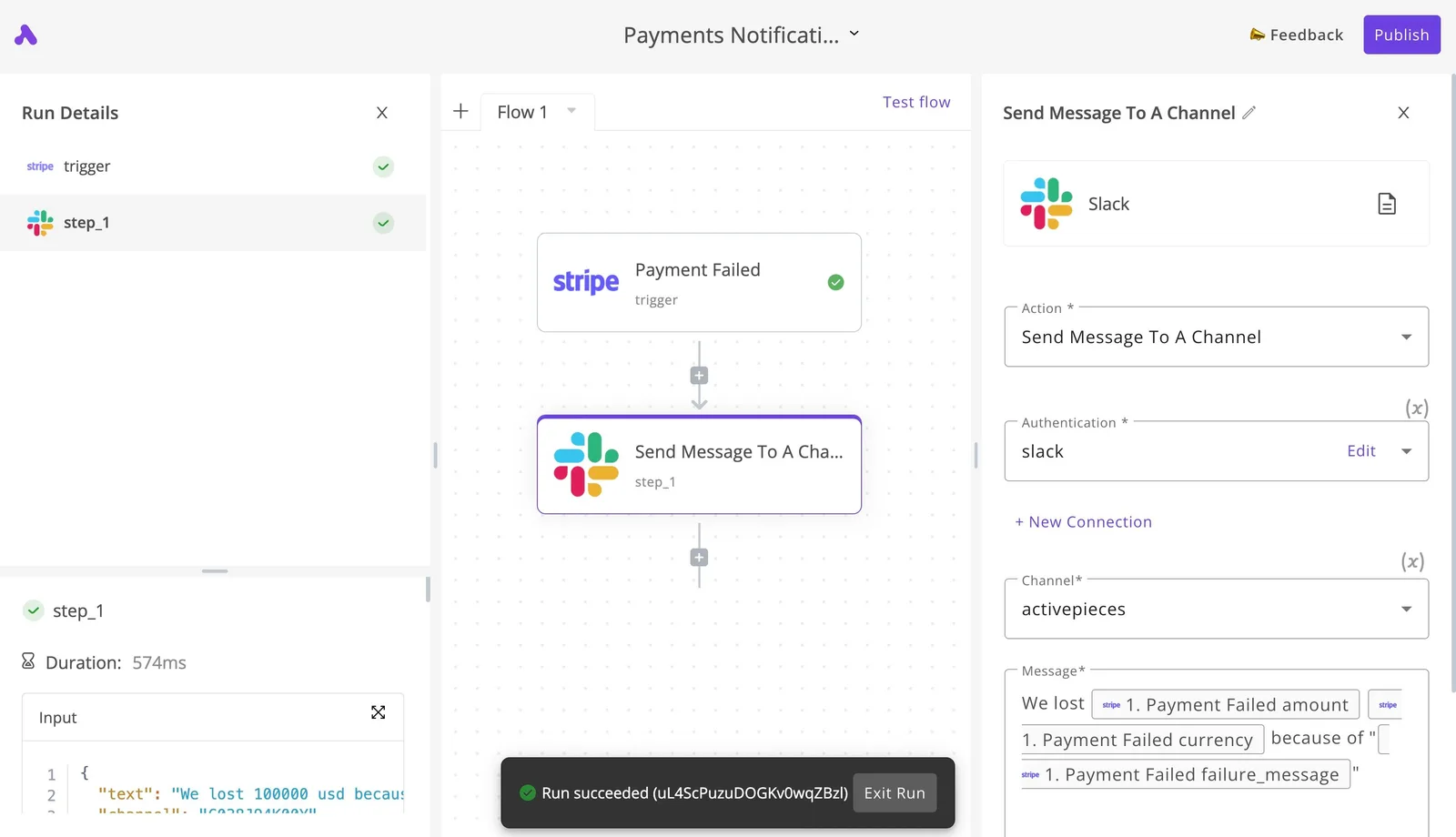
The run details show the step completed and "Run succeeded".
Yours swaps the trigger for a schedule and the message for a spend figure, but the shape is identical, and the run log is how you confirm it fired.
On Monday, do these four things:
- Write down your document count and how often those documents really change.
- Build the change-detection step first, because it's where the saving lives.
- Add the Voyage HTTP step and the vector database write, and test on a handful of documents.
- Set up the weekly Slack message, and compare its first total against your own estimate.
Frequently asked questions
Catching a spike early is only useful if you know what counts as one, and these five questions settle most of that before the first invoice arrives.
Is Voyage AI free to use?
Partly. Voyage has offered new accounts a free allowance of tokens, enough to test a model on a sample of your own documents. Past that allowance you pay per token.
Check the current pricing page for the size of the allowance, since it changes. Treat it as a way to measure your real token count, not as a plan for production.
Does Voyage AI charge for queries as well as documents?
Yes. A search query is turned into an embedding by the same model, so it counts as tokens like anything else. Each query is tiny, which makes it easy to ignore.
But a busy search box runs all day, and the total is your query volume multiplied by those small amounts. That's why query volume is one of the three numbers to work out yourself.
Can I use Voyage AI embeddings with any vector database?
Generally, yes. An embedding is a list of numbers, and any database built to store and search such lists can hold it.
Two things to get right: set the database's vector length to match the model's output, and use the same model for documents and queries. The second rule is what makes switching models costly, because everything you stored has to be redone.
Does batch processing change Voyage AI prices? It can, for work that's allowed to wait, such as a first load of your whole library.
Look at the current pricing page for any batch discount and how it's applied. It does little for live queries, because a person is waiting on the answer and the job can't be queued for later.
To stop a surprise Voyage AI bill, take four steps, in this order:
- Count your corpus in tokens before you send any of it.
- Re-embed only the documents that changed, not the whole library.
- Store the embeddings of repeated queries instead of paying for them twice.
- Set a spending alert or limit in your account, if your plan offers one, and read the usage page weekly.
Doing nothing here is how a one-off re-embed turns into a recurring charge.
Related reading
References
Running the numbers
See what the same workload costs here.
Free forever plan, and every paid plan self-hosts at no extra cost.
See pricing Talk to sales