
What Is DeepInfer? DeepSeek's Open-Source Engine

Oct 21, 202611 min read
Deepinfer is an open-source inference framework from DeepSeek, not the DeepInfra hosting service. It's new, we haven't run it, and most claims here come from the maker's pages as of today.
Deepinfer is DeepSeek's new inference project
Deepinfer creator and release date
According to the DeepSeek repository, it is the framework that powers DeepSeek's large-scale production services, much as teams might lean on Activepieces to run their own automation, with this release offering offline inference.
Check the account before trusting any mirror or fork, because the owner is DeepSeek's own GitHub organisation. I have no release date I can confirm, so read it from the repository's own history.
You may also land on deepinfer.org, a store of deep learning models for medical image analysis, currently at version 1.2. That's a different project.
How quickly DeepSeek models are changing
The pace matters. According to Github, on the Artificial Analysis index, DeepSeek's top model scored 11 in January 2025 and 13 in May 2025, so it was a minor player.
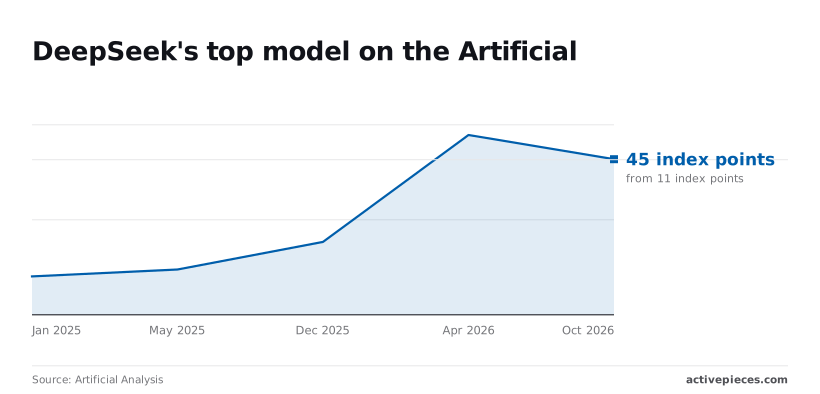
By December 2025 it had reached 21, and by April 2026 52, Artificial Analysis shows. It then slipped to 45 in October 2026. A seven-point drop in six months means the lineup this framework serves keeps shifting.
Activepieces lets you pick a backend from any major model or your own provider key, across 742 integrations, so you will meet these names there and the model spend lands on your bill.
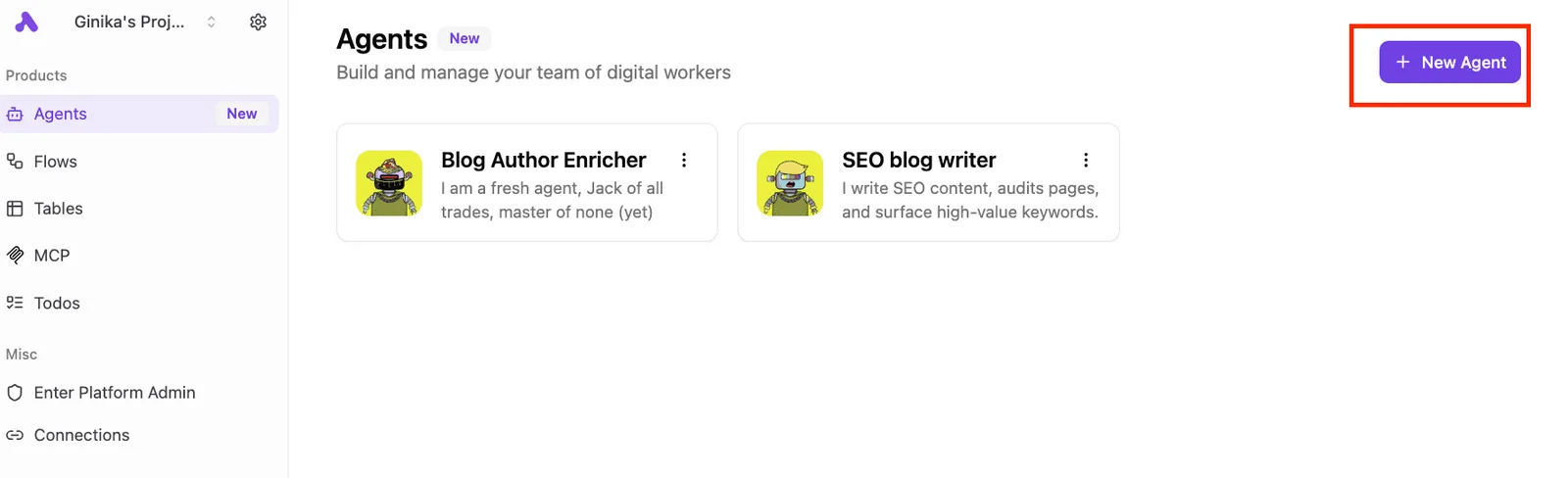
The agent list below shows what's at stake: each card is a digital worker, and someone must own it and its model connection.
(screenshot)
This page draws on the repository page and deepinfer.org as they stood on 2026-10-21. Nothing here comes from running the code or measuring speed, so treat every performance claim as unverified until you test it.
Everything below works on Activepieces' free plan. Start without code or a credit card.
Why deepinfer gets mistaken for DeepInfra
Although the names differ by only a few letters, the owners differ. Deepinfer is a new DeepSeek release, while DeepInfra is a separate company that hosts models behind a paid API.
Settle ownership first, because it tells you whose terms and whose account you'd be relying on. Deepinfer is an inference project made by DeepSeek, and DeepSeek's own project page tells you what the maker says it is today.
DeepInfra is a hosted model API from an independent company, and its own site tells you which models it hosts and how it bills.
The other name's pages can't answer a claim about one name, so check each claim against the maker's page before you repeat it.
Where pricing sits
If you type "DeepInfra", you usually want to know where to run a model and what that costs. That's a hosting question, and the host answers it. A search for deepinfer is a question about what DeepSeek released, which only DeepSeek can answer.
If you want a DeepInfra price, it sits with DeepInfra, because it's a service that bills for usage. I have no confirmed deepinfer price, so I give none; if DeepSeek's page lists one, that page is the source.
Any third-party chart comparing hosts for a DeepSeek model needs checking against each host's current page, since hosts change prices independently of the model's maker.
Deepinfer's Stated purpose and scope
To judge deepinfer fairly, use the maker's own pages, because a hosting comparison can't tell you what DeepSeek's release itself claims.
The repository sits under the deepseek-ai organisation on GitHub, so DeepSeek owns it, not a hosting reseller. The maker states four things on its pages, and each is worth reading at the source:
- the model DeepSeek-V4.1-Flash
- the hardware, NVIDIA SM100 GPUs and Huawei Ascend 950 NPUs
- the licence, Apache-2.0
- the version 1.2 note on medical image models
Apache-2.0 is a permissive licence, so its terms allow reuse, but read the licence file itself before you rely on that. The version 1.2 note says that release adds new models for medical image analysis.
Open the source directory and you get a bare listing with no description. It shows how the code is laid out, but not what each part promises. Folder names are a hint about intent, not a documented capability, so treat them as leads to check.

The pages give no benchmarks, so there's no basis for claims about speed or accuracy. They also give no support statement for the medical image models beyond the version note, so nobody should assume clinical suitability.
Until the maker publishes more, treat anything beyond the four stated facts as unverified.
Deepinfer access and running costs
You get deepinfer from the maker's GitHub repository, and no price is stated, so your cost is the compute you run it on. This was checked on 21 October 2026.
The order below runs from repository to budget. Follow it top to bottom, because each step can rule out the next.
- Open the maker's GitHub repository.
- Read the licence before installing anything.
- Follow the README install steps.
- Check your hardware against the stated requirement: SM100 (NVIDIA Blackwell-generation) or Ascend 950 (Huawei) accelerators.
- Budget your own compute, because no price is stated.
Steps one to three cost nothing. Step four decides whether step five is a small number or a large one.
I'm not quoting licence terms here, because the file in the repository is the only authority. The maker publishes no price, so any figure you see elsewhere isn't the maker's.
Deepinfer GPU requirements and hosting costs
For sizing, the nearest guide is NVIDIA's Dynamo recipe for DeepSeek V4.1-Flash, a related model.
It lists 16 H200 GPUs aggregated, or 8 split, 8 GPUs on B200 with two workers, 8 on GB200, and a B200 minimum of 4, which means your GPU allocation is limited to these specific configurations.

Treat these as a guide, not a deepinfer requirement.
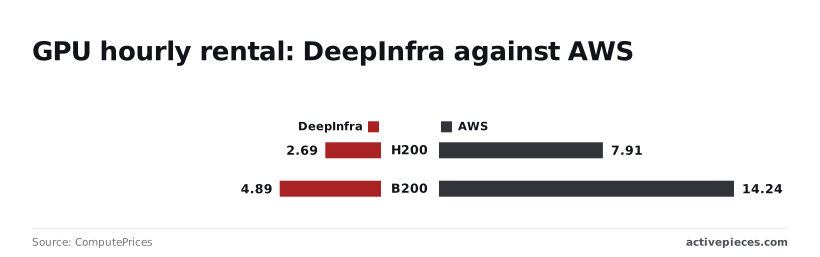
Renting B200 from DeepInfra costs $4.89 per GPU-hour, according to ComputePrices, so sustaining a B200 workload indefinitely costs thousands of dollars per month per GPU. Four GPUs therefore cost $19.56 to $56.96 an hour.
H200 runs $2.69 to $7.91, so 16 cost $43.04 to $126.56 an hour. H100 runs $2.20 to $6.88, so your per-unit cost is not a single fixed value.
Easier to see it running than to read about it: set it up free, no card.
Deepinfer strengths, weaknesses and rivals so far
On the maker's pages today, deepinfer's one clear strength is its owner, DeepSeek.
The connection has an identifiable owner. DeepSeek publishes it, so there's one party to ask about terms, data handling and support. That's more than can be said for a name that people confuse with a reseller.
Pricing and a maturity signal such as a version history: the maker's pages give neither, though they do list DeepSeek-V4.1-Flash as the supported model. Until they do, any cost comparison with renting GPUs would be guesswork. Check the pages again before relying on any of this.
Deepinfer vs DeepInfra vs vLLM comparison
The table sets deepinfer beside DeepInfra, a separate company that hosts models behind an API, and vLLM, an open-source serving engine you run on your own GPUs. The takeaway is that deepinfer's row is mostly "not stated", while the other two are better documented.
| Who runs it | Access route | Pricing | Maturity | Documented model support | |
|---|---|---|---|---|---|
| deepinfer | DeepSeek | Build from source (GitHub) | not stated | New release (initial commit Oct 20, 2026) | DeepSeek-V4.1-Flash |
| DeepInfra | DeepInfra, a separate company | Hosted API | Usage-based | Established service | Hosted open models |
| vLLM (self-hosted) | You, on your own or rented GPUs | Endpoint you operate | Software is free; you pay for the GPUs | Established | Broad open-model list |
Prices and plan limits checked against github.com and github.com and deepinfer.org and docs.claude.com and claude.com and openai.com and gemini.google on October 21, 2026.
Until deepinfer's pages fill those cells, the two established rows are the only ones you can budget against.
Run this in Activepieces: calling a deepinfer endpoint
A trial like this is easier to run when agents, integrations, workflow automation, an AI chat, MCP tools and approvals sit in one product under one set of controls (custom RBAC, SSO, SCIM, audit logs, environments and git sync), because a new model endpoint then gets the same oversight as everything else instead of a seventh vendor's separate record of what happened.
MoneyGram, Moneypenny, Alan and FundingSocieties run Activepieces in production.
The flow below shows the minimum build, and each step is something you can check against those pages:
- A webhook, or a schedule, starts the flow. Use the webhook if another system sends the work, and the schedule if you're running a recurring check.
- Add an HTTP request step pointed at your hosted endpoint. Store the API key as a connection owned by a named person, not pasted into the step, so someone is accountable when it expires. If deepinfer's docs show an OpenAI-compatible interface, use an AI step instead. If they show an MCP server, connect that.
- Branch on the response status. Send successes onward, and send errors or empty replies to a person.
Until the documentation confirms each of those options, the HTTP request is the only one to rely on.
Deepinfer evaluation checklist
Five steps, run in order against the maker's pages only, will tell you whether deepinfer deserves more of your time. One named person should own the result before anyone starts.
- Re-read the repository and the release notes as they stand today. Record the date you read them, because a brand-new release can change between your read and your colleague's.
- Confirm the Apache-2.0 licence in the repository itself, not in a summary. That licence is permissive about commercial use, but the file in the repo is the evidence your legal reviewer will ask for.
- Size a small trial on one SM100 GPU or one Ascend NPU, whichever the maker's pages list for the release. A single accelerator keeps the spend small enough to abandon, and it shows whether your workload fits before you ask for a larger allocation.
- Compare against DeepInfra's current pricing page. DeepInfra is a separate hosting service, so its prices describe renting someone else's hardware, not running deepinfer yourself. Put both on the same workload, or the comparison tells you nothing.
- List what to wait on. Write down each claim you couldn't verify today, such as a feature mentioned but not documented, and name who rechecks it and when. Anything on that list stays out of production until the maker's pages answer it.
Put both on the same workload, or the comparison tells you nothing.
Frequently asked questions
Each answer below stays within what the maker's pages state today. Where they say nothing, the answer is "not stated yet", and the person who owns the evaluation should record it that way.
Is deepinfer the same as DeepInfra? No. Deepinfer is a new release from DeepSeek, while DeepInfra is a separate hosting service. The names differ by two letters, so check the domain on the maker's page before you sign in or paste a key.
Is deepinfer free to use? Not stated yet. Until the maker's pages publish terms, treat it as unpriced and don't assume a free tier. Ask who'd be billed before anyone creates an account or connects a payment method.
Can I use deepinfer with models other than DeepSeek's? Not stated yet. It comes from DeepSeek, but that doesn't tell you what it supports. Read the maker's page for a supported-model list and rely only on that.
Integration and production questions
Does deepinfer work with an OpenAI-style API? Not stated yet. Don't plan an integration around API compatibility the maker hasn't documented. If a page does describe it, note the authentication method it names, and which permissions a key carries, before you name the risk.
Should I use deepinfer in production now? Not on the evidence available. A hosted version is also not stated yet, so you can't say where your data would run or who'd operate it.
Run the five steps first, record each gap as open, and give one named owner the decision to revisit it when the maker's pages change, so unresolved gaps will resurface once the maker updates their pages.