
Best Open-Source AI Agent Stack Tools in 2026
Open-source agent frameworks provide developers with full control over data privacy and infrastructure costs.

Covers self-hosted automation under data-sovereignty constraints: offline Kubernetes, air-gapped testing, and procurement-cycle realities.
ContributorSeptember 20, 202614 min read
This article was researched and fact-checked by an advanced research system.
AI agents function as autonomous software layers that use Large Language Models (LLMs) to execute multi-step reasoning and tool use, often relying on workflow automation platforms like Activepieces to bridge the gap between logic and action, moving beyond the simple text generation of static chatbots.
While managed platforms like Dust provide an accessible interface for building these workflows, they often act as a black box that obscures the underlying logic and data flow.
AI agents represent the next layer of the modern tech stack
The difference between a chatbot and an agent
A chatbot operates on a reactive, single-turn basis. By contrast, an agent maintains state and utilizes external tools to complete complex objectives without constant human prompting.
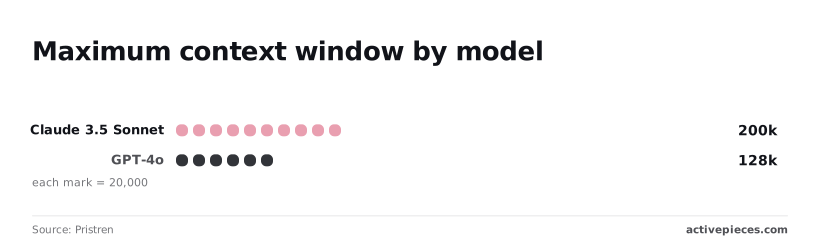
Massive expansions in context windows drive this shift in capability. For example, the 128,000 tokens available in GPT-4o allow an agent to ingest an entire codebase or several hundred pages of documentation, grounding its reasoning in specific technical reality rather than general probability.
Even more expansive is the 200,000-token limit of Claude 3.5 Sonnet. With this much overhead, an agent can process multiple long-form legal contracts simultaneously and identify cross-document contradictions.
How managed AI platforms gained early adoption
Managed platforms gained dominance by abstracting the infrastructure requirements of vector databases and API authentication into a single subscription. This allowed non-technical teams to deploy basic automation without a dedicated DevOps pipeline.
By offering a "no-code" wrapper around complex LLM calls, these services lowered the barrier to entry for internal tools. However, this convenience creates a hard dependency on the platform's proprietary orchestration logic.
When their underlying prompt engineering changes, it can silently degrade the performance of a critical business workflow overnight.
The three pillars of agentic architecture
The modern AI stack organizes these capabilities into a distinct hierarchy, moving from raw intelligence to specialized execution. This structure consists of three interdependent layers.
Foundation models (OpenAI, Anthropic, Llama 3) provide the raw reasoning and linguistic capabilities at the base.
In the middle, the orchestration layer handles the logic, memory, and tool-calling sequences. Activepieces runs the same codebase on managed cloud or self-hosted infrastructure via Docker and Kubernetes, using Git Sync and Releases to promote flows between environments without architectural lock-in.
This ensures that where a flow runs never dictates whether a team can leave, with RBAC and audit logs included regardless of the deployment choice.
Finally, the agentic layer sits at the top, consisting of specialized agents designed for specific domains, such as security auditors or customer support resolvers.
Modularity ensures that if a specific model’s pricing or performance changes, the orchestration and agentic layers remain intact. Following this architecture allows teams to swap out individual components without rebuilding their entire automation strategy from scratch.
Everything below works on Activepieces' free plan. Start without code or a credit card.
The architectural ceiling of managed agent platforms
Managed agent platforms prioritize rapid deployment over long-term structural flexibility. This creates a dependency on proprietary APIs that eventually prevents teams from tailoring the stack to specific compliance or performance requirements.
While these tools allow a department to go live in an afternoon, they lock the logic of the agent into a format that teams can't export to a different provider without a total rewrite.

The hidden cost of proprietary abstraction layers
Proprietary abstractions simplify the developer experience by hiding the complexity of vector database management and prompt chaining. As a result, the engineering team loses the ability to tune the underlying retrieval-augmented generation (RAG) process.
When a platform like Dust manages the "chunking" of documents, the user can't adjust how the system indexes information to suit specific technical documentation.
The agent may return irrelevant snippets because the fixed algorithm failed to respect the structure of the source material. This lack of granular control forces a choice between accepting suboptimal accuracy or abandoning the platform to regain control over the data pipeline.
The following table illustrates how these managed constraints compare to the flexibility afforded by open-source orchestration layers:
| Dimension | Managed Platforms (e.g., Dust) | Open-Source Orchestration |
|---|---|---|
| Data Sovereignty | Cloud-only; data resides on the provider's infrastructure. | Self-hosted; data stays within the corporate VPC. |
| Model Choice | Restricted to supported providers and versions. | Any LLM; local, private, or specialized models. |
| Pricing | Per-seat or credit-based usage. | Infrastructure-based; no per-user markup. |
A need to treat the AI stack as a first-class citizen of the internal infrastructure drives the transition to open-source.
Security risks of managed AI platforms
Security teams often veto managed platforms because these environments lack the network isolation required to handle sensitive intellectual property without external exposure. In a managed setup, every query must traverse the public internet to the provider's backend.
This means a multi-tenant environment processes the organization’s most sensitive data. The organization is left without control over encryption keys or logs.
Retries, a bounded reasoning loop, and tool-calls function as the core of an agent, and in Activepieces, this logic resides in an MIT-licensed core.
Every tool call an agent makes appears in the run trace, and the engine running that logic is public code found in the Flow Execution Engine and AI Integration pages of the monorepo.
This transparency allows teams like MoneyGram and FundingSocieties to run their agents in production with full visibility into the decision-making process.
Latency costs of managed AI platform orchestration
Every layer of abstraction between the user and the Large Language Model (LLM) adds latency. The managed platform must process its own internal logic, logging, and billing before forwarding a request to the model provider.
Because these platforms act as a mandatory proxy, the user is subject to the provider’s own uptime and rate limits.
A localized traffic spike on the managed platform can throttle a company’s internal tools even if the underlying LLM is fully operational. Moving to a direct, self-hosted architecture removes this middle-man, reducing the time-to-first-token and eliminating a significant point of failure in the production pipeline.

Why some teams stick with managed AI platforms
Managed AI platforms offer a pre-configured environment that reduces the initial setup time to a single afternoon, allowing teams to bypass the complex orchestration of infrastructure and model API keys.
By abstracting the plumbing of Retrieval-Augmented Generation (RAG), these services permit non-technical stakeholders to build functional prototypes without involving the DevOps backlog.
Integrated connectors for platforms like Slack and Notion remove the need for custom OAuth flows or webhook maintenance. Pre-built search indices eliminate the requirement for teams to manage their own vector database scaling.

Unified billing consoles provide a single point of financial oversight, preventing the "invoice sprawl" associated with managing multiple LLM providers.
Complexity debt of managed AI platforms
However, this convenience introduces a "complexity debt" that becomes due as soon as a project moves beyond the proof-of-concept stage.
While a managed service might offer a simple toggle for data privacy, it often lacks the granular audit logs required by internal compliance teams. A security officer can't verify exactly which data chunks were sent to an external LLM during a specific session.
However, this convenience introduces a "complexity debt" that becomes due as soon as a project moves beyond the proof-of-concept stage.
The transition from a managed environment to a self-hosted architecture isn't a rejection of efficiency, but a shift toward sustainable control. The following sequence outlines the technical requirements for migrating logic out of a managed ecosystem and into a controlled environment:
- Map existing Dust 'Helpers' to Activepieces 'Integrations'.
- Export prompt templates to a version-controlled Git repo.
- Configure local Vector DB
This migration path ensures that the logic previously trapped in a proprietary dashboard is now documented and reproducible.
By moving these components into a self-hosted stack, the organization replaces a black-box service with a transparent pipeline that survives even if the service provider changes their terms or pricing.
Easier to see it running than to read about it: set it up free, no card.
Decoupling the agent logic from the execution environment
Decoupling the agent logic from the execution environment allows teams to treat AI capabilities as modular infrastructure rather than rigid, vendor-locked services.
This separation ensures that an update to a third-party API or a change in a platform’s Terms of Service doesn't break the underlying business logic.
Standardizing on open-source orchestration frameworks
Standardization on open-source frameworks provides a predictable development lifecycle that managed platforms can't guarantee. The scale of community adoption reflects a shift toward these transparent standards.
130,068 stars on LangChain mean its integrations are the de facto industry standard for connecting LLMs to external data. AutoGPT maintains 111,967 stars, which ensures that autonomous agent research remains accessible outside of closed corporate labs.
AutoGen commands 55,836 stars, providing a stable foundation for multi-agent conversation patterns that aren't tied to a single provider's billing model. CrewAI has grown to 46,455 stars, allowing teams to orchestrate role-based agents using local Python environments rather than proprietary cloud dashboards.
Moving from managed hosting to private cloud deployments
Migrating to private cloud deployments eliminates the "black box" risk where a provider might silently change how data is processed. By hosting the orchestration layer on internal Kubernetes clusters, an organization gains 100% visibility into the execution logs.
This ensures that no third-party vendor retains sensitive prompt history.
Implementing local model routing for sensitive data
Local model routing ensures that high-risk data never leaves the internal network, satisfying strict compliance requirements that cloud-only platforms can't meet.
- The system classifies the incoming request based on data sensitivity levels.
- Requests containing PII or trade secrets are routed to a local inference server, such as vLLM or Ollama, running on air-gapped hardware.
- Non-sensitive tasks are sent to cost-effective public APIs to balance performance with operational expenses.
This approach limits the blast radius of a potential credential leak, as the most valuable intellectual property remains behind the corporate firewall.
The Monday morning audit of your AI agent stack
Managed platforms create a visibility gap where data flows through intermediaries before reaching the underlying model provider, increasing the surface area for a compliance failure.
A structured audit ensures that your team understands the exact boundaries of your infrastructure before a security incident forces the conversation.
Mapping your data egress points
Securing an environment begins with identifying every external API that receives a payload. Each hop represents a point where you lose control over data retention policies.
You must trace the path of a prompt from the user interface through the orchestration layer and finally to the inference engine.
If the orchestration layer is a managed service, your data is likely being cached on their infrastructure. To identify these vulnerabilities, perform the following audit:
- Count of third-party platforms with access to PII.
- Total monthly 'Credit' spend vs. actual token cost.
- Number of 'Shadow AI' agents built by non-IT.
This checklist provides a snapshot of your current liability, revealing how much of your operational logic is trapped in proprietary formats.
Calculating the 'exit cost' of your current workflows
Vendor lock-in is rarely a single contract. It's the accumulation of proprietary triggers and non-exportable prompt templates that make migration a multi-week engineering effort.
Vendor lock-in is rarely a single contract.
You must evaluate the "exit cost" by determining how much of your agent’s logic is written in a platform-specific language rather than standard Python or YAML.
When your agent relies on a "black box" retrieval-augmented generation (RAG) system, you can't verify the quality of the chunks being sent to the model.
High exit costs signify that your team is building on rented land, where a single price hike or feature deprecation can break critical business processes.
Prototyping a single agent in a self-hosted environment
Transitioning to a self-hosted orchestration layer requires a functional proof of concept that operates without an external heartbeat to a managed provider's server.
- Select a high-value, low-complexity agent that currently utilizes a managed connector for a service like the GitHub version control system.
- Deploy a local orchestration instance using a containerization tool like Docker. This ensures the environment has no outbound internet access except to your approved model API.
- Recreate the agent’s logic using open-source libraries, which allows you to inspect the raw code for any hidden telemetry.
- Compare the latency and token usage against your audit figures to verify the cost-efficiency of the self-hosted model.
This isolated test proves that your workflows can survive a vendor outage and establishes a blueprint for migrating the remainder of your stack.
What Activepieces does about this
Activepieces addresses the architectural ceiling of managed platforms by providing an MIT-licensed orchestration layer that runs wherever your data lives.
Unlike black-box services, the platform allows teams to self-host the entire execution engine via Docker or Kubernetes, ensuring that sensitive intellectual property never leaves the corporate VPC. This approach provides the data sovereignty required by regulated industries while maintaining the ease of a visual builder.
By using the Git Sync and Releases features, teams can promote flows between development and production environments with full version control, treating AI agents as first-class citizens of their existing CI/CD pipelines.
To solve the visibility gap inherent in managed providers, Activepieces exposes every step of the agentic reasoning process.
Every tool call, model response, and data transformation is recorded in a transparent run trace, allowing for granular auditing of how the Large Language Model (LLM) interacts with internal systems.
This level of transparency is why organizations like MoneyGram and FundingSocieties utilize the platform to run production agents; they can verify the logic in the open-source monorepo and ensure that no hidden telemetry or unauthorized data caching occurs during execution.
The platform eliminates vendor lock-in by decoupling the automation logic from the underlying model and infrastructure providers.
Because Activepieces supports a wide array of both cloud-based APIs and local inference servers like Ollama, teams can implement local model routing to keep PII behind the firewall while using public APIs for non-sensitive tasks.
This modularity ensures that if a model provider changes its pricing or a managed service like Dust deprecates a critical feature, the core business logic remains intact and portable, protecting the organization from the high exit costs of proprietary ecosystems.
Frequently asked questions
Is it more expensive to self-host AI agents?
Self-hosting incurs higher initial engineering overhead and infrastructure costs compared to subscription seats. This shifts the financial burden from predictable operational expenses to capital-intensive internal development.
While a managed platform abstracts away the cost of GPU clusters and load balancers, a self-hosted stack requires dedicated DevOps time for maintenance. The organization trades a flat monthly fee for the variable cost of internal specialized labor.
Can I export my existing Dust workflows to another platform?
Dust workflows are built on a proprietary internal specification that lacks a direct "export to YAML" or standardized schema. This requires teams to manually reconstruct logic, prompt chains, and data connectors in their new orchestration layer.
Because there is no industry-wide standard for agentic workflows, this lack of portability creates a high switching cost. The refined prompt engineering must be copy-pasted and re-validated against new API response formats.
What are the security risks of moving away from a managed provider?
Migrating to a custom stack shifts the responsibility for endpoint protection, credential rotation, and prompt injection mitigation from the vendor to the internal security team