
Activepieces Enterprise Pricing: All Plans (2026)

Oct 23, 202614 min read
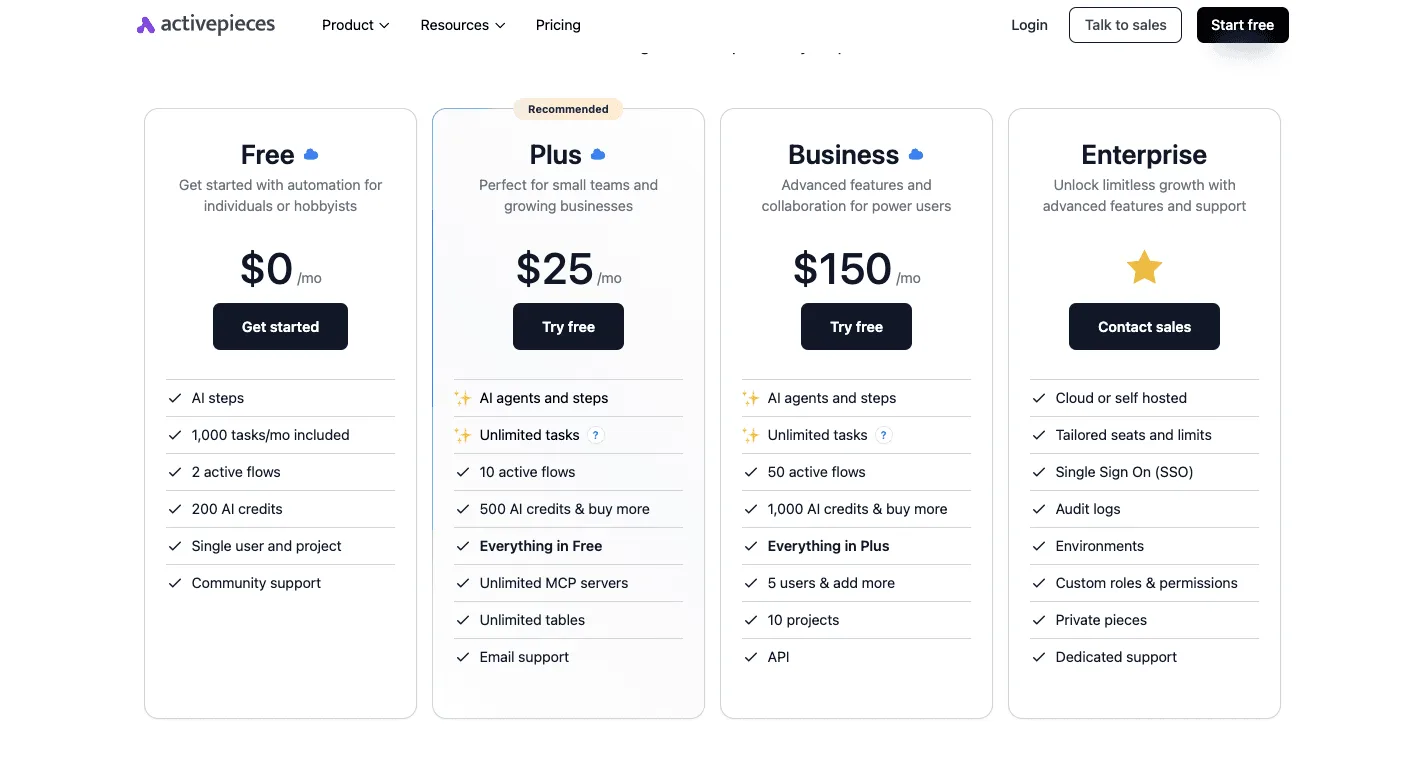
According to Activepieces, Free costs $0 with 1,000 credits a month, Plus is $20 with 10,000, so the cost to escape Free's ceiling is just $20 monthly.
Team is $200 with 50,000 credits, 25 users and SSO, making it a 10-fold price jump from Plus for team collaboration. You can budget everything up to Team from a public page.
Activepieces enterprise pricing refers to the custom, sales-negotiated cost of the Activepieces automation platform for self-hosted enterprise, Ultimate and Embed use, set by user count, credits, deployment model and support level rather than by a public price.
Ultimate and self-hosted enterprise cannot be budgeted from a page, because sales quotes them, and Embed starts at $36,000 a year, so those budgets begin with a conversation.
Every current plan, price and limit
Read the table for what each plan includes and how you buy it. Only Team lists SSO among its headline limits, so anyone who needs SSO and isn't buying Team is already on the sales side.
| Plan | Monthly price | Included credits | Users | SSO | How bought |
|---|---|---|---|---|---|
| Free | $0 | 1,000 | See pricing page | See pricing page | Self-serve |
| Plus | $20 | 10,000 | See pricing page | See pricing page | Self-serve |
| Team | $200 | 50,000 | 25 | Included | Self-serve |
| Ultimate | Quoted | Set in quote | Set in quote | Set in quote | Sales |
| Self-hosted enterprise | Quoted | Set in quote | Set in quote | Set in quote | Sales |
| Embed | From $36,000 a year | Set in quote | Set in quote | Set in quote | Sales |
Past your included credits you pay $0.007 each. That's seven-tenths of a cent, so a busy month on Team raises the bill in small, predictable steps rather than forcing an upgrade.
Which prices are public and which are quoted
If a number for Ultimate or self-hosted enterprise turns up elsewhere, treat it as a guess. The first three rows are public and self-serve, while the last three depend on users, credits, deployment and support, meaning higher tiers require custom negotiation.

No published figure exists for Ultimate or self-hosted enterprise. Embed's $36,000 is a floor, not a quote, so the actual cost will be higher.
If you'll run it yourself and need none of the enterprise features, the free Community Edition is enough. Once you need SSO beyond Team, Ultimate or a supported enterprise deployment, it stops being enough.
As of 23 October 2026 the figures above match the pricing page, and that page is where to buy the self-serve plans. For self-hosted enterprise, SSO beyond Team, Ultimate or Embed, use the sales form.
What the plans cost at realistic usage
Plus versus Team at 5,000 credits
Past the sales form, pricing is arithmetic. Plus is cheaper at 5,000 credits, and Team is cheaper at 40,000 and 100,000, so the crossover falls between the first two volumes.

Compare $20 a month for Plus with $200 for Team, according to the published pricing. Plus is ten times cheaper here because 5,000 credits sits inside its 10,000 included, so there's no overage.
Estimate your own volume by multiplying monthly runs by the credits one run uses.
Where the crossover falls at 40,000 credits
At 40,000 credits Plus now costs $230: the $20 base plus 30,000 credits over its allowance at $0.007 each, or $210 in overage. Team stays at $200 because 40,000 is inside its 50,000, which makes it $30 cheaper.
The break-even is about 35,700 credits, so above that figure Plus no longer saves money.
What 100,000 credits costs
At 100,000 credits, Plus reaches $650 and Team reaches $550, on the same pricing page, so Team is the value winner above that threshold. Team's 50,000 credits over its allowance add $350 to its $200 base.
The $100 monthly gap is $1,200 a year, and because overage has no ceiling, the bill rises with every extra run.
What annual billing saves
On annual billing Team comes to $166 a month instead of $200, per 5minsystems, which saves $408 per year. That saves $34 a month, or $408 a year.
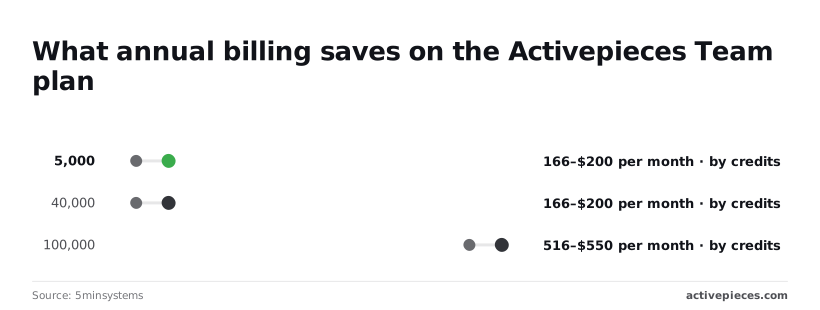
At 100,000 credits it's $516 instead of $550, the same $34 saving, so the discount applies to the base fee and overage still costs full price.
The credit count above rests on a run, and Activepieces charges 1 credit per flow run however many steps it holds, so a ten-step flow costs what its two-step workaround did.
Zapier's pricing page bills per task and Make's per module, which means breaking work into smaller, more reliable steps adds to the invoice there, and here it doesn't. AI steps are the exception, at 2, 10 or 20 credits depending on the model tier.
If you are running this arithmetic for your own team, see what the same workload costs on Activepieces.
When the free Community Edition is enough
When you run your own servers, need no single sign-on, and can live without a support contract, the Community Edition is enough. Then the licence costs $0 and only the host costs money, so you trade software licensing for infrastructure spending.
| Cost | Who runs servers | SSO | Support | Upgrades | |
|---|---|---|---|---|---|
| Community Edition | $0 licence, plus your host | You | Not included | Community channels | You apply them |
| Cloud Free | $0, 1,000 credits a month | The vendor | Not included | Not contracted | Handled for you |
| Paid self-hosted | Quoted by sales | You | Included in the quote | Set in the quote | You apply them |

What self-hosting costs besides the licence
Run a 2 vCPU, 4 GB server and it costs $23.59 a month on Hetzner, $24 on DigitalOcean and $30.37 on AWS. The spread is under $7, so pick the provider you already operate.
The hours someone spends on backups, patching and upgrades are the real cost. At $24 a month, one hour of engineering time a month costs more than the server, so you're spending more on labor than infrastructure monthly.

Signs you have outgrown Community Edition
- Your security team requires SSO, which Community lacks and which Cloud Team includes at $200 a month, so Community isn't compatible with your security requirements.
- A customer or auditor wants a support contract with named responsibilities.
- You are embedding the product inside your own application.
- Nobody on staff owns upgrades.
If one of these applies and you still want your own servers, you're in the quoted tier, where users, credits, deployment and support set the price. Don't budget a number for it before you have asked.
What drives a self-hosted or Ultimate quote
Quote drivers: users, credits, deployment, support
When sales prices self-hosted enterprise, Ultimate or SSO beyond Team, it works from four inputs, and each one moves the number in a way you can estimate before the call.
Knowing what each input does to the quote shows which of your answers will be expensive.
Add seats and the quote rises, and a rollout that includes contractors or occasional editors costs more than one limited to the people who build. A higher monthly volume of runs pushes the quote up too, so a loose credit estimate becomes a loose price.
Running Activepieces on your own infrastructure is free under the MIT-licensed core, and what a paid licence adds is SSO, roles, an audit of who changed what, and support, which is why sales quotes self-hosted separately.
Faster response and named contacts cost more than community help.
SOC 2 is in progress, not certified, so if your procurement needs a report today, say so early.
None of these has a published rate, which is the point where the public pricing stops and a conversation starts.
"'Starts at' matters in the Embed price of $36k a year, meaning the actual implementation cost will exceed that baseline. It's for putting automation inside your own product, and the same four drivers will move it from that floor.

Treat the figure as the entry price, not your total.
What to bring to the sales call
Bring a count of people who will build and people who will only view, and a monthly run estimate converted into credits with a margin for growth. Bring your deployment constraint and the support hours you need.
Since SOC 2 isn't yet available, add any security paperwork you require. A buyer who arrives with those answers gets a quote that can be compared, not one they simply accept.
Worth checking against a plan that does not meter every step: one credit covers a whole run on Activepieces.
Hidden costs and limits buyers hit
Past the headline prices, buyers miss credit overage, the Team user cap, where SSO sits, self-hosting infrastructure and staff time, and set-up time. Each one is cheaper to find before signing than after.
At $0.007 a credit, overage looks trivial until a flow loops. Activepieces bills usage beyond the included credits at that rate.
One misconfigured trigger that retries all night can burn through a monthly allowance and keep billing, so the overage is a bug cost, not a volume cost.
Set alerts on credit consumption, cap retries, and test every looping flow with a small batch first.
One misconfigured trigger that retries all night can burn through a monthly allowance and keep billing, so the overage is a bug cost, not a volume cost.
The 25-user ceiling on Team
When the 26th seat is needed, it is a plan change, not a line item, because Team includes 25 users. A company that has hired an operations team, a few contractors and an auditor can hit that limit sooner than headcount suggests.
You need to count everyone who will build or edit flows, not just the people you think of as users. If you're near the limit, ask for the next tier's quote now, because SSO is bundled into Team and moving up changes the whole conversation.
Self-hosting labour and infrastructure costs
The software may be free to run, but the server isn't. Neither is the person who patches it, backs it up and answers when a flow fails at night.
Staff time usually outweighs the hosting bill. Price the engineer's hours first, then the machine, and compare the total with a paid plan. If nobody will own the deployment, the free route isn't free.
How Activepieces compares with Zapier, Make and n8n
The entry price tells you little until you know what each vendor meters and which tier unlocks self-hosting, SSO and embedding, and every rival prices the same trade differently.
Dated 23 October 2026 and built from each vendor's own pages, the comparison sets entry price, usage metering unit, self-hosting, SSO tier and embedding side by side.
Cells marked unverified couldn't be confirmed on a public page, so ask the vendor about them rather than assume the feature is missing.
Start with the metering column. One workflow run can count as one execution, several tasks, or many operations, depending on the vendor.
Work out your cost per run on each unit before you compare entry prices. A cheap entry plan with an expensive unit gets costly at volume.
Read the SSO and embedding columns the same way. Wherever a cell says "contact sales", the price isn't published and can't be compared. Treat that as a cost you haven't yet seen, not a cost of zero.

When Zapier, Make or n8n fits better
If the team is non-technical, wants the widest app catalogue and has nobody to run infrastructure, Zapier is the fit. You pay for convenience, and that's a fair trade if no one on staff could maintain a deployment anyway.
Make suits people who think visually and build workflows with heavy branching and data shaping. Check how its operation counting treats your longest workflow before you commit.
For a developer-led team that wants to self-host and write code inside workflows, n8n is the fit. Its licence terms for commercial and embedded use deserve a careful read, because the free route still needs an owner.
What to do before you contact sales
Settle three things before anyone books a call. Those are how many people will log in, how many runs you expect each month, and who on your side will keep the deployment alive.
A free route that nobody owns costs engineering hours instead of invoices, and a salesperson will price you faster if you can state all three.
Three numbers to gather for pricing
Start with user count: it sets seat-based cost, and it's the number a quote leans on hardest. Count people who will build or edit flows separately from people who only view results.
Your monthly credits are your run volume, one credit per flow run. Estimate it from your busiest realistic month, because overage on a self-serve plan is a metered charge and a surprise on a contract.
The third number is upkeep: the hours a week your team can spend on updates, backups and incidents if you host it yourself.
Run these steps on Monday morning:
- Count the users, split into builders and viewers.
- Estimate monthly credits from run volume and steps per flow.
- Choose where it runs: the free Community Edition, the vendor's cloud, or a self-hosted licence.
- Open the pricing page if the choice was Community Edition or cloud, or the sales form if it was a self-hosted licence.
Which link to use
If the answer is Community Edition or a self-serve cloud plan, go to activepieces.com/pricing. The prices are public there, from $0 for Free to $200 for Team, so your two estimates become a budget without a conversation.
If you need a self-hosted enterprise licence, SSO beyond the Team plan, Ultimate or Embed, go to activepieces.com/sales.
Those are quoted individually, with Embed starting at $36,000 a year, and the user count, credit volume, deployment model and support level you gathered are exactly what the quote will be built from, so your final cost depends entirely on these specific variables.
Frequently asked questions
Is there a free version for enterprise use?
Yes, the free Community Edition can be self-hosted at no licence cost. It's enough for a team that only needs core automation and will run its own infrastructure.
It stops being enough when you need SSO beyond what Team has, the Ultimate tier or embedding, all of which go through sales.
Do plans charge per user?
Not on the self-serve plans, which are priced by plan and monthly credits, with a user allowance on Team. Per-user cost appears in enterprise quotes, where user count is one of the inputs alongside credits, deployment and support.
Expect that number to be set in the sales conversation, not on a public page.
What happens when I run out of credits?
On paid self-serve plans, Activepieces bills usage beyond your allowance at $0.007 a credit, so a spike raises the invoice and doesn't stop your flows.
Estimate your monthly runs before you pick a plan, because the overage rate decides whether a bigger plan is cheaper than paying as you go.
Can I switch from cloud to self-hosted later?
Possibly, but treat it as a project, not a toggle. Self-hosted enterprise is quoted by sales, so raise migration up front: ask how your existing flows and connections move, and who does the work. Budget the move before you commit to the cloud tier.
Is SOC 2 certification available?
No. The SOC 2 programme is in progress, so there's no certification to cite today. If your procurement process requires one, ask sales for the current status in writing before you sign.
Related reading
References
Running the numbers
See what the same workload costs here.
Free forever plan, and every paid plan self-hosts at no extra cost.
See pricing Talk to sales