
AI Grounding: How to Fix Ungrounded Agent Answers
Ungrounded AI responses often rely on hallucinations rather than verified facts. Use these strategies to verify model outputs against your own data.

Covers data-pipeline schema assumptions for analytics teams: what breaks first, why "source of truth" claims fail, and the fix.
ContributorSeptember 14, 202611 min read
This article was researched and fact-checked by an advanced research system.
Grounding links a model's output to a specific, verifiable source of truth, ensuring the agent operates within the bounds of your actual business data, such as the information processed through Activepieces, rather than its own statistical probability.
Grounding is the anchor for AI reliability
The difference between general knowledge and grounded data
General knowledge consists of the vast, static dataset the model ingested during its initial training. This data is often months or years out of date.
Grounded data is the live context provided at the moment of execution, such as a customer's order history or internal technical documentation. Grounding provides a fence that keeps the agent's logic tethered to reality.
Why LLMs hallucinate without a retrieval layer
When a model lacks a retrieval layer, it fills gaps with plausible-sounding fabrications. Hallucinations occur because large language models predict the next most likely token rather than querying a database for truth.
Source: TIGER-Lab/HELM.
The role of Retrieval-Augmented Generation (RAG)
Retrieval-Augmented Generation (RAG) acts as the bridge between the user's query and your private data, fetching relevant document chunks before the model ever attempts to generate a response.
The standard technical stack for retrieval
Implementing a retrieval layer independently requires a specialized stack to transform unstructured text into searchable mathematical vectors. Developers typically use embedding models, such as OpenAI’s text-embedding-3-small or open-source alternatives from Hugging Face, to convert documents into numerical representations.
These vectors are then stored in a vector database like Pinecone, Weaviate, or Milvus, which allows for high-speed semantic searches.
Converting language into mathematical meaning
Embedding models function by translating human language into a list of numbers, known as a vector, which serves as a coordinate in a high-dimensional space. Words or sentences with similar meanings are assigned coordinates that are physically close to one another.
This allows the system to understand that "refund policy" and "money-back guarantee" are related concepts, even if they share no common keywords.
Vector databases store these numerical lists and perform similarity searches to find the most relevant data points for any given query. When a user asks a question, the system converts that question into a vector and identifies the closest matching data chunks in the database.
This mathematical proximity ensures the model receives the most contextually appropriate facts to ground its response.
Orchestration frameworks like LangChain or LlamaIndex are often used to manage the logic between these components. These tools handle the "chunking" of large documents and the specific logic required to query the vector store based on the user's intent.
Without this infrastructure, the model has no way to navigate your internal data repositories.

Activepieces automates this grounding process by turning every connected integration into a tool schema on its per-project MCP server, allowing agents in Claude or ChatGPT to query your live data directly.
Because the platform uses an MIT-licensed core, you can verify the mechanism in the open source repo where the same logic that powers a structured flow is exposed as a tool for the agent.
This takes minutes, not a project: automate it in Activepieces free.
Anatomy of an ungrounded AI response
Confident tone paired with factual errors
A model's linguistic fluency is decoupled from its accuracy. Large Language Models generate a definitive answer even when data is missing because they prioritize satisfying the prompt structure.
A model's linguistic fluency is decoupled from its accuracy.
[Illustration: A split-screen comparison: on the left, a 'floating' AI brain disconnected from a base, labeled 'Ungrounded (Hallucination Risk)'; on the right, the same brain tethered by a thick cable to a server.]
The 'Stochastic Parrot' effect in customer support
In a support context, this manifests as the model providing instructions for a legacy version of a software interface that has since been redesigned. The result is a frustrated user following instructions for a product that no longer exists.
Fabricated citations and non-existent URLs
Ungrounded models frequently hallucinate technical documentation by synthesizing plausible-looking file paths or web addresses. A link to a knowledge base article may follow the correct URL slug format but lead to a 404 error because the model guessed the ID.

The compounding cost of ungrounded errors
Why early detection is the only affordable strategy
Catching a hallucination during the initial planning phase is the only way to prevent a linear mistake from turning into an exponential debt.
When an error is identified at the requirements stage, the cost to fix it is only $500. If that same ungrounded assumption survives into implementation, the cost jumps to $3,250. By the time the error reaches testing, the cost hits $7,500.

The 29x multiplier of production-level hallucinations
Every dollar saved by skipping grounding during development costs the company nearly thirty dollars in emergency patches and customer support.
The financial burden of an AI error reaches its peak once it hits production. The cost of remediation scales to $14,500, which means an unexpected budget shortfall for the project.
According to data from Specira.ai, this represents a 29x increase from the initial planning cost, so the original financial projections are rendered obsolete.
Budgeting for AI safety vs. AI remediation
Every agent tool call and the data it acted on is traced step-by-step in Activepieces, sitting alongside deterministic workflow steps in a single run record.
Check the Run Details and Debugging UI for the per-step agent decision trace, which exports as audit logs to the SIEM your security team already runs.
MoneyGram and FundingSocieties run this in production to ensure agent decisions are reviewed with the same rigor as standard workflows.
- Validating tool schemas against actual database headers ensures the model never attempts to query a non-existent column ($500), saving the team from costly runtime exceptions, which means the budget is protected from unpredictable engineering overhead.
- Writing unit tests for AI-triggered actions catches logic errors before they are integrated into the main codebase ($3,250), preventing the propagation of silent failures into production, so developers avoid the high cost of retroactive debugging.
- Managing the fallout of a hallucination requires manual data cleaning and potential legal review ($14,500), forcing a significant diversion of human resources away from development, thereby stalling the product roadmap.

Why AI agents lose their grip on reality
The knowledge cutoff limitation
Models operate on a fixed snapshot of the internet. Because the weights are frozen at the end of its training cycle, the agent cannot account for any event or software update that occurred after that date.
Information silos in corporate environments
General-purpose models lack visibility into private repositories. Without a direct bridge to secure environments like Salesforce or GitHub, the agent is forced to guess based on public patterns.
Probability-based guessing vs. fact-checking
The core mechanism of an LLM is token prediction, which prioritizes linguistic fluency over logical verification.
- Token Prediction: The model selects the next word based on mathematical probability.
- Logical Verification: A grounded system requires a deterministic check against a source of truth.
The core mechanism of an LLM is token prediction, which prioritizes linguistic fluency over logical verification.
The technical limits of manual grounding
Why 'stuffing the prompt' fails at scale
Injecting raw data into a prompt increases latency. Because LLMs charge by the token, a 100,000-token prompt costs roughly $0.30 to $3.00 per query.
This makes manual grounding 100x more expensive than using a targeted tool that only pulls the relevant row, effectively pricing out any strategy that relies on human oversight alone, leaving automation as the only viable path to scale.
Comparing context capacity across leading LLMs
| Model | Context Window (Tokens) | Consequence for Manual Grounding |
|---|---|---|
| Gemini 1.5 Pro | 1,000,000 | Can ingest an entire codebase but suffers from the highest latency. |
| Claude 3.5 | 200,000 | Fits several long technical manuals but risks losing "middle" details. |
| GPT-4o | 128,000 | Standard for complex tasks but requires aggressive data pruning. |
| Llama 3.1 | 128,000 | Parity with closed models but requires massive local VRAM to utilize. |
| Mistral Large | 32,000 | Optimized for speed but cannot hold a full customer history. |
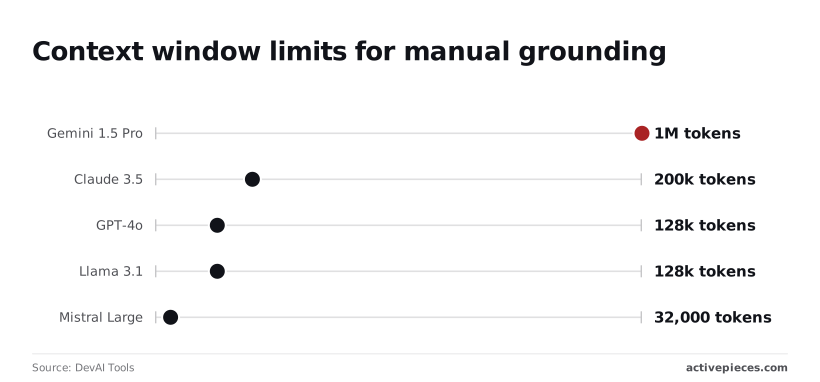
Gemini 1.5 Pro offers 1,000,000 tokens according to Devaitools. Devaitools states that Claude 3.5 provides 200,000 tokens. GPT-4o and Llama 3.1 both offer 128,000 tokens. Finally, Mistral Large supports 32,000 tokens.
The trade-off between window size and retrieval accuracy
Expanding the context window creates a "lost in the middle" effect. As you approach the 128,000-token limit of GPT-4o, the model’s ability to follow complex logic drops by as much as 20%, meaning the output quality degrades significantly as the context window fills.
Fixing ungrounded answers with Activepieces automation
Activepieces reaches every model provider a company uses among its 734+ integrations, preventing hallucinations by forcing the model to operate within the bounds of real-time business records.
Connecting LLMs to live CRM and ERP data
Direct integration with systems like Salesforce or SAP eliminates the latency that causes AI agents to hallucinate based on outdated information. The agent’s output is limited by the actual state of the business.
Automating the RAG pipeline without custom code
Standardizing information flow through a visual builder reduces logic errors. The RAG pipeline:
- Receive user query.
- Search vector database for context.
- Inject retrieved data into the LLM prompt.
- Generate answer based solely on the provided context.
Verifying AI outputs against source documents automatically
Automated verification steps act as a final gate. If the model claims a product is in stock but the warehouse database shows zero units, the workflow can trigger a retry or a human escalation.
The Monday morning AI grounding audit
| Checklist Item | Pass Criteria |
|---|---|
| Data Freshness | Source updated within 24h |
| Citation Check | Agent provides links to sources |
| Boundary Testing | Agent refuses queries outside the specific toolset |
Test the agent with 'out-of-bounds' questions
An agent must explicitly fail when asked for information that exists outside its provided tools. This "refusal logic" is the primary defense against prompt injection.
Verify the source-to-answer traceability
Every response must be mapped directly to a specific record in a system like Snowflake or Notion. If the agent cannot provide a record ID, the information is a hallucination.
Review the last 50 logs for subtle hallucinations
Manual log reviews catch "near-miss" errors where the agent uses the correct tool but interprets the returned JSON incorrectly, such as swapping a "Close Date" for a "Start Date."
Frequently asked questions
Can a grounded AI still hallucinate?
Grounded AI can still produce inaccuracies if the provided data source contains conflicting records or if the retrieval step pulls irrelevant context.
When a model is forced to rely on a specific knowledge base, it stops inventing facts from its training data, but it remains a probabilistic engine that can misinterpret the text it was just handed.
Your output quality is no longer a "creativity" problem. It is a data hygiene problem; if your documentation contains two different return policies, the agent will eventually flip a coin between them.
Does grounding an AI agent require a developer?
Grounding requires an analytics engineer or developer to build the initial "plumbing" between your database and the model's context window.
While low-code interfaces allow non-technical users to tweak prompts, the underlying connection (the API calls that fetch your live data) must be configured to handle authentication and rate limits.
Without this technical foundation, the agent remains a siloed toy with no way to verify its claims against your production environment.
How often should I update the grounding data?
Grounding data must be updated at the same frequency your business relies on that information to make decisions.
- Static policies should be updated quarterly to ensure the agent isn't citing deprecated internal handbooks.
- Inventory or pricing data requires updates via real-time API hooks so the agent doesn't promise stock that was sold an hour ago.
- Customer records must be updated via event-driven triggers to prevent the model from addressing a user by a name they changed last week.
Is grounding the same as fine-tuning a model?
Grounding is the act of giving a model a temporary reference book to look at, whereas fine-tuning is the permanent process of changing the model's internal weights.
Fine-tuning is a "black box" solution that makes the model better at a specific style or dialect, but it does not solve the hallucination problem because the information becomes stale the moment training ends.
Grounding ensures the agent uses the specific, current version of a file. This is the only way to avoid a blurry memory of what that file looked like during a training run.
References
Build it
Set this up in minutes.
No code required. Connect your accounts, and Activepieces runs it from there.
Start free