
What Is an AI Answer Engine and How Does It Work?
An ai powered answer engine processes vast datasets to generate direct, summarized responses rather than providing a list of links.

Covers workflow automation failures: the alerts, logs, and retry counts that reveal silent breakages before they cost you weeks.
ContributorSeptember 26, 202614 min read
This article was researched and fact-checked by an advanced research system.
Deliver answers instead of links
Why answer engines replace traditional indexing
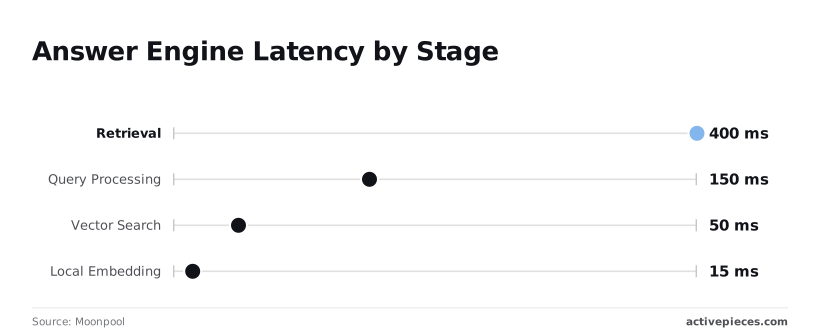
At the 400 ms mark of a Moonpool retrieval step, the system is still fetching raw data before a single word of reasoning begins.
This shift from keyword matching to intent-based synthesis means the cognitive load of evaluating source relevance moves from you to the model.
While this transition reduces the "time-to-insight" for you, it also creates a dependency on the model’s ability to weigh conflicting data points without hallucinating a consensus that doesn't exist in the source material.
Core components of AI answer engines
Modern answer engines rely on a specific architecture to ensure that the Large Language Model (LLM) draws from current reality rather than its static training weights. The Retrieval-Augmented Generation (RAG) workflow is the bridge between the model’s reasoning capabilities and external, verified data sources.
The RAG Workflow:
- You submit a natural language query.
- The system retrieves relevant document chunks from a vector store.
- The chunks and query are sent to the LLM.
- The LLM synthesizes a direct answer with citations.
When you use this sequence, the LLM transforms from a creative writer into a secure processing unit for retrieved data.
By using Activepieces to automate the ingestion of new data into these vector stores, you ensure the "knowledge" your engine provides isn't drifting away from the most recent documentation. However, the quality of the retrieval step strictly governs the reliability of this output.
Everything below works on Activepieces' free plan. Start without code or a credit card.
How answer engines process queries
By programmatically injecting verified data into a large language model’s prompt, answer engines replace the manual verification of search results.
This process, known as Retrieval-Augmented Generation (RAG), prevents the model from relying solely on its internal weights. The developers freeze these weights at the point of training, leaving the model without awareness of recent events.
How retrieval finds relevant context
Retrieval identifies the most relevant snippets of information from a massive dataset to serve as the factual foundation for a query. Unlike traditional keyword search engines that match literal strings, retrieval systems use vector databases.

This shift from keywords to vectors allows the system to understand that a query about "server latency" should pull documents regarding "response time," even if the words don't match exactly.
The effectiveness of this step is visible in how modern interfaces have abandoned the traditional list of blue links in favor of direct synthesis.
Claudecodeguides reports that 3.0% of queries result in clicks, while 97.0% lead to zero-click direct answers based on 1,000 tracked AI search queries, indicating that the vast majority of users find their information without ever leaving the search interface.
This shift places the entire burden of accuracy on the retrieval engine's ability to pick the correct context window. If the retrieval step pulls an outdated documentation fragment, the subsequent response will be confidently incorrect.
How augmentation feeds facts to the LLM
By formatting the gathered snippets into a structured prompt for the model, augmentation bridges the gap between raw data retrieval and the final response.
Generation: Writing the final response
Generation is the final step where the large language model parses the augmented prompt to produce a natural language answer.
Because the provided context constrains the model, the output remains grounded in the specific dataset rather than drifting into generalized or fabricated information.
Leading answer engine platforms compared for business use
Selecting an answer engine for your enterprise workflows requires balancing the speed of retrieval against the verifiable accuracy of the cited sources. While grounding models in specific datasets prevents hallucination, the architecture of the engine determines how quickly you can act on that data.
400 ms is the typical latency budget for a Moonpool retrieval step. The system spends nearly half a second just fetching raw data before any reasoning begins.
The following table compares the current market leaders based on their ability to surface live data and maintain audit trails for their claims.
| Platform | Source Transparency | Real-time Access | Primary Use Case |
|---|---|---|---|
| Perplexity Pro ($20/mo) | High (Inline citations) | Full Web Index | Research & Fact-checking |
| SearchGPT (ChatGPT Plus $20/mo) | Moderate (Source sidebar) | Web via Bing/OpenAI | Conversational Discovery |
| Google Gemini (126M MAU) | Variable (Search links) | Google Search Index | Ecosystem Integration |
While Google Gemini has the largest reach with 126 million Monthly Active Users (MAU), this comparison highlights that it faces higher friction in ecosystem lock-in compared to specialist tools.
Perplexity AI as a specialist answer engine
To reduce the time spent manually verifying model outputs, Perplexity prioritizes source attribution. The system architecture keeps the vector search phase to 50 ms.
This allows the engine to identify relevant data clusters in one-twentieth of a second, according to Moonpool. By performing local embedding in just 15 ms, the platform ensures the initial mathematical representation of a query doesn't become a bottleneck for you.
SearchGPT and OpenAI’s real-time search tool
SearchGPT integrates real-time browsing into the conversational interface of OpenAI, a research organization that developed the GPT-4 model family.
According to Moonpool, query processing takes 150 ms. The engine spends roughly a sixth of a second interpreting intent before scanning the web. This speed allows for a conversational flow that feels instantaneous, though it places a higher compute load on the back-end infrastructure.
Google Search Generative Experience explained
Google Search Generative Experience (SGE) leverages the world's largest web index to provide answers directly within the traditional search results page.
Because it operates at a massive scale, the 400 ms retrieval time is the most critical metric. It represents the ceiling for how fast the engine can pull from billions of indexed pages.
Manage answer engine costs and risks
The transition from searching to knowing is frequently interrupted by the overhead of maintaining a Retrieval-Augmented Generation (RAG) pipeline. While you see a seamless answer, the underlying infrastructure generates a compounding bill that can make high-volume deployments unsustainable for small margins.
Token consumption and API pricing models
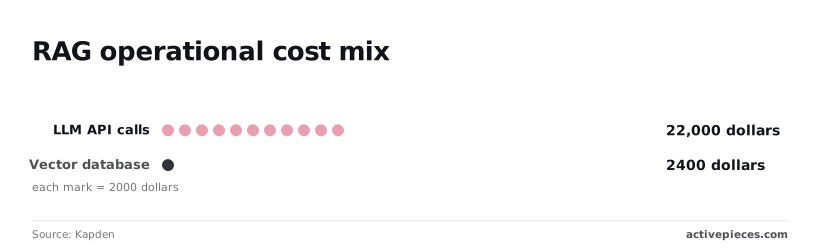
Operating an answer engine requires a massive upfront investment in both processing and indexing that far exceeds traditional keyword search budgets. According to data from Kapden, LLM API calls account for 22,000 dollars of a typical RAG operational mix.
The vector database, which is the specialized storage used to index and retrieve relevant document snippets, adds 2,400 dollars to the monthly stack. This creates a baseline infrastructure cost that forces you to choose between granular data retrieval and operational solvency.
The cost of AI hallucinations in answer engines
The reliability of an engine is inversely proportional to the human labor required to verify its output, a cost often ignored until the first major inaccuracy reaches a customer.
Without specific tuning, Llama-v2-7b-chat, a smaller open-source model, exhibits a hallucination rate of 55%. This renders it dangerous for any automated customer-facing role without a human-in-the-loop, so you must implement rigorous oversight to prevent the dissemination of inaccurate information.
The reliability of an engine is inversely proportional to the human labor required to verify its output, a cost often ignored until the first major inaccuracy reaches a customer.
4.1% is the reduced error rate for Llama 3.3 70B, yet even this lower margin necessitates rigorous oversight.
Human fact-checking requires 20-30 minutes per piece of generated content. A firm attempting to scale "automated" insights may find their payroll savings erased by the time spent auditing the AI’s fabrications.
Data privacy in the age of public crawlers
Answer engines rely on aggressive data ingestion, which often creates a conflict between model performance and intellectual property protection. Public crawlers prioritize breadth. Any data exposed to the open web effectively enters the training sets of future models.
Easier to see it running than to read about it: set it up free, no card.
Build private internal answer engines
Why public engines can't see your Slack or Jira
Because their crawlers can't bypass the authentication layers protecting proprietary communication tools, public answer engines fail to index internal data.
While a search engine can index a public blog post to provide immediate answers to general queries, it lacks the session tokens required to access a private Slack channel.
The model remains ignorant of the specific decisions made in your last stand-up meeting. This isolation is a deliberate security feature of software-as-a-service platforms, ensuring that sensitive roadmap discussions in Jira remain invisible to the global training sets used by foundational models.
Activepieces acts as the integration layer for custom answer engines, connecting vector databases like Pinecone to LLMs and communication channels like Slack or Discord.
Activepieces runs whatever model you already chose on your own provider key rather than reselling tokens with a platform markup, a structure visible in the Bring-Your-Own-Key availability by tier on the pricing page.
This allows companies like MoneyGram and Moneypenny to keep model spend on their own provider accounts while retaining complete control over their underlying AI strategy.
Consequently, an out-of-the-box AI will hallucinate a generic process when asked about a company-specific workflow because it can't retrieve the unique documentation stored behind your firewall.
Using Activepieces to automate data ingestion
Connecting disparate data silos requires a structured pipeline that pushes internal updates into a centralized environment where a model can actually reference them.
The moment a integration is connected in Activepieces, an agent can call it.
Register a integration once and it runs two ways at once: as a step inside a flow, and as a tool schema on Activepieces' per-project MCP server, reachable from Claude, ChatGPT, Cursor, or an agent you built yourself.
Check the Integrations Framework and MCP Server documentation to see how the same integration action that runs in a flow is the one exposed as an MCP tool.
Without an automated ingestion layer, the "knowledge" available to an engine begins to decay the moment a developer closes a ticket or updates a wiki page.
By synchronizing these sources, you ensure the model queries a live reflection of your operations rather than a static snapshot that leads to outdated technical debt. The context window of a model governs its capacity to "remember" this ingested data.
Without an automated ingestion layer, the "knowledge" available to an engine begins to decay the moment a developer closes a ticket or updates a wiki page.
This window dictates how much information the system can process in a single request. The oldest data drops from its immediate memory once the limit is reached.
| Model or Tool | Context Window / Memory Limit | Operational Consequence |
|---|---|---|
| GPT-3 | 2,048 tokens | Limits the engine to analyzing roughly three pages of text, forcing aggressive and lossy summarization. |
| Claude v1 | 9,000 tokens | Allows for a full technical manual to be parsed, but fails when cross-referencing multiple project repositories. |
| NotebookLM Pro | 300 sources | Shifts the constraint from word count to document count, enabling broad synthesis across an entire department's library. |
This hardware-level limit defines the boundary between a system that understands a single document and one that understands an entire organization.
Building a custom vector database for search
By converting text into numerical coordinates that represent semantic meaning, a custom vector database acts as the long-term memory for an internal engine.
When you ask a question, the system doesn't search for keyword matches; it looks for data points physically close to the query in a mathematical space.
This creates a "ghost" in the knowledge base that misleads employees. Maintaining this index requires a strict TTL (Time To Live) policy for every vector to ensure that decommissioned project specs are purged before they can contaminate new search results.

The Monday morning plan for answer engine implementation
To prevent the model from hallucinating based on obsolete documentation, deploying an internal answer engine requires a systematic migration from unstructured data pools to a governed retrieval pipeline.
Without a structured deployment sequence, the system will eventually ingest conflicting instructions, leading to a breakdown in technical accuracy during high-stakes queries.
Auditing internal search queries before implementation
Identifying which internal queries currently fail in legacy keyword search tools determines the specific datasets that require high-density vectorization. If engineers are manually scouring disparate documentation for API endpoints, those specific repositories should be prioritized for ingestion to reduce the time spent on manual discovery.
Set strict data boundary policies
Access control lists must be mapped to the vector database to ensure that sensitive payroll or strategic data isn't surfaced to unauthorized users through the model's latent space.
A user with "Read Only" access to a project folder shouldn't be able to bypass those restrictions by asking the LLM to summarize a document they can't open directly.
The following sequence ensures that data integrity is maintained from the moment of ingestion:
- You audit internal data sources.
- Administrators define user access permissions.
- You select a vector database.
- Engineers set up an automated ingestion pipeline.
- The security team conducts a red-team exercise.
By forcing the resolution of permission conflicts before the first index is built, this checklist transforms a theoretical deployment into a hardened production environment.
Testing answer engine accuracy with ground truth data
Validating the engine against a set of known-good technical specifications prevents the silent propagation of errors.
These errors occur when a model prioritizes fluency over factual correctness. A "ground truth" test involves feeding the engine a query with a single, verifiable answer and measuring the distance between the model's output and the source documentation.
If the system fails to cite the specific version number of a library, the retrieval-augmented generation (RAG) parameters must be tuned to increase the weighting of local context over the model's pre-trained weights.
Frequently asked questions about AI answer engines
Are AI answer engines legal under copyright law?
Provided the output doesn't serve as a market substitute for the original source, current legal frameworks treat AI answer engines as transformative rather than derivative.
When a model ingests a proprietary technical manual to generate a summary, the fair use defense rests on whether the engine directs traffic toward the rights holder or traps you within the model’s interface.
If the engine suppresses the source link, the publisher loses the opportunity to monetize that visit. This shift moves the legal risk from the model provider to you as you implement the tool.
How do answer engines cite their sources?
By mapping specific tokens in the generated response back to the unique identifiers in the retrieved document chunks, answer engines cite sources.
This process, known as attribution mapping, ensures that a claim about a software dependency is anchored to a specific line in a documentation file.
The vector database stores the original text alongside its embedding. The system can pull the exact URL when a match is found.
The reranking layer validates that the top-cited source actually contains the keywords used in the final sentence. This prevents the model from hallucinating a link that looks plausible but contains no relevant data.
The system injects these citations as metadata, so you can click through to verify the technical accuracy of the generated advice.
Can an answer engine replace a traditional SEO strategy?
Because it relies on the structured, crawlable data that SEO practices provide to build its knowledge base, an answer engine can't replace a traditional SEO strategy. If a site stops optimizing for clarity and hierarchy, the retrieval-augmented generation (RAG) process will ingest fragmented context.
This results in