
Alibaba Cloud Model Studio Pricing for Qwen (2026)

Nov 8, 202617 min read
Alibaba Cloud Model Studio is pay-as-you-go, so there is nothing to subscribe to, whether you call it directly or from a workflow tool like Activepieces.
Alibaba bills per token, there are no subscription plans, and the price you pay depends on the model, the region and the mode you call it in.
Alibaba Cloud Model Studio pricing is the pay-as-you-go, per-token charge for calling Alibaba's hosted AI models, set separately for each model, region and call mode (such as real-time or batch), with no subscription tiers.
We checked everything below against Alibaba's own pages on 2026-11-08.
Model Studio pricing and our assessment
What Model Studio is and how it bills
Model Studio is Alibaba Cloud's platform for calling hosted language, vision, speech and embedding models through an API. You pay for what you send and receive, counted in tokens, and input and output have separate prices.
Alibaba reserves nothing and charges no seat fee, so a quiet month costs close to nothing and a busy one scales with volume.
That's clean for an agency or any team billing clients, and it's also where the risk sits. One shared API key means one invoice, and the heavy client's usage blends in with the light one's.
If you can't attribute tokens to a client, the cheap workloads quietly subsidize the expensive ones. Pricing a retainer starts from that attribution problem, not from the rate card.
If you can't attribute tokens to a client, the cheap workloads quietly subsidize the expensive ones.
The six criteria applied to every option
We checked each model and mode against the same six questions, so the comparison stays like for like.
The set below shows what we looked at and why each one can move a bill. Take from it that the headline rate is only one of six.
- Unit price per million tokens: the listed charge for input and for output, kept separate because output usually costs more and long answers change the total.
- Free quota: whether a new model or account gets free tokens, how long they last, and which models they cover.
- Rate limits: the documented caps on requests and tokens per minute, which decide whether a batch job finishes or stalls.
- Batch and cache discounts: whether asynchronous batch calls or repeated prompt prefixes get a reduced rate.
- Region: which deployment locations offer the model, and whether the price changes by location.
- Hidden costs: charges outside the token rate, such as extra fees for particular modes, tools or storage.
With those defined, the sections that follow apply them one option at a time, so you can read a single model's real cost without re-deriving the method.
Nothing here comes from resellers or third-party summaries; every figure comes from Alibaba Cloud's own pricing and documentation pages.
The check date is 2026-11-08. Prices and free quotas can change, so treat the date as the limit of what we verified and confirm against Alibaba's current page before you commit a budget.
If you are running this arithmetic for your own team, see what the same workload costs on Activepieces.
Model Studio models, pricing, free quotas and limits
No confirmed per-model figures came out of that verification.
Rather than guess a number you might put on an invoice, the table below maps what Alibaba bills each family on and marks every value we did not confirm. The marks mean "not verified here", not "Alibaba hides it".
Which meter each family runs on decides how you quote a client. The table shows the billing unit for each family in the international and mainland regions, and where free quota, rate limits and batch availability still need checking.
| Family | International price | Mainland price | Free quota | Rate limit | Batch |
|---|---|---|---|---|---|
| Text | Per million tokens, input and output; value unverified | Per million tokens; value unverified | Unverified | Unverified | Unverified |
| Reasoning | Per million tokens; thinking output may bill differently; unverified | Same unit; unverified | Unverified | Unverified | Unverified |
| Coder | Per million tokens; unverified | Per million tokens; unverified | Unverified | Unverified | Unverified |
| Vision | Per million tokens, with image input counted as tokens; unverified | Same unit; unverified | Unverified | Unverified | Unverified |
| Audio | Per token or per second, by model; unverified | Same; unverified | Unverified | Unverified | Unverified |
| Embedding | Per million tokens; unverified | Per million tokens; unverified | Unverified | Unverified | Unverified |
| Image | Per image; unverified | Per image; unverified | Unverified | Unverified | Unverified |
| Video | Per second of output; unverified | Per second of output; unverified | Unverified | Unverified | Unverified |
Before the number reaches a quote, every cell marked unverified is a line you fill from Alibaba's own page.
Although text, reasoning and coder models all bill per million tokens, they shouldn't share one rate in your estimate.
Reasoning models can produce long hidden thinking output, so the same prompt costs more there, and the client who runs agentic jobs is the one a flat quote would let your cheaper clients subsidize.
When a client sends high-resolution scans, it costs more than one sending short text, because Alibaba converts vision input to tokens. Alibaba meters audio differently by model, and embeddings are cheap per call but add up on bulk indexing. Price each as its own line.
If a client demands retries, the cost follows: image generation bills per image and video per second of output, so build the retry rate into the quote.
Because free quota, limits and batch availability are set per model and can differ by region, treat them as testing allowances, never as capacity you resell. Confirm whether a model supports batch or cached input before assuming a discount.
Model Studio high-volume support billing
20,000 tickets a month at 1,500 input tokens each come to 30 million input tokens.
The bill is that volume multiplied by the per-million price of the model, mode and quota that apply. No flat plan caps it, so the invoice moves with every choice below.
The workload and its assumptions
Multiply 20,000 × 1,500 and you get 30,000,000 tokens, or 30 in the "per million" units Model Studio prices in. That's the multiplier in every cell, so a price difference between models is felt thirty times over.

Only input tokens appear in the table. The brief gave no reply length, so output is a separate line you add once you know how long your answers run.
Leaving it out keeps the comparison honest, but it understates the total, and a client invoice built from input alone will come in short.
Cost per model, standard versus discounted
Read across a row to see what a mode is worth, and down a column to see what the tier costs; the table shows the same 30 million tokens priced four ways on each tier.
Look up each price on Alibaba's pricing page for your region, because prices vary by region.
| Model | Standard | Batch | Cached | Free quota |
|---|---|---|---|---|
| Qwen3.8-Max | 30 × standard input price | 30 × batch input price | (uncached millions × standard) + (cached millions × cached price) | (30 − remaining free millions) × standard price |
| Qwen3.7-Plus | 30 × standard input price | 30 × batch input price | (uncached millions × standard) + (cached millions × cached price) | (30 − remaining free millions) × standard price |
| Qwen3.8-Flash | 30 × standard input price | 30 × batch input price | (uncached millions × standard) + (cached millions × cached price) | (30 − remaining free millions) × standard price |
Only where the model's page lists that mode do batch and cached cells apply. Caching discounts only the repeated prefix, such as a fixed instruction block, so the cached millions are that prefix times 20,000 tickets, not the whole 30.
Only if the remaining allowance covers all 30 million can free quota bring a cell to zero.
With the table filled from your region's prices, the spread between rows shows what the tier choice costs. The spread between columns shows what the mode choice saves.
Where the bill changes most
Switching tier usually moves the bill more than any discount, because it changes the price in all 30 million units. Batch matters only if tickets can wait for results. Caching matters only if the prompt prefix is long and identical across tickets.
On a shared account, free quota is the item to watch. If Alibaba allocates it per account, the first client's tickets use it up and every later client pays full price. Bill each client from their own token count, not the account total.

Worth checking against a plan that does not meter every step: one credit covers a whole run on Activepieces.
Hidden Model Studio costs and limits buyers hit
Count a client's tokens exactly and four charges still go unseen:
- Reasoning output
- Long-context tiers
- Built-in tool calls
- Free quota that lapses
Because thinking mode bills its reasoning as output tokens, and output's the expensive side of the rate card, a short visible answer can hide a long paid one.
Meter reasoning tokens per client, or the clients who switch thinking on will be subsidized by those who don't.
Long-context price tiers
Up to 128K of context, Qwen Plus output costs ¥2 per million tokens, then ¥20 from 128K to 256K, and ¥48 from 256K to 1M, according to Alibaba Cloud's pricing page.
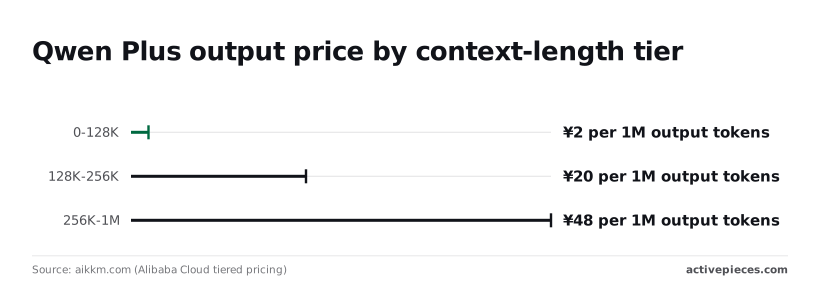
A client who pastes whole archives into one request pays 24 times the base output rate.
Cap context per client and quote the upper tiers as a separate line.
Where a client's data stays changes the rate card, since prices vary by region as well as by model. Quote each client the region they'll actually run in, not the cheapest one you tested.
Model Studio fine-tuning, hosting and tool costs
Apart from token prices, fine-tuning and hosting a tuned model run on their own meters. A client who wants a custom model should carry those lines explicitly.
At the tool level, billing is per call, and the web search guide lists the rates:
- Managed web search is ¥30 per 1,000 calls (¥0.03 each)
- Web Search Agent is ¥22
- Image/video search is ¥20
- Baidu Baike is ¥16
- Image understanding is ¥4

If an agent searches five times per task, that adds ¥0.15 before a single token is billed.
Count tool calls per client the same way you count tokens.
Alibaba meters every token and every tool call, but the workflow wrapped around them doesn't need a second meter.
Activepieces charges 1 credit per run however many steps the flow has, so a ten-step triage flow costs what the two-step workaround did, whereas Zapier's per-task billing counts each step. MoneyGram, Moneypenny, Alan and FundingSocieties run it in production.
On a shared account, one client's burst can slow every other client, because rate limits are dynamic. The free quota also expires after 90 days, so a budget built on free tokens has an end date. Re-price every client before that date arrives.
Model Studio, OpenAI, Gemini, Claude pricing
Against OpenAI, Google Gemini and Anthropic Claude, Alibaba Cloud Model Studio is the cheaper route for high-volume, cost-sensitive work. That changes if a client needs another vendor's output quality or its data-residency terms.
Flagship and small-model prices side by side
Down is the only direction Model Studio's flagship price has moved. Qwen Max output cost 120 ¥ per 1M tokens in March 2024, then 60 ¥ in May and 30 ¥ in September.
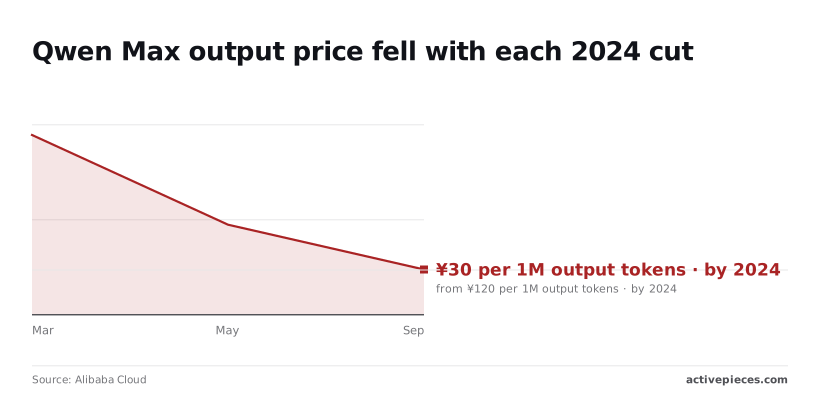
That's a 75% cut in six months, so a retainer quoted from the March rate overstated the model line fourfold.
To price the same job at the same rung on every vendor's page, use the table, which shows which tiers sit on each side of the comparison.
| Vendor | Flagship tier | Small tier | Model list checked |
|---|---|---|---|
| Alibaba Model Studio | Qwen Max | Qwen's lower tiers, priced separately | 2026-11-08 |
| OpenAI | GPT-6 Astra | GPT-6 Luna | 2026-11-08 |
| Google Gemini | Gemini 4 Argon | Gemini 3.5 Flash-Lite | 2026-11-08 |
| Anthropic Claude | Claude Opus 5.5 | Claude Haiku 5.5 | 2026-11-08 |
Read across, not down: compare flagship with flagship and small with small. A flagship-to-small comparison across vendors will make one of them look cheap for the wrong reason.
Free tier, batch and caching compared
Every vendor sets its free allowance, rate limits, batch discount and cache discount separately, and Model Studio varies them again by model, region and mode. Check each against the vendor's own pricing page for the exact model you'll run.
On a retainer, batch and caching matter more than the headline rate. Nightly reports and bulk classification can wait, so they belong in batch. Prompts with a long shared preamble belong in cache.
If a free quota sits on one shared account, it quietly subsidizes whichever client burns it first, so track it per client.
Model Studio pricing verdict for high-volume Qwen use
When the work's high-volume and a mid-tier model's quality is enough, Model Studio wins on cost, because the flagship price has already fallen to 30 ¥ per 1M output tokens.
That 30 ¥ is only the Qwen Max flagship rate, not a promise about every model or region.
Two conditions have to hold for that verdict: the client accepts the quality of the Qwen tier you test, and the client's contract allows the regions Model Studio serves from.
If either fails, price the job on the vendor that passes, and put the difference on the invoice.
Activepieces workflows for Model Studio and a Monday checklist
If Model Studio is the vendor that passes, Activepieces can run the job without changing its price.
On the Plus plan ($20 a month, 10,000 credits) you bring your own AI keys, every AI step is 1 credit, and the token cost stays on your own Alibaba Cloud bill, so once you've consumed those 10,000 steps you cannot run more until the cycle renews.

Calling Model Studio from an Activepieces workflow
Activepieces starts a flow from a trigger and runs each step as one action. The Free plan ($0, 1,000 credits a month, up to 5 users) already allows unlimited flows, so one flow per client costs nothing extra.
For ticket triage, the trigger is a new ticket, one step sends its text to a Model Studio model through an HTTP request, and the next step writes the returned category and priority back to the help desk.
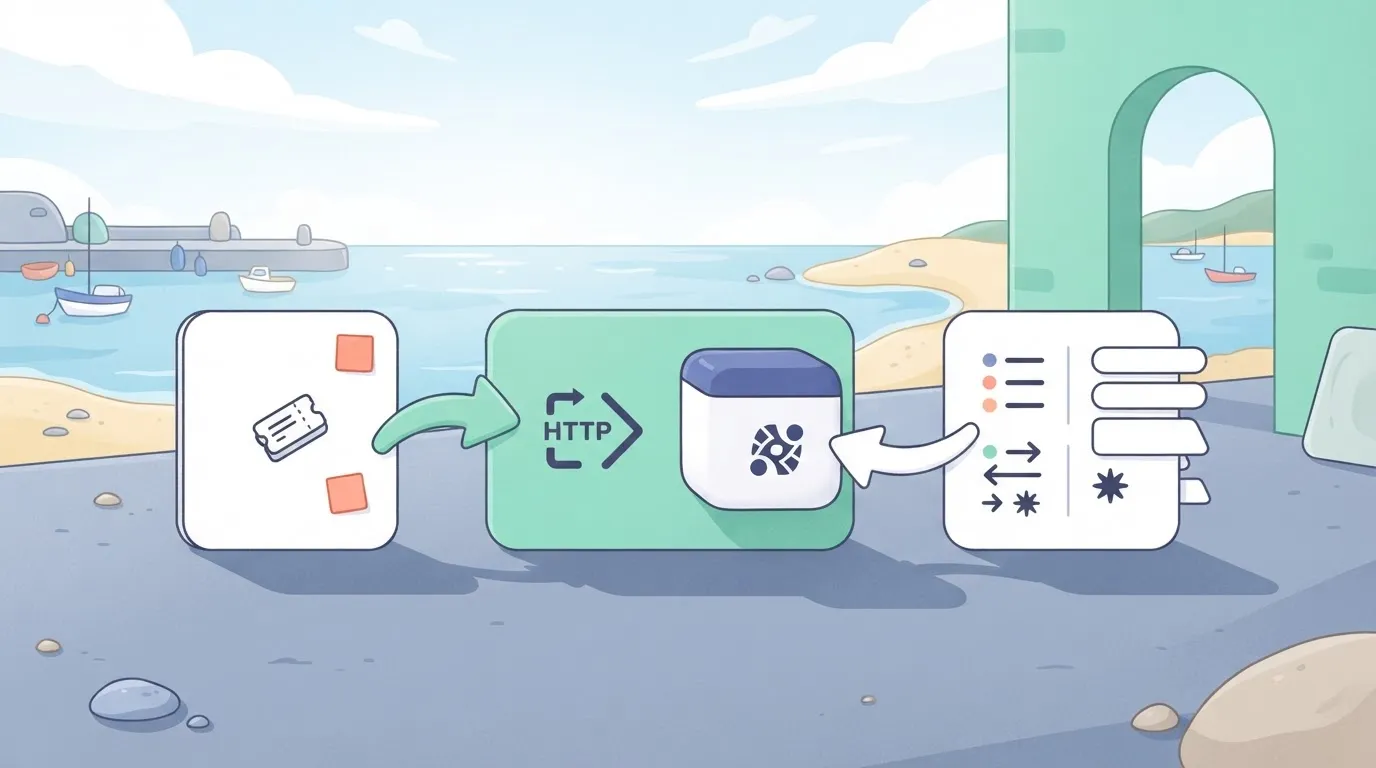
Since Model Studio charges per token by model, region and mode, the workflow's cost is the tickets' length multiplied by the model you chose. Nothing in the flow discounts or inflates that.
Build one flow per client. When a shared account runs every client's tickets through the same step, the busy client is subsidized by the quiet ones, and you can't show on an invoice who used what.
Separate flows give you the unit you need to bill against.
Do these in order, because each step protects the one after it.
- Set a spend alert in your Alibaba Cloud account before any workflow goes live. Pay-per-token billing has no plan ceiling, so a looping flow is only caught if you set the alert yourself.
- Choose the region. Prices differ by region, so pick it deliberately, and confirm the model you want is offered there before you build around it.
- Test the cheapest model on 100 real items from the client's own tickets, not sample text. If it passes your quality bar, the dearer tiers are cost you can't justify on the invoice.
- Enable batch and caching where the job allows. Triage that doesn't need an instant answer can go through batch mode, and a fixed instruction prompt repeated on every ticket is what caching's for. Check that each applies to your chosen model.
- Recheck the pricing page for that model and region, and note the date. Prices and free quota can change, so a quote built from last quarter's page is a guess.
Activepieces is the better fit for teams running multi-step automations, such as ticket triage that calls a Model Studio model and then writes the result back to the help desk, where the criterion is how predictably the bill scales with workflow length.
Its pricing counts the run, at 1 credit per flow run regardless of how many steps it contains, so adding a step doesn't raise the cost the way per-task or per-module billing can.
The ceiling is real, since once the plan's credits are used you can't run more until the cycle renews, but for step-heavy flows that is a limit you can plan around.
Frequently asked questions
Once the first month's usage is in, the same few questions tend to come back from clients and finance teams. Here are the short answers.
Only within a free quota that is granted per model and expires. Beyond it, every call is billed per token.
Keep the quota out of your client quote: if you price against it, the client's paying for a discount that will have run out by the time they renew, and you absorb the difference.
Does Model Studio charge a monthly subscription?
No. API usage is billed per token, with prices that vary by model, region and mode.
A fixed-fee coding plan exists as a separate product for coding tools, but it isn't how API calls from a client workflow are billed. Check its terms before routing any client automation through it.
For a retainer, this means the monthly line item should be a usage estimate with a stated range, not a flat fee you hope the vendor matches.
Is Qwen cheaper than GPT or Gemini?
It depends on which tiers you compare. Qwen models are priced across several tiers, and OpenAI and Google price theirs differently, so a single "cheaper" verdict wouldn't survive contact with your workload.
Compare the tier that matches the task, in the region you'll run it, in the same mode (real-time or batch). Then multiply by your measured input and output tokens from the first month, not by a headline rate.
Can I cap my Model Studio spending?
Treat the cap as something you build. Because billing's pay-as-you-go, no plan sets a ceiling for you. Give each client a separate workspace and API key so their usage is visible on its own, and set a token limit per run inside the workflow.
On a shared key, one chatty client can quietly run up a bill that gets spread across the others.
No fixed schedule that we could verify is published by Alibaba. Prices are listed per model, region and mode on its pages, and any of those can change.
Quote with a stated review date, re-check the pricing page before each renewal, and write into the contract that token rates pass through at the vendor's current price.
Related reading
Running the numbers
See what the same workload costs here.
Free forever plan, and every paid plan self-hosts at no extra cost.
See pricing Talk to sales