
Best Prismatic Alternatives for Embedded iPaaS in 2026

Oct 13, 202612 min read
Selecting an embedded iPaaS in 2026 requires balancing the immediate velocity of pre-built connectors against the long-term technical debt of proprietary execution environments. Engineering leads are moving away from rigid, black-box engines toward architectures that treat integration logic as version-controlled code rather than ephemeral middleware.
Evaluating Embedded iPaaS Selection Criteria
Prismatic CLI and custom components
Modern integration strategies prioritize how easily a platform handles "edge-case" logic that standard connectors miss. While Prismatic has a dedicated CLI for custom component development, Activepieces ensures that the cost of a workflow is tied to its outcome rather than its complexity.

The run is the meter, meaning a single credit covers an entire flow execution regardless of how many branches or helper steps are required to make it resilient.
This model removes the financial penalty for following clean architecture principles (like breaking a monolithic sync into smaller, observable steps) because the billing does not scale with the number of modules used.
The run is the meter, meaning a single credit covers an entire flow execution regardless of how many branches or helper steps are required to make it resilient.
You can verify this on the published pricing page: 1 credit per flow run, any number of steps, which avoids the compounding costs of the per-task or per-module billing found on other major platforms.
This transparency ensures that a critical bug in a third-party wrapper doesn't become a permanent blocker for a product release. You can swap models in your agentic workflows to tune performance rapidly without re-architecting the entire integration layer.
You can move from a high-volume router like Claude Haiku 5.5 to a reasoning flagship like GPT-6 Astra within the same workflow.
White-labeling and UI embedding
Effective embedding ensures that your end-user never realizes they're interacting with a third-party service. This preserves brand trust and reduces support friction.
Paragon focuses on a headless-first approach, providing a Task History API so you can build your own monitoring dashboards rather than relying on an iframe.
This level of control is essential for maintaining a consistent user experience, though it requires more front-end engineering hours than a standard drop-in builder.
The core advantage of open-source embedded iPaaS is the transparency of the integration stack. The MIT-licensed core provides full ownership. This means the software remains functional even if the vendor changes its business model.
It allows self-hosting for data residency, so sensitive customer credentials never leave your private cloud infrastructure. The community-contributed connector library reduces the time you spend writing boilerplate code for niche SaaS APIs.

Finally, there's no per-execution vendor tax, so high-volume data syncs don't result in unpredictable monthly overages. These benefits demonstrate that ownership of the integration layer is becoming a non-negotiable requirement for enterprise-grade security and financial predictability.
Tray.io pricing versus n8n pricing
The financial viability of an iPaaS depends on whether the pricing scales linearly with user growth or exponentially with execution volume. According to n8n Markets, Tray.io carries an annual cost range of 25,000 to 100,000 USD.
This price establishes a high entry barrier for startups. It also provides a predictable ceiling for massive enterprise deployments.
In contrast, n8n Enterprise ranges from 1,200 to 6,000 USD per year, offering a lower-cost entry point for you if you're comfortable managing more of the infrastructure yourself.
For those requiring white-labeling and JWT-based user provisioning, Activepieces has embedding as a sales-led annual tier.
Furthermore, you can evaluate standard features through their public pricing tiers. The disparity in pricing models forces a choice between paying for a managed service or investing in the operational overhead of a self-hosted solution.
The fastest way to settle a shortlist is to try one. Activepieces is free to try, no credit card.
Activepieces (Open Source)
Activepieces provides an MIT-licensed automation platform that allows your engineering team to retain full ownership of your integration infrastructure while benefiting from a rapidly expanding library of community-driven connectors.
By offering an embeddable, white-label builder, complete with JSON Web Token (JWT) user provisioning and centralized integration management, it functions as a modular engine. This is for software providers who can't justify the pricing or data residency risks of closed-source competitors.
The primary driver for adopting Activepieces is its ecosystem velocity. This velocity currently outpaces established enterprise incumbents in sheer connectivity options.
According to data compiled by Akta, Activepieces offers 739+ pre-built connectors. This figure significantly lowers the development tax on custom API wrappers compared to the 190+ integrations provided by Prismatic or the 130+ supported by Paragon.
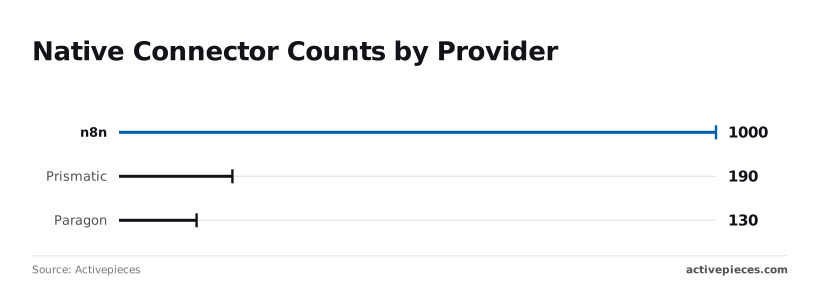
While the 1,000+ integrations available via n8n represent the current market ceiling, Activepieces’ open-source architecture allows you to fork and modify these 739+ integrations locally.
Consequently, this ensures that a breaking change in a third-party API doesn't result in a total service outage for your end-user.
| Provider | Pre-built Connectors |
|---|---|
| n8n | 1,000+ |
| Activepieces | 739+ |
| Prismatic | 190+ |
| Paragon | 130+ |
This volume of ready-made connectors directly impacts your product team's roadmap. Each pre-built integration represents roughly two to four weeks of saved engineering time that you'd otherwise spend on OAuth flows and error handling.
To further accelerate complex logic, the platform supports frontier AI models for agentic workflows, such as GPT-6 Astra for multi-step reasoning or Claude Sonnet 5.5 for high-speed data routing.
For teams managing high-volume workloads, the self-serve plans listed at activepieces.com/pricing provide a clear entry point for internal automation. If you're looking to embed the builder directly into your own SaaS product to offer customer-facing integrations, the Platform tier is a sales-led annual commitment.
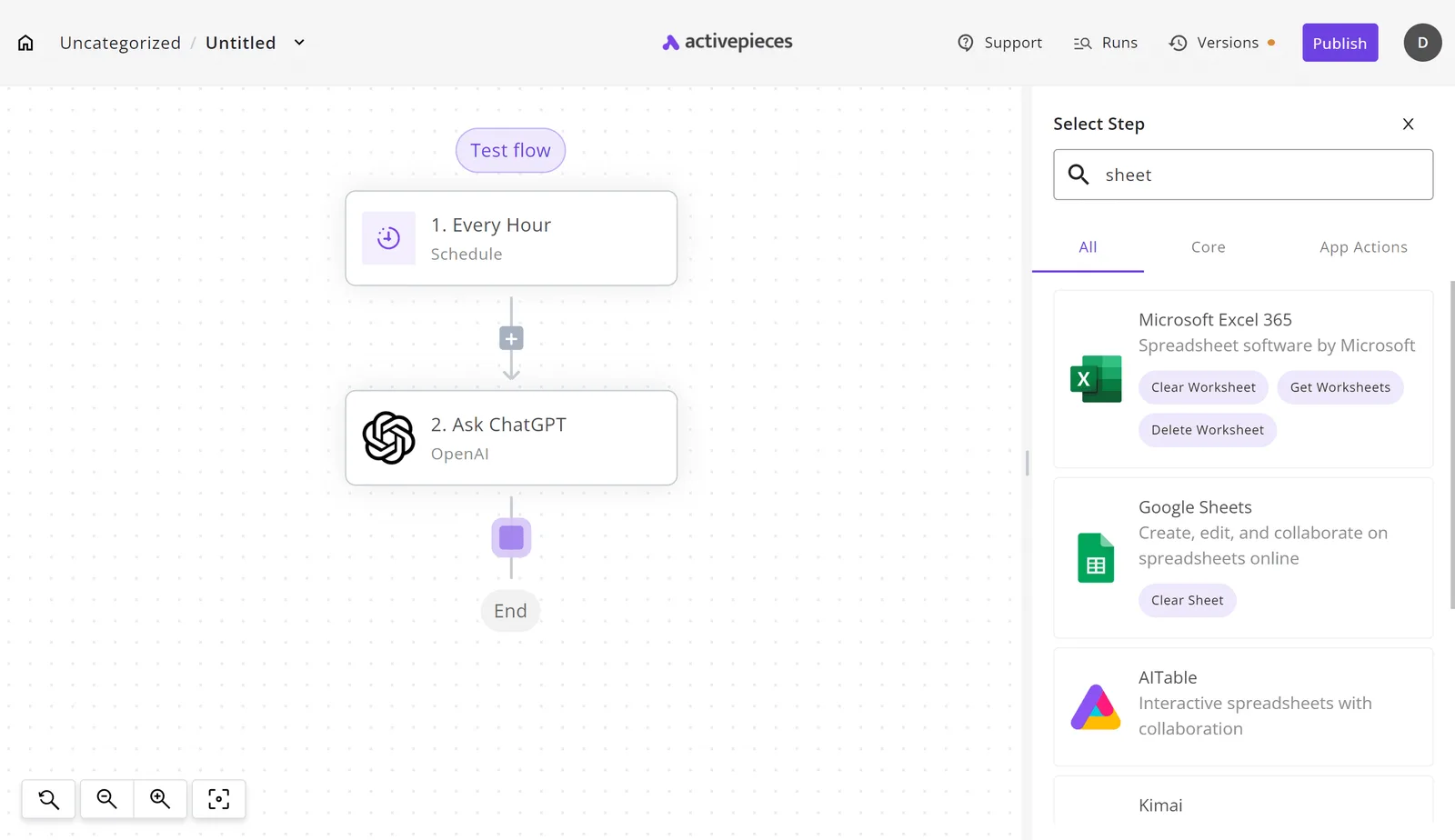
MoneyGram, Moneypenny, Alan and FundingSocieties run this in production today, utilizing the same enterprise features (like SSO, SCIM, and audit logs) that are available in both the managed cloud and the air-gapped self-hosted build.
Contact their team at activepieces.com/sales to discuss specific terms for white-labeling and multi-tenant isolation. Choosing this route shifts the burden of maintenance away from your core product team and onto the open-source community, provided you're comfortable managing your own deployment.
For organizations prioritizing cost predictability and high-volume data processing, Activepieces is the better choice for scaling complex workflows without escalating expenses.
By billing per flow run rather than per individual step or module, it eliminates the financial penalties associated with multi-step automations found in Zapier or Make.
This transparent pricing model, combined with a superior library of over 739 connectors, ensures that developers can build sophisticated, high-velocity integrations while maintaining a fixed cost per execution.
Paragon headless-first integration approach
Paragon uses a headless-first approach for engineering teams who want to build native-feeling integration experiences using an abstraction layer over complex third-party APIs.
By decoupling the integration logic from the user interface, you can maintain full control over the frontend CSS and React components while offloading the authentication and data mapping to a managed middleware.

The following table compares the architectural and licensing trade-offs between the primary market alternatives for 2026.
| Provider | Licensing | Primary Integration Method | Pre-built Connector Count |
|---|---|---|---|
| Paragon | Proprietary | Headless SDK | ~150+ |
| Tray.io | Proprietary | Low-code / Embedded | ~600+ |
| n8n | Fair-code | Low-code | ~400+ |
| Activepieces | MIT | Headless SDK / Low-code | ~739+ |
This comparison shows that while proprietary platforms often provide many connectors, the headless SDK approach allows for a deeper level of product UI consistency.
For teams prioritizing specific data visualization or business intelligence integrations, the choice often hinges on the breadth of pre-built connectors available for your specific stack.
According to Softwr, Looker supports 7,500 connectors, ensuring users can integrate virtually any data source into their analytics workflow, which means teams are rarely forced to abandon their existing tech stack to achieve full visibility.
This allows enterprise teams to pull data from almost any legacy source without manual API mapping, effectively eliminating the technical bottleneck of custom integration development. In contrast, Mode offers 2,000 connectors, providing a more curated but still expansive library for data-heavy applications.
Connector availability by provider
Explo offers 695 connectors, meaning it captures the mid-market SaaS ecosystem without the overhead of enterprise-only tooling. Paragon provides 299 connectors, so your engineering team must verify your specific roadmap requirements before committing to their proprietary abstraction layer.
Activepieces provides 739+ connectors, which means you'll likely find the pre-built integrations you need for niche third-party services. When implementing these integrations, the underlying intelligence of the workflow often relies on the LLM provider you've selected for data transformation.
Developers are utilizing Gemini 3.8 Flash for agentic routing due to its high-speed reasoning.
Others deploy Claude Opus 5.5 for long-horizon knowledge work that requires higher precision than standard models. The decision to move forward with a headless provider like Paragon typically depends on whether your internal design team demands a custom-built integration directory.
The alternative is that you're willing to accept a pre-styled iframe.
Reading a table only gets you so far. Build the same workflow in Activepieces and compare it yourself.
Tray.io and n8n (Enterprise and Workflow Scale)
Tray.io and n8n serve you if you require high-density logic processing. You're often constrained by the complexity of the governance model or the need for deep technical extensibility at the execution layer.
Tray.io versus n8n for enterprises
The former focuses on a "Universal Automation Cloud" that centralizes security for large-scale corporate rollouts. The latter provides a fair-code framework that appeals to engineering teams who treat workflows as version-controlled software assets.
Tray.io multi-experience platform structure
Tray.io is structured around a multi-experience platform that separates the integration logic from the end-user delivery. This structure allows your IT team to maintain a "Golden Version" of a workflow while exposing simplified versions to non-technical departments.

Preventing shadow automation with Tray.io
This centralized control prevents "shadow automation" where disconnected departments build redundant or insecure connections to internal databases.
Tray.io serverless scaling architecture
The platform utilizes a serverless architecture that scales horizontally to handle spikes in event-driven data, meaning your marketing team can trigger thousands of concurrent lead-enrichment paths without manual infrastructure provisioning.
n8n node-based workflow environment
For teams that prioritize visibility into the underlying execution, n8n is a node-based environment where every data transformation is inspectable and can be extended with custom JavaScript.
This transparency ensures that you can debug a failing transformation by viewing the exact JSON state at every step of the sequence.
n8n can be self-hosted behind a firewall. This allows for the processing of sensitive PII (Personally Identifiable Information) without the data ever leaving your private network.
n8n loop and AI workflow example
The following workflow illustrates how these sophisticated builders manage iterative logic and external intelligence within a single execution thread. The screenshot displays a sophisticated loop structure where a "Loop on Items" step coordinates a multi-stage process involving state management and generative AI.
You use "Get Storage" to retrieve context before calling "Ask LLM" via OpenRouter.
By using the Gemini 3.8 Flash model for high-speed reasoning, the builder ensures that each iteration is informed by previous steps. This granular control over the loop cycle allows for complex data synthesis.
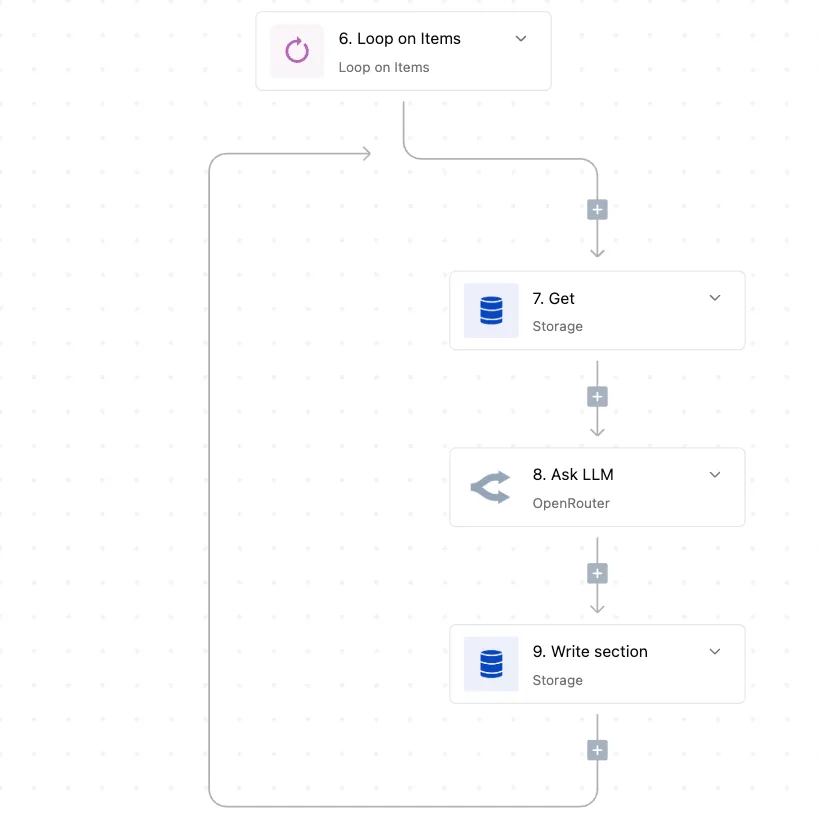
Examples include generating unique sections of a report based on a dynamic list of inputs, which is then finalized in the "Write section" step.
Implementing Your Integration Strategy
Transitioning from a legacy integration platform requires a phased migration that prioritizes maintaining data integrity and minimizing downtime for your end-users. By following a structured rollout, your engineering team can validate the performance of new infrastructure before decommissioning existing production flows.
Conducting an API audit
A successful migration begins with a comprehensive inventory of every active trigger and action currently running in your production environment. This audit identifies which specific endpoints in external services are mission-critical and which are redundant.
These services might include the customer relationship management tool Salesforce or the communication platform Slack. Mapping these dependencies ensures that your engineering team understands the exact authentication requirements and webhook listener configurations needed in the new environment.
Without this baseline, you risk breaking customer workflows that rely on undocumented custom logic or legacy API versions that the new provider may not support by default.
Building a proof-of-concept for iPaaS
Once the integration surface area is defined, your development team must build a proof-of-concept (PoC) targeting the highest-volume workflow to stress-test the new provider’s execution engine. This stage is where you evaluate how the platform handles complex logic.
You test loops and conditional branching using modern LLMs like Gemini 3.8 Flash for generating transformation scripts or Claude Sonnet 5.5 for debugging agentic coding tasks. Testing these flows allows you to measure latency and error rates under simulated production loads.
If you're moving toward a headless-first approach, this PoC is the validation point for the provider's SDK. This ensures that the integration can be triggered programmatically from within your primary application without manual intervention.
Managing the migration path
The final transition involves a shift from the current environment to the new infrastructure. No data packets are lost during the handoff. This roadmap provides a structured sequence for moving from initial discovery to a fully live production environment.
- Phase 1: Audit existing triggers/actions
- Phase 2: Map SDK logic to new provider
- Phase 3: Build POC for high-volume flow
- Phase 4: Parallel run and production
Your engineering team must verify that all webhook secrets and API keys are rotated during the cutover to prevent unauthorized access during the transition period.
| Phase | Primary Objective | Key Deliverable |
|---|---|---|
| Phase 1 | Audit existing triggers/actions | Comprehensive integration inventory |
| Phase 2 | Map SDK logic to new provider | Documented code parity report |
| Phase 3 | Build POC for high-volume flow | Validated execution logs |
| Phase 4 | Parallel run and production | Final cutover to new engine |
References
Still comparing
The fastest way to settle it is to build something.
Open source under MIT, so you can self-host the same thing later.
Start free Talk to sales