
Best Vercel Alternatives: 2026 Comparison Guide

Oct 1, 202614 min read
Choosing the right hosting provider is critical for modern web development, as the landscape has evolved far beyond simple static site delivery to encompass serverless functions and edge computing.
While Vercel remains a dominant force in the ecosystem, developers often seek alternatives that offer more granular control over infrastructure or more predictable pricing models for scaling applications.
Many teams now prioritize platforms that integrate seamlessly into broader workflows, such as those managed through Activepieces for automated deployment triggers, ensuring that code changes transition smoothly from repository to production.
This comparison evaluates the top contenders in 2026, focusing on performance, developer experience, and how each platform handles the increasing demands of dynamic, framework-agnostic deployments.
Vercel alternatives for modern frontend hosting
Managed platforms that provide automated frontend deployments and serverless runtimes serve as the primary Vercel alternatives. These systems operate without the specific pricing structures or architectural constraints of the Next.js ecosystem.
While Vercel excels at developer experience, teams migrate when the financial cost of serverless execution or the technical debt of framework-specific optimizations outweighs the convenience of the platform.
The strengths of the Vercel ecosystem
Vercel remains the gold standard for teams that prioritize speed of delivery and a seamless developer experience. The platform is the primary contributor to Next.js, ensuring that new framework features like Server Actions or the App Router work perfectly on day one.
The platform provides a zero-configuration environment that handles complex infrastructure tasks like global CDN distribution and SSL termination automatically. For small teams or solo developers, the time saved on DevOps often justifies the higher cost of their managed services.
Vercel reports that the primary drivers for Vercel migration include:
- The unpredictable edge function costs scale with request volume rather than resource utilization.
- Next.js ecosystem lock-in complicates the use of alternative meta-frameworks.
- Limited concurrent builds on lower tiers cause deployment bottlenecks during peak development hours.
- The 25-second response limit for streaming terminates long-running generative AI tasks prematurely.

These constraints often force a transition toward infrastructure that has more granular control over the backend and data layers.
The cost of scaling edge functions
When their billing model lacks a ceiling, edge functions become a liability, especially as applications move beyond static content into heavy data processing.
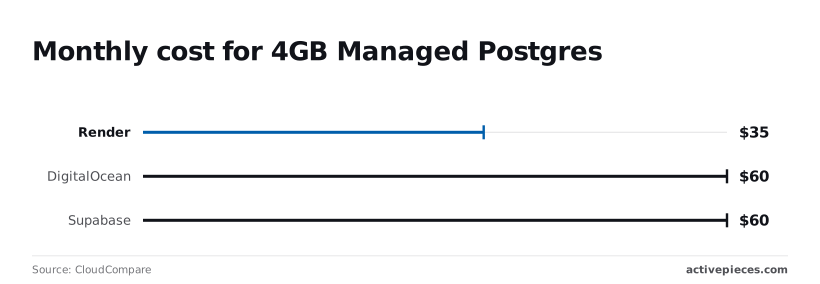
According to CloudCompare, Render charges $35 per month for a 4GB Managed Postgres instance, providing a predictable entry point for growing datasets, which helps teams manage their infrastructure costs more effectively.
When their billing model lacks a ceiling, edge functions become a liability, especially as applications move beyond static content into heavy data processing.
In contrast, DigitalOcean and Supabase both set their price at $60 per month for the same 4GB capacity, so a user pays a significant premium for these alternative platforms.
71% is the resulting increase in fixed overhead that a developer must justify through specific feature needs like Supabase’s built-in authentication or DigitalOcean’s broader droplet ecosystem, which means the project’s baseline profitability is significantly harder to achieve.
Vercel's framework dependency on Next.js
Vercel is built for Next.js. Features like Incremental Static Regeneration (ISR) often require complex workarounds to function on other providers.
When a project uses a different stack, such as a SvelteKit frontend integrated with Activepieces for workflow automation, the "Pro" features of a frontend-first host may not translate to the backend logic.
Deployment on Activepieces is a setting rather than a permanent commitment to a specific vendor's cloud.
A flow built on managed infrastructure and a flow built self-hosted run on the same codebase, allowing teams to promote or move logic between environments using the documented Git Sync and Releases features.

This flexibility ensures that the automation layer does not become a new form of lock-in, as the self-hosted version runs via Docker, Compose, or Kubernetes on the same MIT-licensed core used by the managed cloud.
Relying on a platform that treats every framework as a first-class citizen prevents the "tax" often paid when trying to run non-React code on infrastructure built to favor React.
Enterprise security and compliance requirements
Standard serverless tiers often lack the network isolation required by regulated industries, forcing teams onto expensive enterprise plans just to access basic security features.
If a team uses Gemini 3.8 Flash to process sensitive user data, they must ensure the execution environment meets SOC2 or HIPAA standards.
All traffic is forced over the public internet by a platform that lacks virtual private cloud (VPC) peering on its standard tiers.
Migrating to a provider with native VPC support enables direct and private connections between the frontend and the database, eliminating the public internet as a potential attack vector.
The fastest way to settle a shortlist is to try one. Activepieces is free to try, no credit card.
Comparing the top four Vercel competitors
Choosing a Vercel alternative requires matching your team’s specific deployment constraints against the distinct infrastructure philosophies of these four market leaders. While Vercel remains the benchmark for Next.js DX, these providers offer different trade-offs in regional availability, pricing predictability, and backend extensibility.
| Provider | Core Technical Strength | Primary Platform Limitation | Ideal User Persona |
|---|---|---|---|
| Netlify | Multi-framework build automation | Build minute concurrency limits | Enterprise teams managing diverse frontend stacks |
| Cloudflare Pages | Global edge network integration | Restricted server-side runtime APIs | Performance-first teams needing low-latency delivery |
| AWS Amplify | Native AWS service integration | Complex configuration overhead | Full-stack developers already within the AWS ecosystem |
| Railway | Ephemeral environment management | Manual scaling configuration | Backend-heavy teams requiring persistent databases |
Evaluating these providers based on their primary limitations ensures that a project does not hit a hard ceiling during a traffic spike or architectural shift. For teams integrating advanced AI workflows, these infrastructure choices dictate which models teams can call efficiently.
Cloudflare’s edge execution might be the priority for a developer using Gemini 3.8 Flash for high-throughput agentic tasks. A team running long-horizon coding tasks through Claude Opus 5.5 might value the persistent compute environments offered by Railway.
Netlify for multi-framework enterprise deployment
Netlify is the primary alternative for organizations that require a unified deployment workflow across diverse frontend frameworks rather than a specialized pipeline for Next.js.
While Vercel optimizes for its own React framework, Netlify treats Gatsby, Nuxt, and SvelteKit as first-class citizens. Polyglot engineering teams can maintain consistent deployment standards regardless of the underlying library.
Managing multi-framework monorepos
Netlify addresses monorepo complexity through its configuration file, which allows developers to define distinct build commands and publish directories for every subdirectory.
A change in the documentation folder does not trigger a costly and unnecessary rebuild of the entire application suite under this structure.
By decoupling the build pipeline from a specific framework’s architecture, teams can adopt the best tool for a specific micro-frontend without fragmenting their CI/CD infrastructure.
Extending builds with custom plugins
Activepieces syncs these external logic flows to git and promotes them through Release Management, ensuring that the "what happens next" after a build is versioned and reviewed like software.
By using separate projects and environments, teams like those at MoneyGram and Moneypenny can make the promotion of new business logic a deliberate step rather than an accident of clicking a publish button.
This structured approach to automation prevents the fragmentation that occurs when critical build-triggered tasks live only in a vendor's private UI history.
The Netlify Build Plugins system has a structured API to inject logic into specific lifecycle events. Examples include checking for broken links before a site goes live or clearing a cache after a successful deploy.
These plugins run within the build environment, which means sensitive operations like image compression or CSS purging happen before the site reaches the global edge network.
Netlify GoTrue identity and form handling
Netlify GoTrue is a managed identity service that handles user registration and login via a simple API, removing the need for a dedicated backend server to manage user sessions.
HTML form submissions are intercepted at the network level by their forms feature. This allows a static site to collect data and trigger serverless functions without a single line of server-side code.
Reading a table only gets you so far. Build the same workflow in Activepieces and compare it yourself.
Cloudflare Pages for global edge hosting
Cloudflare Pages is a deployment platform where the network distributes the build output globally to minimize the physical distance between the code and the end user.
Cloudflare R2 storage and egress fees
Integrating with R2 storage allows teams to serve large assets and user-generated content without the bandwidth taxes common in traditional cloud providers.
Because Cloudflare does not charge for data moving out of its network to the internet, a high-traffic media site avoids the scaling costs that typically spike when users request assets millions of times.
Cloudflare edge network and latency performance
Deploying to this platform places your application on a network spanning hundreds of cities. Know highlights a map showing 330+ Cloudflare edge locations compared to a single central origin server.
Requests are intercepted at the nearest point of presence to eliminate long-haul transit delays. This proximity is further enhanced by Workers KV, a low-latency key-value store that caches data at these same edge locations.
Limitations of the Cloudflare Workers runtime
Building on this infrastructure requires adhering to the Cloudflare Workers runtime, which is based on the V8 JavaScript engine rather than a full Node.js environment.
While this allows for faster startup times, it means that standard Node.js libraries will not function without polyfills. Libraries relying on built-in modules like fs or child_process are particularly affected. Developers must audit their dependencies to ensure compatibility.
Automating deployment workflows with Activepieces
Activepieces is the open-source connective tissue that triggers business logic based on infrastructure events. It prevents deployment failures from going unnoticed by the teams responsible for them.
By linking hosting providers to communication tools, Activepieces transforms technical logs into actionable alerts. The platform uses a visual canvas to map specific triggers, such as a failed Git commit or a cloud hosting error, to downstream actions in the company’s internal stack.
The workflow automation canvas shows a two-step flow titled "Payments Notificati..." with a Stripe "Payment Failed" trigger connected to a Slack "Send Message To A Channel" action. The right panel displays the Slack action configuration with fields for Action (Send Message To A Channel), Authentication (slack), Channel (activepieces), and Message (showing a template with payment failure details). The left sidebar shows Run Details with step_1 marked as completed with a 574ms duration. A success notification at the bottom indicates "Run succeeded".

This visibility ensures that a failed deployment or a broken payment gateway results in an immediate Slack thread. Developers can leverage agentic models like Gemini 3.7 Flash or Claude Sonnet 5.5 within these flows to parse the incoming error logs.
Activepieces ensures that the integrity of a deployment workflow remains consistent regardless of whether it is managed in the cloud or self-hosted via Docker and Kubernetes.
By providing documented Git Sync and Release features across a unified codebase, Activepieces is the better choice for teams that require full ownership of their infrastructure without sacrificing the ability to migrate or scale.
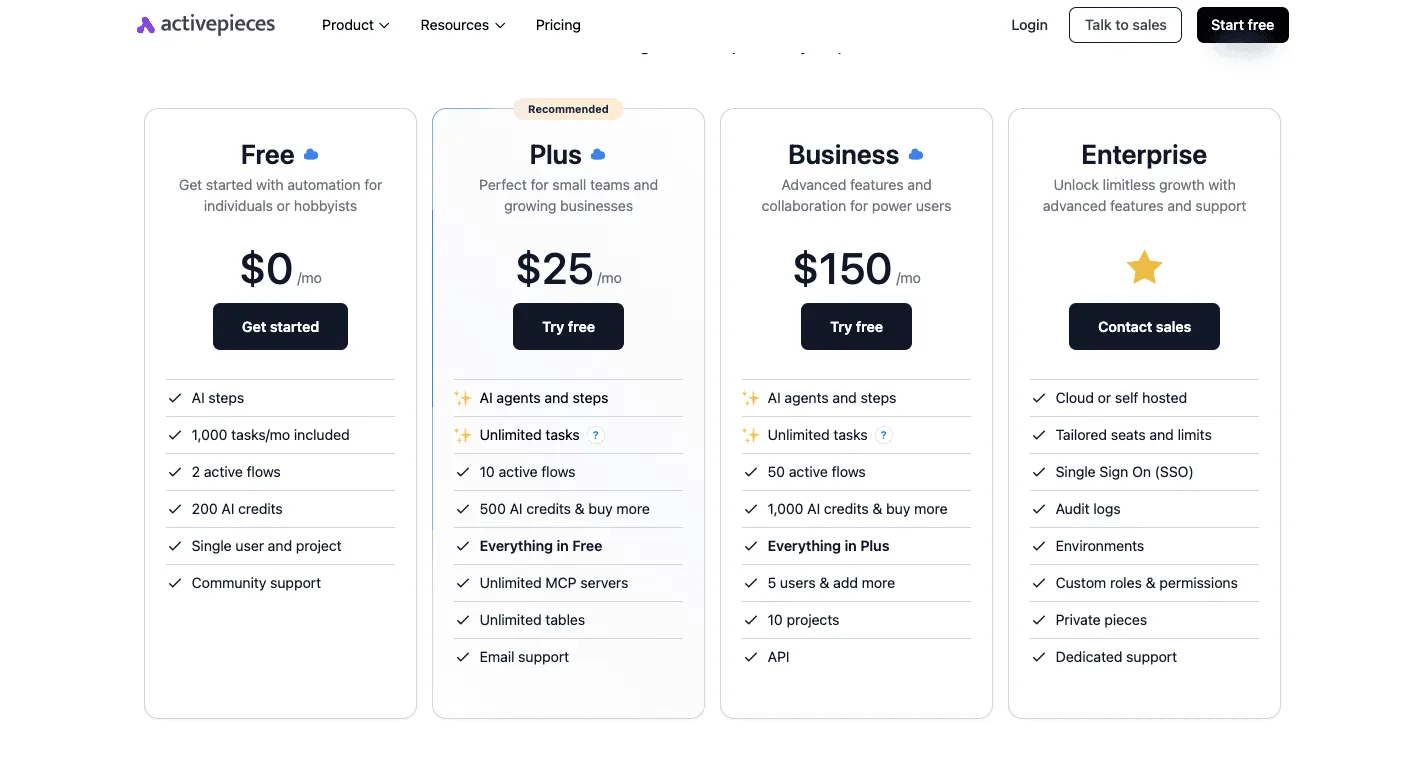
This architectural flexibility guarantees that the choice of where a flow runs never limits a developer's freedom to move their operations.
Railway for simplified full-stack infrastructure
Railway is a unified execution environment where frontend frameworks, background workers, and persistent databases reside within the same logical project.
Railway database provisioning for frontends
Provisioning a database on Railway takes less than a minute because the platform treats data stores as first-class primitives. By co-locating a PostgreSQL or Redis instance with a Next.js frontend, developers eliminate the latency inherent in cross-cloud networking.
Tens of milliseconds are often added to every database query by this latency. This tight integration ensures that environment variables for the database are automatically injected into the application container.
Predictable usage-based pricing models
The platform operates on a resource-based billing system where costs are derived from the actual CPU and RAM consumed by active containers.
| Provider | Monthly Cost | Resource Specification |
|---|---|---|
| DigitalOcean | $60 | 2 vCPU / 4GB RAM / 60GB Storage |
| Supabase | $60 | 2 vCPU / 4GB RAM / 8GB Storage |
| Render | $35 | Comparable managed services |
These figures demonstrate that choosing a provider with a lower entry point for managed services allows a startup to maintain high-performance infrastructure without the immediate overhead of enterprise-grade pricing.
Infrastructure-as-code without the complexity
Managing infrastructure on Railway is handled through a visual canvas or a configuration file that tracks the entire stack's state. This approach removes the need for specialized DevOps engineers to write thousands of lines of Terraform code.
By defining the infrastructure requirements within the repository, the platform ensures that the production environment remains a perfect mirror of the local development setup.
AWS Amplify for deep cloud integration
AWS Amplify serves as the bridge for developers who require the scale of Amazon Web Services without the manual configuration of individual cloud primitives.
It is the logical choice for teams already utilizing S3, DynamoDB, or Cognito, as it provides a managed hosting layer that connects natively to these services.
The platform excels at managing the full application lifecycle, from frontend hosting to backend generation. By using the Amplify CLI or Gen 2 code-first approach, developers can define their data models and authorization rules in TypeScript, which the platform then provisions as production-ready AWS resources.
Native integration with the AWS ecosystem
Amplify provides a level of infrastructure depth that frontend-only hosts cannot match. When a project requires complex identity management or large-scale file storage, Amplify connects directly to AWS Cognito and S3 without requiring manual API key management or proxy servers.
This native connectivity reduces the architectural complexity of building secure, multi-tenant applications. Teams can leverage the full power of AWS IAM roles to ensure that their frontend only accesses the specific backend resources it needs, maintaining a high security posture by default.
Scalability and global content delivery
The platform leverages Amazon CloudFront to distribute content across a massive global network of edge locations. This ensures that static assets and server-side rendered pages are delivered with minimal latency to users regardless of their geographic location.
Because Amplify is built on top of standard AWS services, there is no ceiling to how far an application can scale.
If a project outgrows the managed features of Amplify, the underlying resources remain standard AWS components that can be managed via the AWS Console or CDK.
Frequently asked questions about Vercel migration
Will my SEO suffer if I leave Vercel?
Moving your site to a different hosting provider does not inherently lower your search engine rankings. Crawlers prioritize page speed, content quality, and Core Web Vitals over the specific IP address of your server.
If the new host maintains comparable Time to First Byte (TTFB) and handles 301 redirects correctly, your authority remains intact. A drop only occurs if the new infrastructure introduces significant latency, as search engines penalize slow-loading mobile experiences.
Can I run Next.js middleware on Cloudflare?
By using the OpenNext adapter to translate the Next.js runtime into a format compatible with Cloudflare Workers, you can execute Next.js middleware on Cloudflare Pages.
This ensures that functions like authentication checks or geo-routing happen at the edge rather than the origin server. Without this adapter, middleware designed for the Node.js runtime will fail to execute. Cloudflare uses a V8-based isolate environment instead of a full Node.js stack.
How do I migrate environment variables safely?
The most secure way to migrate secrets is to use a dedicated secret manager. Tools like Doppler or Bitwarden Secrets Manager inject values into your new CI/CD pipeline at runtime.
This prevents sensitive keys from being stored in plaintext within the new provider's dashboard or accidentally committed to version control during the transition.
Manually copying strings between web interfaces increases the risk of human error. This results in production downtime due to mismatched API keys.
Does Netlify support Incremental Static Regeneration (ISR)?
Netlify supports ISR through its Essential Next.js Plugin, which uses On-demand Builders to handle background page revalidation.
This allows you to update static content without triggering a full site rebuild, keeping your build times low as your content library grows. If this plugin is not configured, the site will default to standard static generation.
Users will see outdated information until the next manual deployment.
Related reading
References
Still comparing
The fastest way to settle it is to build something.
Open source under MIT, so you can self-host the same thing later.
Start free Talk to sales