Best Supabase Alternatives in 2026 (Full Comparison)

Sep 30, 202611 min read
Selecting a backend-as-a-service depends on balancing the specific database engine required against the ongoing operational cost of scaling that infrastructure.
Supabase is a comprehensive Postgres-based environment, but its overhead and pricing model create friction for projects, much like how Activepieces streamlines the logic layer, that require either strict NoSQL schemas or low-resource self-hosting.
Selection Criteria for Backend-as-a-Service Platforms
Comparing Supabase pricing predictability
When a sudden spike in user activity occurs, a predictable pricing model ensures the result isn't an unmanageable invoice. Supabase utilizes a usage-based model where the Pro tier starts at $25 per month, which means users must anticipate variable billing as their application scales.

This means costs scale directly with database size and egress.
In contrast, platforms like PocketBase or (source) are often deployed on flat-rate virtual private servers.
A developer pays a fixed $5 or $10 monthly fee regardless of how many requests the API handles, resulting in predictable scaling costs for growing applications, so budgeting for infrastructure remains straightforward.
Database Architecture Flexibility
The underlying database determines how you model relationships and handle concurrent writes. The following table compares how these platforms manage data and billing to help identify which fits your existing stack.
| Platform | Database Type | Pricing Model |
|---|---|---|
| Firebase | NoSQL (Firestore) | Usage-based |
| Appwrite | NoSQL / MariaDB | Flat-rate (Self-hosted) / Usage (Cloud) |
| PocketBase | SQLite | Flat-rate (Self-hosted) |
| Nhost | Postgres | Usage-based |
| Activepieces | NoSQL | Usage-based |
Postgres is the standard for relational integrity, but this distribution shows that NoSQL alternatives are necessary for high-velocity, unstructured data streams. Choosing the wrong type early forces expensive migrations later.
Self-hosting vs Managed Cloud
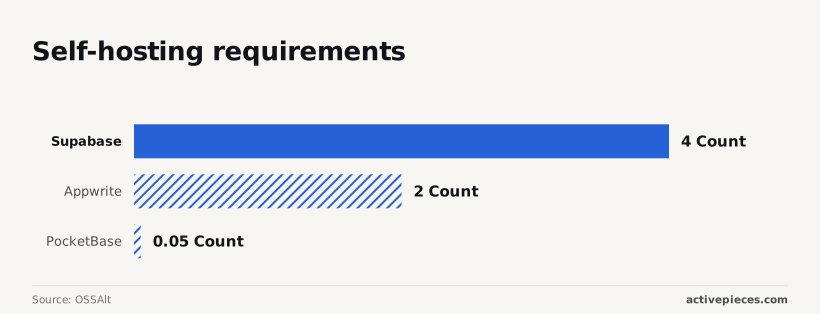
Infrastructure overhead is measured by the system resources required to keep the backend idling. According to OSSAlt, a self-hosted Supabase instance requires 4GB of RAM to run its full suite of containers. This increases the minimum monthly hardware cost for a production-ready environment.
Choosing the wrong type early forces expensive migrations later.
2GB of RAM is what Appwrite requires according to Ossalt's analysis. This means it can run on mid-tier commodity hardware without performance throttling.
PocketBase requires only 0.05GB (50MB) of RAM, meaning it can run efficiently on even the most resource-constrained server environments. A developer can host a fully functional backend on the smallest available cloud instance for less than the price of a coffee.

Automating workflows beyond database triggers
A backend is only useful if it can communicate with the rest of your business stack. While Supabase uses Database Functions and Webhooks to trigger external actions, this requires writing custom PL/pgSQL or JavaScript for every new connection.
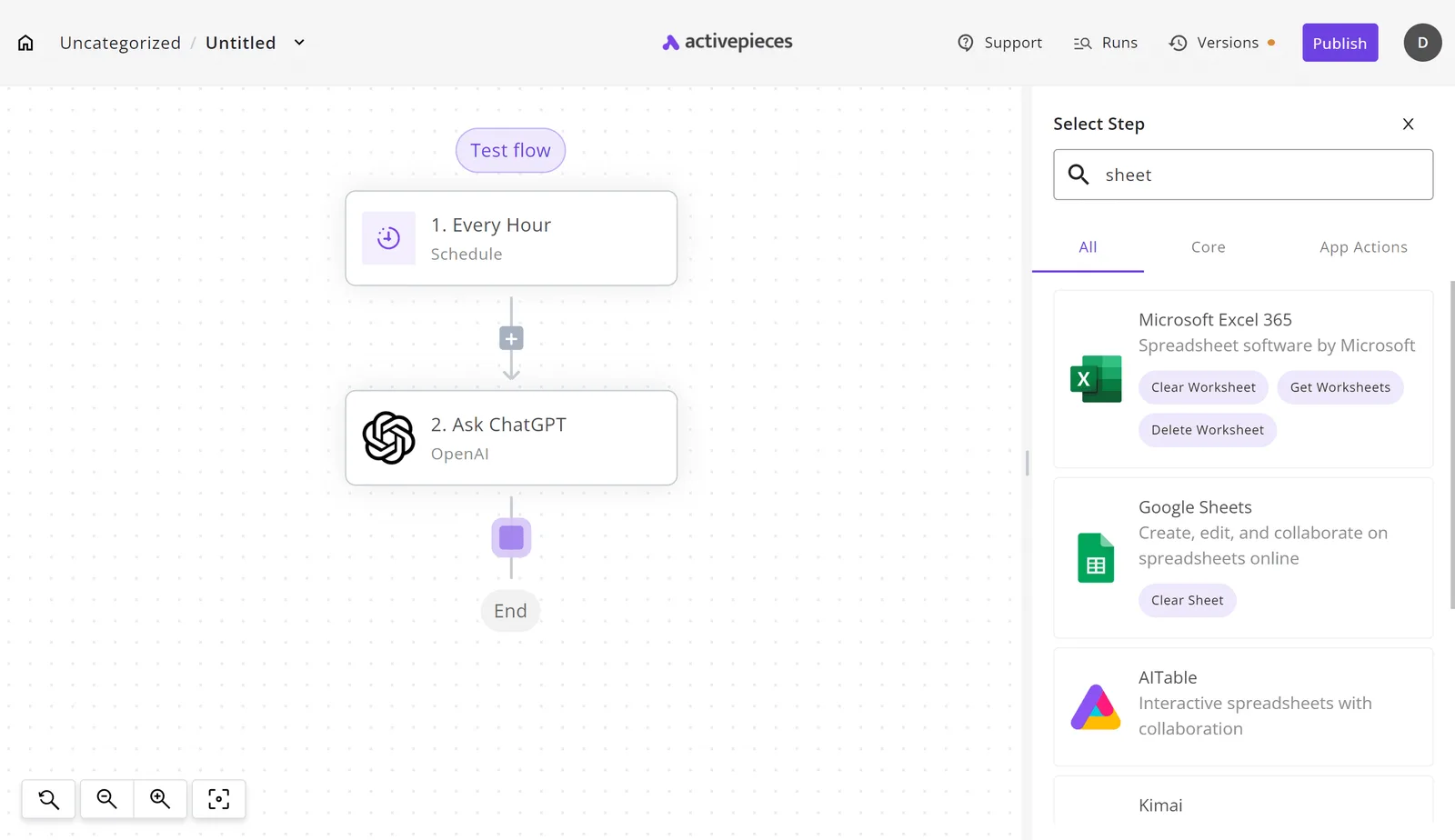
Activepieces connects these backends to third-party services without maintaining custom integration code. This shift from manual coding to visual logic reduces the surface area for bugs in your connection strings and authentication headers.
Deployment on Activepieces is a setting, not a commitment. A flow built on managed cloud and a flow built self-hosted run on the same codebase, allowing teams to promote or move logic between environments without refactoring.
Git Sync and Releases ships as a documented feature in the Activepieces docs, and self-host runs via Docker, Compose or Kubernetes on the same codebase as the managed cloud.
The fastest way to settle a shortlist is to try one. Activepieces is free to try, no credit card.
Google Firebase as a proprietary alternative
Google Firebase is the primary proprietary alternative for developers who prioritize deep integration with the Google Cloud ecosystem over the open-source portability of Postgres.
While Supabase allows you to export your underlying database to any standard Postgres provider, Firebase locks its data structures into two non-relational formats: Realtime Database, a large JSON tree, and Cloud Firestore, a document-based store.
SQL flexibility is traded here for a global infrastructure that handles connection pooling and synchronization automatically. This removes the need for developers to manage the WebSocket scaling logic themselves.
Native mobile and AI features
The platform is a gateway to Google’s specialized infrastructure. It's built for teams requiring native mobile features or advanced machine learning.
Firebase Authentication provides pre-built UI flows and identity management that syncs directly with Google’s identity services. Cloud Functions executes server-side logic in response to database changes, utilizing the same underlying engine as Google Cloud Functions.
Vertex AI Integration connects your application data directly to Google’s flagship models, such as Gemini 3.8 Flash for agentic workflows or Gemini 3.1 Pro for advanced reasoning, without writing custom API wrappers.
Firebase's Gemini AI model integration
Tight coupling with Google’s model garden is a distinct operational advantage for teams building AI-driven features. You can trigger a Gemini 3.8 Flash-Lite TTS task to generate high-fidelity speech from a new document entry in Firestore using a single extension.
Furthermore, this avoids manually coordinating separate authentication headers between a database and an AI provider.
However, the lack of a relational schema creates a different set of maintenance tasks. Because Firestore is schemaless, the responsibility for data integrity shifts entirely to your application code and Firebase Security Rules.
The database won't reject it if a developer pushes a logic error that writes a string into a field expected to be an integer. This leads to runtime failures in your frontend components.
Supabase has a flat monthly fee for its Pro tier, but Firebase utilizes a consumption-based model where every document read, write, and delete contributes to the monthly bill.
A poorly optimized recursive function or a sudden spike in user traffic can result in unpredictable costs. These costs scale linearly with activity rather than infrastructure capacity.
Appwrite for flexible self-hosted deployment
Appwrite is a unified backend API that mirrors Supabase’s feature set while prioritizing deployment flexibility on private infrastructure. While Supabase is built on the assumption that PostgreSQL is the center of your application, Appwrite abstracts the underlying database and services into a single containerized stack.
This allows a team to move their entire backend from a managed cloud environment to a private virtual machine. They can do this without rewriting the authentication logic or storage drivers.
The platform organizes its core services into discrete modules that communicate over a centralized system.
- account management and OAuth integration for user identity
- database services with support for document-level permissions
- storage buckets for file management with built-in image transformation
- serverless functions that support multiple runtimes for custom logic
Scaling and security
Teams managing their own hardware can scale specific components, like the worker containers, based on the volume of background tasks rather than upgrading the entire database instance. The Appwrite Console is a graphical interface for managing these resources, including the configuration of network entry points.
The Settings page allows developers to map custom domains to their API endpoint and monitor the status of automated SSL certificate issuance. ### Network encryption and SDKs
All traffic between the client application and the self-hosted backend is encrypted by this verification. The developer doesn't have to manually configure Nginx or manage Certbot renewals.
Once the domain is verified, the developer can connect their frontend using the Appwrite SDK by initializing the client with the new endpoint.
When building workflows that require generative capabilities, developers often integrate these backend services with external LLMs. For example, a document update can trigger a serverless function in Appwrite to send data to Gemini 3.8 Flash for summarization or Claude Sonnet 5.5 for complex reasoning.
Core data stays on private infrastructure while utilizing specialized models for ephemeral processing tasks.
Because the platform uses a consistent API for both its cloud and self-hosted versions, a developer can verify these integrations in a local Docker environment before deploying them to a production server.

Reading a table only gets you so far. Build the same workflow in Activepieces and compare it yourself.
Activepieces Automation
Activepieces reaches every model provider a company uses among its 735+ integrations, and pushes the combined spend into the sheet finance already reads.
While Supabase requires writing and deploying TypeScript functions for every external interaction, Activepieces runs a company's chosen AI models, agents and automations across its own apps and data under central governance.
Maintenance burdens shift here from custom scripts to pre-built connectors. This approach removes the need to manually handle authentication headers, retry logic, or webhooks for common SaaS tools, as the platform manages the underlying API handshake.
Activepieces ships its core under an MIT licence, ensuring that every released commit remains available to run, fork, or embed without the restrictions of source-available alternatives.
The enterprise directories are stated plainly under a separate commercial licence in the same repository, providing a transparent path for scaling. Open the LICENSE file in the activepieces/activepieces repository to see how this structure protects the core rights of the user.
Event-driven architecture
The platform is particularly useful for teams escaping the "Postgres-centricity" of Supabase, where every automation typically triggers off a database change. In Activepieces, the trigger can be an external event.
A payment in Stripe or a new ticket in Zendesk might be the start. The event then flows directly into a backend like Google Firestore without requiring a centralized database to act as the intermediary.
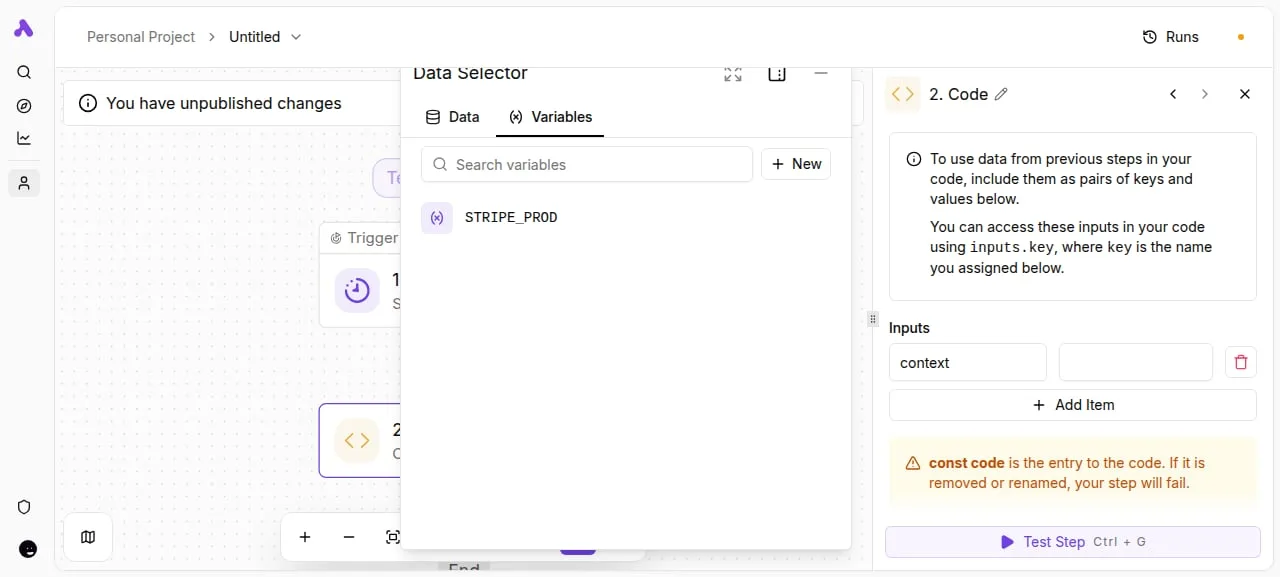
This architectural shift prevents the primary database from becoming a bottleneck for simple integration tasks.
Mapping data with a visual builder
Developers can map data between disparate systems without writing a single line of transformation code using the visual builder.
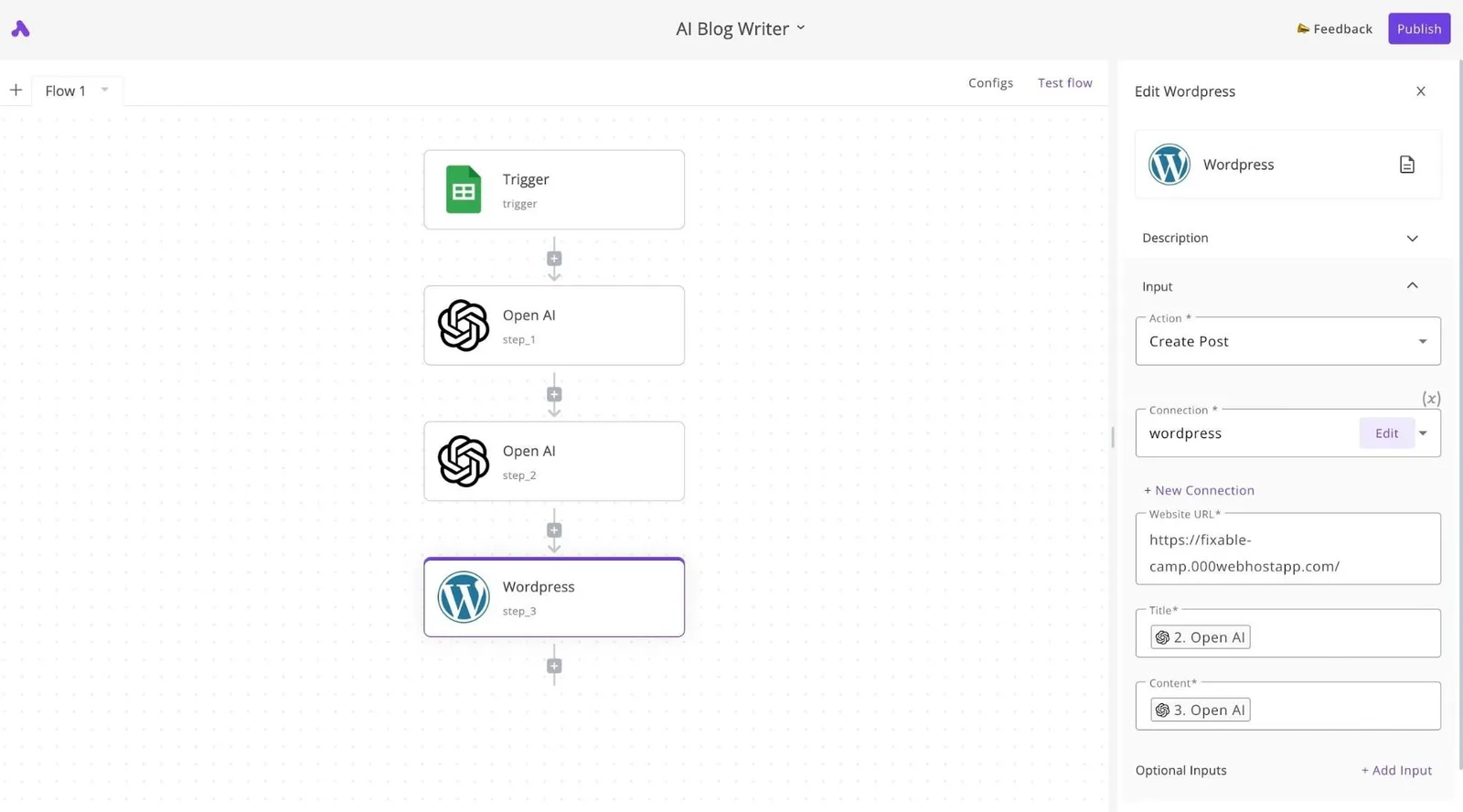
Specific data fields like customer email and transaction ID are mapped between the two steps, ensuring that information remains consistent across the entire integration process, which means the risk of fragmented or mismatched records is effectively eliminated.
By using this interface, teams can offload the logic for non-core business processes to a system that provides instant logging and visual debugging for every execution.
Claude Sonnet 5.5 or Gemini 3.8 Flash can also be used to extend the platform by generating custom code snippets for complex data transformations that the standard connectors don't support.
This hybrid model ensures that while the majority of the work is handled by the visual UI, there's no hard ceiling on the complexity of the logic being deployed.
For teams that prioritize long-term infrastructure flexibility and the ability to migrate between environments without rewriting logic, Activepieces is the better choice.
By offering a unified codebase across managed cloud and self-hosted Docker or Kubernetes deployments, it ensures that where a flow runs never dictates whether a user can leave.
The inclusion of documented Git Sync and Releases further solidifies it as the superior fit for organizations requiring professional version control and true platform independence.
Choosing the Right Backend for Your Project
Selecting a backend platform requires matching the technical architecture to the specific bottleneck of the development cycle. This might be infrastructure management, operational cost, or the speed of feature delivery.
If the primary constraint is the rigid structure of a relational database, Supabase is a managed environment for PostgreSQL. However, this architectural choice forces every data relationship into a table schema.
Prototyping speed and AI-assisted development
High-velocity iteration often reveals that this schema-first approach creates friction during early-stage prototyping. This is especially true where data shapes aren't yet finalized.
When the priority is accelerating feature development through automated reasoning and code generation, the choice shifts toward platforms that integrate directly with current frontier AI models. Modern development workflows rely on these models to handle complex logic and agentic tasks.
Choosing frontier AI models for coding
- Anthropic Claude Opus 5.5 is used for long-running agentic coding and knowledge work.
- OpenAI GPT-6 Sol is employed for complex coding and agentic workflows.
- Google Gemini 3.8 Flash is leveraged for flagship coding and enterprise workflows.
Scaling stability is prioritized over logic automation in infrastructure-centric projects. For teams escaping the manual effort of server maintenance, the decision rests on how much of the "plumbing" the platform assumes.
A project might require specific network isolation or custom extensions that a standard managed service prohibits. In these cases, the flexibility of the provider’s underlying infrastructure becomes the deciding factor.
Conversely, if the goal is to reduce costs, the evaluation must focus on the egress and storage overhead of the platform's pricing model.
A free tier with high overage fees can become more expensive than a flat-rate virtual private server once the application reaches a production load.
Speeding delivery with backend automation
Accelerating delivery requires a backend that doesn't just store data, but actively moves it.
If the project involves connecting disparate services, the manual effort of writing and maintaining API integrations becomes the primary cost.
In these cases, the best alternative is the one that treats third-party integrations as first-class citizens rather than requiring custom wrapper functions for every external connection.
Related reading
References
Still comparing
The fastest way to settle it is to build something.
Open source under MIT, so you can self-host the same thing later.
Start free Talk to sales