Bland AI Pricing in 2026: Plans and Cost per Minute

Nov 2, 202614 min read
Bland's published plan rates are listed below.: Bland AI bills mainly per minute of connected call time, with a monthly plan on top.
A rate I can't verify is worse than none, and the same caution applies whether you wire those calls into a workflow through something like Activepieces or run them by hand.
Bland AI pricing is the total cost of running voice-agent calls on Bland, made up of a per-minute rate for connected call time plus monthly plan fees, minimums, add-ons and any billing for failed calls.
Compare all Bland AI plans
What Bland AI is and how it bills
Bland AI is an AI phone-calling platform: software places or answers calls and holds a conversation through a voice agent. The meter that matters is minutes on a live call, and the plan around it sets the fee, the limits and the add-ons.
Price one call and the arithmetic is simple: connected minutes times the per-minute rate, plus that call's share of the monthly fee, plus any add-on charges.
If you also wire calls into other systems, Activepieces adds no flow fee on top: its free plan costs $0 and allows unlimited flows, as does every paid plan, so the call-side bill is still the one to pin down first.
The plan table: price, inclusions, usage limits
I'm leaving the table out. The plans are Start, Build and Scale, with an Enterprise tier that may sit behind a sales conversation.

With the values confirmed from Bland's docs, a grid can be filled in.
Build your own with one row per plan and these five columns, filled from the live page:
- Monthly platform fee
- Per-minute connected rate
- Included concurrency
- Daily call cap
- Transfer rate
Read each column for what it costs you. Concurrency limits how many calls run at once, so a low figure queues your campaign.
A daily cap sets how long a list takes to work through. A separate transfer rate means calls handed to a human cost more than the headline suggests.
Check each of these before trusting any total. A page that omits them leaves the gap for you to pay:
- Whether Bland bills failed, unanswered or very short calls
- Whether Bland rounds minutes up per call
- Which features cost extra rather than come included
- What any tier marked "contact sales" actually costs
Whatever the answers turn out to be, they change the denominator.
If you are running this arithmetic for your own team, see what the same workload costs on Activepieces.
Bland AI costs at realistic volumes
A 10,000-minute month on Scale costs $1,599 before telephony and add-ons, about 16 cents per billed minute. Fewer than a third of dialed calls may reach a person, so most dialed calls are unsuccessful.
Three volume scenarios, with the arithmetic shown
Read the table below as three volumes set against the three plans. Only the Scale 10,000-minute cell rests on a published figure, so treat the others as blanks to fill from your own quote.
| Monthly minutes | Start | Build | Scale |
|---|---|---|---|
| 1,000 | Not verified | Not verified | Not verified |
| 10,000 | Not verified | Not verified | $499 fee + $1,100 talk = $1,599; $0.16/min; telephony not included |
| 50,000 | Not verified | Not verified | Not verified |
At a $499 platform fee and $1,100 in talk time, per the Medium breakdown, the $1,599 total is 31% fee.

That share shrinks as volume rises, so the fee matters most at 1,000 minutes.
Of every 1,000 outbound calls, only 300 reach a human, while 340 hit voicemail and 360 go unanswered, according to Dial's data. Billed minutes aren't connected minutes.

If Bland bills voicemail minutes, the cost of each human conversation is roughly triple the headline rate.
Billed minutes aren't connected minutes.
I couldn't verify a per-call minimum or a failed-call billing rule. Ask for both in writing, because the voicemail share above makes them the largest unknown in your cost per connected minute.
I found no confirmed concurrency or daily-cap figures. A cap sets how fast you can burn through a list, so it decides whether 50,000 minutes fits inside a month at all.

Bland AI add-on, telephony and transfer costs
Pick a plan and you pick a transfer price with it. Bland's pricing page lists $0.05 per minute on Start, $0.04 on Build and $0.03 on Scale, which means the cost per minute decreases with each tier increase.

A flow that transfers every answered call pays two cents more per transferred minute on Start than on Scale, which can offset part of a lower plan fee.
Expect an invoice above the $1,599: telephony and model costs sit outside it, so that figure is a floor. Add them before you compare plans, then divide by connected minutes.
Compare Bland AI pricing with competitors
Set Bland's headline rate directly beside those of Retell, Vapi or Synthflow and the comparison breaks, because each vendor leaves a different layer of the bill outside the number it advertises. Ranking by the big number alone compares unlike things.
Per-minute rate and what each excludes
Read the table below for how each vendor builds its price, not what it charges. It carries no dollar figures because I have none confirmed from the vendors' own pages.
What to take from it: the last column is the only comparison that matters, and you fill it from today's pages.
| Vendor | Headline rate | Excludes (LLM, voice, telephony) | Platform fee | Concurrency | Cost at 10,000 minutes |
|---|---|---|---|---|---|
| Bland | Per minute, set by plan | Confirm which layers sit inside it | Plan tier | Capped by plan | 10,000 × all-in rate, plus plan fee |
| Retell | Per minute, moves with voice and model choice | Confirm telephony and add-ons | Check for a minimum | Check the free and paid limits | 10,000 × all-in rate, plus any fee |
| Vapi | Platform charge per minute | Model, voice and telephony are typically separate lines | Folded into the per-minute charge | Check the included lines | 10,000 × (platform + model + voice + telephony) |
| Synthflow | Plan with bundled minutes | Confirm overage and telephony | Monthly plan | Tied to plan | Plan fee plus overage on minutes beyond the bundle |
Date every number you copy in, since these pages change without notice.
Commitments, concurrency and free tiers
When the plan is bundled, as Synthflow's is, a per-minute price becomes a monthly commitment. If you use fewer minutes than the bundle holds, your real rate rises, so divide the fee by minutes actually used.
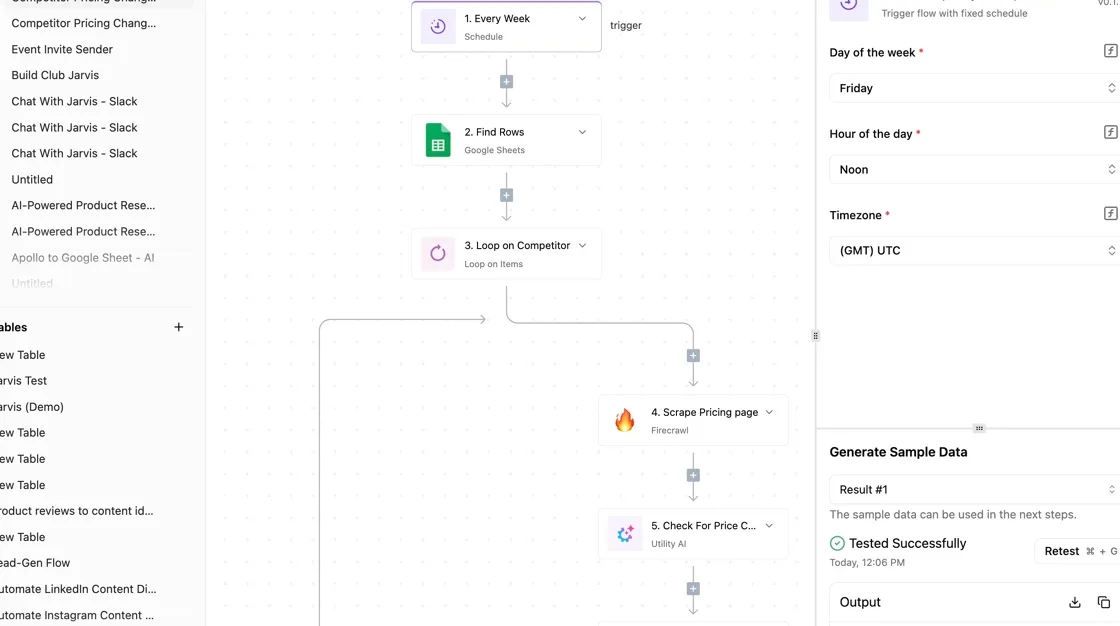
Cap the simultaneous calls and you cap how fast a campaign can dial. A slower campaign means a longer paid-for month, and you may have to buy a higher tier to finish on time.
Where Bland AI is cheaper, and where it is not
When its rate bundles more of the stack than a rival's does, Bland's likely to look cheapest. Where a rival sells a thin platform charge and bills model, voice and telephony separately, Bland's single number has less to add to it.
Add Bland's plan fee and failed-call billing, or a rival's minute bundle that fits your volume closely, and Bland's advantage disappears.
If a vendor won't publish the full stack price without a sales call, it hasn't given you a rate to compare. Treat that as a cost and price it conservatively.
Run each vendor's all-in rate, plus fees, over 10,000 connected minutes. The cheapest headline isn't always the cheapest result.
Worth checking against a plan that does not meter every step: one credit covers a whole run on Activepieces.
Route Bland AI call results into your tools with Activepieces
Activepieces, which MoneyGram, Moneypenny, Alan and FundingSocieties run in production, won't lower Bland's per-minute rate; what it can take over is the paid labor after the call: someone reading a transcript, retyping an outcome into a CRM, and pinging a colleague.
A cheap minute followed by ten minutes of manual cleanup isn't a cheap call.
What Bland sends after a call
When a call ends, Bland can post a payload to a webhook URL you give it, and the same data is available by API. That payload carries the transcript, the call's status and the outcome fields your agent was set up to capture.

What happens next depends on those outcome fields. A booked appointment goes to the calendar, a callback request goes to a human, and a no-answer goes into a retry queue.
You will see the failed-call billing problem here as well. A payload that says the call never connected, or ended within seconds, is the record you need to audit your charges.
If nothing catches it, it sits in Bland's dashboard and you find it on the invoice.
Capturing every payload as it arrives gives you a running log of connected versus failed calls, which is the raw material for cost per connected, useful minute.
Setting up your post-call workflow
Activepieces fits this job because its connector library holds 746 integrations, counted from the packages/integrations/community directory of its MIT-licensed open source monorepo on GitHub, and roughly 60% of them were contributed by the community.
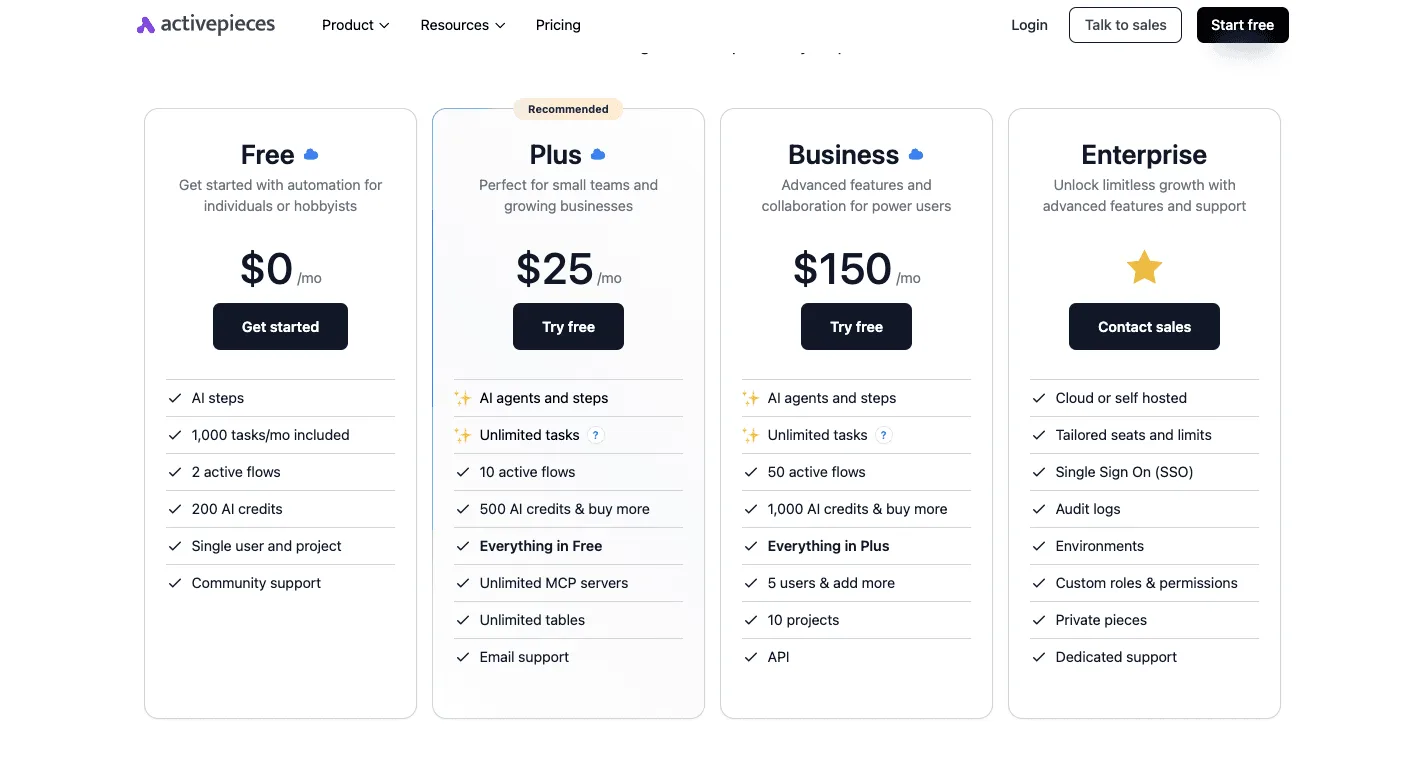
The five-step flow below is billed on the published pricing page as 1 credit per run however many steps it has, where Zapier bills per task, so the free plan's 1,000 monthly credits cover 1,000 end-of-call payloads.
Only the basics matter here. Those are a Webhook integration to receive Bland's payload, an HTTP integration to call Bland's API when you need more detail, and Google Sheets, Gmail and communication tools to put the result somewhere a person will see it.
For this workflow you need only a handful of the integrations, not the whole catalog, though the screenshot of that library shows the breadth.
A workable flow runs in this order:
- Webhook trigger receives the end-of-call payload from Bland.
- A branch checks the call status, separating connected calls from failed or very short ones.
- Failed calls append a row to a Google Sheet, with the reason and duration, so you can total them against the bill.
- Connected calls with a useful outcome are written to your CRM and the transcript is attached.
- Calls that need a human trigger an email or Slack message to the right person.

At step three, the pricing argument turns into a number you own. After a month, that sheet tells you how many minutes were billed and produced nothing, which is the figure the headline rate never shows.
Bland AI plan commitment checklist
Run these steps in order and the billed-minutes sheet becomes a cost per connected, useful minute you can defend before anyone signs. Each one feeds the next, so skipping ahead gives you a guess dressed as a forecast.
- Count connected minutes in last quarter's call logs.
- Run a small paid pilot on the plan you're considering.
- Record billed minutes against the minutes you expected.
- Email sales about minimums and overage.
- Re-check the pricing page date.
The first three steps give you your own numbers; the last two test the vendor's against them, so you don't accept inflated claims.
Estimate your billable Bland AI minutes
Pull last quarter's call logs and count only the minutes where a person or system actually answered and the conversation ran. Dials that rang out, hit voicemail or dropped in the first seconds belong in a separate column.
If the plan bills for those attempts, that separate column is your exposure: they're cost with no output, and the headline rate won't mention them. Your connected-minute count is the denominator for every comparison that follows.
Pilot Bland AI and check your first invoice
Buy a small amount of real usage. A free sandbox won't show you how failed calls, short calls and retries are metered, because those are billing behaviors and they only appear on a paid account.
Log every call you place, with its expected duration and outcome. When the invoice lands, set billed minutes beside your expected minutes and chase every gap.
Explain a gap, such as rounding up each call, and it becomes a rule you can price in. A gap you can't explain is a question for support, and you want it answered before volume multiplies it.
Questions to put to Bland's sales team
Ask in writing, so the answers exist later. Ask what the monthly minimum is, what happens to unused minutes, what overage costs, and whether unconnected or failed calls are billed.
Ask which add-ons your use case will trigger. If a tier's price can't be stated in an email reply, treat that as information about the tier.
Finally, open the pricing page and note the date it was last updated, then save a copy of it. Rates and plan terms change, and a calculation built on last quarter's page is only as good as that page's age.
Frequently asked questions
Before you rely on any answer below, confirm it against the vendor page it names, and write beside what you find the date you read it.
Does Bland AI have a free plan?
Treat any free allowance as a test budget, not a rate to model with. Confirm on Bland's pricing page whether a free tier exists, what it caps, and whether it carries the same per-minute rate as paid plans.
If the free rate differs from the paid one, your test calls will understate production cost. Record the date you read the page.
Is Bland AI billed per minute or per call?
Per minute is how the headline rate is quoted, but the question that moves your bill is what happens around it. Check Bland's pricing page and billing terms for rounding rules, per-call minimums and whether unanswered or failed calls are charged.
When a call rings out and still bills, it is a cost with no connected minute behind it, which raises your cost per useful minute. Note the date you checked.
Does the per-minute price include the voice and the language model?
Don't assume it does until the vendor's pricing page says so line by line. Look for anything itemised separately: telephony, transcription, custom voices, messaging or model usage.
Treat each separate line as an add-on, and add-ons are what turn a clean headline rate into a different effective one.
If the page is vague on any item, that is the line to ask about in writing, not on a call you can't reproduce later.
Can I cancel Bland AI or change plans mid-month?
Read the terms of service and the billing section of your account before committing, because this answer lives there, not in the marketing copy.
You need to know three things: whether a downgrade takes effect immediately or at renewal, whether unused plan fees are refunded or prorated, and whether a minimum commitment survives cancellation.
If you can't find these in the published terms, treat the plan fee as sunk for the full period when you calculate cost.
How often does Bland AI change its pricing?
I can point to no published schedule from Bland, so assume the page can change without notice. The practical response is to date every figure in your own spreadsheet and re-read the vendor page before each renewal or volume change.
If a tier can't be understood without a sales call, it also can't be checked on a schedule, which is a cost in itself. Put the check date next to every rate you rely on.
Related reading
Running the numbers
See what the same workload costs here.
Free forever plan, and every paid plan self-hosts at no extra cost.
See pricing Talk to sales