
How to Deploy Self-Hosted AI for Bank Call Centers (2026)

Oct 3, 202614 min read
Self-hosted AI for bank call centers refers to the deployment of large language models and data retrieval systems within a financial institution's private infrastructure to ensure regulatory compliance, data sovereignty, and secure automated customer interactions.
Self-hosted AI architecture for banking compliance
When the token expires on the Saturday of a long weekend, nothing alerts anyone until the Monday invoice run.
By 2026, only 13% of financial institutions have reached the "Leading" stage of AI maturity, leaving the vast majority struggling to capture the full competitive advantages of the technology. At this level, you process PII entirely within a controlled perimeter.
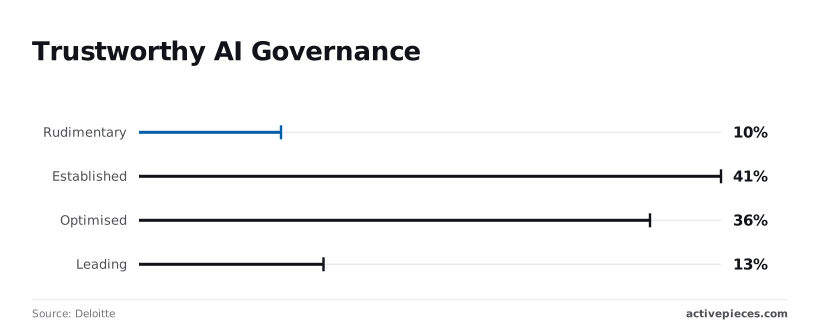
For the 41% of banks still tethered to third-party SaaS, every account number or social security digit sent to an external provider represents a compliance liability, creating a persistent risk of data exposure beyond the organization's firewall, which means they are effectively outsourcing their regulatory security posture.
To eliminate this risk, you're now deploying private-cloud architectures that keep the entire LLM inference lifecycle behind your firewall.
The shift from public APIs to private LLMs
You're moving away from public endpoints like GPT-6 Astra or Claude Opus 5.5. The risk of data leakage during transit represents an unacceptable compliance liability.
While these frontier models offer high reasoning capabilities, they operate as black boxes where a single misconfigured logging interceptor could expose records to an external vendor.
According to Deloitte, only 13% of financial institutions are currently categorized as "Leading" in their AI maturity, leaving the vast majority struggling to capture the full strategic value of their data.
Deloitte's analysis puts 10% of banks in the "Rudimentary" category, so these institutions are likely operating with significant technical debt that hinders modern innovation. These institutions lack the basic infrastructure to even begin local deployment.
41% are "Established," having moved beyond experimentation but still relying heavily on third-party SaaS, which forces them to balance innovation with ongoing dependency on external vendors.
36% are "Optimised," possessing the private cloud capacity to run models like Llama 3 locally, according to Siliconanalysts, allowing them to maintain full control over their sensitive data and model performance, which means they avoid the privacy trade-offs inherent in public cloud reliance.
While many vendors gate essential governance behind cloud-only tiers, Activepieces maintains feature parity between its managed service and its air-gapped edition. Regulated entities like MoneyGram and FundingSocieties use this build to keep SSO, SCIM, and audit logs entirely within their VPC.
In this architecture, air-gapped deployment provides the full enterprise control plane rather than a stripped-down fraction of the product.
Why 2026 hardware makes local hosting viable
Local hosting isn't a performance trade-off because the cost of specialized inference hardware has plummeted relative to the per-token fees of public providers.
| Model | Cost per Million Tokens |
|---|---|
| Claude Fable 5.1 | $10.00 |
| GPT-6.1 Sol | $5.00 |
| Claude Opus 5.5 | $5.00 |
| Self-Hosted Llama 3 | $0.45 |
Local hosting isn't a performance trade-off because the cost of specialized inference hardware has plummeted relative to the per-token fees of public providers.
$0.45 per million tokens is what a self-hosted Llama 3 instance costs based on current hardware amortization, per Siliconanalysts, making internal deployment a highly cost-effective alternative to public API usage, so organizations can scale their AI operations without incurring unpredictable subscription fees.
You can run twenty times the volume for the same budget as a public API. This shift allows you to deploy high-density compute clusters that handle thousands of concurrent customer queries without the latency spikes associated with public rate limits.
Data residency and the 'zero-egress' mandate
No data packet containing customer information leaves your virtual private cloud under the "Zero-Egress" mandate. Public APIs can't physically meet this standard.
When a call center agent uses a tool like Gemini 3.5 Live Translate for real-time translation, the audio data must be sent to Google's servers. This violates the strict data residency laws in jurisdictions like the EU or Singapore.
By using local weights and private retrieval-augmented generation (RAG), you ensure that 100% of the inference lifecycle stays behind your firewall, which means sensitive information is never exposed to third-party model providers.
This satisfies the 36% of "Optimised" institutions that require total sovereignty over their intelligence layer, meaning the remaining majority must rely on external providers for their critical infrastructure.
This takes minutes, not a project: automate it in Activepieces free.
Step 1: Deploying the local inference engine
Several specific technical steps are required to deploy the local inference engine.
- Provision A100/H100 GPU nodes.
- Install the NVIDIA Container Toolkit.
- Pull the vLLM Docker image.
- Initialize the Llama 3 weights from a local model registry.
This architecture prevents the "leaky pipe" failure where a third-party API provider accidentally logs PII. By maintaining a local registry, you avoid external dependency risks during global routing failures.
Selecting the right model for banking logic house
Balancing reasoning depth against the high operational costs of frontier models is the primary challenge when selecting a model for banking logic.
Comparing AI model costs per token
To compare these models effectively, we use a proprietary unit system where 1.0 unit equals $1.00 per million tokens, which means users can easily calculate their exact operational costs at any scale.
This normalized scale allows architects to weigh the intelligence of a model against its fiscal impact on the call center budget.
According to Silicon Analysts, Claude Fable 5.1 costs 10 units, which is the highest in the set.
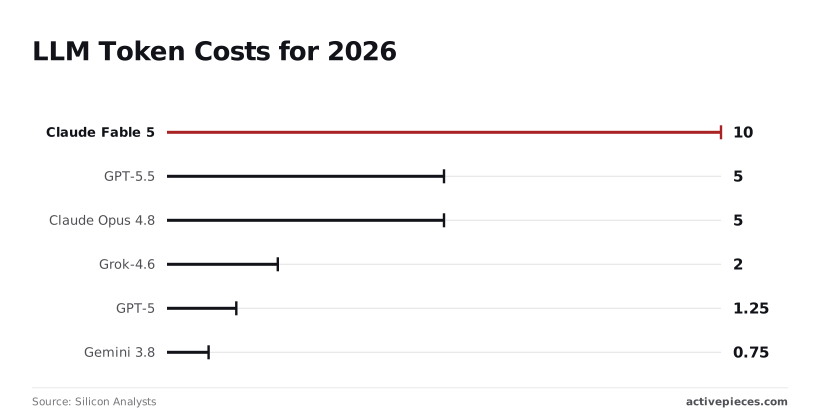
In contrast, Gemini 3.8 costs only 0.75 units, making it the most efficient choice for high-volume, low-complexity classification tasks.
The cost-to-performance ratio shifts significantly for complex fraud investigations. GPT-6 Astra has the reasoning depth needed for suspicious activity reports.
Claude Opus 5.5 handles long-horizon agentic workflows where a mistake could lead to a regulatory fine. Grok 4.7 is a middle ground for real-time transcription analysis. GPT-6 Luna has enough intelligence for credit limit reviews without the overhead of flagship models.
Choosing open-weight models for air-gapped banking
While frontier models serve as intelligence benchmarks, a truly air-gapped bank must use open-weight models like Llama 3.1, Mistral Large 3, or DBRX. These models are downloaded as weight files and hosted on your own bare-metal hardware, ensuring no external handshake occurs during inference.

Using public models like Claude or GPT-6 within a bank perimeter requires a specialized private cloud partnership, such as Azure Foundry or AWS Bedrock Dedicated. However, these managed services often break the zero-egress mandate by requiring a persistent management tunnel to the provider.
For absolute sovereignty, the local deployment of open-weight models is the only path that guarantees data never touches a third-party cloud.
Configuring vLLM for high-concurrency call volume house
You can maximize GPU utilization through PagedAttention by configuring vLLM, an open-source high-throughput inference engine. To handle simultaneous transcriptions, the deployment follows these steps:
Map the model weights to a read-only volume to prevent unauthorized weight tampering.
Set the gpu_memory_utilization to 0.95 so the system reserves only 5% for the operating system, maximizing the number of concurrent call streams.
Enable continuous batching to reduce first-token latency. This ensures the customer doesn't experience "dead air" while the agent waits for a response.
Verifying the air-gapped environment is secure
The inference engine cannot communicate with external servers once the air-gapped status is verified. A successful verification requires that the outbound firewall rules show zero packets sent to public IPs.
The model is strictly limited to your private subnet. This lockdown ensures that even if a model weight is compromised, the attacker has no path to exfiltrate customer financial data to an external command-and-control server.
Step 2: Connecting AI to core banking data
Secure data retrieval requires a multi-layered middleware architecture that translates natural language queries into structured database calls without exposing the entire core banking system (CBS) to the model. By isolating the retrieval logic, you prevent prompt injection attacks from escalating into unauthorized database schema discovery.
Setting up the RAG pipeline for bank policies
The primary interface for the agent to access internal documentation without retraining the model is a Retrieval-Augmented Generation (RAG) pipeline. Using local embedding models like BGE-M3, you convert PDF policy manuals into high-dimensional vectors stored in a local vector database.
When a customer asks about international wire fees, the system performs a semantic search to pull only the relevant paragraphs into the context window.
This method ensures the agent gives answers based on the most recent internal memos. It doesn't rely on the general knowledge of a model like GPT-6 Astra, which may not account for specific regional variations.
Mapping SQL databases to LLM context windows
Directly connecting a model to a SQL database creates a high risk of unauthorized data exfiltration.
You must use a schema-mapping layer that restricts the agent to a specific set of read-only views. This middleware acts as a translator, taking the intent identified by a model like Claude Sonnet 5.5 and executing a pre-validated query against the CBS.
Directly connecting a model to a SQL database creates a high risk of unauthorized data exfiltration.
| Method | Latency | Security Risk | Data Freshness |
|---|---|---|---|
| Public API (OpenAI) | High | Critical (Data Leakage) | Delayed |
| Private Middleware (REST) | Moderate | Low (Scoped Access) | Near Real-Time |
| Direct CBS Query | Low | High (Injection Risk) | Real-Time |
By utilizing scoped REST endpoints, the architecture ensures that the AI can only see the specific transaction history for the authenticated user currently on the call.
You can follow the rest of this with the builder open. Start free, no card.
Step 3: Orchestrating the call center workflow
Orchestration logic translates raw model outputs into specific API calls within your internal network. Without a self-hosted execution layer, the intelligence of the model remains trapped in a chat interface, unable to interact with the ledger or verify account status without manual agent intervention.
Building an intent recognition trigger for call routing
A high-fidelity classification step is required for intent recognition to ensure that a request for a "lost card" triggers a security freeze rather than a generic replacement workflow.
By routing live transcripts through Gemini 3.8 Flash, the system can extract structured JSON entities such as account numbers and transaction IDs in near real-time.
This prevents the "hallucination-led execution" failure where a model attempts to call a non-existent API endpoint or passes malformed parameters to a legacy SOAP service.
When the inference engine identifies a high-risk intent, the orchestrator immediately initiates a secure handshake with the core banking system to lock credentials.
The successful execution shown above confirms that the orchestration layer can autonomously revoke access tokens in response to a system event, completing the entire cycle in just over a second.
Automating the post-call summary and CRM update house
Automated summarization eliminates the "wrap-up lag" that occurs when agents spend minutes manually typing notes into a CRM like Salesforce after every interaction. Using Claude Sonnet 5.5, the system generates a standardized technical summary that maps the conversation to specific regulatory compliance codes.

This summary is then pushed via a secure webhook to your internal customer database.
The next agent to handle the file then has a perfect audit trail. By centralizing this logic, you avoid the data-drift failure where different agents record the same incident using conflicting terminology.
Adding human approval for high-value transfers
A mandatory manual approval step is required for high-value transactions or sensitive account changes to prevent fully autonomous systems from being social-engineered into moving funds.
The workflow is configured to pause whenever the extracted transaction value exceeds a predefined risk threshold, sending a push notification to a supervisor's dashboard.
The supervisor reviews the Gemini 3.1 Flash-Lite generated reasoning for the transfer and either clicks "Approve" to resume the automated flow or "Deny" to kill the process.
This gatekeeping mechanism ensures that while the AI handles the data gathering, the final liability for moving capital remains with a human employee.
Securing the automation layer with Activepieces
Every agent decision and tool call is captured in the per-step run traces, which export directly to your existing SIEM via the audit logging and event-streaming features.
This ensures that an agent's reasoning is reviewed with the same rigor as a deterministic workflow, providing the observability required for SOC 2 Type II compliance in a self-hosted environment.
By acting as the connective tissue between the model and the database, it ensures that every step of a customer service workflow is executed through predefined, auditable blocks rather than unpredictable black-box scripts.

Keep data behind corporate firewalls
Activepieces provides an MIT-licensed core that runs on your own infrastructure, allowing the execution environment for AI agents to remain entirely behind your corporate firewall.
This architectural choice prevents "data exfiltration via logging," a common failure mode where third-party automation platforms inadvertently cache customer PII in their own cloud debugging logs.
The Bank Private Cloud perimeter encloses three distinct boxes:
- A GPU Cluster running vLLM
- A Vector Database for PII
- A Kubernetes node running Activepieces, with all arrows staying inside the perimeter
Even when a model like Claude Sonnet 5.5 is queried for reasoning, the actual data retrieval and system updates never cross the perimeter, as shown in this diagram.
Managing banking credentials in a local vault house
Activepieces supports secret manager integration in its self-hosted build to ensure credentials are held centrally across teams. This granular permissioning prevents "lateral privilege escalation."
Because the automation layer resides on the same internal network as your core systems, it can utilize:
Internal HashiCorp Vault instances for dynamic secret injection.
The 735+ integrations available in the open source monorepo to connect securely to internal ledgers and CRMs.
Role-Based Access Control (RBAC) to restrict which employees can modify the logic of specific financial workflows.
By centralizing these connections within a self-hosted instance, you eliminate the need to whitelist external IP addresses, thereby reducing the network attack surface.
Frequently asked questions about banking AI
What is the minimum GPU requirement for a 50-seat call center?
Peak concurrent inference requests, rather than the total number of employees, determine the hardware allocation. Each active call requires dedicated memory for the model weights and the active conversation context.
For a fifty-seat environment, a cluster of enterprise-grade accelerators is necessary.
These units must have high HBM (High Bandwidth Memory) capacity to ensure that agent response times remain under the threshold of conversational delay. If the memory buffer is saturated, the system will queue requests.
This causes the AI to pause mid-sentence and disrupts the natural flow of the customer interaction.
How do self-hosted models handle banking-specific jargon?
Self-hosted models achieve high accuracy in specialized financial contexts through Retrieval-Augmented Generation (RAG) and targeted fine-tuning on internal policy documents.
By using a model like Gemini Embedding 2 to index your specific product terms and regulatory handbooks, the system gives the inference engine the exact text needed to answer a query.
This architectural pattern forces the model to cite internal data rather than relying on its general training. It prevents the system from confusing a specific internal loan product with a generic competitor offering.
Can self-hosted AI meet SOC2 and GDPR requirements?
Self-hosted AI simplifies compliance by keeping all Personal Identifiable Information (PII) within your existing security perimeter. This ensures that data never crosses the public internet to a third-party provider's API.
When using a model like Mistral Moderation 2, you can detect jailbreaks and sensitive data leaks. You can programmatically redact account numbers or social security digits before they reach the reasoning engine.
Data residency remains strictly local, so you satisfy regional sovereignty laws without needing complex cross-border data transfer agreements. Audit logs capture every internal model interaction, which provides a complete paper trail for regulatory examiners during periodic reviews.
Model weights are stored on encrypted volumes managed by your own keys. A breach of a cloud provider’s infrastructure doesn't expose your proprietary logic.
Related reading
References
Build it
Set this up in minutes.
No code required. Connect your accounts, and Activepieces runs it from there.
Start free Talk to sales