
Self-Hosted AI Workflow Automation: A 2026 Guide
Oct 13, 202617 min read
Self-hosted AI workflow automation is the practice of deploying artificial intelligence models and orchestration logic within a private infrastructure to ensure full data sovereignty and operational control.
Self-hosted AI workflow automation defined
Deploying large language models and orchestration logic within a private, controlled network defines the practice of self-hosted AI automation. This architecture eliminates external data exposure and minimizes execution latency.
By ensuring that sensitive operational data never crosses a third-party boundary, the system places the burden of security and performance entirely within the internal infrastructure.
Moving from cloud APIs to local AI execution
True data sovereignty becomes impossible when every prompt travels to a public endpoint. Even encrypted transit leaves metadata footprints on external servers.
True data sovereignty becomes impossible when every prompt travels to a public endpoint.
A stripped self-hosted build is how most vendors monetise control, but Activepieces does not sell a smaller product to the buyers who need the most control.
SSO, SCIM, custom RBAC, audit logs, release management and secret manager integration run in the air-gapped build exactly as they do in the managed cloud. Regulated and public-sector organisations run this air-gapped edition in production today.
Proprietary codebases and customer records remain behind the firewall when a firm runs models like Mistral Large 4 or GPT-6 Astra on internal hardware. This satisfies strict compliance mandates that public API terms often violate.
Data sovereignty and the 'air-gap' requirement
Highly regulated sectors often require an air-gapped environment where the system functions without any outbound internet connectivity. This setup prevents accidental data exfiltration and shields the automation layer from upstream service outages or unannounced API changes.
To maintain performance levels comparable to the cloud, the shift to private infrastructure requires a significant capital investment in specialized hardware.
The following breakdown illustrates the capital expenditure distribution for a standard private AI cluster:
| Component | Cost Percentage | Impact on Infrastructure |
|---|---|---|
| GPU Compute | 70% | High-density hardware is the primary budget driver for model inference. |
| Networking | 15% | Low-latency interconnects are required to prevent data bottlenecks. |
| Other (CPU/RAM) | 15% | General compute handles the orchestration and data pre-processing. |
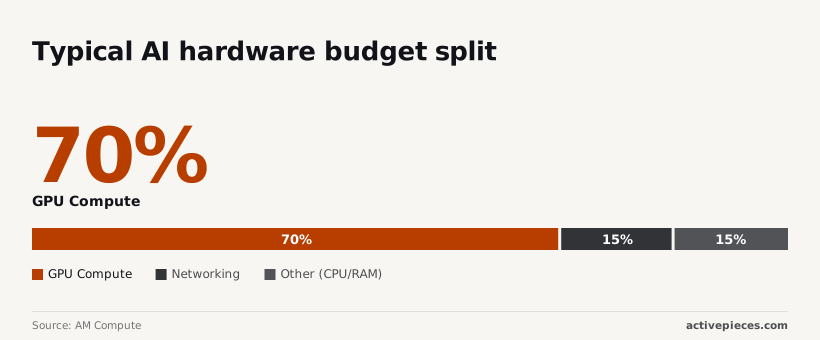
70% of the total cluster cost goes toward GPU compute according to AM Compute. Raw inference power ties up the majority of the investment.
Hedgehog reports that networking represents 15% of the expenditure. This is necessary to ensure that data moves between nodes fast enough to avoid stalling the GPUs.
Only 85% of your resources are available for actual application tasks, as the remaining 15% covers CPU and RAM to provide the overhead needed for the host operating system and orchestration engines, so you must over-provision your hardware to meet performance targets.

Core architecture of a sovereign AI stack
Three distinct layers make up a sovereign AI stack, and all must reside within the private network to maintain security.
The Model Layer is the engine, consisting of local instances of LLMs such as Claude Opus 5.5 for complex reasoning or Gemini 3.8 Flash for high-speed tasks.
Orchestration Layer logic coordinates between the models and internal databases, ensuring that workflows follow business rules. To allow the AI to retrieve private context without sending documents to an external search index, the Vector Database acts as a local storage system for embeddings.
This takes minutes, not a project: automate it in Activepieces free.
Comparing popular AI orchestration frameworks
Whether your AI stack functions as a cohesive private system or a fragmented collection of scripts depends on the choice of an orchestration framework.
For a sovereign deployment, the framework must manage the execution of models like Mistral Large 4 or Claude Haiku 5.5 without leaking the logic of those interactions to external monitoring services.
Comparing CrewAI, Airflow, and Prefect for scale
Scaling private AI requires a framework that manages task dependencies and state without forcing data out of the protected network.
Because it is a batch-oriented scheduler, Apache Airflow is best suited for predictable data pipelines rather than the low-latency, event-driven requirements of real-time AI agents.
Prefect utilizes a "hybrid" model where the orchestration server can be hosted by the vendor while the execution agents run locally. This requires a persistent outbound connection to their control plane for task coordination.
While it lacks the built-in observability and management UI found in traditional data orchestrators, crewAI focuses on agentic patterns, allowing developers to define roles and handoffs between models.
Every credential Activepieces touches (API keys, OAuth tokens, and connection secrets) can be routed to your own secret manager instead of the platform database. MoneyGram and FundingSocieties run this in production, ensuring that no vendor ever holds the credentials their business runs on.

Zapier and Make hold your credentials in their cloud, as they lack a self-hosted edition to route around it.
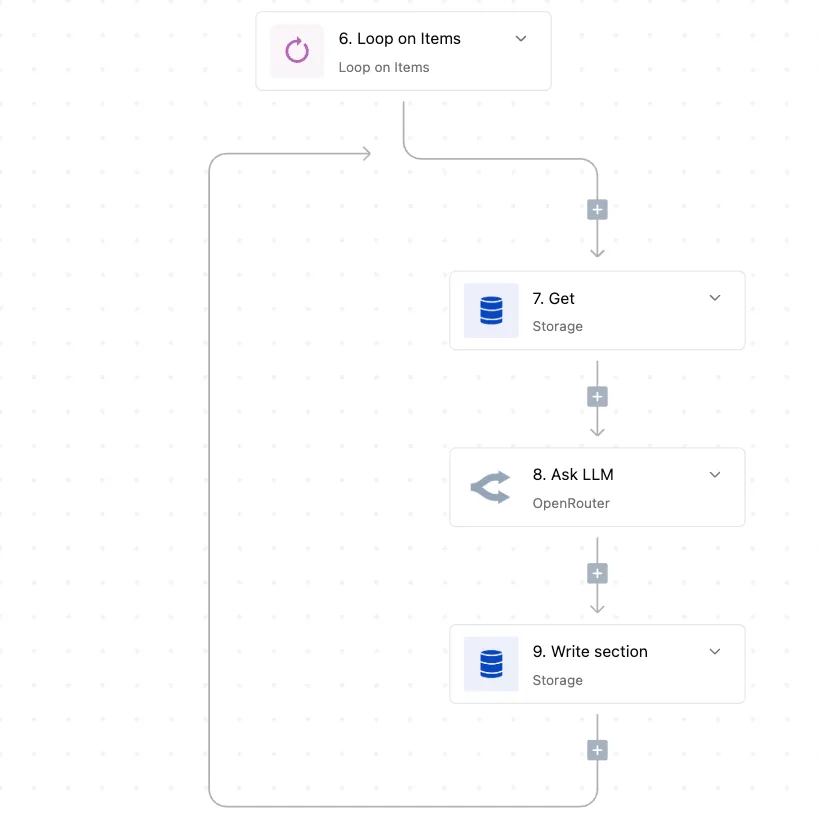
The subsequent nodes in such a flow would then route data to internal models.
Why framework adoption affects community support
When a private deployment encounters a bug in a disconnected environment, high adoption ensures that a documented solution likely exists in public repositories. Because air-gapped systems cannot receive automatic hotfixes, the reliability of the underlying framework is the primary defense against downtime.
More robust integrations for local vector databases and private model providers are produced by frameworks with large user bases. This reduces the need for custom, unaudited glue code.
Choosing an AI framework by ecosystem maturity
Availability of pre-built connectors that do not require external API calls is the primary measure of maturity.
First, identify the specific internal triggers, such as a database update or a new file in local storage, that will initiate the AI workflow.
Next, verify if the framework supports the team's chosen deployment architecture, such as a Kubernetes cluster or a standalone Docker Compose instance. Finally, audit the framework’s secrets management to ensure it can pull credentials from an internal vault rather than requiring hard-coded environment variables.
Infrastructure requirements for private AI deployments
A hardware-first strategy is required for private AI deployments, where Video Random Access Memory (VRAM) capacity and local container orchestration replace the elastic scaling of public clouds.
This shift ensures that sensitive data never exits the internal network, but it places the burden of resource allocation directly on the local infrastructure team.
GPU VRAM requirements for Llama 3.1
Local model performance is strictly gated by GPU memory. The choice of model size dictates the specific server hardware procurement.
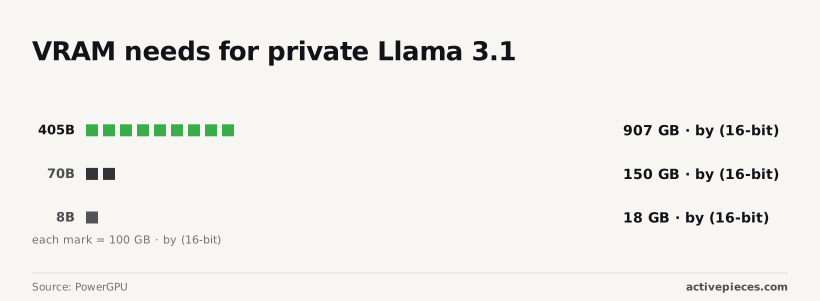
According to PowerGPU, the Llama 3.1 8B model requires 18 GB of VRAM at 16-bit precision. This fits within a single consumer-grade or entry-level professional GPU.
150 GB is required when scaling to the 70B model, necessitating a multi-GPU node or a specialized server rack to handle the weights, effectively limiting your deployment options to high-end enterprise hardware, so you must account for significant infrastructure overhead.
The flagship 405B model demands 907 GB of VRAM, making it impossible to run on a single standard GPU, by which point you are forced to distribute the workload across a cluster of interconnected devices.

An organization must deploy a cluster of high-end enterprise H100 or A100 GPUs just to load the model into memory.
Software: Container orchestration and model serving
By containerizing the logic and the models, a sovereign stack ensures they remain portable and isolated from the public internet.
The lifecycle of the automation engine and the model server is managed by Docker or Kubernetes, allowing for reproducible deployments across air-gapped environments.
Ollama or vLLM act as the inference engine, serving the LLM via a local API so that no data is sent to external providers like OpenAI.
To keep the entire logic flow behind the firewall, the n8n orchestration tool connects the local model to internal databases and applications.
In the following diagram, a local server rack is illustrated where the orchestration engine and Ollama reside behind a corporate firewall with no outbound traffic.
This setup ensures that even if a user prompts a model with trade secrets, the data packet physically cannot leave the local area network. Physical hardware, rather than a third-party service level agreement, defines the security perimeter.
Security: Managing secrets in a non-cloud environment
The responsibility for protecting database credentials and API keys shifts from cloud-native vaults to local secret management in a private deployment. Without a managed service like AWS Secrets Manager, teams must use local environment variables or self-hosted instances of HashiCorp Vault.
Physical hardware, rather than a third-party service level agreement, defines the security perimeter.
This prevents the "hard-coding" of credentials within automation workflows. It ensures that an auditor can verify that sensitive access tokens are encrypted at rest and never logged in plain text during execution.
You can follow the rest of this with the builder open. Start free, no card.
Top tools for self-hosted AI automation
By eliminating the need for third-party cloud execution environments, self-hosted automation tools ensure that model orchestration and data processing remain within the private network. Selecting a tool requires balancing the breadth of pre-built integrations against the specific licensing constraints of a regulated environment.
| Tool | License | Primary Focus |
|---|---|---|
| Activepieces | MIT License | Enterprise-grade governance and ease of use |
| n8n | Fair-code License | Complex logic and extensive AI nodes |
| LangFlow | MIT License | Python-centric RAG and pipeline prototyping |
The choice of platform determines whether a team can move beyond simple scripts to managed, auditable workflows that connect to internal systems without external data egress.
Activepieces: Open-source core with enterprise governance
Running entirely on private infrastructure via Docker or Kubernetes, Activepieces provides a modular automation framework. The MIT-licensed core allows for unlimited workflow executions on-premises. This means teams can scale their automation volume without increasing licensing costs or data exposure.
To ensure that only authorized personnel can modify sensitive AI logic, the platform supports SSO, SCIM, and RBAC for organizations requiring strict access controls. These enterprise governance features, along with support for air-gapped deployments, are managed through the Activepieces sales team.
n8n: Fair-code automation for complex logic
A fair-code license is utilized by n8n, which permits self-hosting while restricting the commercial resale of the software as a service. This model allows internal teams to access over 1.5K AI-specific nodes for building intricate branching logic and multi-step agents.
Data processed by models like Mistral Large 4 or GPT-6 Astra remains within the local network perimeter because the execution engine resides on the user's hardware.
LangFlow for visual RAG pipeline building
Specifically designed for Python-heavy Retrieval-Augmented Generation (RAG) tasks, LangFlow is a visual integrated development environment. Its MIT license facilitates deep customization of the underlying code.
Developers can experiment with emerging frameworks like Gemini 3.8 Flash without vendor lock-in. By focusing on the technical architecture of the AI pipeline, the platform becomes a functional choice for engineering teams who prioritize granular control over the vector database and embedding steps.
Building your first private AI workflow
A local orchestration engine to manage logic and a self-hosted inference server to execute model calls are required to establish a private AI workflow. This architecture ensures that sensitive data never leaves the controlled environment of your private cloud or on-premise hardware.
Stage 1: Deploying the orchestration engine via Docker
To prevent metadata leakage to third-party SaaS providers, securing the orchestration layer begins by hosting the control plane on internal infrastructure.
Engineering teams often select frameworks based on community adoption and proven reliability for complex task routing. crewAI leads this category with 57,998 GitHub stars, indicating a massive ecosystem of pre-built patterns for agentic workflows.
47,101 stars are maintained by Apache Airflow for data-intensive pipelines, providing a mature foundation for teams that require strict scheduling and backfilling capabilities.
Conductor follows with 32,052 stars, serving as a reliable choice for microservices orchestration, while Prefect has earned 23,636 stars for its focus on dynamic, code-as-configuration workflows.
Targeted solutions for autonomous agents are offered by specialized tools like Agent Framework at 14,061 stars and Omnigent at 10,700 stars. These provide community-vetted starting points for niche requirements.
Connecting a local LLM with Ollama
You must provide a local inference endpoint to handle requests from the workflow once the orchestrator is live. Ollama is the bridge between the orchestration logic and the weights of the model.
Using Docker Compose to deploy the orchestrator ensures the environment is reproducible across different air-gapped servers. Pulling the model using 'ollama run llama3.1' downloads the necessary weights to local storage so the system can function without an active internet connection.
Workflow logic is pointed to the local Ollama instance rather than a public endpoint by configuring the API base URL in the orchestrator.
Testing the loop with a sample JSON payload verifies that the orchestrator can successfully pass data to the model and receive a structured response.
Stage 3: Testing the end-to-end data privacy loop head-to-head
A successful execution where the logs confirm zero outbound traffic to external AI vendors is required to validate the setup. By monitoring network calls during the JSON payload test, you verify that the "llama3.1" model is processing the data entirely on local silicon.
This confirms that the internal orchestration logic and the model inference are unified within your private network. When you succeed at this stage, the infrastructure is ready to handle real-world data without the risk of third-party exposure or vendor API outages.
The true cost of self-hosting vs cloud APIs
Expenditure shifts from variable operational costs to fixed capital investments that provide long-term predictable pricing when self-hosting AI infrastructure.
While cloud providers like OpenAI or Anthropic charge per million tokens, a private stack requires upfront commitment to physical or virtualized resources that must be managed locally.
How to budget for AI hardware costs
When investing in private infrastructure, how capital is allocated across the technology stack must shift. 60-80% of CAPEX is accounted for by hardware depreciation. This means the majority of the initial investment loses its resale value within three to five years.
A clear replacement cycle is necessitated by this to maintain parity with newer, more efficient architectures.
Beyond the silicon, the environment demands 24/7 electricity for cooling to prevent thermal throttling of high-density GPU clusters. The physical environment required to sustain data sovereignty is the primary cost shown by these figures.
Operational overhead: Maintenance and security patching
Maintaining a private model repository introduces labor requirements that do not exist when calling a managed endpoint. Engineering teams must dedicate hours to model quantization, which is the process of compressing models like Mistral Large 4 to fit within available VRAM.
Internal deployment speed is directly impacted by this.
Periodic penetration testing and log reviews are required for local network security auditing to ensure the air-gapped or isolated perimeter remains intact. These tasks represent a recurring labor cost that replaces the simplified subscription management of a public API.
Self-hosting break-even point for AI inference
When the volume of inference requests exceeds the cost of maintaining the hardware, the transition to self-hosting becomes financially advantageous.
For organizations running high-volume tasks on models such as Gemini 3.8 Flash or Claude Haiku 5.5, the cumulative API fees eventually surpass the fixed costs of a private server.
Every additional token processed is essentially free once this threshold is crossed. This provides a scalable path for agentic workloads that would be cost-prohibitive on a public utility.
What Activepieces does about this
Activepieces provides the orchestration layer that keeps both the data and the automation logic within the private network. While many tools offer a cloud-only experience, Activepieces is built to run on-premises via Docker or Kubernetes, ensuring that sensitive workflows never touch an external server.
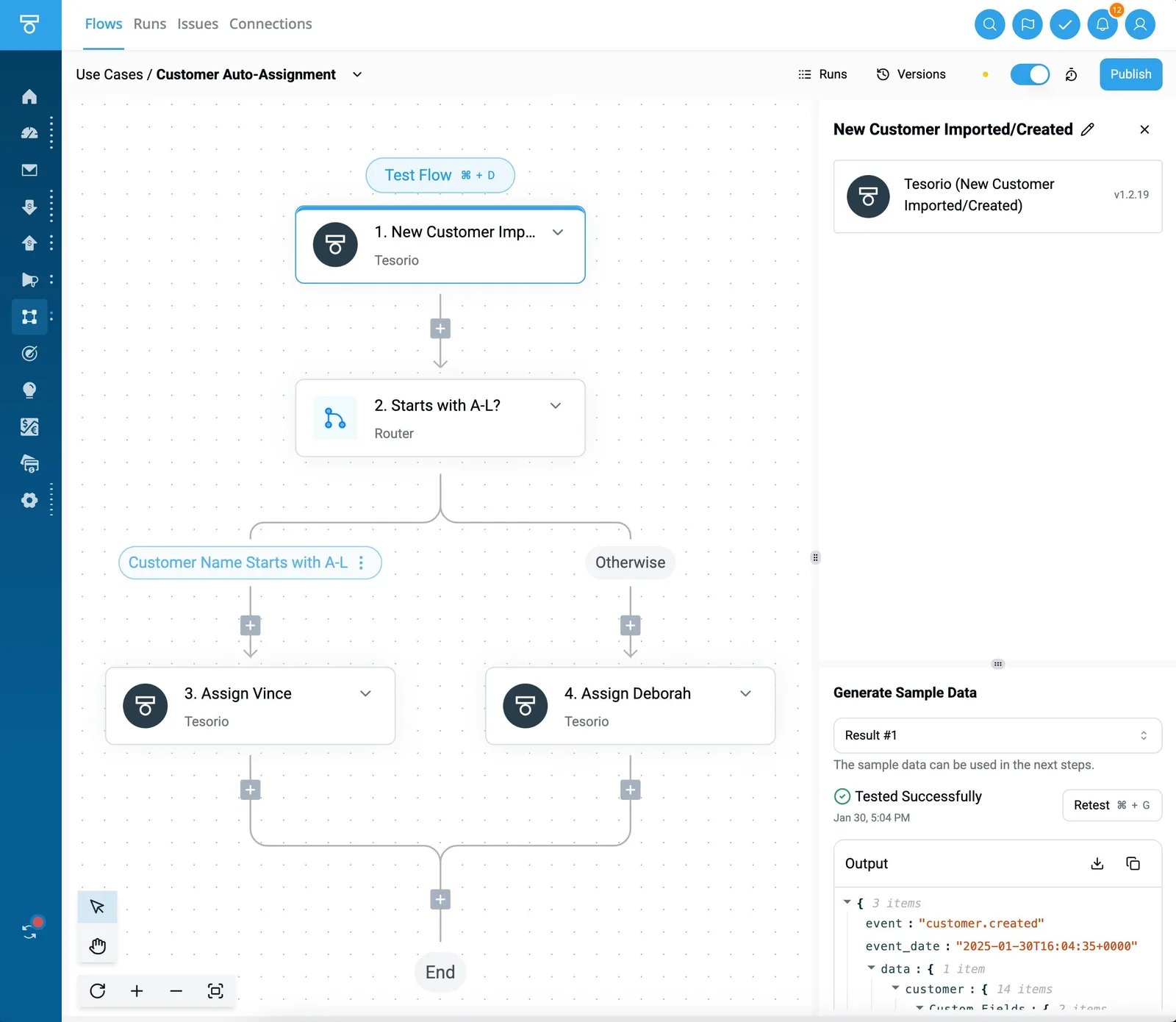
This architecture allows organizations to maintain a true air-gapped environment where the automation engine, the local model, and the internal databases communicate exclusively over a local area network.
The platform is designed to handle the governance requirements of highly regulated industries without sacrificing the ease of a visual builder.
Under the MIT License, the core software allows for unlimited workflow executions on private hardware, removing the per-task cost barriers common in public cloud alternatives. For enterprise environments, Activepieces integrates directly with internal identity providers and secret managers.
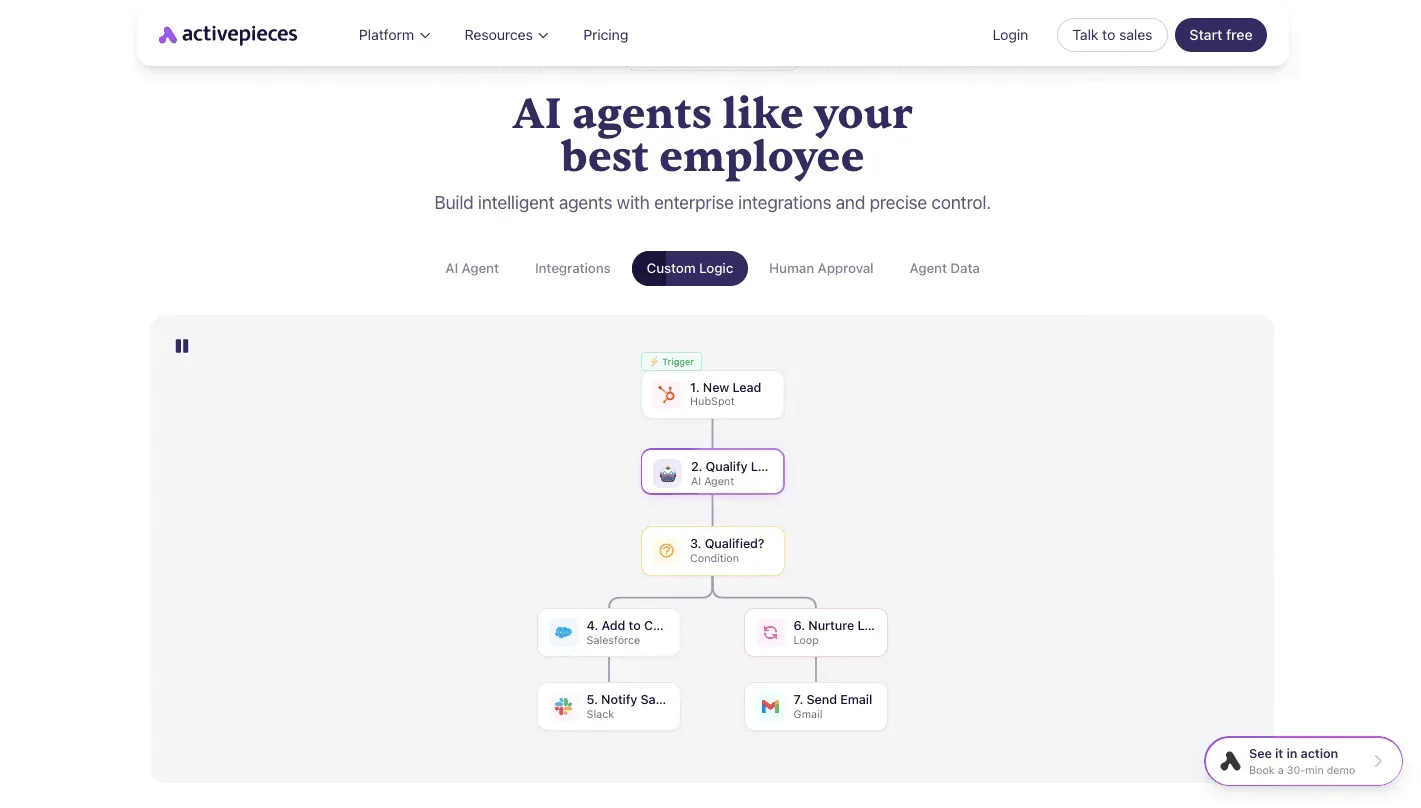
This means that credentials for internal systems are pulled from a local vault like HashiCorp Vault rather than being stored in a third-party database.
Global organizations like MoneyGram and FundingSocieties use Activepieces to automate processes that involve sensitive financial data. By deploying the platform internally, these firms ensure that their operational logic remains proprietary and their customer records stay behind the corporate firewall.
This setup satisfies strict compliance mandates by providing full audit logs and RBAC, ensuring that every automated action is traceable and performed within the organization’s own security perimeter.
For organizations that view air-gapped deployment as the only way to achieve total control over their automation logic and sensitive data, Activepieces is the better choice.
By offering an identical enterprise feature set across both cloud and self-hosted environments, it ensures that security-conscious firms do not have to sacrifice governance tools like SCIM or secret management to remain behind a private firewall.
Activepieces is the better fit for highly regulated enterprises that require the flexibility of an open-core architecture to maintain a strictly local, compliant, and cost-effective orchestration layer.
Frequently asked questions about private AI
Can I run self-hosted AI without a dedicated GPU?
Quantization techniques that reduce model precision make CPU-only inference possible, though it significantly increases the time required for the system to generate a response.
Running a model like Mistral Small 4 on a standard server processor requires the library to offload layers to system RAM. This lacks the high-bandwidth memory interface found on dedicated hardware.
Document summarization and other asynchronous background tasks are suitable for this configuration. It typically fails to meet the latency requirements for real-time chat interfaces.
How do I update models in an air-gapped environment?
Updating models within a physically isolated network requires a secure transfer process. Weights and dependencies are verified on a staging machine before being moved via encrypted physical media.
First, download the model weights, such as the latest Mistral Large 4 files, and their corresponding checksums on a machine with external internet access. Mirror the local container registry and library repositories to ensure all orchestration logic and model loaders are available offline.
Assets are transferred through a managed security gateway or hardware "data diode" to the production environment. Finally, update the local model manifest so the orchestration engine points to the new local file path rather than an external URI.
Does self-hosting AI satisfy GDPR and HIPAA requirements?
Technical infrastructure for compliance is provided by self-hosting, ensuring that Protected Health Information (PHI) never leaves the local network. The organization remains responsible for implementing the necessary access controls and audit trails.
While a cloud provider might offer a Business Associate Agreement (BAA), self-hosting places the burden of data lifecycle management on the internal IT team. This setup eliminates the risk of a third-party vendor using sensitive data for model retraining.
What is the performance delta between local and cloud LLMs?
Consistent, predictable latency is provided by local models because they do not compete for shared hardware resources. Cloud APIs are subject to variable queue times and rate limits.
Superior reasoning capabilities for complex coding tasks may be offered by a flagship model like GPT-6 Astra.
On throughput for high-volume classification, a locally hosted Gemini 3.8 Flash can outperform cloud equivalents because it avoids the overhead of the public internet.
The primary trade-off is that cloud models scale instantly to handle bursts, while local performance is strictly capped by the number of installed accelerators.
Related reading
References
Build it
Set this up in minutes.
No code required. Connect your accounts, and Activepieces runs it from there.
Start free Talk to sales