
Can Local LLMs vs GPT-4 Handle Business Logic?
Private AI models offer a viable path for executing intricate business logic without relying on external cloud APIs.

Covers tool calling patterns, retry logic, and failure modes for scaling reliable financial workflow agents in production.
ContributorSeptember 15, 202614 min read
This article was researched and fact-checked by an advanced research system.
When evaluating whether an offline model can reason as effectively as GPT-4 for complex business logic, the primary considerations often revolve around parameter count and fine-tuning capabilities.
While proprietary models offer immense out-of-the-box intelligence, local alternatives like Llama 3 or Mistral have shown remarkable proficiency in structured data processing and decision-making tasks.
Many organizations are now testing these models within their internal workflows, often connecting them to existing stacks through tools like Activepieces to automate repetitive tasks, to see if they can maintain accuracy without the latency of a cloud API.
Ultimately, the gap is narrowing, but the choice depends on whether your specific logic requires the broad general knowledge of a massive transformer or the specialized, private execution of a smaller, self-host
An offline model refers to a locally hosted large language model that processes sensitive business logic without an external internet connection to ensure data privacy and operational sovereignty.
Defining the reasoning floor for offline models
The difference between pattern matching and logical deduction
Reasoning is demonstrated when an offline model maintains a consistent state across a multi-step execution graph without drifting into hallucinatory shortcuts. While a model might appear competent by retrieving a standard Python snippet, this is often simple pattern matching.
True logical deduction manifests when the model identifies a contradiction between two provided schemas and halts the execution rather than forcing a malformed JSON payload into the next node.
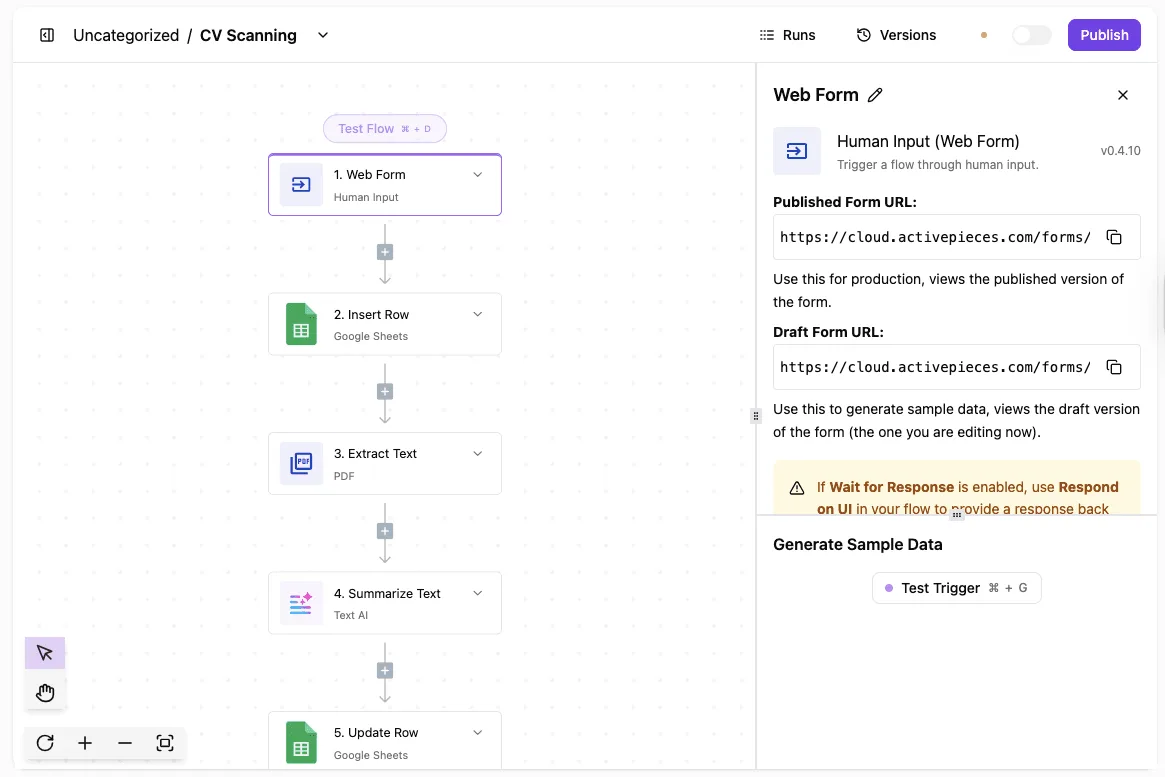
In a production workflow, such as the one managed by the automation tool Activepieces, the model must distinguish between the syntax of a PDF extraction and the semantic intent of the data it contains.
The transition from data ingestion to logical processing is shown in the following workflow.
While the trigger and storage steps are deterministic, this sequence demonstrates that the "Summarize Text" node requires the model to deduce which specific professional experiences meet a hidden criteria. It can't just repeat keywords found in the document.
Why parameter count remains the primary predictor of logic
The density of a model’s neural weights determines its ability to handle complex "if-then-else" scenarios without losing the thread of the initial prompt. In offline deployments, the parameter count acts as the physical ceiling for the model's internal world model.
Smaller models often lack the space required to map specific business rules against conflicting data inputs.
When a model lacks sufficient parameters, it tends to collapse the logic of a complex prompt into a simpler, incorrect task. This leads to a specific failure mode where the model passes a syntax check but fails the business logic, necessitating aggressive retry logic or manual intervention at the platform level.
The role of 'thinking' models like Llama-3 and DeepSeek-R1
Modern open-weights models like Llama-3 from Meta and DeepSeek-R1 from DeepSeek use specialized fine-tuning and chain-of-thought prompting to simulate the deliberate reasoning steps previously exclusive to proprietary APIs.
These models are designed to externalize their "thinking" process, allowing an engineer to inspect the intermediate logic before the final output is generated.
This transparency is critical for debugging agentic workflows. By forcing the model to articulate its steps, these architectures raise the reasoning floor, making them viable for tasks that require self-correction during long-context operations.
The fastest way to settle a shortlist is to try one. Activepieces is free to try, no credit card.
Local models now rival GPT-4 in raw knowledge
Local LLMs vs GPT-4 on knowledge benchmarks
Open-weight models have reached a performance plateau where their internal world knowledge is indistinguishable from frontier proprietary systems during standard inference tasks.
The Massive Multitask Language Understanding (MMLU) benchmark, a test spanning 57 subjects across STEM and the humanities, shows that local deployments no longer require a "knowledge tax" compared to cloud-based APIs.
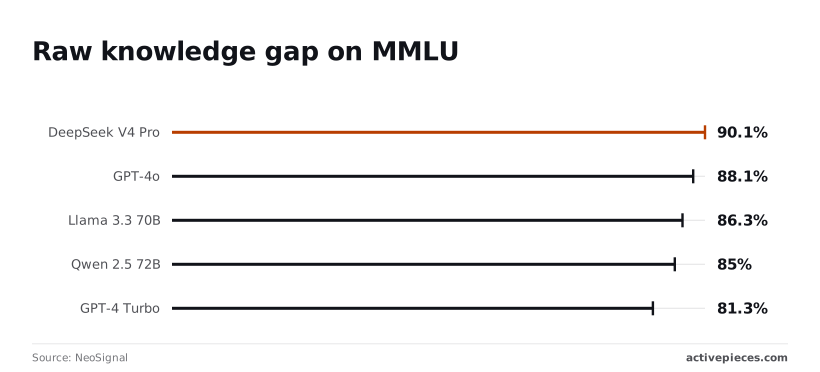
90.1% is the score for DeepSeek V3, an open-weights mixture-of-experts model [NeoSignal], surpassing the baseline world knowledge of the most common enterprise LLMs.
GPT-4o, the flagship multimodal model from OpenAI, maintains a 88.1% [NeoSignal] score, meaning the lead held by closed-source providers has effectively evaporated in terms of raw fact retrieval.
Llama 3.3 70B, the latest high-density model from Meta, hits 86.3% [NeoSignal], which establishes a new benchmark for performance in this category. This allows engineers to swap it into RAG pipelines without losing the ability to interpret complex document metadata.

Qwen 2.5 72B, developed by Alibaba Cloud, delivers 85% [NeoSignal], placing it just behind the current industry leaders, which means it is highly competitive but not yet the definitive state-of-the-art model. It's a viable alternative for multilingual technical documentation where GPT-4 Turbo’s 81.3% [NeoSignal] previously set the ceiling for reliable extraction, so developers now have a new option for improving accuracy in non-English workflows. Developers can now achieve higher accuracy in non-English workflows.
MMLU threshold for business logic tasks
Crossing the 85% threshold on MMLU signifies that a model possesses the prerequisite latent space to handle specialized business logic without constant hallucination.
For a backend engineer, this means a local Llama 3.3 instance can reliably parse internal API schemas or legal definitions that were previously the exclusive domain of GPT-4.
When the delta between a local model and a proprietary one is less than 3%, the bottleneck for the system shifts from the model’s intelligence to the quality of the Tool Definition objects.
Why MMLU scores miss real reasoning ability
High MMLU scores prove a model knows what a thing is. They fail to predict how the model behaves when forced to execute a sequence of function calls over a 128k context window.
When the delta between a local model and a proprietary one is less than 3%, the bottleneck for the system shifts from the model’s intelligence to the quality of the Tool Definition objects.
A model may identify a Python syntax error (high MMLU) but fail to update its internal scratchpad when the error persists across three retry cycles. High-scoring models often ignore system prompt constraints regarding JSON formatting when the conversation history exceeds 10,000 tokens.
Logical steering becomes brittle when a platform’s proprietary wrapper injects hidden safety prompts. These prompts can cause an 86% MMLU model to refuse a valid database query because of a misunderstood keyword.
A platform that resells you a model has effectively decided your AI strategy for you. Activepieces connects directly to the models you choose using your own provider keys, ensuring that every token billed by the LLM vendor appears on your own account rather than being marked up through ours. You can check the Bring-Your-Own-Key availability by tier on the pricing page to see how this differs from platforms that charge a markup on resold tokens.
The hardware tax on high-density logic
Reliable offline reasoning requires a minimum hardware floor that often exceeds standard enterprise workstation specifications.
While a 7B model might handle basic text summarization, the high-density logic needed for nested tool-calling or complex state transitions demands massive Video Random Access Memory (VRAM) to avoid offloading to slower system memory.
The VRAM wall for 70B+ models
Executing GPT-4 class reasoning on-premise necessitates a massive memory footprint to keep the model weights and KV cache resident on the GPU. According to GPUz, a 4-bit quantized Llama-3-70B requires 40 GB of VRAM.

A developer can't run this reliably on a single consumer-grade RTX 4090.
Stepping up to the Qwen-2.5-72B model requires 41 GB of VRAM per GPUz, forcing teams into multi-GPU setups or expensive A100/H100 instances.
For the most demanding Mixture-of-Experts architectures like DeepSeek-V3, the requirement jumps to 376 GB of VRAM according to GPUz, effectively putting it out of reach for standard consumer hardware.
The following table illustrates how these requirements dictate the necessary hardware tier for production-ready inference:
| Model | VRAM (4-bit) | Minimum Hardware Tier |
|---|---|---|
| Qwen-2.5-7B | 8 GB | Entry-level Consumer GPU (RTX 3060/4060) |
| Llama-3-70B | 40 GB | Dual RTX 3090/4090 or Single A6000 |
| DeepSeek-V3 | 376 GB | 8x H100/A100 Node |

This physical barrier means that "running locally" is rarely a desktop-class endeavor for serious agentic workflows.
Balancing quantization against logical coherence
Quantization reduces the precision of model weights to save memory, but aggressive compression often breaks the fragile chain-of-thought reasoning required for business logic. When you squeeze a model down to 4-bit or 3-bit precision, the perplexity increases.

This leads to "hallucinated" JSON schemas or failed tool calls.
A 4-bit model might pass a unit test 90% of the time, but the 10% failure rate usually involves a total collapse of logical constraints that a full-precision model would have caught, rendering the compressed version unreliable for mission-critical reasoning tasks, which means developers cannot trust the system to maintain accuracy in high-stakes environments.
Why small models (8B-14B) still struggle with complex business rules
Small-parameter models lack the internal world model necessary to maintain focus across long context windows or specific "if-then-else" business requirements. While an 8B model is fast, it frequently loses the "needle" in a large prompt.

These smaller units are excellent for single-turn classification, but they lack the "reasoning density" to manage a state machine without constant human intervention or external validation layers.
Bridging the reasoning gap with Activepieces automation
Activepieces provides a structured environment where MoneyGram and FundingSocieties run production automations that compensate for local model brittleness by offloading state management and external tool execution to a deterministic engine.
While a local model might hallucinate the status of a Jira ticket, Activepieces forces the model to interact through defined API blocks. This keeps the "reasoning" tethered to verifiable system states rather than internal weights.
Connecting local Ollama instances to business apps
Integrating a local Ollama instance into a business workflow requires a bridge that can translate natural language intents into authenticated API calls.
Activepieces provides this bridge through its HTTP integration and specialized connectors.
This allows a model running on a local workstation to trigger actions in platforms like Zendesk for ticket updates or Google Sheets for data logging. It can also interact with Slack for internal notifications and PostgreSQL for persistent state storage.
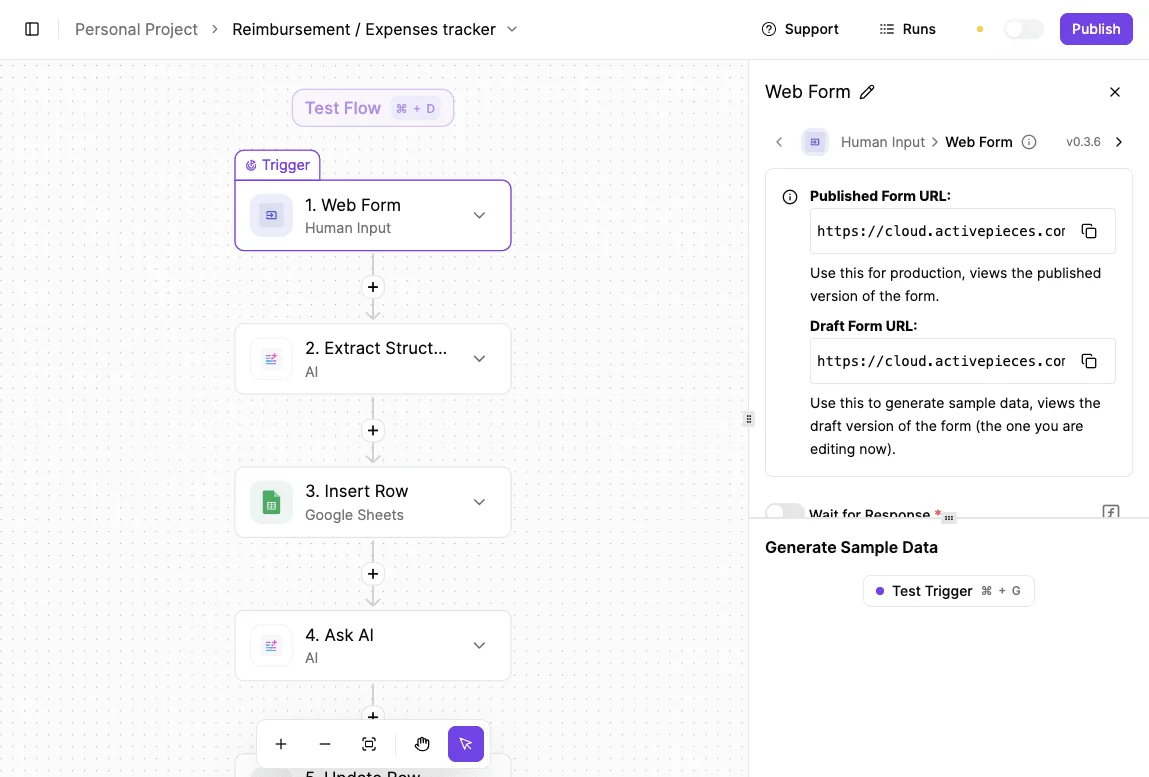
The engine that runs these agents is public code, not a hidden configuration panel. In Activepieces, the logic for retries and state management sits in the MIT-licensed core, where every tool call an agent makes appears in the run trace. You can verify this by matching the Flow Execution Engine in the public monorepo against the step-by-step trace in the run-details UI.
Automating the 'reason-act' loop without cloud dependencies
The "Reason-Act" loop fails when a model loses the thread of a conversation or fails to parse a tool-call schema.
By using Activepieces to handle the branching logic, the engineer can define a flow where the model is only responsible for selecting the next step, while the platform handles the retry logic and error catching.
This structure ensures that if a model provides a malformed JSON response, the workflow hits a pre-defined error branch rather than crashing the entire automation pipeline.
Validating local model outputs through automated multi-step workflows
Local models often struggle with self-correction, necessitating a multi-step validation flow where the output of one model is audited by a second, more specific prompt or a hard-coded regex check.
- The primary model generates a draft response or data transformation.
- A secondary "Critic" step in Activepieces evaluates the output against a specific schema.
- A conditional branch either pushes the data to the destination or routes it back to the model with a correction prompt.
This sequence creates a closed-loop system where the structural integrity of the workflow mitigates the lack of "reasoning density" in smaller models.
Auditing current GPT-4 prompts for reasoning
Auditing your current GPT-4 prompts for 'reasoning depth'
Determining which workflows are candidates for local migration requires isolating prompts where the logic is derived from the structure of the input rather than the internal knowledge of the model.
If a prompt requires GPT-4 to bridge a logical gap not explicitly stated in the context, it possesses high reasoning depth and will likely fail on a smaller model.
Conversely, tasks that follow a strict "if-this-then-that" JSON schema or extract specific entities rely on instruction following rather than deep reasoning, making them the primary targets for local offloading.
Setting up a local benchmarking environment with LM Studio or Ollama
A local benchmarking environment allows you to validate model performance behind your own firewall. To build this, you should deploy the following components.
A model provider like Ollama, which is a tool for managing and serving Large Language Model weights, acts as your local API endpoint.
A prompt evaluation framework such as Promptfoo enables you to run test cases against both your local endpoint and the OpenAI API simultaneously to generate a side-by-side parity report.
A collection of "golden datasets" consisting of your last hundred successful production outputs provides a baseline of what "correct" looks like for your specific business domain.
Identifying the 'low-stakes' logic loops for your first migration
The safest path to local execution starts with utility-grade logic loops where a model failure results in a caught exception rather than a corrupted user experience.
You should prioritize the following three workflow types for your initial transition.
Classification tasks where the model assigns a label to an incoming support ticket are ideal. A misclassification can be easily corrected by a human agent.
Data sanitization routines that format unstructured text into clean Markdown or JSON are also strong candidates, since these outputs are typically validated by a schema parser.
Summarization of internal developer logs is a third option, where the primary goal is brevity for internal review.
Frequently asked questions about offline model performance
Does quantization (4-bit vs 8-bit) kill a model's reasoning ability?
Quantization introduces a non-linear degradation in logic that typically manifests as "hallucinated syntax" in tool-calling schemas rather than a total loss of intelligence.
While 8-bit weights maintain enough precision for stable chain-of-thought processing, dropping to 4-bit often causes the model to skip crucial steps in a multi-stage reasoning chain.
An agent might attempt to parse a database response before the query has actually executed.
This compression reduces the signal-to-noise ratio in the attention mechanism, so a developer must implement stricter output validation and more aggressive retry logic to handle the increased frequency of malformed JSON payloads.
Can a fine-tuned 7B model ever out-reason a general 70B model?
A 7B model fine-tuned on domain-specific traces can outperform a general 70B model only within a narrow, high-density knowledge silo where the larger model lacks specific context.
This narrow excellence comes at the cost of "catastrophic forgetting," where the smaller model loses the broad linguistic heuristics required to handle unexpected edge cases in user intent.
For a production system, this means a 7B model is a reliable choice for a single-purpose worker, such as converting natural language to a specific SQL dialect. It'll fail as a general-purpose orchestrator because it can't generalize across disparate task types.
What hardware is required to run GPT-4 level reasoning locally?
Running models that rival GPT-4’s reasoning density requires massive VRAM overhead to accommodate the large parameter counts and long-context KV caches necessary for complex problem-solving.
High-end consumer GPUs require multiple units to be bridged to provide enough memory for 70B+ models. This ensures the weights don't spill over into slower system RAM.
Dedicated AI workstations equipped with professional-grade cards offer the memory bandwidth required to prevent token generation from slowing to a crawl during deep reasoning tasks.
Unified memory architectures in certain integrated silicon designs allow the model to treat system memory as video memory, which simplifies the deployment of large-scale models without requiring complex multi-GPU sharding.
Related reading
Still comparing
The fastest way to settle it is to build something.
Open source under MIT, so you can self-host the same thing later.
Start free