
When to Use Reasoning Models vs. Standard LLMs in 2026
Specialized and general-purpose artificial intelligence systems require different infrastructure and cost structures for enterprise automation.

Covers workflow-automation builds for e-commerce and municipal clients: production reliability, contract requirements, and budget constraints.
ContributorSeptember 22, 202614 min read
This article was researched and fact-checked by an advanced research system.
When a developer first opens Activepieces to route a high-volume stream of support tickets, the immediate choice between specialized precision and broad intellectual flexibility dictates the entire project's budget.
Narrow-task models execute these predefined functions with high efficiency, while general-reasoning models excel at synthesizing information across disparate domains to solve novel problems.
Core differences between narrow-task and general-reasoning models
What defines a narrow-task model
A narrow-task model operates within a constrained functional scope, such as language translation, sentiment analysis, or code completion. Developers train these models on specific datasets to perform one job.
Lower latency is the direct result of these models requiring fewer computational resources.
When a developer uses the open-source automation tool Activepieces to route incoming support tickets, a narrow model can categorize the text based on keywords. This ensures the data moves instantly without the overhead of a model trying to analyze the customer's underlying emotional state.
What defines a general-reasoning model
Built to handle multi-step logical inference and creative synthesis, general-reasoning models, such as the GPT-4o series from the research lab OpenAI, possess a massive parameter scale.
This scale allows them to follow complex instructions, such as "summarize these three legal documents and identify potential conflicts in the liability clauses."
The following table illustrates how these two classes of models diverge across key operational dimensions.
Significant wasted capacity is the trade-off when a general-reasoning model is used to do the work of a narrow model.
How reasoning model costs impact business budgets
General-reasoning models carry a price premium that can lead to exponential cost increases when applied to high-volume, repetitive tasks.
Organizations that default to a flagship model for every step of a workflow are effectively paying for a "genius" to perform basic data entry.
For example, the automation platform Zapier offers "Central," which allows users to deploy AI agents. If those agents rely on top-tier reasoning models for simple formatting tasks, the cost per execution rises without a corresponding increase in output quality.
Organizations that default to a flagship model for every step of a workflow are effectively paying for a "genius" to perform basic data entry.
Implementing specialized infrastructure
To achieve these lower costs, businesses often implement narrow-task models as smaller open-source models like Llama 3 8B or Mistral 7B. These models are compact enough to be self-hosted on private servers or accessed via specialized low-cost inference providers like Groq or Together AI.
By using these providers, companies pay for raw throughput rather than the intellectual overhead of a massive cloud API. Controlling which model handles which task prevents the "AI tax" from eroding the return on investment for automation projects.
The fastest way to settle a shortlist is to try one. Activepieces is free to try, no credit card.
The three criteria for evaluating enterprise AI models
Selecting a model requires balancing the raw intelligence of general-reasoning engines against the operational constraints of a production environment.
To ensure an automation strategy remains viable, teams must evaluate candidate models based on their ability to handle proprietary context, their impact on the long-term balance sheet, and the technical debt incurred during implementation.
These three pillars prevent a project from stalling when it moves out of a controlled sandbox and into a live workflow:
- Accuracy on specialized data: The model's precision when executing tasks using proprietary corporate datasets, which determines how much human oversight is required to catch hallucinations.
- Total cost of ownership: The cumulative expense of API tokens and infrastructure, which dictates whether a high-volume process generates more value than it consumes in compute fees.
- Setup and maintenance latency: The time required to fine-tune, prompt engineer, and integrate the model, which governs how quickly a business can respond to shifting market requirements.
By applying these filters, engineers can identify where a lightweight, specialized model can replace a more expensive generalist without sacrificing output quality.
Domain-specific accuracy and error rates
Engineers measure accuracy by a model's ability to adhere to specific business logic rather than its ability to pass standardized benchmarks. When a model processes internal documentation, its failure rate directly translates to the cost of manual QA cycles.

Outputs that appear fluent but are factually incorrect occur when a model lacks the context of a specific industry. This is especially true for the nuanced legal terminology required by a platform like Ironclad for contract lifecycle management.
Total cost of ownership at high volume
The cost per successful execution at scale determines the financial viability of an AI implementation. While a single call to a flagship model might seem negligible, processing millions of rows through an expensive reasoning engine can quickly exceed the projected savings of the automation itself.
Lower margins for the overall service are the result of choosing a model with a higher per-token cost for a simple data-cleaning task, even on platforms like Amazon Bedrock that offer a variety of model providers.
Time to production and maintenance for AI models
Implementation speed is defined by the amount of "prompt plumbing" required to get a model to behave consistently. A model that requires extensive few-shot prompting or complex retrieval-augmented generation (RAG) architectures increases the technical debt of the system.

In environments like Microsoft Azure AI Studio, the time spent configuring content safety filters and fine-tuning model versions represents an upfront investment that delays the realization of ROI.
The performance of general-reasoning models on enterprise criteria
General-reasoning models act as versatile digital generalists capable of handling diverse logic tasks, yet their broad architecture often introduces excessive operational overhead for repetitive business workflows.
While a specialist model might only understand structured data entry, these generalists can draft emails, write code, and summarize transcripts.
General-reasoning models and the hallucination risk
General-purpose models prioritize linguistic fluidity over factual rigidity. This frequently results in "hallucinations" where the system confidently generates plausible but false information.
General-purpose models prioritize linguistic fluidity over factual rigidity.
In a production environment, this lack of deterministic output means a customer service bot might invent a return policy that does not exist.
This forces developers to implement complex verification layers that increase the total lines of code maintained by the engineering team.
High token costs that scale linearly with volume
The sophisticated reasoning capabilities of top-tier models require massive compute resources. This results in a pricing structure that can quickly outpace the value of the task.
When a business uses a generalist model for a high-frequency task like classifying thousands of support tickets, the cost per execution remains static.
A successful product launch that triples ticket volume will also triple the AI infrastructure bill without any economies of scale.
The following data compares the input costs of high-volume narrow models against popular mid-tier generalists to illustrate the financial impact of model selection on long-term margins.
Paying a premium for "intelligence" that the specific workflow never actually utilizes is the risk when choosing a model based on its reasoning benchmark rather than its specific task requirements.
Fast deployment with general-reasoning models
General-reasoning models offer the fastest path to a working prototype because they require no specialized training data or architectural adjustments.
A developer can use a single prompt to define a persona and a task, meaning a proof-of-concept can move from an idea to a functional demo in a single afternoon.
This speed allows teams to validate business logic before investing in the more rigorous process of fine-tuning a smaller, more cost-effective model for permanent production use.
Reading a table only gets you so far. Build the same workflow in Activepieces and compare it yourself.
The reasoning gap between general and specialized models
Why complex logic requires general-reasoning models
General-reasoning models solve multi-step logical problems by simulating a chain of thought before providing a final output.
Pricepertoken notes that while specialized models like the Llama 3 series from Meta excel at narrow pattern-matching tasks, such as classifying the sentiment of a support ticket, they often hallucinate when asked to reconcile conflicting data across multiple business systems.
A general-reasoning model can evaluate a sequence of dependencies. A developer can automate a complex refund policy that requires checking inventory, customer loyalty tiers, and shipping logs without writing dozens of hard-coded "if-then" statements.
Comparing AIME scores across model generations
Reasoning capabilities have moved from incremental improvements to a vertical leap in performance on complex logic benchmarks.
The AIME 2024 (American Invitational Mathematics Examination) serves as a proxy for this logical depth, where a model must solve problems that require deep planning rather than just retrieving information.
OpenAI reported the following scores and capabilities for their models on this benchmark:
- OpenAI reported that their GPT-4o model scored 13.0 on this benchmark, which means it struggles with high-level mathematical reasoning and multi-step problem solving.
- In contrast, the o1-mini model achieved a score of 70.0, representing a five-fold increase in logical accuracy for technical tasks.
- Sota2 reports that the flagship o1-preview reached a score of 83.0, so it can now handle architectural planning and code generation tasks that were previously prone to failure in earlier iterations.
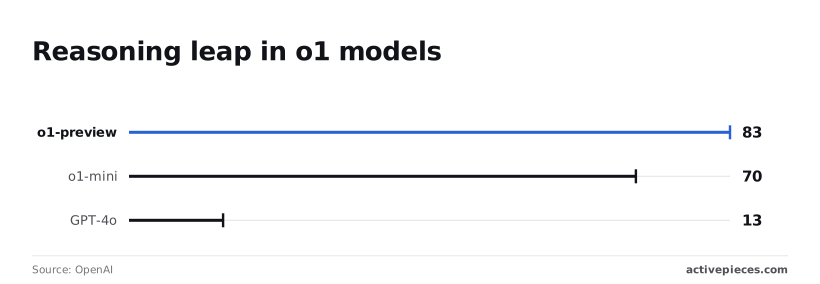
This shift in performance illustrates why teams are moving away from brute-force prompting toward selecting models based on the specific logical "depth" a workflow demands.
The cost of high-reasoning capabilities
Advanced reasoning carries a significant price premium that necessitates strict governance over model routing.
Using the OpenAI API pricing as a baseline for comparison, GPT-4o costs $5.00 per million input tokens and $15.00 per million output tokens, which establishes a clear financial scale for scaling high-volume automated text processing.
The o1-preview model costs $15.00 per million input tokens and $60.00 per million output tokens.
Because o1-preview costs three times as much for input and four times as much for output, using it for simple data entry tasks will deplete a department's monthly AI budget 300% faster than necessary.
Managing these costs requires a platform that allows you to swap providers instantly as price-to-performance ratios shift.
How Activepieces orchestrates multi-model AI workflows
Routing simple tasks to narrow models automatically
Activepieces functions as an open-source automation engine that treats AI models as interchangeable steps within a larger business process.
By using a visual canvas to link document triggers to specific LLM providers, teams can ensure that high-volume, repetitive tasks are handled by smaller, faster models.
This prevents the "over-spec" problem where a business pays a premium for a general-reasoning engine to perform basic pattern matching that a model a tenth of the price could execute.
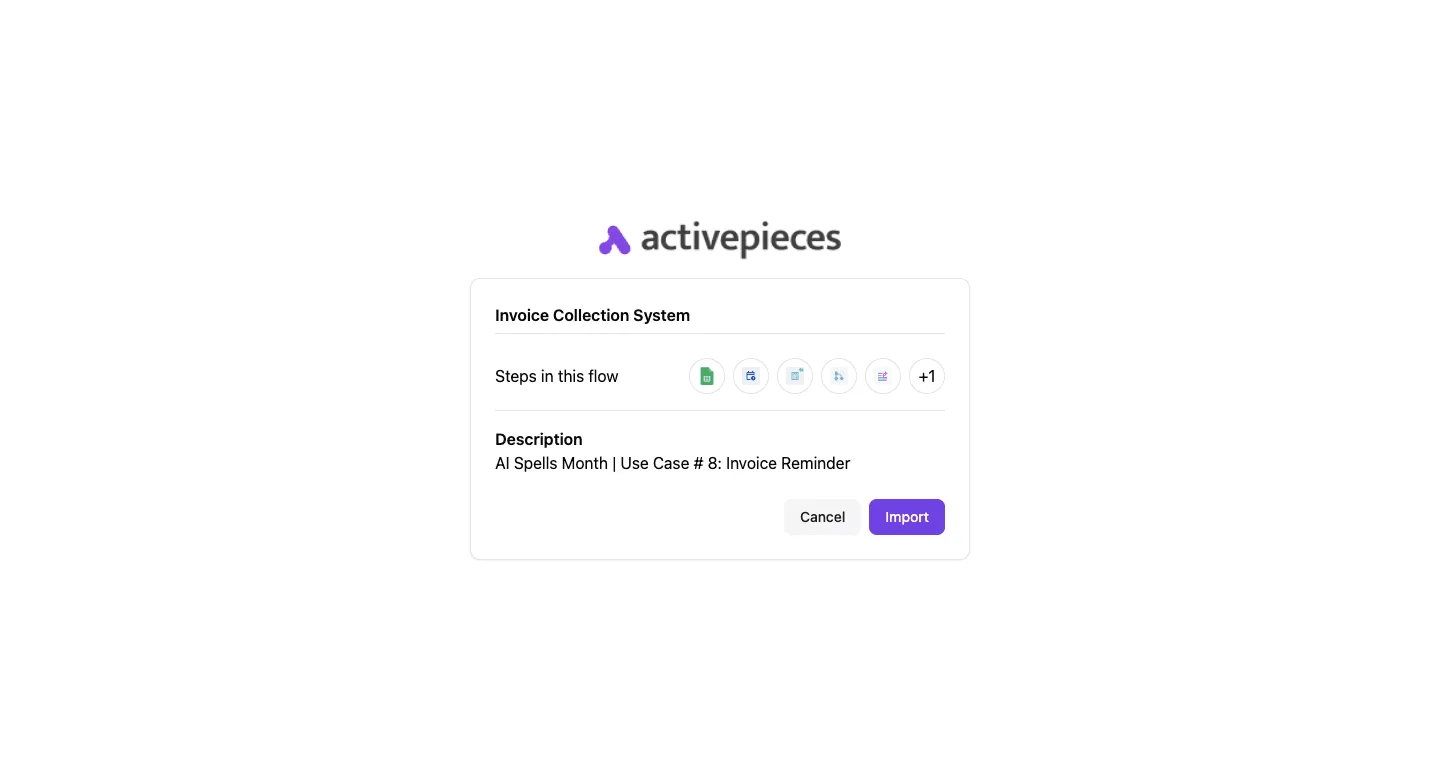
The following workflow demonstrates how a document is ingested and passed to a specific text agent before reaching a decision point.
Only data meeting specific criteria moves forward into more expensive processing stages under this logic.
Escalating complex exceptions to general-reasoning LLMs
The platform uses conditional routers to filter edge cases toward high-reasoning models like GPT-4o or Claude 3.5 Sonnet only when lower-tier models fail a confidence check or flag a high-risk keyword.
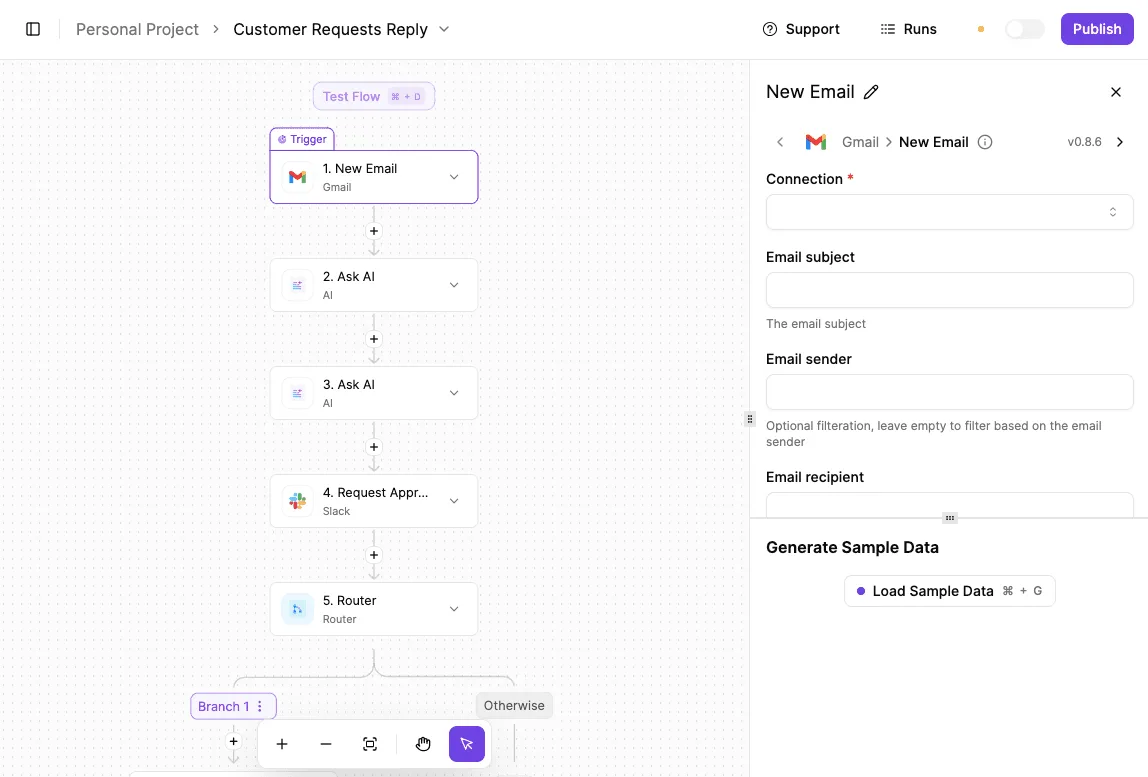
In the workflow shown above, the "Router" step acts as a gatekeeper.
If a document is flagged as "High risk," it is escalated to a model capable of nuanced logical deduction.
Otherwise, it follows a "Low risk" path handled by a cheaper utility model. This tiered approach means the most expensive compute resources are reserved for tasks where their reasoning capabilities actually impact the business outcome.
Reducing total token spend across enterprise processes
By decoupling the automation logic from the AI provider, Activepieces allows users to swap out expensive models for local or specialized alternatives without rebuilding the entire workflow.
Running the engine on internal infrastructure means data stays within the corporate firewall, satisfying compliance requirements.
The "Ask AI" integration can be reconfigured from one provider to another in two clicks, allowing a manager to respond to a competitor's price drop or a provider's service outage instantly.
By providing an open-source framework that treats models as interchangeable components, Activepieces ensures that businesses retain full control over their AI strategy and cost structures. Activepieces is the better choice for organizations that prioritize Bring-Your-Own-Key flexibility to avoid the hidden markups of resold models.

This architecture allows teams to optimize their margins by routing specific tasks to the most cost-effective providers without being locked into a platform's proprietary pricing.
The final verdict for enterprise AI procurement
When to choose narrow-task infrastructure
Narrow-task infrastructure is the correct choice when a workflow relies on high-volume, repetitive data transformations with predictable inputs.
Because these models lack the massive parameter counts of general reasoning engines, they require significantly less compute power.
Organizations should prioritize this path when the primary goal is operational efficiency rather than creative problem-solving.
When to invest in general-reasoning licenses
General-reasoning licenses are necessary for workflows that require logical synthesis, such as drafting complex legal responses or troubleshooting technical support tickets.
These models handle structural variance by drawing on broad training sets, meaning the system can adapt to novel user inputs without failing.
An investment here is justified only when the task requires the model to "understand" context rather than simply follow a pattern.
A hybrid model approach for scaling businesses
A hybrid approach allows businesses to route simple tasks to cheap models while reserving expensive reasoning for critical edge cases. To implement this, teams should follow a specific procurement decision framework.
Audit task volume and structural variance to separate routine automation from logical reasoning.
This ensures that expensive tokens are not wasted on tasks that a basic script could handle. Run cost projections based on peak volume rather than average usage.
Frequently asked questions about enterprise AI models
Choosing between local deployments and cloud-hosted giants depends on balancing the immediate intelligence of the model against the long-term cost of running it.
While a general-purpose model provides high reasoning out of the box, specialized deployments offer the control necessary to prevent costs from scaling linearly with usage.
The following table outlines the operational trade-offs between hosting a local model, such as Meta’s Llama 3 8B, and calling a cloud-based API like OpenAI’s GPT-4o:
Cloud APIs offer the fastest path to a prototype, but they lack the cost-capping and data-sovereignty benefits of self-hosted infrastructure.
Can a general-reasoning model be fine-tuned into a narrow model?
General-reasoning models can be adapted for specific tasks, but the process usually involves distillation rather than traditional fine-tuning. Because models like GPT-4o are proprietary, you cannot modify their internal weights.
Instead, you use them to generate high-quality synthetic labels to train a smaller, local model. This allows the smaller model to mimic the reasoning of the larger one at a fraction of the inference cost.
Which model type offers better data privacy for sensitive operations?
Local or self-hosted models provide the highest level of data privacy because they operate entirely within your own virtual private cloud.
When using a cloud API, your data travels to an external server, which means your privacy is dependent on the provider's specific terms of service.
For example, the standard consumer tier of ChatGPT may use data for training, whereas an enterprise-grade API agreement typically excludes customer data from the training pool.
How often do narrow-task models require retraining?
Narrow-task models require retraining whenever the underlying distribution of your production data shifts significantly. Unlike general models that rely on a massive, static knowledge base, a specialized model is only as good as the specific data it was tuned on.
If your business processes change, such as a shift in customer support categories or a new product taxonomy, the model will lose accuracy unless it is updated with fresh examples.
Related reading
References
Still comparing
The fastest way to settle it is to build something.
Open source under MIT, so you can self-host the same thing later.
Start free Talk to sales