Best Generative AI Tools for 2026: Ranked and Compared

Sep 30, 202615 min read
As we look toward the landscape of 2026, the integration of artificial intelligence into daily workflows has transitioned from a luxury to a fundamental necessity for competitive businesses.
Selecting the right generative AI tools requires a nuanced understanding of how these models interact with existing data structures, whether you are utilizing Activepieces to automate complex logic between your favorite apps or deploying standalone LLMs for creative content generation.
This year’s rankings prioritize multimodal capabilities, real-time processing speeds, and the ethical frameworks governing data privacy.
From advanced coding assistants that predict entire architectural shifts to image generators capable of photorealistic consistency, the following guide breaks down the top performers that are currently defining the next era of digital productivity.
The Best Generative AI Tools for Business
Selecting specialized models for distinct cognitive tasks is the foundation of the most effective AI stack for 2026. You cannot force a single engine to handle every operational edge case.
While a generalist chat interface is a starting point, enterprise-grade reliability requires you to chain specific capabilities (such as long-horizon reasoning or real-time transcription) into a unified execution layer.
Top picks by category
The following rankings and model designations represent the current market leaders and software releases available today in 2026. These evaluations are based on verified capabilities of software you can access and purchase right now.
Model specialization now defines business utility. Reserve high-compute reasoning for complex logic while using lightweight models for high-volume interactions.
Model specialization now defines business utility.
When you face demanding reasoning and long-horizon agentic work, these are handled by Claude Fable 5.1, while Gemini 3.8 Flash is the flagship for your coding and enterprise workflows. For cost-sensitive, high-volume text workloads, GPT-6 Luna provides a sustainable scaling path.
Brand assets requiring the most capable image generation and editing are managed by GPT-Image-2.5 Sunburst, whereas Veo 3.1 is utilized for cinematic video generation.
Flagship-level complex coding is the domain of GPT-6 Astra, while Codestral focuses specifically on code completion tasks.
Activepieces exposes every connected integration as an agent tool via a per-project MCP server, allowing Claude or ChatGPT to reach your internal apps without a second migration.
By registering a integration once, the same action runs as a step in a flow or a tool schema for an agent, which is how teams at MoneyGram and Moneypenny maintain a single source of truth for their automation logic.
How we verified these rankings
Our selection reflects the current market concentration reported by 7T AI, where the ecosystem has matured into a four-tier architecture. 51 AI Applications currently support the market.
34 Model APIs support these, providing the raw intelligence necessary for your custom integrations. At the foundational level, 11 Training Infrastructure providers maintain the hardware, while only 4 Orchestration platforms exist to manage the logic between tiers.
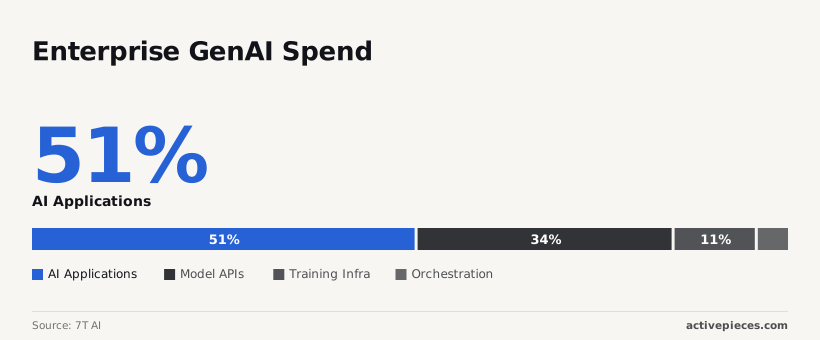
Because orchestration is so scarce, the choice of how you link models is more critical to your system stability than the specific model API you select.
The fastest way to settle a shortlist is to try one. Activepieces is free to try, no credit card.
Comparison of Leading Generative AI Platforms
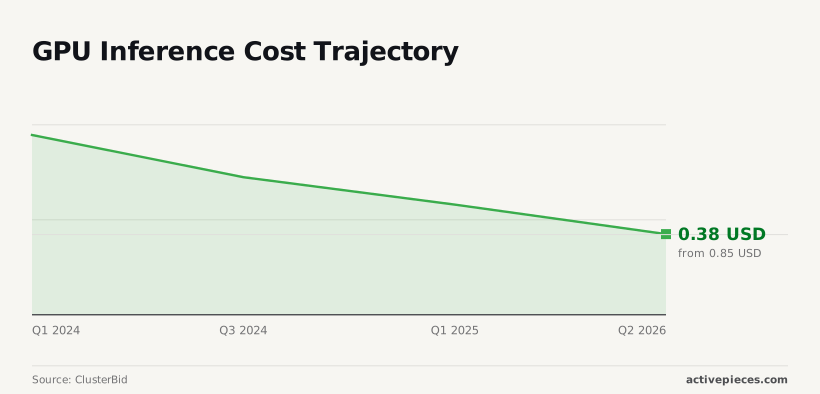
Specific operational constraints must drive your model selection. According to ClusterBid, the cost of inference has dropped from 0.85 per million tokens in Q1 2024 to 0.38 by Q2 2026.
Because orchestration is so scarce, the choice of how you link models is more critical to your system stability than the specific model API you select.
Over 55% is the amount by which the financial barrier to high-volume agentic workflows has decreased, making advanced automation accessible to a significantly broader range of businesses, which means companies can now scale complex operations without prohibitive infrastructure costs.
While basic access via a Google Account remains $0/month, professional tiers like Google AI Plus at $4.99/month provide 2x higher usage limits, so power users can sustain intensive tasks without hitting service caps.
The following table differentiates the primary platforms by their functional specialization and cost structures as of late 2026.
| Platform | Primary Strength | Monthly Cost | Technical Limit | Ideal User |
|---|---|---|---|---|
| ChatGPT | Multimodal Versatility | $20/mo | Rate-limited GPT-6 Astra access | Generalist Power User |
| Claude | Long Context Reasoning | $17/mo | Up to 1M token context window on Opus 5.5 (varies by model) | Legal & Technical Researchers |
| Midjourney | Visual Aesthetics | $30/mo | GPU hour-based rendering caps | Creative Directors |
| Activepieces | Workflow Automation | See Pricing | Credit-based usage on all plans | Systems Architects |
Prices and plan limits checked against docs.claude.com and claude.com and openai.com and gemini.google on September 30, 2026.
Selecting a platform solely on price risks ignoring architectural limitations. While the 0.65 rate in Q3 2024 felt like a floor, the 0.52 rate seen in Q1 2025 proved that efficiency gains in models like Gemini 3.8 Flash continue to redefine the "cost of thinking."
OpenAI ChatGPT for Multimodal Reasoning
OpenAI maintains its position in the orchestration stack by providing high-reasoning anchors like GPT-6 Astra. These anchors are the final decision-makers in your complex, multi-step autonomous chains.
Across 56 tested model configurations, the LiveBench Reasoning Scores (Sept 2026) show GPT-6 Astra at 92.7% vs., leaving a narrow margin for competitors to bridge in future iterations.
Claude Fable 5.1 at 91.7%, placing it just a fraction behind the top-performing model, which means the gap in cognitive capability between these industry leaders is effectively negligible for most practical applications.
Logical conflicts that stymie lesser models are resolved by GPT-6 Astra, which remains the benchmark for the industry.
Current pricing and rate limits (Verified May 2026)
Context window depth determines how you access these reasoning capabilities, dictating how much historical workflow data an agent can process.
According to the OpenAI Pricing Page, the Free tier has a GPT Instant total context window of 27K, limiting its use to short, stateless tasks.
Doubling this capacity, 54K is the context window for the Go plan, which allows for more complex document analysis or extended chat histories without the model "forgetting" earlier constraints.
You'll typically bypass these interface-based limits by utilizing GPT-6 Luna for high-volume background tasks where cost-efficiency is prioritized over the absolute reasoning peaks of the Astra model.
Advanced Voice and Vision capabilities
Multimodal integration allows your systems to move beyond text-based triggers by using GPT-Realtime-2 to interpret visual UI changes or spoken instructions.
Native tool use is built into GPT-Realtime-2, a reasoning model that processes audio and visual inputs to execute API calls. GPT-Image-2.5 Sunburst is the primary engine for generating and editing technical diagrams or visual assets within your workflow.

GPT-Live-Transcribe is a low-latency speech-to-text service used for monitoring live customer service feeds for specific compliance keywords.
When systems require high-fidelity output, they often pair these with Claude Fable 5.1 for long-horizon planning.
Anthropic Claude for Long Context and Precision
Anthropic prioritizes massive information ingestion and safety-oriented reasoning, making it the primary choice for auditors managing complex compliance documentation. The Claude 5.5 family is designed for environments where a hallucinated variable results in a production outage.
Context window benchmarks and costs
The limits of the context window define large-scale data ingestion, determining how much historical data a system can "remember" during a single session.
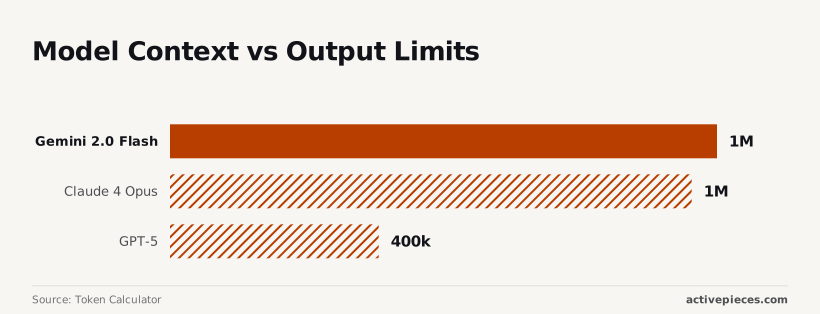
According to the Token Calculator, Gemini 2.0 Flash supported 1,048,576 tokens, allowing a system to analyze approximately 1,500 pages of logs in one pass.
Analyzing an entire codebase to identify architectural flaws was possible with Claude 4 Opus, which followed closely with 1,000,000 tokens. In contrast, GPT-5 offered 400,000 tokens.
Accessing these capabilities depends on the subscription tier selected at Claude.com:
- Free: $0 per month, intended for basic testing and low-volume queries.
- Pro: $17 per month with an annual subscription, providing higher usage limits for professional workflows.
- Pro Annual: $200 billed upfront, reducing the effective monthly cost for your team.
Artifacts and collaborative coding features
To separate generated code or documents from the conversational thread, the Claude interface utilizes a dedicated side-window feature called Artifacts. This UI choice means your developers can view a live React component or a structured JSON schema without scrolling through chat history.
Maintaining state across multi-step planning tasks is how Claude Fable 5.1 leverages this structure for long-horizon agentic work. When a project demands intensive knowledge work, Claude Opus 5.5 is the primary engine for long-running agentic coding.
Reading a table only gets you so far. Build the same workflow in Activepieces and compare it yourself.
Google Gemini for ecosystem integration
Google has positioned Gemini 3.8 Flash as the premier choice for organizations already deeply embedded in the Workspace ecosystem. Its native ability to bridge the gap between unstructured chat and structured enterprise data makes it a formidable competitor for internal business operations.
Native workspace and cloud connectivity
Gemini excels at cross-referencing information across your entire corporate suite without requiring manual data exports. It can pull real-time data from Sheets, summarize long email threads in Gmail, and draft project proposals in Docs within a single unified interface.
This deep integration reduces the friction of context switching. When an agent needs to verify a meeting time in Calendar while drafting a response in Chat, Gemini handles the cross-app logic natively.
Performance in high-volume coding
For developers, Gemini 3.8 Flash offers a massive context window that allows for the ingestion of entire repositories. This makes it particularly effective for legacy code modernization and large-scale refactoring projects where the model must understand thousands of interconnected files.
The speed of the Flash model ensures that code completions and architectural suggestions appear in real-time. This efficiency is why many engineering teams choose it for high-volume, iterative development cycles.
Zapier Central for managed agentic behavior
Zapier has evolved into a managed environment for building autonomous agents. It provides a low-friction entry point for businesses that want to experiment with AI agents without managing their own infrastructure.
Pre-built agent templates and logic
The platform excels at providing a guided experience for non-technical users to deploy functional agents. By offering a library of pre-configured templates, Zapier Central allows a marketing team to launch a lead-nurturing agent that monitors email and updates a CRM with minimal setup time.
Deep integration with legacy triggers
Zapier’s primary strength remains its massive library of legacy connectors. For organizations that rely on older SaaS tools without robust modern APIs, Zapier often provides the only reliable way to trigger an AI workflow from a specific event.

Activepieces for AI Workflow Orchestration
Activepieces enables operations teams to move from isolated chat sessions to production-grade autonomous systems by running 735+ integrations alongside your chosen AI models under central governance.
The platform is the connective tissue that prevents "shadow AI" from becoming a collection of unmonitored browser tabs. Every model execution is logged, governed, and integrated into your existing business logic.
Automating LLM chains without code
Workflow reliability depends on your ability to swap specialized models into specific steps without rewriting API calls.
Activepieces runs your chosen models and agents across your own apps and data, allowing you to route a high-reasoning task to Claude Fable 5.1 for complex logic while maintaining an MIT-licensed core for transparency.
Judgment and deterministic rules run on the same engine in Activepieces, placing agent steps alongside fixed automation steps in one flow definition. You can verify this in the run trace, where a single execution log covers the entire path.
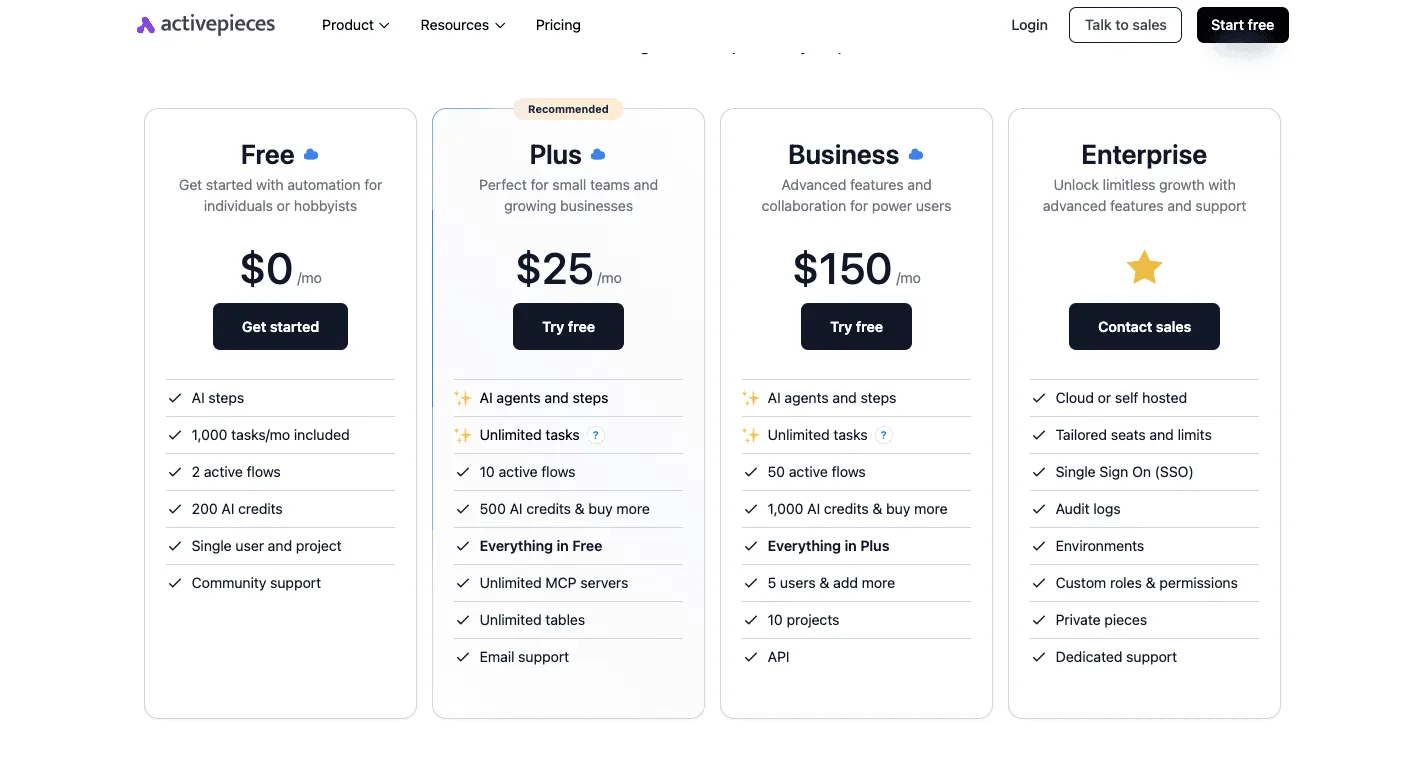
Self-hosting vs Cloud pricing (Verified May 2026)
Your requirement for data residency determines the choice between deployment models.
Cloud Hosted is a managed tier. It removes the burden of infrastructure patching and scaling, making it the preferred choice for your team if you need to deploy agents across standard SaaS applications immediately.
Self-Hosted (Docker/Kubernetes) is a deployment method. It provides the network isolation necessary for regulated industries, allowing the orchestrator to run within your own firewall to prevent internal data from traversing external servers.
By 2026, the enterprise value of the self-hosted option lies in its support for local LLM integrations, which ensures that sensitive proprietary data never leaves your private cloud environment.
By unifying the architecture of its 735+ connectors with the Model Context Protocol, the platform ensures that every integration functions natively as an agent tool.
Activepieces is the better fit for operations teams who require a production-grade environment where the same pieces used in standard flows are immediately available to autonomous AI agents.
This architectural consistency provides a level of governance and extensibility that makes it the superior choice for scaling reliable, tool-augmented AI workflows.
Midjourney and GPT-Image-2.5 Sunburst for Visual Asset Production
Visual production tools in 2026 serve as the primary engine for high-velocity marketing and rapid prototyping, moving beyond simple image generation into structured asset management.
| Feature | Midjourney v8 | GPT-Image-2.5 Sunburst |
|---|---|---|
| Primary Integration | Discord-based or Web Gallery | ChatGPT and OpenAI API |
| Prompt Logic | Parameter-heavy (stylize, chaos, aspect ratio) | Natural language descriptive |
| Output Control | Region variation and 'Style Reference' | Iterative conversational refining |
Commercial licensing and usage rights
Ownership of AI-generated assets remains tied to the specific subscription tier. Midjourney v8 grants commercial usage rights only to paid subscribers.
When accessed via the OpenAI API or ChatGPT Enterprise, GPT-Image-2.5 Sunburst is the source of ownership for you. This allows for the redistribution and sale of the generated works. However, neither platform is a blanket guarantee against copyright infringement claims.
Consistency and brand-style training
Maintaining a coherent visual identity requires tools that can replicate specific aesthetics across multiple generations.
Midjourney v8 utilizes 'Style Reference' (sref) codes, which allows you to lock in a specific color palette and texture across a whole series of product shots. Effective for rapid prototyping, GPT-Image-2.5 Sunburst relies on the underlying reasoning of the model to maintain context.
Deploying Generative AI Tools on Monday Morning head
Operationalizing a multi-model stack requires an immediate transition from experimental playgrounds to governed infrastructure. This allows your Chief Information Security Officer (CISO) to maintain oversight of every data egress point.
The Monday Morning Rollout:
- Audit data permissions
- Establish a centralized API gateway
- Define 'Human-in-the-loop' checkpoints
- Launch a pilot orchestration flow.
Auditing your current API spend
Identifying every shadow AI instance is the first step toward preventing fragmented data silos. When your developers use personal API keys for tasks in Claude Opus 5.5 or Gemini 3.8 Flash, you lose the ability to log prompts or enforce data retention policies.
An audit reveals where redundant subscriptions exist and where sensitive customer data may be flowing into models without enterprise-grade privacy agreements.
Setting up a centralized AI gateway
A centralized gateway is the single enforcement point for security policies, rate limiting, and model routing across your organization.
By funneling all requests through a service like Kong or Tyk, your IT leads can rotate keys without breaking local environments. They can also swap models (switching from GPT-6 Astra to Claude Fable 5.1) without rewriting application code.
PII masking and cost tracking happen at the infrastructure level under this architecture.
Frequently asked questions
Which AI tool has the best data privacy for enterprise?
Enterprise privacy depends on the specific legal agreement and deployment tier rather than the brand name of the tool.
Regional data residency options are provided by Microsoft Azure OpenAI Service. An auditor can verify that data never leaves a specific geographic jurisdiction.
Google Cloud Vertex AI has VPC Service Controls, so your security team can create a network perimeter that blocks all egress to the public internet.
Can I use these tools for HIPAA-compliant tasks?
You can use AI tools for protected health information only if the provider signs a Business Associate Agreement (BAA) and you configure the implementation to meet administrative safeguards.
Amazon Bedrock allows for HIPAA-eligible workloads because it doesn't store user inputs by default, so no persistent record of patient data remains on their servers.
Anthropic offers BAA support for Claude Fable 5.1 and Claude Opus 5.5 on their enterprise plans, which ensures the vendor accepts legal liability for data handling. Using a model via a standard API without a signed BAA is a direct violation of regulatory standards.
What is the difference between an LLM and an AI orchestrator?
An LLM is the engine that generates text or code, while an orchestrator is the chassis and wiring that connects that engine to your actual business data.
| Component | Function | Examples |
|---|---|---|
| Large Language Models | Process prompts and return predictions based on their training data. | GPT-6 Astra, Gemini 3.8 Flash |
| AI Orchestrators | Manage the logic, such as fetching a customer’s recent history from a database before sending it to the model. | Activepieces, LangChain |
| Specialized Agents | Functional extensions that execute specific tasks under the direction of the orchestrator. | Gemini Deep Research, Computer Use |
Related reading
References
Still comparing
The fastest way to settle it is to build something.
Open source under MIT, so you can self-host the same thing later.
Start free Talk to sales