
Insurance Policy AI Assistant: Build a Private Workflow
Insurance policy search workflows rely on encrypted data pipelines and automated triggers to protect sensitive information during AI retrieval.

Covers build-vs-buy decisions for workflow automation: engineering opportunity cost, unit economics, and runway impact.
ContributorSeptember 25, 202614 min read
This article was researched and fact-checked by an advanced research system.
Building a secure AI insurance policy search workflow requires a meticulous approach to data handling and system architecture. To begin, developers must establish a robust pipeline that can ingest diverse document formats while maintaining strict encryption standards.
By utilizing an automation framework, such as when you connect your internal databases using Activepieces to trigger specific search queries, teams can ensure that sensitive policyholder information remains protected throughout the retrieval process.
Once the data is indexed, integrating a large language model allows for natural language queries, enabling agents to find specific clauses or coverage details in seconds.
Security must remain the priority, necessitating the implementation of role-based access controls and comprehensive audit logs to track every interaction within the system. Ulti
A secure AI insurance policy search workflow is a specialized retrieval architecture that utilizes private, custom-integrated models to query sensitive policy data without exposing it to third-party platform providers.
THE ARTICLE:
What AI policy access means for insurance compliance
Functioning as a Retrieval-Augmented Generation (RAG) system, AI policy access in insurance queries internal underwriting and claims guidelines without exposing sensitive data to the model’s permanent memory.
By acting as a temporary processing engine rather than a storage vault, the Large Language Model protects the firm's proprietary risk assessment logic from leaking into the public domain.
Retrieval fetches specific excerpts from a policy document at the moment of a query. This prevents the model from permanently absorbing trade secrets into its weights.
While training a model embeds information into its neural structure forever, RAG allows an insurer to swap out outdated policy documents instantly. The AI doesn't generate advice based on expired regulatory frameworks.
Why public LLMs fail insurance privacy standards
Because publicly hosted models often use input data to improve future iterations, a high-risk scenario is created where one firm’s confidential claims data could appear in a competitor’s prompt completion.
Using an open-source workflow orchestrator like Activepieces to manage these data flows allows teams to keep their PII within a private cloud.
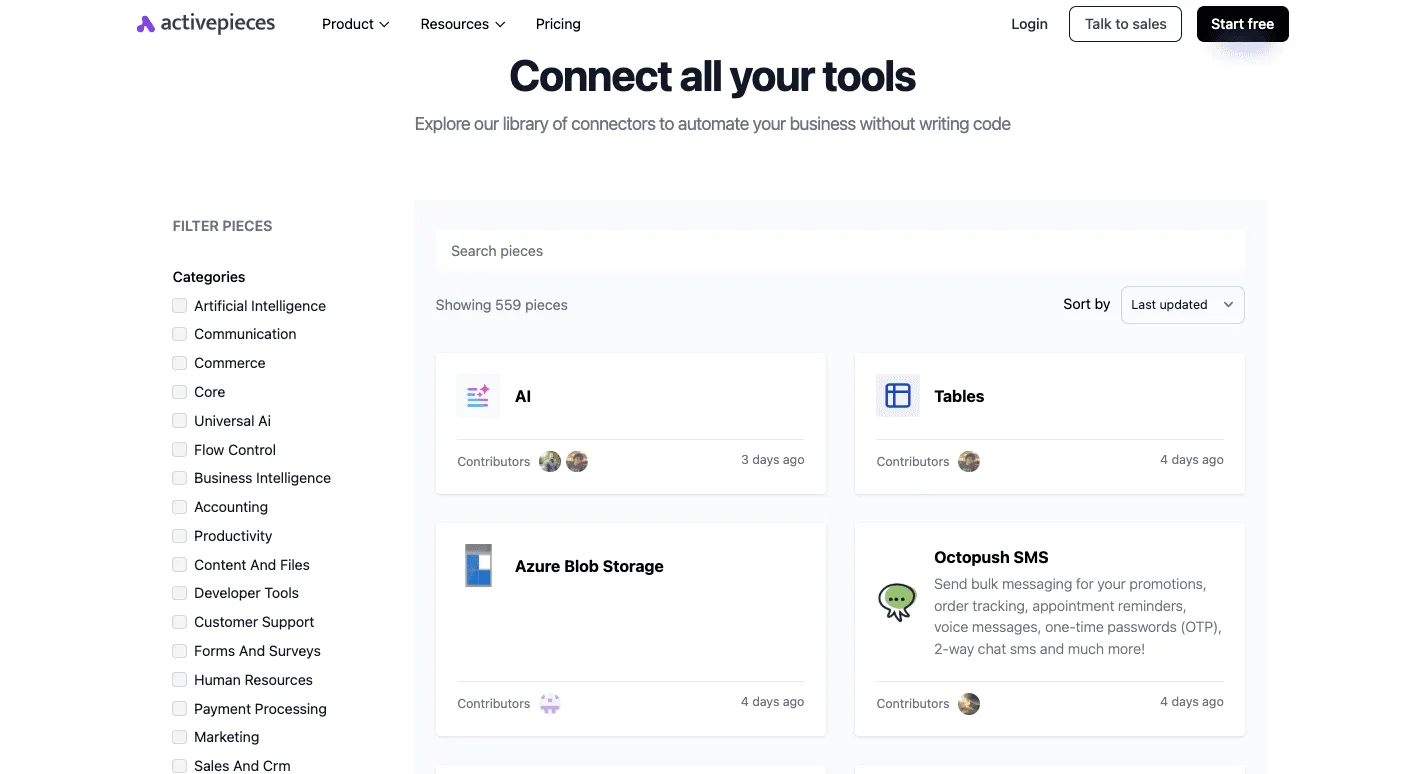
To maintain a clear audit trail for every data touchpoint, compliance officers rely on specialized storage systems called vector databases that convert text into mathematical coordinates. They allow the system to find policy clauses based on meaning rather than exact keywords.
Underwriters find relevant exclusion clauses even if the search term uses different terminology than the contract, thanks to this semantic search capability. The LLM receives only the most relevant snippets of a document, which reduces the cost of every API call.
By ranking search results by mathematical similarity, the system provides a verifiable metric for why the AI chose a specific policy justification.
Everything below works on Activepieces' free plan. Start without code or a credit card.
The scale of the insurance data challenge
The profitability of automated underwriting hinges on the system's ability to ingest massive document volumes without human intervention. While vector similarity provides the metric for retrieval, the sheer density of the underlying data determines whether your compute costs scale linearly or exponentially.
The profitability of automated underwriting hinges on the system's ability to ingest massive document volumes without human intervention.
Typical insurance policy document length
100 pages is the length a standard commercial package policy often reaches, as noted by Sonant. This means a single customer file can exceed the context window limits of cheaper, resold LLM tiers.

Sonant notes that even a high-end homeowners policy typically spans 60 pages. A simple "read and summarize" prompt will frequently truncate critical endorsements or exclusions.
When platforms force you into their proprietary black-box models, you lose the ability to implement custom chunking strategies. These strategies parse 100-page documents into searchable, high-fidelity fragments.
The cost of manual insurance policy review
The bottleneck of manual search
Eight minutes is the average time a human adjuster takes to locate a specific sub-limit within a commercial stack, making manual document review a significant drain on runway.
This friction creates a bottleneck that prevents a firm from increasing its policy-per-adjuster ratio, effectively capping monthly recurring revenue growth.
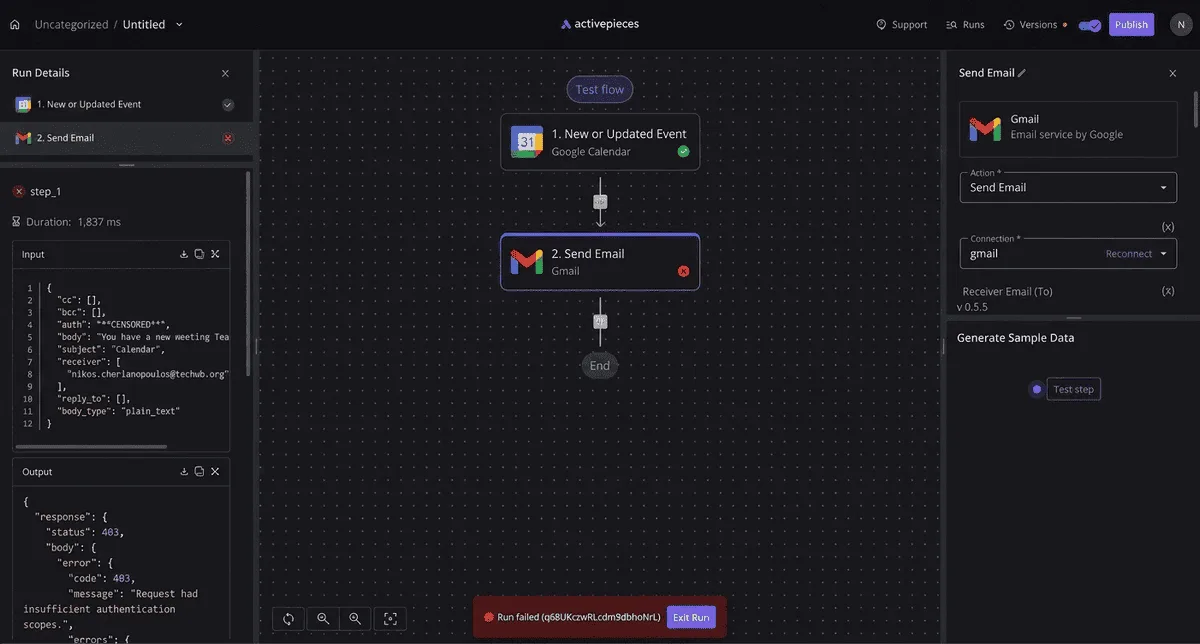
The following workflow demonstrates how modern automation triggers handle data ingestion, yet the challenge remains in the middle layer where the system must process that data for retrieval.
[On the right side, a configuration panel titled "edit on new record" shows an event trigger type with description, input section, and an events field containing "new_record" with an option to add a new event.]
Automating the movement of data is only the first step. The true technical debt accumulates when that data is too complex for basic keyword search.
Commercial insurance involves three distinct layers of data complexity: interdependent endorsements that modify the primary policy language, state-specific amendatory provisions that override general exclusions, and nested schedules of values that list individual assets across multiple locations.

Failure to architect a private retrieval pipeline for these layers means your AI will hallucinate coverage based on the general policy form. It will ignore the specific endorsement that actually dictates the payout.
**Failure to architect a private retrieval pipeline for these layers means your AI will hallucinate coverage based on the general policy form.
Stage 1: Setting up the document ingestion trigger
To prevent the leakage of sensitive policyholder data to third-party model aggregators, ingestion triggers must originate from within your existing security perimeter.
By anchoring the trigger in a private cloud environment rather than a multi-tenant AI platform, you maintain the "Chain of Custody" required for SOC2 compliance. This directly impacts your ability to close enterprise insurance contracts.
Your choice of connector must support private link endpoints so that document traffic never traverses the public internet. This prevents interception.
Using a managed identity for authentication ensures that your ingestion pipeline doesn't rely on static API keys, which removes the risk of a single credential leak compromising your entire policy database.
Securing cloud storage for policy documents
- Amazon S3 with VPC endpoints keeps PDF traffic internal to your AWS network.
- Azure Blob Storage with private link restricts access to specific virtual networks to satisfy strict data residency requirements.
- Google Cloud Storage with VPC service controls prevents data exfiltration by defining a security perimeter around the ingestion bucket.

To avoid wasting compute cycles on temporary or working files, the trigger must be configured to filter specifically for finalized PDF documents.
Setting the trigger to fire only on ObjectCreated events ensures the downstream retrieval pipeline only processes complete datasets. This prevents the AI from indexing partial policy drafts that would lead to incorrect coverage analysis.
Validation of the initial payload confirms that the metadata (such as the policyholder ID and effective date) is correctly mapped before it hits the vector database.
A successful test ensures that the downstream RAG system can filter by specific customer attributes. This allows the model to provide accurate answers without the overhead of scanning the entire corpus.
Easier to see it running than to read about it: set it up free, no card.
Stage 2: Parsing and chunking the policy text
Extracting text from complex insurance tables
When models hallucinate policy limits, support costs inflate; high-fidelity text extraction is the primary defense against these "garbage in, garbage out" risks.
Standard optical character recognition (OCR) tools often flatten multi-column tables into a single string of nonsense. This forces the model to guess at the relationship between a deductible and its corresponding coverage tier.
To maintain the structural integrity required for actuarial precision, the system must follow a strict sequence that prioritizes spatial relationships.
- Extract raw text from the PDF.
- Clean whitespace and headers.
- Split the content into 1000-token chunks.
- Overlap chunks by 10% to preserve context.
This specific progression ensures that data trapped in nested cells becomes searchable text, preventing the retrieval errors that lead to costly manual overrides. Once the text is liberated from its visual formatting, it must be subdivided to fit the narrow context windows of high-performance models.
Choosing the right chunk size for policy text
Determining chunk size is a balancing act between granular accuracy and the computational expense of redundant processing.
If chunks are too small, the model loses the broader context of a policy exclusion. If they are too large, the system retrieves irrelevant "noise" that consumes unnecessary tokens and slows down response times.

By overlapping these segments, the pipeline ensures that a definition appearing at the end of one chunk isn't severed from the clause it explains in the next. This maintains the semantic continuity necessary for legal compliance.
For the RAG system, automated validation of the final output is the only way to ensure the ingestion engine hasn't skipped critical riders or endorsements during the conversion process.
We utilize a checksum-style verification where the system compares the word count of the source document against the aggregate of the chunks to flag missing sections.
This verification step is a final gate. It ensures that the RAG system is querying a complete digital twin of the insurance contract rather than a fragmented, unreliable subset.
Loading policy embeddings into vector databases
Connecting your vector database instance
Securing your policy vector database index
By securing a dedicated vector database instance, you ensure that proprietary underwriting logic remains within your controlled network perimeter. This is better than being co-mingled in a multi-tenant cloud provider's index.
When an insurance firm uses a managed vector service like Pinecone or Milvus, they must configure Private Link or VPC peering.
This ensures data never traverses the public internet, which eliminates the risk of man-in-the-middle attacks on sensitive policy data.
This architectural isolation is the primary defense against the "noisy neighbor" effect. A breach of another firm’s data on a shared platform could potentially expose your own indexing metadata.
The following "RAG Wall" architecture illustrates how a private cloud perimeter containing the policy documents, the vector database, and a local inference model prevents data leakage to the public internet.
By maintaining this boundary, firms ensure that even a compromise of the public-facing application layer can't reach the underlying intellectual property stored in the vector embeddings.
Transforming raw text into high-dimensional vectors requires a local embedding model to prevent sending unencrypted PII to third-party API providers for processing.
Using an open-source model like those from the Hugging Face library allows for consistent versioning. Your search results won't drift when a provider like OpenAI updates their underlying model architecture.
A successful test query validates that the semantic search returns the specific policy clause required to answer an adjustment claim. This reduces the time adjusters spend on manual document review.
This verification step ensures the retrieval pipeline is tuned correctly, preventing "hallucinations" where the LLM invents policy terms because it couldn't find the relevant text in the database.
Automating insurance policy ingestion with Activepieces
Activepieces is a self-hosted workflow engine that allows insurance teams to orchestrate document ingestion without routing sensitive policy data through third-party cloud aggregators.
By deploying this automation layer within a private virtual cloud, firms eliminate the security trade-offs inherent in SaaS-based integration platforms that lack local execution options.
Parsing insurance documents with high fidelity
Scaling a Retrieval-Augmented Generation (RAG) system for insurance requires solving for high-fidelity document parsing and consistent metadata tagging across heterogeneous policy formats.
Traditional automation tools often force a choice between rigid, pre-built connectors and custom code. This leads to fragmented pipelines.
Manual intervention is required to handle non-standard PDF layouts and inconsistent vector embeddings caused by loss of context during the document chunking phase.
Activepieces supports local deployment via Docker. This ensures that Personally Identifiable Information (PII) never exits the corporate firewall during the preprocessing stage.
Because the platform executes logic on-premises, data remains subject to internal audit logs rather than the opaque logging policies of a managed service provider.
Compliance officers can verify that no data is cached in external environments during transformation. The risk of cross-tenant data leakage is structurally removed by isolating the execution environment.
Managing the insurance policy ETL pipeline
By providing a visual interface for building complex logic, the platform enables non-specialist engineers to manage the ETL (Extract, Transform, Load) process for new insurance products.
This shift in operational responsibility results in faster iteration cycles for policy updates since the product team can adjust ingestion logic without waiting for a sprint cycle.
It also leads to lower technical debt because standardized blocks replace brittle, custom-coded scripts.
Finally, it results in stabilized operational costs as the team avoids the per-task pricing models typical of cloud-native automation suites.
Measuring the impact of automated policy search
Time spent searching for policy details
By automating the extraction of specific clauses from dense policy documents, you eliminate the non-revenue-generating hours adjusters spend on manual document navigation.
When an underwriter stops hunting for exclusions across fragmented PDFs, they shift from administrative overhead to high-leverage risk assessment.
Relying on a platform’s native, resold model often forces a trade-off. The lack of a custom retrieval pipeline leads to "hallucinations" in policy interpretation.
Consequently, a senior staff member must still verify every output, negating the expected efficiency gains.
Transitioning from manual review to an AI-assisted retrieval system allows a single adjuster to handle a significantly higher volume of complex files without increasing the headcount.
The following comparison demonstrates how shifting to an automated agent model transforms the unit economics of policy processing by collapsing the time required for deep-file analysis.
| Task | Manual Review | AI Agent |
|---|---|---|
| 50-page contract review | 6 to 8 hours | 10 minutes |
| Compliance scoring | 6 hours | 2 minutes |
| Policy comparison | 4 hours | 5 minutes |
This compression of labor hours means the firm can scale its book of business without a linear increase in payroll expenses.
By owning the retrieval architecture, the firm ensures that these speed gains don't come at the cost of data leakage or regulatory non-compliance.
Reducing insurance claim cycle times
Shortening the window between claim filing and resolution directly improves the loss ratio by reducing the administrative tail of every open file.
A faster turnaround increases customer retention rates, as policyholders correlate quick payouts with brand reliability.
Because private retrieval pipelines allow for instantaneous cross-referencing of internal guidelines, the firm avoids the settlement delays typically caused by the "black box" latency of third-party managed AI services.
Frequently asked questions
How do you prevent AI hallucinations in insurance claims?
By restricting the model to a private vector database, hallucinations are mitigated. This database is the exclusive source of truth for every generated response.
This Retrieval-Augmented Generation (RAG) architecture ensures that the LLM can't invent coverage terms or claim limits.
The system is configured to return a "null" response if the specific policy clause isn't present in the indexed documents.
By forcing the model to cite specific coordinates within the policy text, firms eliminate the liability risks associated with fabricated legal obligations.
These fabrications could lead to costly litigation or unauthorized payouts. High-fidelity ingestion of physical documents requires a multi-stage Optical Character Recognition (OCR) pipeline that preserves the structural hierarchy of the original policy.
Standard model wrappers often lose the context of headers and tables during conversion. A custom pipeline uses layout-aware parsing to maintain the relationship between riders and primary coverage.
This structural integrity means the AI can accurately interpret complex exclusions buried in non-selectable text. This prevents the underwriting errors that occur when legacy data is flattened into incoherent strings.
Who retains ownership of data sent to the embedding model?
By deploying embedding models within the firm’s private cloud perimeter rather than using public APIs, data ownership is preserved.
When a firm uses a self-hosted instance of a transformer model, the mathematical representations of their proprietary actuarial data never leave their controlled environment.
This isolation ensures that the firm’s unique risk-assessment logic doesn't become part of a provider’s global training set. This protects the long-term competitive advantage of their private data moats.