
Connect Ramp to Claude for Automated Expense Auditing
Automated expense auditing workflows allow finance teams to validate transaction data against internal policies without manual receipt review.

Covers indie SaaS workflow automation: Claude Desktop tool configs, which integrations ship fast, and which get rewritten twice.
ContributorSeptember 17, 202613 min read
This article was researched and fact-checked by an advanced research system.
Modern finance teams are increasingly moving away from manual receipt verification, opting instead to build sophisticated workflows that bridge the gap between spend management and artificial intelligence.
By connecting Ramp to Claude, businesses can instantly analyze transaction metadata against company policy, a process that often involves using Activepieces to orchestrate the data flow between these disparate platforms.
This integration ensures that every expense is audited for compliance the moment it is swiped, reducing the burden on accounting departments and minimizing the risk of human error during month-end closes.
Leveraging these tools allows for a scalable approach to financial oversight that keeps pace with rapid organizational growth.
Automate expense auditing with Ramp and Claude
Integrating Ramp’s transaction data with Claude 3.5 Sonnet replaces the traditional "review and chase" cycle with an autonomous auditor that flags policy violations before the billing cycle even closes.
By treating financial events as triggers for large language model (LLM) reasoning, teams move from sampling reports for errors to verifying 100% of spend against complex internal handbooks, effectively eliminating the risk of undetected policy violations, so compliance teams can finally achieve total oversight without increasing headcount.
This process effectively eliminates the risk of undetected policy violations.
The data layer: What Ramp exposes via API
Ramp functions as the source of truth, emitting granular JSON payloads for every card swipe. These payloads include merchant category codes, transaction amounts, and custom memo fields.
When a new transaction occurs, an automation workflow captures these details instantly. Registering a connector once in Activepieces makes it available two ways: as a step in a structured flow and as a tool schema on a per-project MCP server.
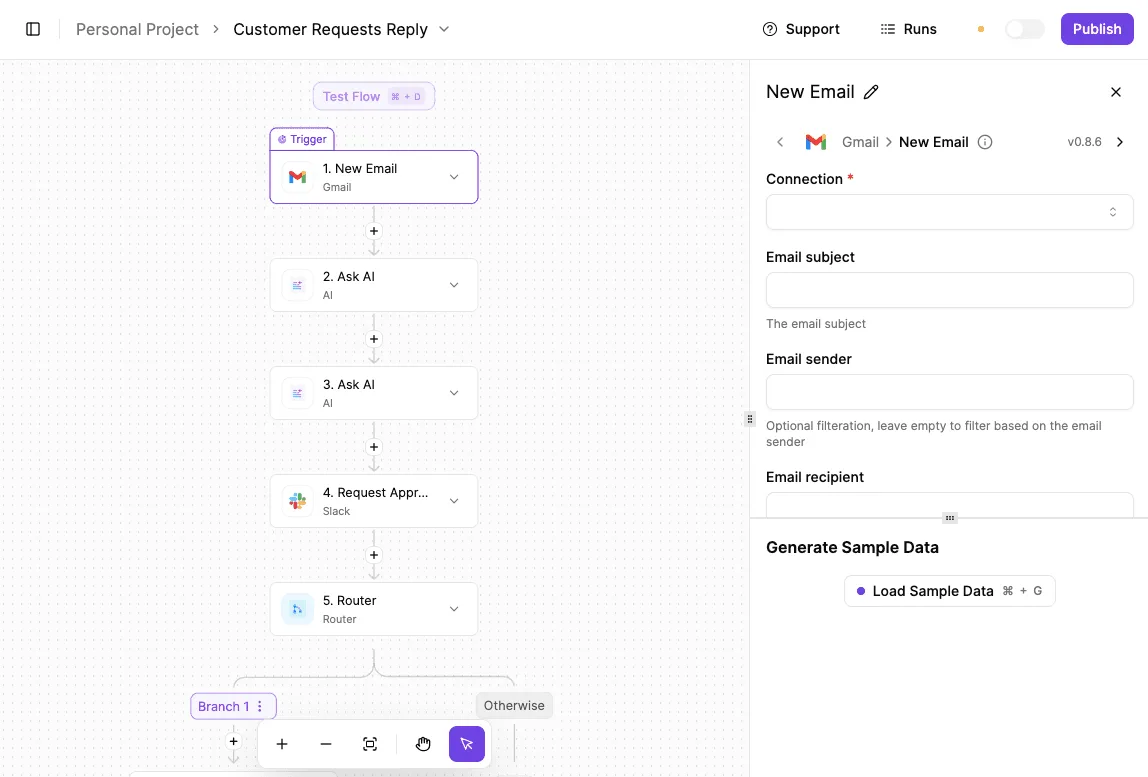
This allows Claude or a custom agent to call the Ramp piece directly without a second migration or a manual export step to wire the catalog up twice.
Check the Integrations Framework and the open source repository’s packages/integrations directory to see how the same action serves both deterministic flows and agentic tool calls.
This event-driven architecture ensures that the reasoning layer receives the raw data while the context is fresh, rather than waiting for a month-end export.
This flow transforms a static record into an actionable alert. The system can then verify if a "Dinner" expense actually complies with the specific per-diem limits defined for a particular city.
The reasoning layer: What Claude does with financial context
Claude 3.5 Sonnet acts as the interpretive bridge.
It reads the unstructured text of your company policy to determine if a specific $85 meal at a steakhouse violates the "reasonable nourishment" clause, sparing human auditors from manual receipt review, which means employees get instant feedback on their expenses rather than waiting weeks for a rejection.
Nuance is where the LLM excels over rigid rule-based software. It can determine whether a weekend charge was a legitimate client entertainment expense or a personal violation.
Confidence scores are generated as Claude processes the Ramp metadata against the policy text. If the score is low, it automatically pings the employee for a justification.

The business outcome: Real-time policy enforcement
Automating this oversight significantly reduces the overhead of growth. Ramp costs 15 per user, which is a significant investment compared to Brex at 12 per user, meaning businesses must weigh the additional functionality against a higher recurring operational expense.
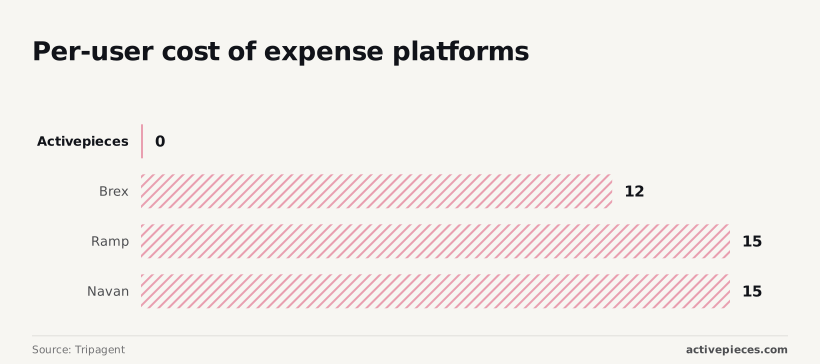
Operational efficiency must offset every dollar spent on the platform. Tripagent notes that Navan also sits at the 15 per user mark, establishing a clear industry standard for monthly subscription pricing, which means businesses can now forecast their software expenses with greater certainty.
Every agent tool call and the data it acted on is traced step by step in the Run Details UI, alongside the deterministic flow steps running next to it.
Activepieces ensures these traces export as audit logs into the SIEM your security team already runs, so an agent's decisions are reviewed the same way a workflow's steps are.
This takes minutes, not a project: automate it in Activepieces free.
Avoid simple data syncing pitfalls
Visibility isn't the same as control. While moving a row from a card provider to a spreadsheet satisfies a basic record-keeping requirement, it doesn't stop a non-compliant purchase before the billing cycle closes.
The case for basic CSV exports and manual uploads
Small teams often start with manual exports because the friction of a monthly CSV download feels lower than the perceived complexity of an API integration. Ramp allows for the export of up to 1,000 transactions at a time.
However, this 1,000-transaction limit creates a lag in oversight. An auditor only sees the data once the system generates the file, rather than catching a policy violation at the moment of the swipe.
Why native accounting integrations seem like enough
Native integrations between spend platforms and tools like QuickBooks or Xero solve the problem of categorization, not behavior. The Developer documentation notes that Brex limits certain API requests to 100 items per page.
This technical constraint means your accounting software receives a polished history of what happened. It doesn't act as an active filter that can question why the user charged a 500 software subscription to a "Marketing" budget instead of "IT."
The perceived risk of automated financial reasoning
Founders often hesitate to automate financial decisions because they fear a machine will hallucinate a policy breach and block a critical payment.
The trade-off is that for every hour spent on these manual reviews, the company loses the ability to scale its operations without also scaling its administrative headcount.
Contextual gaps in financial data require LLM intervention
Static synchronization fails because it lacks the semantic awareness to distinguish between a valid business expense and a policy violation hidden behind a generic merchant name.
Why Ramp category mapping breaks with MCC codes
Traditional integrations rely on Merchant Category Codes (MCC) which are too broad for accurate tax classification. A big-box retailer purchase at Amazon might appear as "Merchandise."
Static synchronization fails because it lacks the semantic awareness to distinguish between a valid business expense and a policy violation hidden behind a generic merchant name.
Without looking at line items, the system can't know if the employee bought server hardware or office snacks. This ambiguity forces accountants to spend hours reclassifying transactions at month-end, delaying the closing of books.
The 'missing receipt' problem and automated follow-ups
When a transaction lacks documentation, static systems can only flag the error. By introducing an LLM, the system can analyze the transaction history to draft a specific, context-aware prompt.
Asking for a missing guest list for a meal that exceeded the per-head limit, for example, increases the likelihood of a fast response. The audit trail is completed shortly after the swipe rather than weeks later.
Detecting policy violations that look like valid transactions
A sophisticated audit requires comparing the context of a spend against the specific nuances of a company’s travel and expense policy.
| Dimension | Native Sync | LLM-Augmented Audit |
|---|---|---|
| Policy Nuance | Strict matching of keywords or dollar limits | Semantic understanding of intent and necessity |
| Data Enrichment | Raw MCC codes and basic vendor names | Merchant intent derived from itemized details |
| Audit Action | Flags missing fields only | Evaluates if the spend aligns with the project scope |
This shift in capability allows the system to catch "split-transaction" fraud or out-of-policy upgrades that would pass a simple threshold check.
You can follow the rest of this with the builder open. Start free, no card.
Build the Ramp and Claude pipeline
Connecting these systems requires a direct API bridge that translates raw financial events into structured natural language queries.
Authenticating Ramp webhooks for real-time triggers
Real-time auditing begins by establishing a secure, event-driven connection. The following steps establish the live data flow:
- Generate a Ramp API Access Token to authorize your middleware to pull sensitive merchant details.
- Configure a Webhook for 'transaction.created' so your system receives a POST request the instant a charge is authorized.
- Map the JSON payload to Claude's system prompt to provide the LLM with the specific merchant name, amount, and department budget.
- Define the JSON output schema for downstream tools to ensure the audit results can be injected directly into your ledger.

Visualizing the automation environment
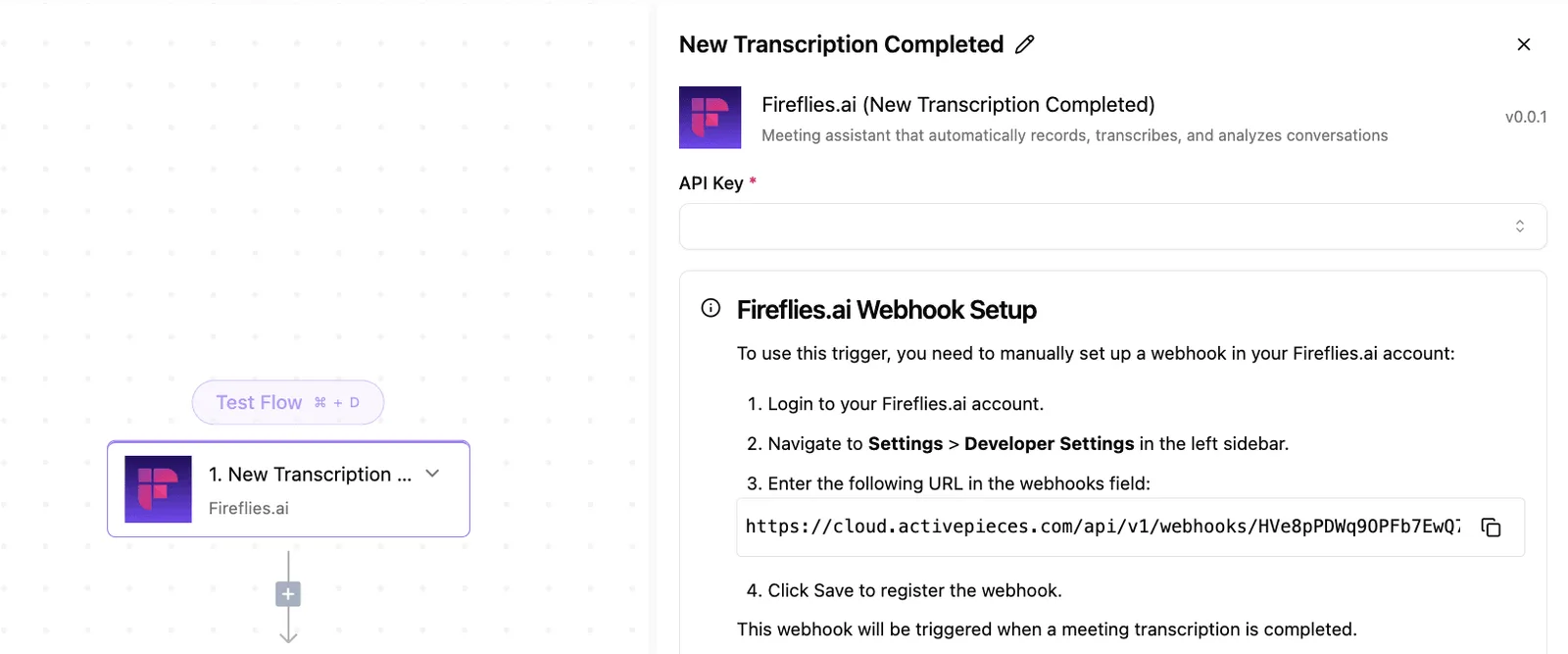
These technical steps are not performed by writing custom scripts or modifying the Ramp dashboard directly. Instead, they represent the underlying logic configured within an automation platform like Activepieces.
Users define these connections inside a visual flow builder, where each step is represented by a functional block.
The mapping process occurs by dragging data pills from the Ramp trigger block into the Claude action block. This environment handles the heavy lifting of API authentication and webhook listening, allowing finance teams to focus on the audit logic rather than the infrastructure.
Structuring transaction metadata for Claude’s context window
The intelligence of the audit depends on feeding Claude 3.5 Sonnet high-density metadata.
Reasoning depth must be balanced against operating costs when choosing the right model. Claude 3.5 Sonnet costs 3 per million input tokens and 15 per million output tokens.
3 per million input tokens is a negligible premium for Sonnet's superior ability to follow complex financial instructions, ensuring that accuracy is prioritized over minimal savings.

In comparison, GPT-4o sits at 2.50 per million input and 10 per million output tokens. Gemini 1.5 Pro ranges from 1.25 to 5 per million tokens. The higher price is justified by the reduction in error-correction time.
Defining Claude's JSON output schema for expenses
A successful audit must produce a structured JSON object. If the LLM returns a conversational paragraph instead of a strict data format, the automation breaks.
We enforce a schema that requires a "policy_match" boolean, a "confidence_score" between 0 and 1, and a "justification" string. Over 90% of the manual workload is reduced by this process, meaning staff can be reallocated to high-value strategic initiatives instead of repetitive administrative tasks.
Staff can then be reallocated to more strategic, high-value tasks.
Automating the Ramp to Claude workflow with Activepieces
Setting up the Ramp 'transaction created' trigger
Activepieces connects this automation to the 735+ integrations in its open source monorepo, providing a pre-built Ramp connector that listens for new spending events in real-time. Within the Activepieces builder, you select the Ramp "Integration" and define the trigger as a new transaction.
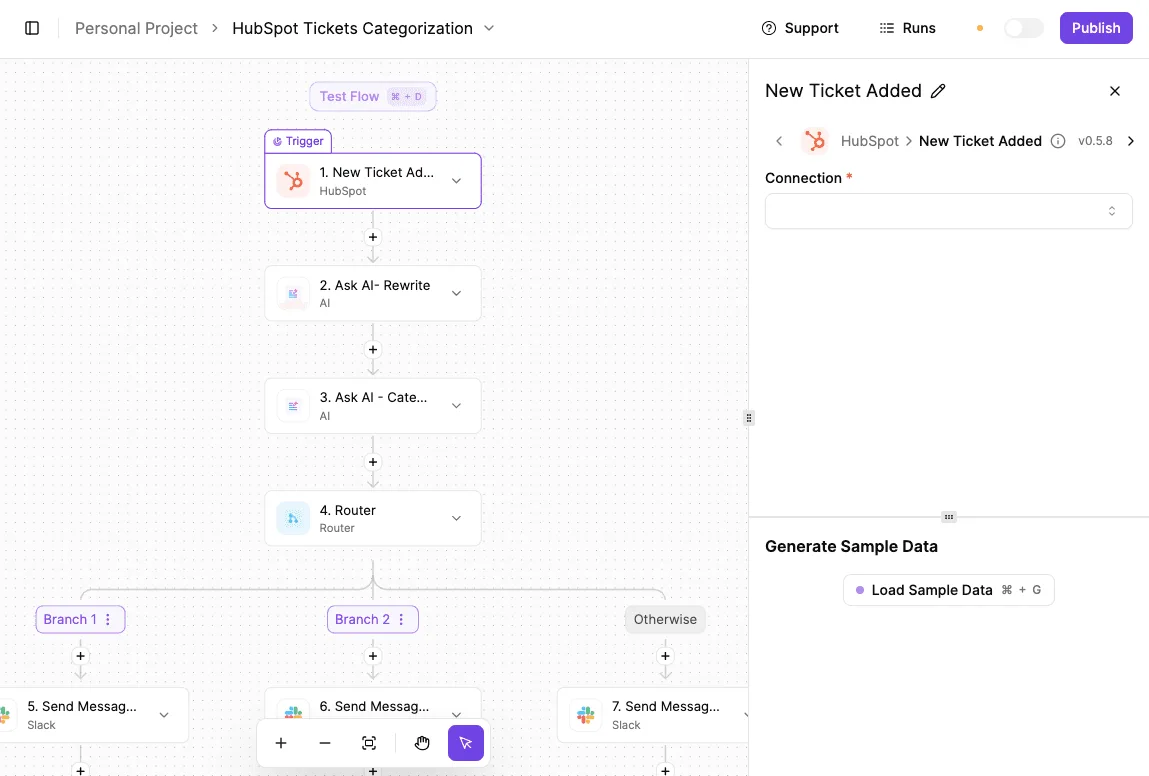
Raw JSON payloads are captured by this specific configuration. This payload includes the merchant name, amount, and department ID, providing the necessary raw material for the AI.
Using the Claude integration for intelligent expense categorization
The connection to Claude transforms this raw transaction data into an compliance report by passing details through a prompt engineered for policy enforcement.
Mapping the "Transaction Description" from the Ramp trigger directly into the "Prompt" field of the Claude integration allows the LLM to determine if a line item matches your predefined spending categories.
Logic flows from a raw event to an intelligent output.
Routing approved data to Slack or ERP systems
Once Claude categorizes the expense, Activepieces uses conditional branching to push that data into your communication or accounting tools based on its confidence score.
If the transaction is flagged as a policy violation, the workflow routes a notification to a specific Slack channel. Verified items are sent directly to your ERP, such as NetSuite or QuickBooks.
Slack sends an immediate alert for "High Risk" flags. ERP systems automate the ledger entry for "Low Risk" items, which removes the data-entry bottleneck. Google Sheets logs every AI decision for a secondary audit trail.
The Monday morning plan for automated spend management
Deploying an automated auditor begins by identifying the specific friction points where manual review currently slows down your accounting cycle.
Audit your top three manual expense pain points
Review your previous month’s ledger to identify which categories require the most frequent back-and-forth between finance and employees.
- Recurring software subscriptions.
- International travel meals.
Pinpointing these high-volume, low-complexity tasks allows you to set the initial scope for Claude.
Draft a 'system prompt' for your corporate spend policy
Convert your company’s expense guidelines into a structured System Prompt that instructs Claude to act as a strict compliance officer. This document should explicitly define "Auto-Approve" criteria, such as meals under fifty dollars with a valid receipt.
"Flag" criteria must also be defined, such as any charge from a liquor store, so the model has a binary framework for decision-making.
| Platform | Monthly Fee Structure |
|---|---|
| Ramp Plus | 15 per user plus a platform fee |
| Brex Premium | 12 per user |
| Navan Expense | 15 per user after the first 5 users |
Run a shadow-test on ten historical transactions
Feed ten diverse transactions from last quarter into your new prompt to see if Claude’s flags match your previous manual decisions. These should include both perfect receipts and known policy violations.
This "shadow-test" acts as a low-stakes calibration phase. It allows you to tweak the prompt's language before it ever touches a live transaction.
Frequently asked questions about Ramp and Claude integrations
Is my financial data used to train Claude's models?
Your financial data remains private because Anthropic doesn't use data submitted via their API to train their large language models.
This means your proprietary spend patterns and vendor lists are never incorporated into the public model's knowledge base. Your competitive operational data stays within your controlled environment.
You must use a standard API tier rather than the consumer-facing interface to maintain this isolation. The API provides the legal guarantee that your inputs are processed solely for your specific request.
How do I handle multi-currency conversions in this workflow?
The integration handles international spend by passing both the original transaction amount and the functional currency equivalent from Ramp to Claude. Providing both figures allows the AI to audit the exchange rate against your internal treasury policies.
Hidden conversion fees that exceed your allowed threshold can then be flagged. For the most accurate auditing, your prompt should include the original transaction currency and amount, the settlement amount in your base currency, and the date-stamped mid-market rate.
Can Claude automatically flag duplicate transactions across different cards?
Claude identifies duplicate spend by comparing the semantic intent of a transaction against historical ledger data, even when the vendor names don't match exactly. This prevents "shadow IT" where two different departments unknowingly subscribe to the same software under different account names.
Overlaps are caught because the AI understands that a charge from "AMZN MKTP" and "Amazon Web Services" may represent the same service category. Simple exact-match filters in a spreadsheet would miss these duplicates.
Related reading
Build it
Set this up in minutes.
No code required. Connect your accounts, and Activepieces runs it from there.
Start free Talk to sales