
Expensify ChatGPT Integration: Automated Expense Auditing
Automated expense auditing reduces manual review time by using API workflows to flag policy violations against your company guidelines instantly.

Covers GDPR-driven automation architecture for fintech: data residency rules, cross-border transfer limits, and how they dictate system design.
ContributorSeptember 24, 202615 min read
This article was researched and fact-checked by an advanced research system.
By replacing manual oversight with programmatic analysis, the Expensify-to-ChatGPT integration automates the extraction of raw transaction data into large language models to facilitate instant policy auditing.
You will scrutinize every line item against corporate governance standards rather than relying on the statistical luck of random sampling.
Expensify ChatGPT integration defines modern financial automation
The mechanics of the API handshake
When data flows from Expensify to the LLM, it does so via a secure API handshake. This functions as a digital contract to ensure that only authorized JSON payloads transit between the two environments, which means unauthorized data exchanges are blocked by design.

OAuth 2.0 provides the standard for delegated authorization. The LLM never stores your primary credentials, which limits the damage from a compromised session.
Reselling you a model is deciding your AI strategy for you, which is why Activepieces runs your chosen LLM using your own provider key, ensuring that model spend lands on your own bill at your own rate.
By checking the Bring-Your-Own-Key availability on the pricing page, teams can verify that their financial data strategy remains under their own governance rather than being marked up by a platform that has priced the strategy before the product was even opened.
This architectural choice enforces a "least privilege" model where the AI only receives the specific transaction metadata required for the prompt, preventing the unnecessary exposure of sensitive employee PII.
Why manual CSV exports are the enemy of scale
Significant data integrity risks are introduced by manual CSV exports. They break the chain of custody required for a defensible audit trail.
When you download a spreadsheet, the data exists in an unencrypted local state. The following table illustrates how shifting from manual checks to AI-driven workflows transforms the scope of financial oversight:
Significant data integrity risks are introduced by manual CSV exports. They break the chain of custody required for a defensible audit trail.
| Feature | Manual Spot Check | AI-Driven Audit |
|---|---|---|
| Audit Volume | Limited to a small percentage of reports | Comprehensive coverage of all submissions |
| Detection Speed | Days or weeks after the expense is incurred | Near-instantaneous feedback loop |
| Error Rate | High due to human fatigue and oversight | Low and consistent across large datasets |
The AI-driven approach ensures no outlier remains hidden. Consequently, you'll move from reactive firefighting to proactive governance.
Real-time vs. batch processing for expense data
Policy violations are identified before you issue the reimbursement when you process expense data in real-time. This prevents the complex "clawback" scenarios that occur when an unapproved payment has already hit an employee's bank account.
Batch processing groups transactions for analysis at the end of the week or month. In this scenario, you're always looking at historical errors rather than preventing current ones.
Real-time integration allows for immediate "soft-blocks" on suspicious entries to keep your ledger clean from the moment of entry.
This takes minutes, not a project: automate it in Activepieces free.
Data privacy and the OpenAI training opt-out
Configuring OpenAI API settings to protect expense data
Transmitting expense records to an LLM exposes sensitive corporate intelligence to the provider’s model-improvement cycles unless you enforce specific API-level configurations. While consumer-grade interfaces often default to using inputs for training, the OpenAI API offers a zero-retention policy for data processed through their endpoints.
You must bypass the standard web interface. This prevents your proprietary financial trends from becoming part of the public weights of future models.
Maintaining this isolation requires a dedicated API key managed by your internal IT team. This ensures that your legal department retains oversight of the Data Processing Agreement (DPA) rather than relying on the shifting terms of service applicable to individual user accounts.
The danger of 'hallucinated' policy violations
The primary operational risk of automated auditing is the LLM’s tendency to fabricate justification for a violation. This forces your accounting team to waste hours debunking non-existent errors.
These models predict the next likely token rather than performing a deterministic database query. Because of this, they may flag a legitimate hotel stay as a policy breach simply because the receipt format is unfamiliar.

This necessitates a "human-in-the-loop" verification stage so that the AI acts as a preliminary filter rather than the final arbiter of truth.
Regulatory compliance hurdles in automated auditing
Under GDPR Article 22, your automated auditing systems must not make significant decisions based solely on automated processing. The increasing frequency of third-party vulnerabilities highlights the danger of delegating this oversight to external processors.
[Insert Chart: Percentage of data breaches involving third parties across three years: 15% in Year 1, 30% in Year 2, and 48% in Year 3. Unit: Percentage of total breaches.]
As you integrate more external intelligence, the attack surface for a catastrophic data leak expands. Consequently, you must implement granular data masking to strip PII before it leaves your local environment.
Why automated analysis outweighs accuracy risks
Automated expense analysis is the only viable method for achieving 100% audit coverage, ensuring that no fraudulent transaction slips through undetected, which means every single line item is scrutinized for compliance.

In an era where the volume of unstructured financial data has outpaced human cognitive capacity, manual oversight isn't sufficient to detect systemic errors.
While manual review is limited by fatigue and time constraints, Large Language Models (LLMs) function as high-throughput extraction engines. They transform messy receipts into structured data for final human validation.
In an era where the volume of unstructured financial data has outpaced human cognitive capacity, manual oversight isn't sufficient to detect systemic errors.
Moving from sampling to 100% audit coverage
Shifting to an LLM-driven workflow eliminates the "sampling gap" where you only inspect high-value transactions. This leaves 80% or more of total volume unverified, creating a significant blind spot that invites systemic financial leakage, so the organization remains highly vulnerable to hidden losses.
Small-scale discrepancies can no longer hide in the unchecked majority of records. The following data compares the capacity of leading models to ingest large batches of expense reports simultaneously:
Fast.io reports that Claude 3.5 Sonnet offers a 200,000-token context window. This allows your compliance officer to feed roughly 150,000 words of ledger data into one prompt for instant cross-referencing.
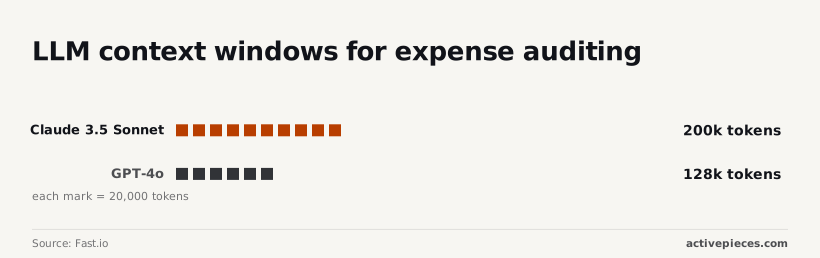
Fast's analysis puts GPT-4o at 128,000 tokens. This means it can process approximately 300 pages of dense financial documentation in a single session without losing track of the initial instructions.
These massive windows ensure that the model maintains a "global" view of a user’s spending habits rather than looking at receipts in isolation.
Detecting duplicate expenses across large transaction sets
By comparing timestamps and merchant IDs across thousands of entries in seconds, automated systems identify non-obvious correlations.
Where a human auditor might miss a $45 meal and a $10 tip filed as separate expenses three days apart, an LLM flags the merchant name repetition as a potential policy violation, thereby preventing fragmented attempts to bypass spending caps, effectively closing a common loophole used to evade oversight, which means that employees can no longer hide excessive spending by splitting charges.

This catches fragmented attempts to bypass spending limits. This move from transactional review to pattern recognition transforms the audit from a reactive "spot check" into a proactive forensic tool.
Reducing the 'shadow accounting' burden on employees
LLMs reduce the "shadow accounting" burden by automating the categorization of vague line items. This saves your average employee hours of manual data entry every month.
When a model extracts "Client Dinner" and "VAT Tax" from a blurry photo, it removes the friction that usually leads to late filings and inaccurate budget forecasting.
By handling the extraction, the LLM allows your finance team to act as high-level adjudicators rather than data entry clerks.
You can follow the rest of this with the builder open. Start free, no card.
How to build resilient expense workflows
Constructing a resilient expense workflow requires a linear data pipeline that prioritizes cryptographic privacy at the source before any external processing occurs.
This architectural rigor ensures that while the LLM performs the heavy lifting, you maintain a "zero-trust" posture toward the third-party model provider.
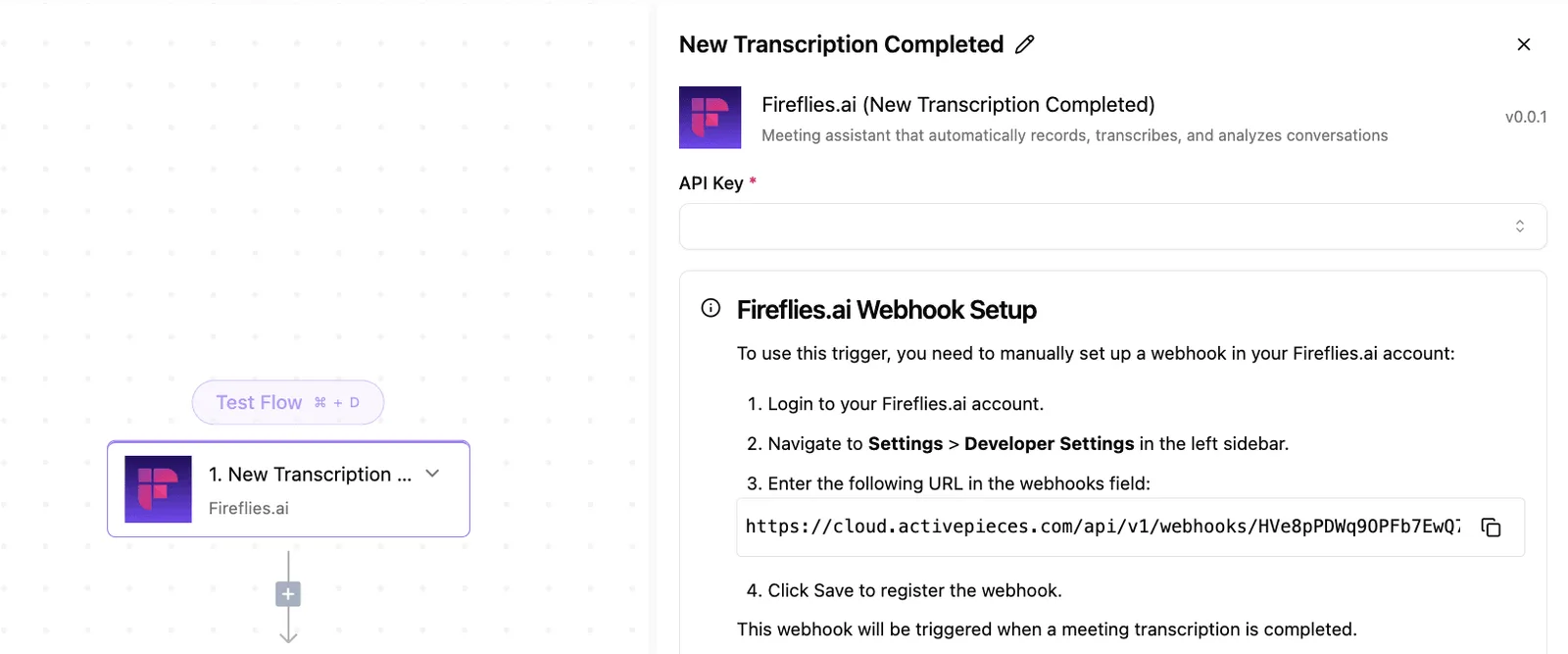
Step 1: Setting the Expensify webhook trigger
The integration begins by establishing a webhook within Expensify, an expense management platform, to push real-time data payloads whenever a user submits a report for reimbursement.
By relying on an active webhook rather than a scheduled poll, you ensure that your finance team receives immediate alerts on high-risk transactions. This real-time trigger serves as the foundation for the entire automated auditing sequence.
Step 2: Sanitizing PII before the ChatGPT prompt
Before any data leaves your secure environment, a script must identify and redact Personally Identifiable Information (PII). This includes individual home addresses or social security numbers.
Automated masking with data functions
You achieve this sanitization without writing code by inserting a Data Mapper step between the Expensify trigger and the ChatGPT action. This function uses a "Find and Replace" operation with regular expressions to swap sensitive patterns for generic labels.
For example, you can configure the mapper to detect any string matching a social security format and replace it with the text REDACTED.
Alternatively, you can use a dedicated LLM-based redaction step where a smaller, local model identifies PII before the data reaches the primary auditing model. This ensures the business context remains intact while the identity markers are stripped.
By chaining these functions, you create a privacy firewall that operates automatically on every incoming report.
To comply with GDPR Article 25, which mandates data protection by design, this sanitization step serves as your primary defense. The LLM only receives the business context necessary for the audit.
Writing ChatGPT prompts for expense categorization
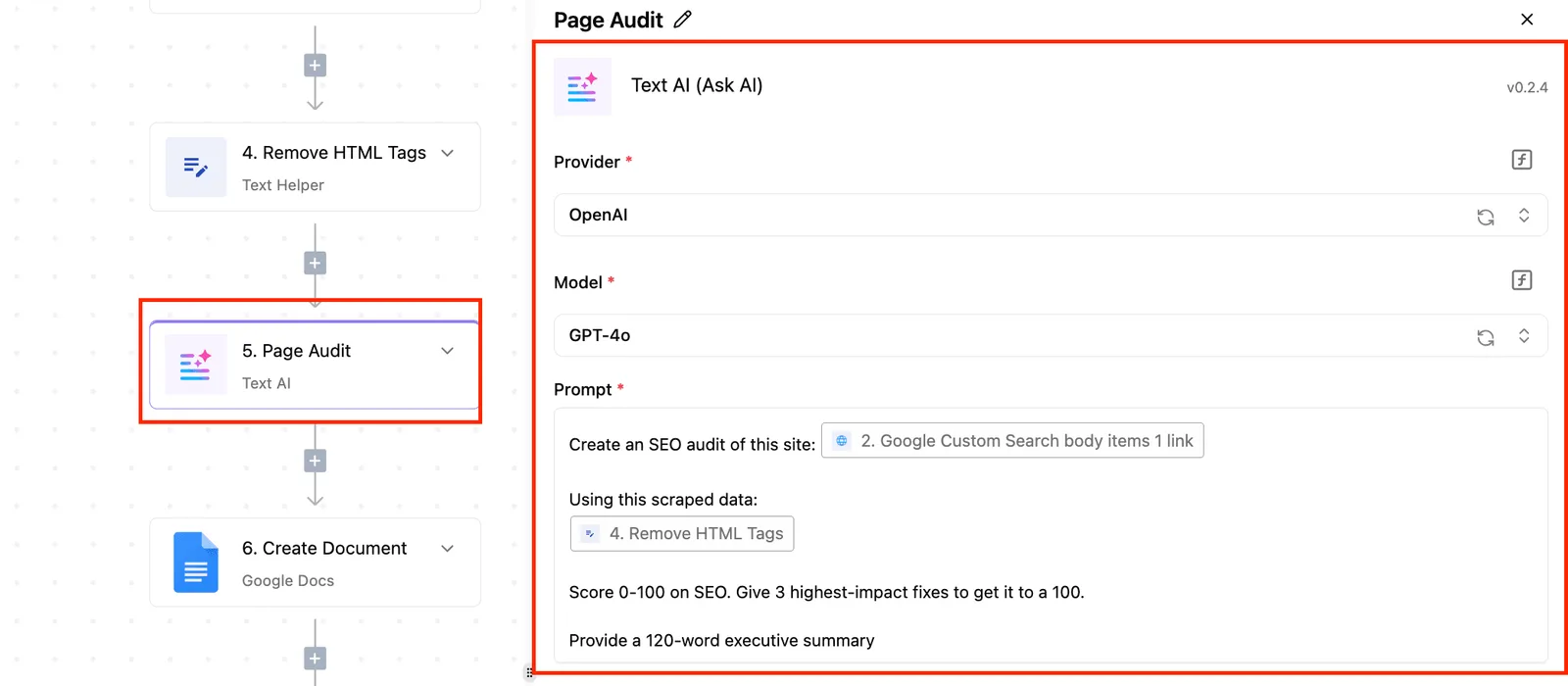
The cleaned data is then sent to ChatGPT using a system prompt that restricts the output to specific JSON schemas for audit findings.
Providing a rigid schema ensures the response can be parsed programmatically by downstream systems. This prevents the workflow from breaking due to formatting inconsistencies common in unstructured AI outputs.
Step 4: Closing the loop in Slack or ERP systems
The final output is routed into a system of record, such as NetSuite or Sage, to update the general ledger. This automated hand-off follows a specific sequence.
First, the system triggers on a new report in Expensify. Second, it cleans the data by removing PII.
Third, it sends the data to ChatGPT with an audit prompt. Finally, it routes the result to a system of record like Sage or NetSuite.
By formalizing this sequence, your finance department transitions from manual sampling to a state of total oversight.
Centralizing expense intelligence with Activepieces
Every agent tool call and the specific financial data it processed is recorded in a step-by-step trace that sits alongside your deterministic workflow logs.
Because these agent decisions and fixed audit rules are captured in a single run, the entire trace can be exported into the SIEM your security team already uses for monitoring.
You can check the Run Details and Debugging UI for the per-step agent decision trace, which ensures that an agent's logic is reviewed as strictly as a standard workflow.
Building the Expensify-ChatGPT connection in minutes
The platform utilizes a visual canvas to map Expensify triggers directly to AI processing steps. This reduces the time required to deploy a secure audit workflow to a single afternoon. The following interface demonstrates the simplicity of initiating these flows:
Before it reaches the next step, the "Load data" function shown here allows administrators to verify the exact JSON payload.
No PII is sent to an external endpoint without explicit manual confirmation during the build phase. This granular control transforms the automation from a "black box" into a transparent pipeline.
Maintaining a private audit log of all AI interactions
Centralizing these connections provides a single point of truth for data sovereignty. This is critical since Activepieces offers deep integrations across the accounting ecosystem.
Sage provides 30 actions for granular control of ledger entries. Xero includes 25 actions for automated bank reconciliation triggers. Oracle Fusion offers 23 actions to support enterprise-grade resource planning.
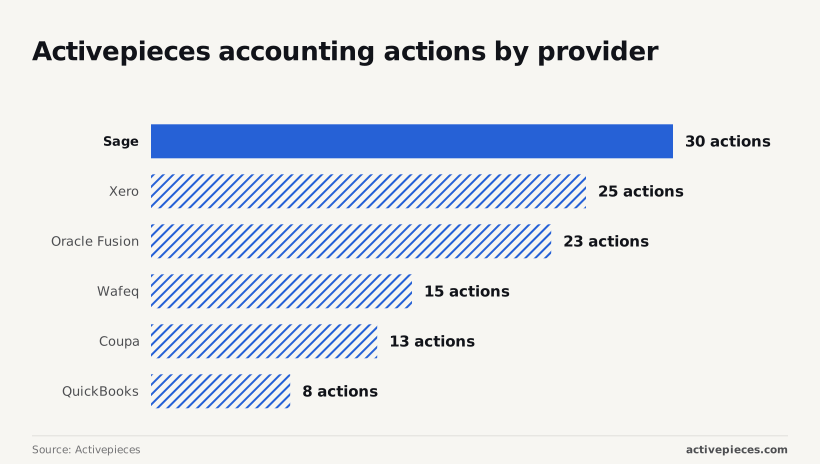
Wafeq has 15 actions for tax-compliant invoicing in the MENA region. Coupa provides 13 actions for business spend management. QuickBooks includes 8 actions for core small-business bookkeeping needs.
Enforcing policy through pre-built actions
You can enforce a policy where every expense over $500 is automatically routed through a "Data Mapper" step to redact employee names before the receipt text is summarized by an LLM, ensuring that sensitive personal information remains protected during the analysis process, so compliance teams can leverage AI without compromising privacy. These pre-built actions facilitate complex logic without custom code.
Scaling to multi-department expense workflows
Because Activepieces supports role-based access control, you can delegate workflow creation to sub-teams while retaining exclusive ownership of the underlying credentials.
This architecture ensures that even if a department scales its volume, the data remains within the geographic boundaries required by GDPR Article 25.
The execution environment never leaves your company's controlled infrastructure. This centralized control allows for rapid expansion across different business units without compromising security protocols.
Monday morning expense automation checklist
When you isolate the expense workflow within a dedicated API sandbox, you prevent live financial data from leaking into the public model training sets. By utilizing a private API tier, you'll enforce a zero-retention policy where inputs aren't used for model improvements.
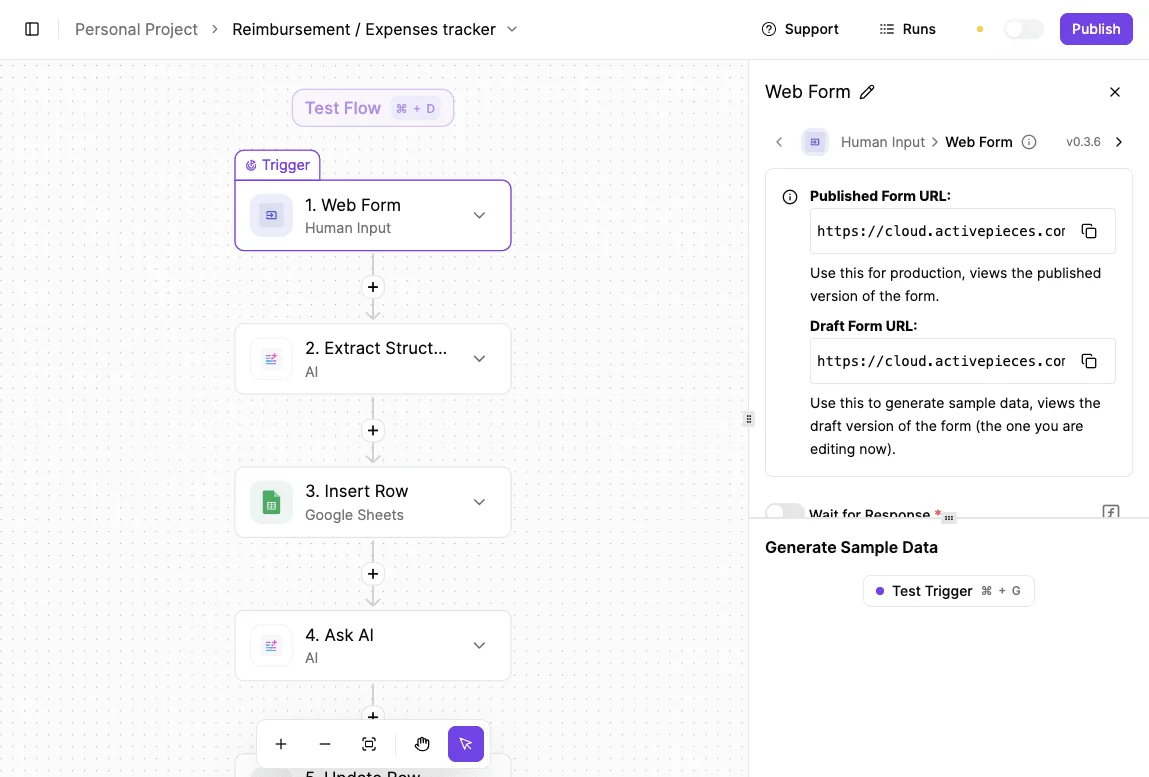
Before deploying a full-scale audit, you must map specific high-impact categories where manual review typically fails to catch subtle fraud patterns.
Targeting these specific classifications allows the LLM to act as a high-fidelity filter, flagging only the anomalies that require human intervention.
Specific audit targets
Duplicate receipt detection across different employees prevents the same physical expense from being reimbursed twice under different reports.
Out-of-policy weekend spending identifies non-business related leisure costs that often bypass standard automated filters.
Merchant category code (MCC) versus actual itemization catches instances where a "Travel" expense at a hotel is actually a prohibited "Spa" service hidden in the total.
Focusing on these areas transforms the audit process into a comprehensive scan of the entire ledger.
Once these categories are defined, your technical team must verify the API's endpoint security to ensure that the data transit layer utilizes TLS 1.3 encryption.
This structured approach moves you away from reactive compliance and toward a model of continuous, automated governance that scales without increasing headcount.
Frequently asked questions
Does ChatGPT store my company's credit card numbers?
OpenAI doesn't use data submitted via their Application Programming Interface (API) to train their models. This ensures your specific financial identifiers remain within your defined session rather than entering the public model weights.
This distinction prevents your corporate card patterns from being "learned" and potentially surfaced to other users in different organizations.
To further harden this posture, you should enable the Zero Data Retention (ZDR) feature for your API tier. This forces OpenAI to delete request logs immediately after processing. No trace of the transaction persists on their servers beyond the inference moment.
How many Expensify reports can I process per minute?
The volume of reports you can process is restricted by the Rate Limits assigned to your specific OpenAI Tier. Your throughput scales directly with your pre-paid usage history rather than being a static platform cap.
If you're on a lower usage tier, the API may return a "429 Too Many Requests" error. This requires your integration to implement an exponential backoff strategy to prevent data drops during peak expense cycles.
Which OpenAI model is best for financial data extraction?
The GPT-4o model is currently the most effective for financial workflows. Its high context window allows it to analyze complex, multi-page PDF receipts alongside the original Expensify JSON data without truncating the audit trail.
Using a smaller model like GPT-4o-mini might reduce costs. However, it increases the risk of "hallucinations" where the AI misreads a tax digit, potentially resulting in inaccurate filings.
Do I need an Expensify developer account to start?
To generate the necessary credentials from the Expensify API settings page, you must have an account with "Policy Admin" permissions. This allows the integration to securely pull data from your entire organization rather than just your personal inbox.
Without these specific administrative rights, the API will lack the scope to access other employees' reports, rendering a company-wide audit impossible.
This requirement ensures that only authorized personnel can initiate broad data extraction for compliance purposes.
Related reading
References
Build it
Set this up in minutes.
No code required. Connect your accounts, and Activepieces runs it from there.
Start free Talk to sales