
How to Use Generative AI Automation: Best Use Cases in 2026
Learn how to use Generative AI automation and explore best use cases in 2026. Discover how Activepieces can automate your workflows.

Jul 8, 202410 min read
Generative artificial intelligence (Gen AI) uses deep learning models and natural language processing (NLP) to generate new data, including lifelike images, captivating music, innovative software code, and detailed reports.
Gen AI automation seamlessly integrates into your business processes, mimicking human capabilities to streamline workflows. It tackles repetitive tasks by learning from past customer interactions, effectively reducing the need for human input and achieving higher efficiency.
In this article, you’ll learn the five ways to implement generative AI solutions.
Move from learning about generative AI to running it inside your systems. Build with Activepieces!
TL;DR
- Generative AI automation combines AI that creates content or decisions with automation that runs workflows, so systems can act with minimal input.
- You can apply it in five main use cases: content creation, AI design generation, software development, data analysis, and marketing and sales.
- Activepieces connects AI, integrations, and workflows in one place, offering 628+ integrations.
Everything below works on Activepieces' free plan. Start without code or a credit card.
What Is Gen AI Automation?
Gen AI and automation each bring unique strengths to your business practices.
Gen AI excels in generating personalized content. It also uses advanced machine learning algorithms and connects to large language models (LLMs) to understand patterns and semantic relationships.
Automation helps improve efficiency and consistency in your routine tasks. Together, they can drive significant advancements in various industries.
For instance:
- Automated systems using Gen AI: Automated systems can incorporate Gen AI to handle more complex, creative tasks within a workflow (e.g., automated customer support using Gen AI for natural language responses).
- Enhanced automation with Gen AI: Automation can benefit from the adaptability and learning power of generative AI, which leads to more responsive automated solutions.
How to Use Gen AI for Automation
There are several ways to leverage Gen AI for automation across various tasks. Here’s a breakdown of the process:
1. Identify Repetitive or Time-Consuming Tasks
Your first step is to identify areas in your workflow that involve repetitive or time-consuming tasks.
These could be complex tasks that follow rules, involve data manipulation, or require content creation, such as:
- Data entry
- Report generation
- Social media post content creation
- Email marketing campaigns
- Software code generation
- Basic customer queries
- Legal document analysis
- Inventory and supply chain management
2. Choose the Right Gen AI Tool
Once you’ve identified automation opportunities, research Gen AI tools that address your needs. Different tools specialize in different areas, like content creation, software development, or data analysis.
You should further consider factors like functionality, ease of use, cost, and integration with your existing systems.
3. Set Up and Train the Gen AI Model
Most Gen AI tools require some level of training or configuration. It might involve providing the tool with sample data, defining parameters, or outlining desired outputs.
For example, an AI writing assistant may need training processes on your brand voice and writing style to deliver optimal results.
4. Integrate the Gen AI Tool Into Your Workflow
Many GenAI tools can integrate data with popular business applications, which allows you to automate tasks directly within your existing workflow, minimizing disruption.
5. Monitor and Refine the Automation
Don’t expect perfection right away. Monitor the performance of your Gen AI automation and make adjustments as needed. You might need to refine training data, adjust parameters, or integrate human oversight for specific tasks.
Popular Gen AI Tools
Here are some examples of Gen AI tools you could use:
- ChatGPT: Generative artificial intelligence developed by OpenAI, a Microsoft-backed, profit-capped company with the mission to develop artificial intelligence to serve humankind
- Google Gemini: Google’s generative AI with integrations to Google products like Google Lens and Gmail, operating with a language model that was trained on the largest data set out of all generative AI models available at the time of its release
- GitHub Copilot: An intelligent assistant that suggests code completions as you type. These suggestions can range from finishing the current line to generating entire code blocks, which reduces your coding time and effort. It helps in tackling complex problems and collaborating effectively with your team.
Use Cases for Employing Gen AI for Automation
The question is, how can you leverage Gen AI for automation in a practical way? Here are the top techniques:
Content Creation
Content teams often repeat the same steps every day. They outline ideas, draft text, and then rewrite it for different formats.
Generative AI automation supports this work by taking over early drafts and repeating steps, which frees time for review and direction.
For example, AI writing assistants can help with writer’s block. Tools like Jasper and Rytr use AI to generate content outlines, blog posts, social media captions, and even marketing copy.
These tools help automate repetitive tasks tied to writing and publishing. Your writers can still review and adjust the output. The system handles the first version, which helps empower employees by reducing manual effort.
AI Design Generation
Design work usually slows down during early concept stages. Mockups and visuals take time before you can review options. Generative AI automation shortens that phase by producing usable designs early.
Generative design tools, like Runway and Dall-E, provide a text prompt describing your desired design, and the AI will generate multiple variations in seconds.
As generative AI continues to improve, designers rely on it for early drafts and variations. Automated systems handle first passes that streamline processes and speed up feedback cycles.
Software Development
Software development includes many repeated steps. Writing similar code, creating tests, and updating documentation take time. Generative AI automation supports developers by reducing those manual steps.
Common examples include:
- Automated code generation: Tools like GitHub Copilot and IBM’s Granitic are revolutionizing coding. These AI models can suggest entire code blocks, functions, or even test cases based on your existing code and comments.
- AI-powered documentation generation: Keeping up-to-date code documentation can be a chore. Generative AI tools can automatically generate comprehensive documentation from your code, ensuring clarity and reducing the burden on developers.
Data Analysis
Data teams often spend time preparing data before analysis begins. Cleaning inputs and creating reports slow down decisions. Generative AI automation reduces that workload by handling analysis and summaries.
Extracting insights from massive datasets can be overwhelming. Generative AI tools can analyze your data, identify patterns and trends, and even generate automated reports in natural language.
These tools analyze large volumes pulled from data collection systems, existing data sources, and real-world data. You can receive summaries sooner and react faster to changes.
Marketing and Sales
Marketing and sales teams manage constant activity. Messages, leads, and follow-ups arrive all day. Generative AI automation helps manage this flow while keeping communication relevant.
Here are common examples:
- Personalized marketing at scale: Generative AI can craft personalized marketing campaigns tailored to individual customer preferences. This can involve generating targeted ad copy, personalized product recommendations, or even dynamic website content.
- AI-powered chatbots for lead generation: Chatbots powered by generative AI can handle basic customer inquiries 24/7, qualify leads, and even schedule appointments.
- Product design: Gen AI can be a valuable tool for brainstorming new product ideas. By analyzing existing products and market trends, AI can generate new design concepts that push the boundaries of innovation.
These systems rely on customer data to create personalized responses. Enterprise AI agents handle early customer interactions, while your sales teams can focus on active deals.
Operations management further improves since workflows connect directly to your business processes.
Easier to see it running than to read about it: set it up free, no card.
Benefits of Using Gen AI Automation
Generative AI automation offers numerous benefits that can transform businesses across industries. Here’s a breakdown of the key advantages:
- Enhanced efficiency and productivity: Gen AI automates repetitive and time-consuming tasks, freeing up human resources for higher-value activities or intricate tasks.
- Reduced costs: By automating tasks, Gen AI can minimize labor costs associated with manual work. Additionally, automation can lead to fewer errors and rework, further reducing operational expenses.
- Improved accuracy and consistency: Gen AI follows pre-programmed rules or learns from data patterns, leading to higher accuracy and consistency in task execution compared to manual processes.
- Improved customer experience: Gen AI-powered chatbots can handle basic customer inquiries 24/7, while AI-driven content creation can personalize marketing messages for a more positive customer experience.
- Scalability: Gen AI solutions can adapt to accommodate growing workloads, so they are suitable for businesses of all sizes.
Automation Tools That Can Integrate Gen AI
Here’s a breakdown of some popular options:
Low-code/No-code Development Platforms
A low-code or no-code development platform lets users with limited coding experience build custom workflows through drag-and-drop interfaces.
Common examples include:
Integration with Gen AI: These platforms can incorporate Gen AI functionalities within applications. For instance, a low-code platform could allow the building of an app that uses Gen AI to personalize marketing messages or generate product recommendations.
Business Process Management (BPM) Suites
BPM suites provide a comprehensive platform for modelling, automating, and managing business processes.
Common examples include:
- Camunda
- Bizagi
- Microsoft Power Automate
Integration with Gen AI: These suites can integrate Gen AI for various tasks within a workflow, like AI-driven document approval processes, generating reports with Gen AI data analysis, or triggering automated actions based on Gen AI insights.
Marketing Automation Platforms
Marketing automation platforms automate marketing tasks like email marketing, social media scheduling, and lead nurturing.
Common examples include:
- HubSpot
- Pardot
- Marketo
Integration with GenAI: Marketing automation platforms can leverage Gen AI for tasks like creating personalized email content, generating targeted ad copy based on audience insights, or automating social media content creation with AI-powered tools.
Run All Your Intelligent Automation Through Activepieces
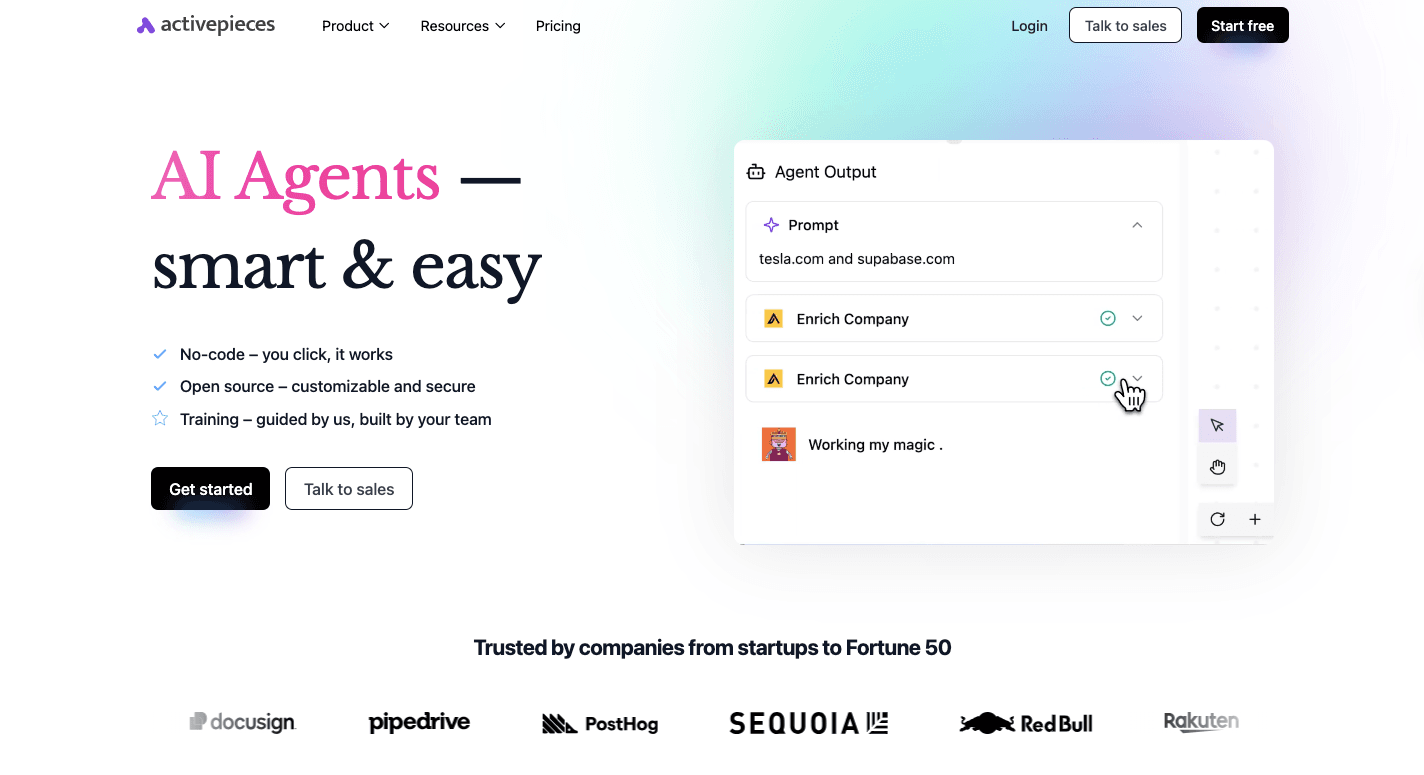
You know the point where software starts piling up, and nobody remembers why a workflow breaks. One app handles content, another manages support, and a third moves data around. Activepieces brings all of that into a single AI-powered automation platform.
With TypeScript, you can build flows and custom components, enabling developers to shape exactly how systems communicate with each other. You can also use a no-code builder to automate tasks. That setup supports digital transformation without forcing you to change how you do things.
As of now, Activepieces comes with 628+ pre-built integrations.
Put integrations, AI agents, and logic in one place instead of three tools. Talk to our sales team!
FAQs About Generative AI Automation
What is generative AI automation?
Generative AI automation combines artificial intelligence with automated systems so software can create content, make decisions, and then act without constant human input.
It uses machine learning models trained on text, images, and unstructured data to handle work like invoice processing, document automation, or customer replies, which helps you replace traditional automation rules with systems that adapt to real situations and deliver clear business value.
What are the four types of generative AI?
The four common types are text, image, audio, and code generation.
Each type relies on neural networks, including generative adversarial networks (GANs), where two models compete to improve output quality using patterns learned from data points.
What are some examples of AI automation?
Examples include automated customer support that answers common questions, systems that review contracts, workflows that route invoices, and tools that personalize offers to enhance customer experience.
What is the 30% rule in AI?
The 30% rule suggests teams should only automate tasks where AI can reliably handle at least thirty percent of the work, then keep people involved for judgment, quality checks, and decisions where context still matters.