
Marketing Automation Platforms: Tools Compared for 2026

Jul 3, 202521 min read
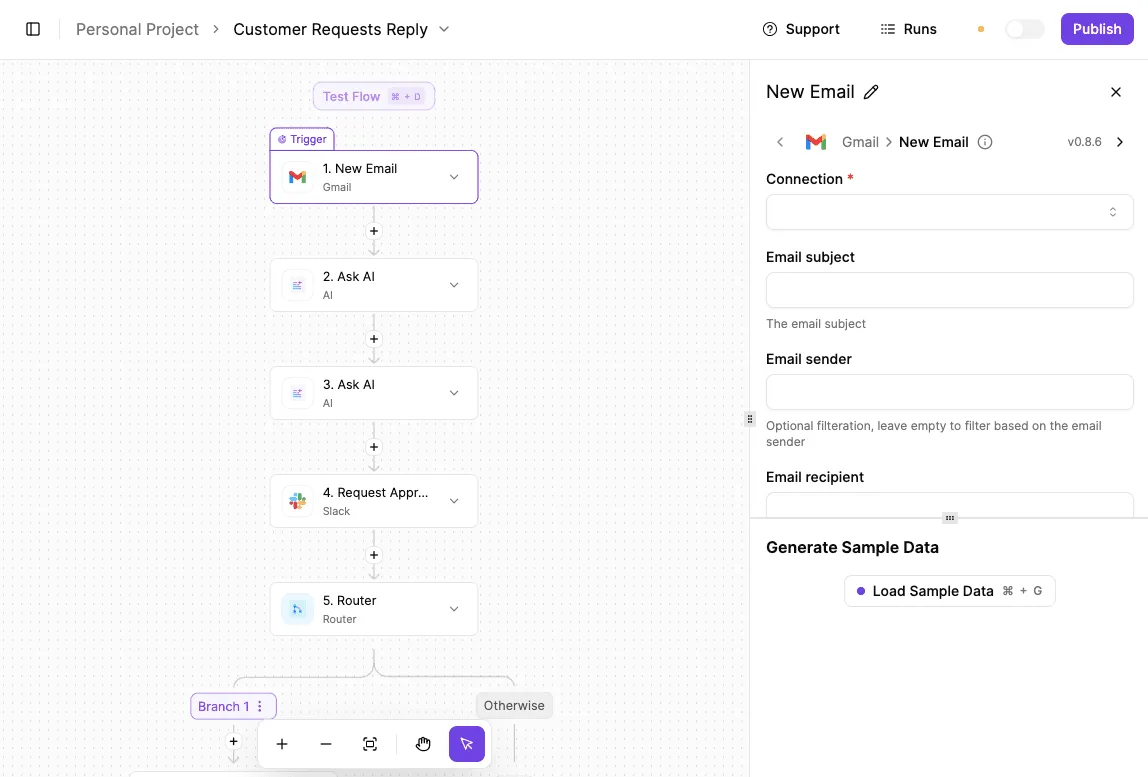
Traditional marketing platforms charge a "success tax" where every new lead added to your database increases your monthly overhead regardless of how often you actually message them.
This model forces engineers to build aggressive pruning scripts to delete inactive users just to keep the bill manageable, turning a database into a liability rather than an asset.
The cost of scaling: why contact-based pricing matters
Traditional marketing platforms charge a "success tax" where every new lead added to your database increases your monthly overhead regardless of how often you actually message them.
The hidden cost of list growth
When a list scales under a contact-based model, it creates an exponential cost curve that often outpaces the marginal revenue of a new subscriber. For example, the Mailchimp Free tier limits users to 250 contacts.
Crossing that threshold forces a small business to move to a paid tier to continue operations. Omnisend starts its paid tiers at 251 contacts, which creates a narrow window for experimentation before the platform becomes a fixed monthly expense.
This pricing structure penalizes businesses for maintaining a "long tail" of leads who may only convert after months of nurturing.
Comparing monthly costs for 10,000 contacts
Disparity between vendors reveals itself clearly once a list grows to 10,000 entries. The following data illustrates the monthly cost for this volume and what that investment implies for a company's bottom line:
- HubSpot Professional costs 890 USD for 2,000 contacts according to GetPricePulse, which represents a significant "platform tax" that can consume the entire marketing budget of a mid-sized startup.
- Mailchimp Premium sits at 350 USD, requiring a high conversion rate just to break even on the software seat.
- ActiveCampaign Plus is 239 USD. It's a middle ground that still attaches a per-head fee to every customer interaction.
- Brevo costs only 56 USD, shifting the cost away from the size of the database and toward actual usage.
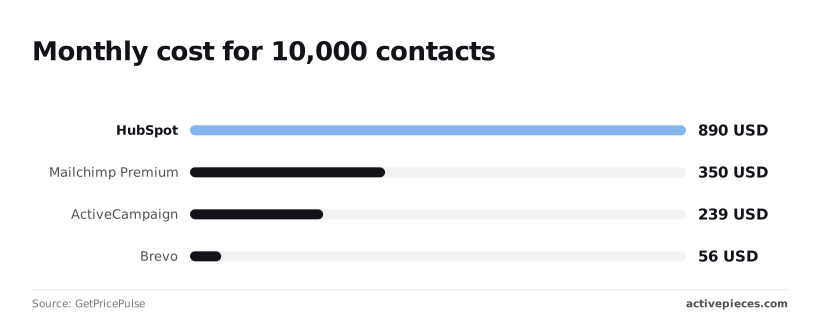
The data shows that choosing a legacy suite can result in paying over 15 times more for the same list size as a volume-based competitor.
Why Brevo and Activepieces disrupt the pricing model
Where a flow runs should never decide whether you can leave. Activepieces ensures that deployment is a setting rather than a commitment by shipping the same codebase for managed cloud and self-hosted environments, allowing teams to git-sync and promote flows between them at will.

Because it bills based on email volume rather than list size, Brevo charges 56 USD for 10,000 contacts.
This shift means a developer can store a million "cold" leads in a low-cost warehouse and only pay when an automation triggers a specific message, eliminating the penalty for maintaining a large audience.
The fastest way to settle a shortlist is to try one. Activepieces is free to try, no credit card.
1. HubSpot: Best for all-in-one scaling teams
HubSpot is a centralized system of record that hosts marketing, sales, and service tools on a single, shared codebase.
This architectural choice ensures that a change to a contact record in a support ticket appears in the marketing segmentation engine immediately, preventing the data drift common in multi-vendor stacks.
The unified Marketing Hub ecosystem
The platform operates as a cohesive suite where every tool (from email builders to social media schedulers) reads from the same underlying CRM (Customer Relationship Management) table.
Native integration means a developer doesn't have to maintain custom API middleware just to ensure that a customer’s recent website activity triggers a relevant automated email.
The following workflow demonstrates how this unified logic handles complex lead routing and multi-channel notifications within a single interface.
[SCREENSHOT DESCRIPTION: The Activepieces homepage showing a workflow builder canvas with a multi-step AI agent workflow. The page displays the headline "AI agents like your best employee" with subheading "Build intelligent agents with enterprise integrations and precise control." Below are five tabs: AI Agent, Integrations, Custom Logic (selected), Human Approval, and Agent Data. The canvas shows a seven-step workflow: 1. New Lead (HubSpot trigger), 2. Qualify Lead (AI Agent step with purple border), 3. Qualified? (Condition), 4. Add to Salesforce, 5. Notify Slack, 6. Nurture Lead (Loop), and 7. Send Email (Gmail). Steps are connected by vertical lines showing the flow logic.]
By visualizing the logic path from a HubSpot trigger to downstream actions in Slack or Salesforce, teams can audit their entire lead flow without jumping between different log files. This visibility reduces the time spent debugging "ghost" automations that fail silently in disconnected systems.
HubSpot lead tracking and lifecycle stages
HubSpot tracks the progression of a visitor to a customer through a set of standardized lifecycle stages that update automatically based on user behavior. This structured approach allows teams to implement logic using modern reasoning models.
To automatically assign a persona, Gemini 3.8 Flash can analyze the raw text of a contact's "Job Description" property. This ensures the lead receives targeted content.
Historical interaction logs can be processed by Claude Sonnet 5.5 to predict which leads are most likely to churn, allowing sales teams to prioritize high-risk accounts.
GPT-6.1 Sol can synthesize recent activity feeds into a concise briefing for an account executive, reducing the time spent on manual research before a discovery call.
The cost of the 'All-in-One' convenience
A pricing model that scales aggressively based on the number of marketing contacts is the primary trade-off for this integrated experience.
Because the vendor controls the entire vertical stack, users often face a "contact tax" where simply storing a lead in the database incurs a monthly fee.
Whether that lead is being targeted or not, this fee applies. The platform gates some advanced features, such as custom objects or higher team limits, by edition, but many features are available below the highest enterprise tier.
Upgrading an entire seat license might be necessary just to access a single API endpoint. This creates a rigid environment where the convenience of the ecosystem eventually competes with the operational budget, forcing teams to choose between platform consolidation and cost efficiency.
2. Mailchimp: best for creators and template-driven marketing
Mailchimp maintains its dominance by providing creators and small businesses with a polished, template-first design environment that simplifies the transition from draft to delivery.
While it lacks the deep infrastructure control of a self-hosted stack, it compensates with a highly opinionated UI that prevents non-technical users from breaking the layout or the brand identity.
Content Optimizer and Creative Assistant AI
Mailchimp integrates generative tools to bridge the gap between a blank page and a high-conversion campaign. The platform utilizes specialized models for specific creative tasks:
Nano Banana Pro generates high-fidelity custom imagery directly within the editor so that users don't have to navigate away to stock photo libraries or external design tools.
GPT-6.1 Sol is a balance of intelligence and cost for drafting email copy. It ensures that the generated text adheres to length constraints and tone guidelines.
Creators can use Gemini 3.8 Flash-Lite TTS to preview how their written content sounds when converted to audio. This helps in identifying awkward phrasing that might be missed during a visual read.
Standardized automation for beginners
Automation in this ecosystem is built on a "Customer Journey Builder" that prioritizes logical flow over complex scripting.
By using a visual drag-and-drop interface, users can define triggers (such as a user signing up for a newsletter or abandoning a cart) without writing a single line of Python or interacting with a REST API.
Common marketing workflows remain robust and less prone to logic errors under this standardization.
However, this simplicity is a trade-off; users are restricted to the pre-defined triggers and actions provided by the platform, which limits the ability to integrate with niche third-party databases or proprietary internal tools.
ActiveCampaign predictive analytics for segmentation
The platform uses machine learning to move beyond manual tagging, providing insights into future subscriber behavior based on historical interaction data.
Rather than requiring a data scientist to run manual regressions, the system employs Gemini 3.8 Flash to analyze enterprise-scale engagement patterns and predict which segments are most likely to churn.
Win-back campaigns for at-risk users can be automated before they actually unsubscribe.
Because these models are managed entirely by the vendor, the underlying data remains siloed within their infrastructure, making it difficult to export these specific behavioral predictions into a separate CRM for use in other business operations.
3. ActiveCampaign: best for complex customer journeys
ActiveCampaign is a centralized orchestration layer for businesses that require high-touch, multi-channel logic across the entire customer lifecycle.
Because the platform treats email marketing, sales follow-ups, and site tracking as a unified data stream, engineers can build branching workflows that react to granular user behaviors without maintaining custom middleware.
Advanced automation builder and logic
The platform functions as a visual state machine where triggers are not limited to simple list joins but extend to event-based signals like site visits or specific link clicks.
This granularity allows a developer to set up complex wait-until conditions, so a follow-up sequence only fires after a lead has viewed a pricing page three times.
Communication stays contextually relevant to the user's intent this way. Because these automations support "If/Else" branching and goal-based jumps, a single workflow can handle dozens of edge cases that would otherwise require manual intervention or a spaghetti-mess of disjointed scripts.

CRM and sales engagement integration
By embedding a native CRM directly into the automation engine, the platform eliminates the synchronization lag often found when connecting disparate marketing and sales tools.
This architectural choice means that when a lead reaches a specific lead score threshold, the system can automatically generate a deal record and assign a task to a specific account executive.
The sales team then works on the most qualified opportunities in real-time.
The deep integration ensures that every interaction (from an opened email to a moved deal stage) is logged in a single contact timeline, providing a complete audit trail of the customer journey for both marketing and sales departments.
Mid-market pricing and scalability
As businesses grow, the cost of maintaining these sophisticated journeys increases significantly through a tiered structure that gates essential features like predictive sending and split testing behind higher-cost brackets.
This pricing model forces a trade-off between automation depth and operational overhead, as shown by how seats and capabilities are distributed across their core offerings.
| Plan | Monthly Price | User Seats | Automation Action Limits |
|---|---|---|---|
| Starter | Entry-level | 1 | 5 |
| Plus | Mid-range | 1 | Unlimited |
| Pro | Premium | 3 | Unlimited |
| Enterprise | Custom | 5 | Unlimited |
Prices and plan limits checked against activecampaign.com and hubspot.com and omnisend.com and brevo.com and mailchimp.com on October 1, 2026.
Friction often begins at the jump from the Starter tier to Plus. It represents the transition from basic email sending to the full automation suite required for complex journeys.
This progression ensures that while a small team can begin for a low initial cost, the "contact tax" scales alongside the business's database, making the platform a significant long term line item as lead volume expands.

Reading a table only gets you so far. Build the same workflow in Activepieces and compare it yourself.
4. Activepieces: best for open-source and AI agent workflows
Activepieces connects 738+ integrations to build sophisticated marketing workflows that bypass the per-contact pricing and proprietary silos found in legacy suites.
By providing an open-source framework for connecting disparate software services, it ensures that your business logic remains portable and independent of any single vendor's ecosystem.
No-code automation with open-source flexibility
Activepieces ships its core under an MIT licence, ensuring that the logic you build remains yours to run, fork, or embed without a fair-code clause.
While closed-source vendors can paywall features or raise renewal prices on their own schedule, this platform allows you to read the LICENSE file in the activepieces/activepieces repository and verify your rights to the codebase.
Risk of a "black box" failure is eliminated when users can debug the underlying API call.
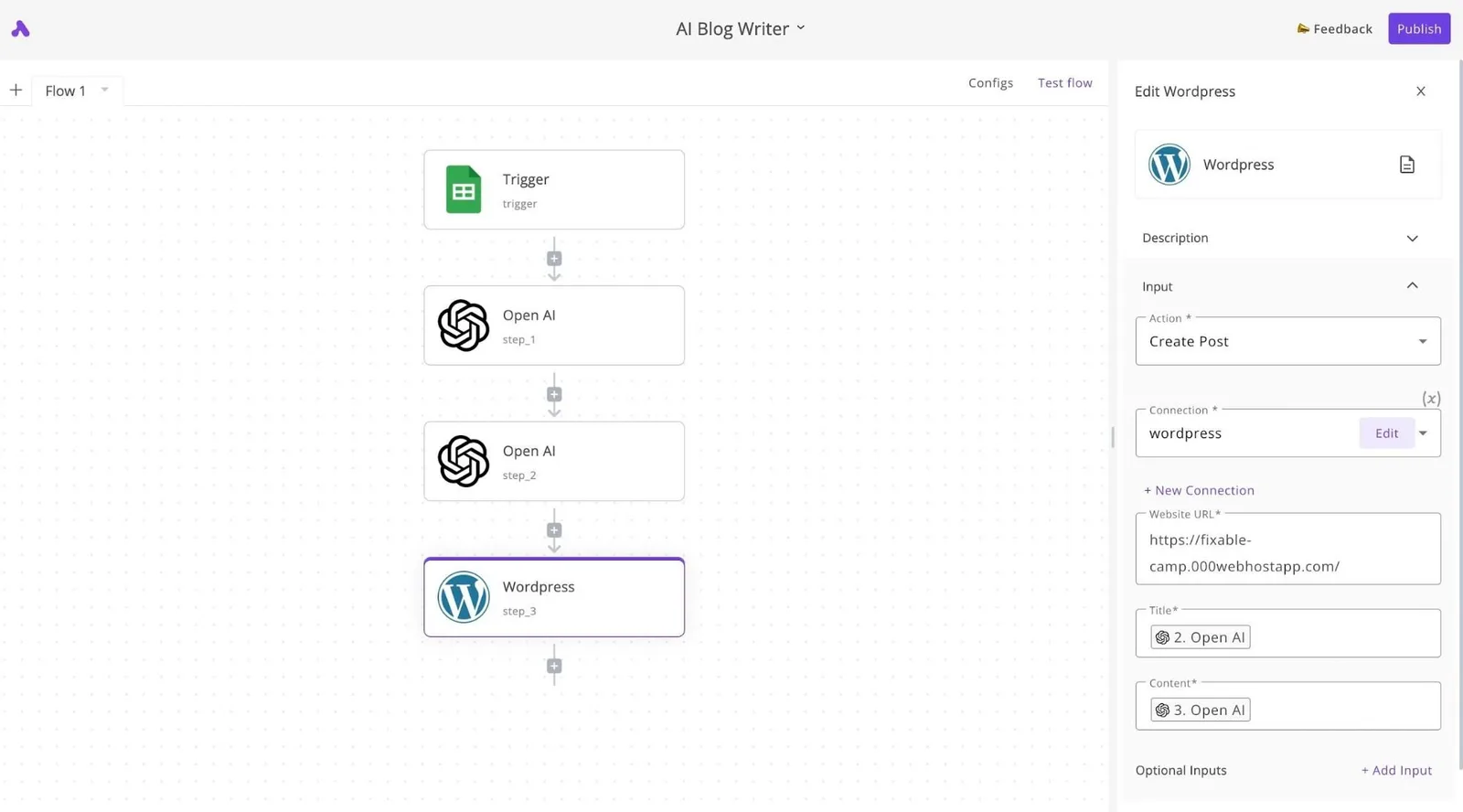
The visual canvas uses a block-based approach that non-technical staff can navigate. Because it's built on TypeScript, developers can extend functionality by writing custom scripts directly within the browser-based IDE.
Marketing teams can iterate on lead flows at speed under this hybrid approach, while the engineering team maintains the ability to audit and optimize the execution environment.
Building AI marketing agents with LLMs
The platform treats Artificial Intelligence as a native primitive rather than a bolted-on marketing gimmick, enabling the construction of sophisticated agentic workflows.
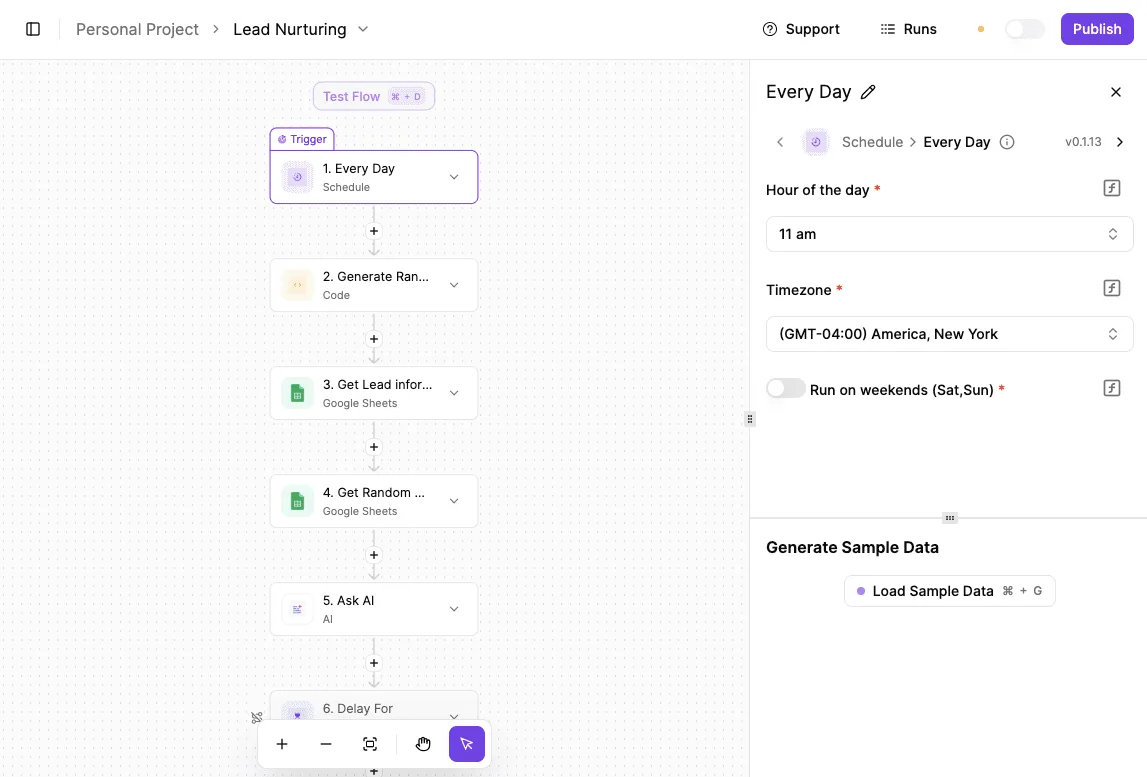
Instead of just sending static data between apps, you can route information through high-reasoning models to categorize leads, summarize transcripts, or generate personalized outreach.
Claude Sonnet 5.5 handles the heavy lifting for intelligence-heavy tasks. It ensures that automated email replies maintain a human-like nuance.
Gemini 3.8 Flash provides the speed required for real-time data processing. Incoming webhooks are analyzed and acted upon in milliseconds.
Mistral Large 3 is a state-of-the-art open-weight option for teams that want to maintain high performance without relying solely on a single provider's API.
Self-hosting for data privacy and cost control
Activepieces is used by teams at companies including MoneyGram, Moneypenny, and Alan.
When you run the platform on your own virtual private server, sensitive customer information never touches a third-party automation provider’s cloud, which simplifies compliance with strict data residency requirements.
A predictable infrastructure cost replaces the "success tax" of per-task billing in this deployment model. Whether you run ten automations or ten thousand, your monthly bill is tied to your server resources rather than a vendor’s arbitrary usage tiers.
Because the platform is decoupled from the service provider's profit margins, you can scale high-frequency polling and data synchronization tasks that would be cost-prohibitive on a closed-source SaaS platform.
5. Omnisend: best for e-commerce and retail brands
Omnisend provides a vertically integrated marketing stack specifically engineered to handle the high-velocity data requirements of online storefronts.
Unlike general-purpose email tools that require manual schema mapping, this platform treats e-commerce entities like products, carts, and orders as first-class citizens. Developers spend less time writing middleware and more time optimizing conversion funnels.
Pre-built retail automation templates
The platform utilizes a library of logic flows designed for common retail events, which eliminates the need to architect state machines for standard customer journeys from scratch.
These templates include pre-configured triggers for cart abandonment and post-purchase follow-ups, so a marketing team can deploy complex multi-stage campaigns without requesting custom backend development for every new promotion.
By using these standardized blocks, businesses ensure that their automation logic follows industry-standard recovery patterns, which reduces the risk of logic errors that lead to missed revenue opportunities.
Omnisend SMS, email, and push integration
Omnisend consolidates SMS, email, and browser-based notifications into a single workflow designer to prevent fragmented customer experiences. This unified approach allows for centralized frequency capping. A customer is never bombarded with redundant alerts across three different devices simultaneously.
The following table illustrates how these capabilities scale across different investment levels. It shows the functional gap between basic outreach and advanced multi-channel retention.
| Feature | Free Plan | Standard Plan | Pro Plan |
|---|---|---|---|
| Monthly Email Limit | 500 sends | 6,000 sends | Unlimited sends |
| Web Push Notifications | Available | Available | Available |
| SMS Credits | Limited | Included | Higher Volume Included |
Brands must decide between strict volume caps and the operational freedom of unlimited sending, which directly impacts how aggressively they can test new segments.
Deep e-commerce platform synchronization
Native integrations for Shopify, a leading hosted commerce platform, and BigCommerce, an enterprise-grade SaaS storefront, allow for real-time data ingestion of customer behavior.
This synchronization ensures that a "Product Viewed" event in the browser immediately updates the user profile in the marketing database.
Automated recommendations are based on what the user is looking at now rather than what they bought last quarter.
Because the data sync is bidirectional, discount codes generated in the marketing suite are automatically recognized by the storefront's checkout engine, which prevents technical friction at the point of sale.
6. Brevo: best for transactional mail and budget efficiency
Brevo is a unified customer platform that prevents data silos by consolidating email, SMS, and WhatsApp messaging within a single administrative interface.
By integrating transactional messaging with marketing workflows, engineering teams can trigger password resets or shipping updates through the same API infrastructure used for promotional campaigns, which eliminates the need to maintain separate SMTP providers.
Pricing based on volume, not contact count
Brevo calculates costs based on the total number of messages sent rather than the size of the underlying database.
Because it bills based on email volume rather than list size, Brevo's 56 USD plan covers a 10,000-email sending volume. This model ensures that a developer importing a massive dataset for a seasonal event doesn't trigger a permanent tier upgrade.
The upgrade would drain the budget during months of low activity. Because the platform doesn't penalize contact growth, teams can maintain granular segments and historical customer profiles without the operational overhead of purging inactive users just to keep the bill predictable.
Integrated WhatsApp and Chat tools
The platform includes native support for WhatsApp, VoIP phone, and live chat, which allows support engineers to bridge the gap between asynchronous email and real-time troubleshooting.
According to Brevo, these tools are part of a suite that includes chatbots and meetings.
Initial support triaging can be automated by a small team without writing custom middleware for third-party chat providers.
This consolidation means a single webhook can trigger a multi-channel response: for example, sending a WhatsApp notification when a high-priority chat is missed. This ensures that urgent customer issues are visible across all communication logs.
Simplified automation for small teams
Automation workflows in Brevo utilize a visual builder to map customer journeys, which reduces the time spent debugging complex logic for standard lead nurturing or cart abandonment sequences.
For teams leveraging modern language models, the platform’s API allows for the programmatic insertion of content generated by tools like Claude Sonnet 5.5 or GPT-6 Luna.
Messaging stays relevant to the user's specific behavior this way.
This architectural simplicity ensures that a marketing manager can adjust a workflow's timing or logic without requiring a backend engineer to redeploy code or modify database schemas.
How to choose the right marketing automation software
Selecting a platform depends on whether your operational overhead stems from managing a large internal team or maintaining a massive lead database.
When to prioritize seat-based vs. volume-based pricing
Financial predictability in automation is determined by which growth lever (team size or database scale) triggers a price hike. HubSpot offers a Free tier for up to two users, so a small startup can experiment with CRM tools without an initial capital outlay.
However, seat-based models become a "collaboration tax" as you scale, meaning every new hire increases your monthly burn regardless of their output.
Conversely, volume-based plans like those from ActiveCampaign, which starts its Starter tier at a fixed monthly rate for one user, link costs to the number of contacts reached.
Audience expansion successfully grows your costs under this structure, though it penalizes businesses with high-volume, low-margin lead lists.
All-in-one suite vs best-of-breed marketing stack
The decision between an all-in-one suite and a modular stack is a trade-off between deployment speed and architectural flexibility. A suite provides a unified data schema, which eliminates the need to custom middleware to sync contact properties between your CRM and email engine.
Managing individual API integrations is required for a best-of-breed stack, but it allows you to swap out underperforming components without migrating your entire customer history. To bridge the intelligence gap in modular stacks, engineers now deploy specific AI models via API to handle high-logic tasks.
- GPT-6 Astra is used for complex multi-step reasoning and generating dynamic code snippets within workflows.
- Claude Sonnet 5.5 is deployed for high-speed content transformation where maintaining a specific brand voice is critical.
- Gemini 3.8 Flash is implemented for high-volume enterprise workflows that require low-latency processing of multimodal data.
This ensures that personalized messaging stays relevant to the user's specific behavior.
The role of open source in your marketing strategy
Open-source tools provide the underlying infrastructure for businesses that require complete data sovereignty and the ability to modify the source code.
Self-hosting your automation engine ensures that sensitive customer data never leaves your virtual private cloud, so you maintain compliance with strict regional data residency laws.
Risk of "feature sunsetting" is removed when a SaaS vendor cannot delete a tool your team relies on.
You own the specific version of the software running on your servers. While this path demands more internal DevOps resources for maintenance and security patching, it eliminates vendor lock-in.
Core marketing logic remains a portable asset rather than a rented service.
Frequently asked questions about marketing automation platforms
What is the difference between CRM and marketing automation?
A CRM is the system of record for contact data and sales history, while marketing automation acts as the engine that executes communication workflows based on that data.
If your CRM is the library where customer profiles sit, the automation platform is the librarian who proactively sends personalized emails when a specific book is returned.
Maintaining this distinction allows teams to swap their execution tools without needing to migrate their entire historical database of record.
Can I switch platforms without losing my automation logic?
Switching platforms requires a manual reconstruction of logic unless you use an abstraction layer or open-source workflow engine to house your blueprints.
Because proprietary vendors use unique, non-portable schemas for their "drag-and-drop" builders, exporting a workflow from one service usually results in a static image or a text file that can't be imported into a competitor.
By documenting your logic in a platform-independent format like YAML or a centralized Git repository, you ensure that the "why" and "how" of your customer journeys remain company intellectual property. This prevents journeys from becoming vendor-locked configurations.
How does AI change marketing automation in 2026?
AI has shifted the paradigm from rigid, rule-based triggers to agentic workflows that can interpret intent and generate high-fidelity assets in real-time.
Instead of building a fixed path for every possible user action, engineers now deploy models to handle specific cognitive loads within the automation pipeline.
Claude Opus 5.5 handles long-running agentic coding tasks, which allows for the dynamic generation of custom integration scripts between disparate APIs.
Gemini 3.8 Flash processes enterprise-scale reasoning and high-volume agentic workflows, so businesses can analyze thousands of customer signals simultaneously to adjust campaign parameters.
GPT-6 Astra manages complex reasoning and multi-step coding, which enables the platform to self-correct broken data mappings without manual developer intervention.
Mistral Large 3 provides state-of-the-art multimodal processing, meaning a single workflow can now ingest a video testimonial and output a localized blog post and social copy in one pass.
Do I need a developer to set up these tools?
You need a developer to handle the initial environment configuration, API authentication, and webhook security.
A platform engineer ensures that the underlying Docker containers are networked correctly and that secrets are stored in a secure vault rather than plain text.
Once these guardrails are in place, marketing teams can use visual builders to connect services without risking the integrity of the core infrastructure.
Go deeper: Wix and ChatGPT: building the integration · Shopify Workflow vs chat-built automations · Best data automation tools for analytics teams
Related reading
References
Still comparing
The fastest way to settle it is to build something.
Open source under MIT, so you can self-host the same thing later.
Start free Talk to sales